
 English
  العربية
  Español
  Deutsch
  Français
  Português
  Русский
  日本語
日本語  Italiano
  Nederlands
  Svenska
  Suomi
Suomi  ไทย
ไทย  Dansk
Dansk  Ελληνικά
  Bahasa Melayu

When choosing FIFA-certified football turf, you need to focus on three dimensions: technical standards, material selection, and site acceptance as a reference to select a suitable FIFA artificial grass system.
Technical standards: First of all, it must comply with the standard requirements for FIFA football grass technical parameters in the field design plan (sports performance, safety performance, ball rebound speed).
Material selection: the venue’s event level, frequency of use and purpose of use (determines the venue life cycle and budget).
Acceptance standards: It is necessary to consider the site acceptance standards and technical support of the entire project system before, during, and after sales.
Choosing appropriate FIFA-certified turf is not only about the safety and fairness of athletes, but also considers the life cycle of the field. MightyGrass, as a FIFA certified grass expert, today will give you a comprehensive understanding of what FIFA football grass is, FIFA football grass certification system standards, FIFA football grass certification process, FIFA football field acceptance standards, and how to choose a FIFA-certified grass supplier.
What’s FIFA-certifie Turf?
FIFA Certified football turf is specially designed for football and complies with the FIFA Quality Scheme. This turf has passed rigorous testing and has specific performance standards. It is considered an alternative to natural turf and is used to varying degrees in various sports. Compared with ordinary football turf, FIFA-certified turf has higher requirements in terms of performance and quality.
According to FIFA’s official website, with the popularity of football around the world, artificial turf is increasingly used in football fields because of its weather resistance and all-weather properties that are superior to natural grass. Therefore, FIFA (FIFA) began to introduce the concept of FIFA certification system in the field of artificial turf, and began to promote the certification of “FIFA Mark” for artificial turf fields in 2001. It also improved the quality of the game and protected the health and interests of players, clubs and associations. At the same time, it also solved the problem of how to choose artificial turf for sports builders.
Understand FIFA-certified turf Levels
FIFA’s artificial turf certification system is divided into two levels: FIFA Quality and FIFA Quality Pro. Among them, FIFA Quality Pro fields can host any FIFA final-phase matches and UEFA’s highest-level competitions, while FIFA Quality is mainly intended for lower-level FIFA competitions and other types of events. The two categories are primarily differentiated by their intended use.
According to common terms in FIFA licensing agreements, there are currently 21 global suppliers with FIFA Quality certification (such as Mighty Grass, FieldTurf). The certification conditions include at least:
FIFA Quality: Designed for training/community pitches with high-frequency usage (40–60 hours per week), and surfaces that are relatively “softer.”
a. A minimum of 5 new FIFA-certified fields must be added each contract year.
b. At least 1 certified field must remain valid at all times.
The certificate is valid for 3 years.
FIFA Quality Pro: Aimed at professional/competition-level matches, with shorter certification cycles and stricter requirements for re-testing and performance maintenance.
- Annual additions: 5–10 new FIFA Quality Pro fields
- FIFA Quality Pro product certificate: 2 years
- FIFA Quality Pro field certificate: 1 year
- At least 60% of standard fields in use must employ products that comply with FIFA Quality or FIFA Quality Pro standards.
- FIFA Quality Pro certification is conducted by FIFA-designated independent testing institutes, involving pre-inspection, on-site testing, post-installation verification, and ongoing monitoring.
In 2024, FIFA introduced new certification regulations for artificial turf, marking a significant upgrade in global football pitch construction standards. On top of the existing FIFA Quality (non-professional competitions) and FIFA Quality Pro (international competition level), a new FIFA Basic certification was added to cover grassroots field needs. While Basic certification relaxes pre-installation testing requirements, it strengthens fundamental performance indicators (such as shock absorption and surface evenness), providing standardized solutions for school and community pitches. Meanwhile, FIFA Quality Pro certification has increased the Lisport XL mechanical wear test to 6,000 cycles and introduced a fiber brittleness test, setting higher durability requirements for premium products.
FIFA Football Turf System Standards
The standards are mainly divided into laboratory standards and field standards.
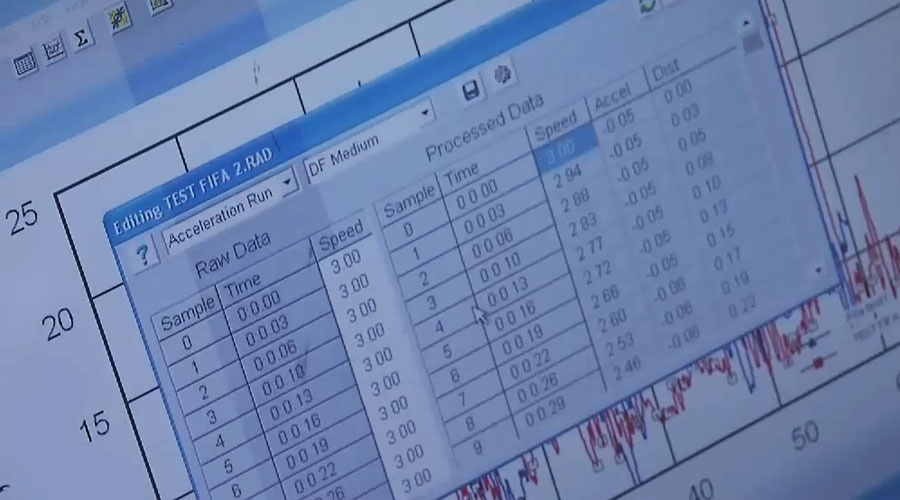
Laboratory Tests
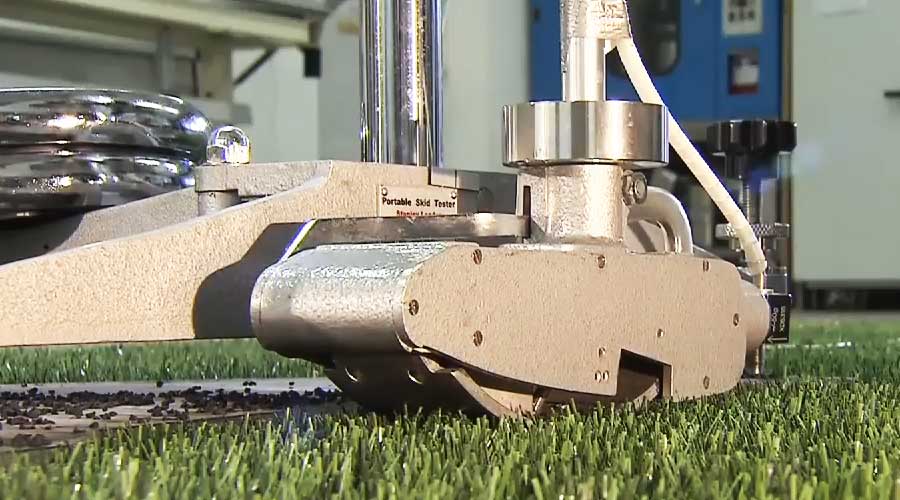
FIFA requires all turf systems applying for certification to first pass laboratory testing, covering product performance and environmental adaptability. This mainly includes: requirements for artificial turf and infill (such as TPE granules), performance tests for player/surface interaction, environmental testing, UV resistance, and durability testing.
Materials & Product Testing
- Artificial turf fibers: tensile strength, tuft withdrawal force, abrasion resistance, friction coefficient
- Fiber specifications:
- Fiber height: typically 40–65 mm
- Fiber density: ≥10,000 stitches/m² (recommended)
- Fiber type: monofilament or hybrid systems
- Fiber material: polyethylene (PE), polypropylene (PP), or blends
- UV resistance: must pass ≥5,000 hours UV aging test
- Fiber height: typically 40–65 mm
- Infill materials (e.g., TPE, EPDM, SBR): particle size, density, content of heavy metals and hazardous substances (must comply with environmental regulations)
Player/Surface Interaction Performance
- Shock absorption: 55–70% (key indicator for athlete safety)
- Vertical deformation: 4–11 mm
- Rotational resistance: 25–50 Nm
- Skin friction: ≤40 (to reduce abrasion injuries)
- Energy restitution: evaluates athletic performance and ball response
- Ball rebound height: 0.6–1.0 m (dropped from 2 m)
- Vertical ball rebound deviation: ≤7.5 mm
- Ball roll distance: 4–10 m
- Ball roll deviation: ≤10%
Environmental & Durability Testing
- UV resistance
- High/low temperature cycling tests
- Heat/humidity aging and weather resistance
- Abrasion durability testing (Lisport XL simulated wear, equivalent to 6–10 years of use)
Field Tests
After passing laboratory certification, the system must undergo on-site testing by FIFA-accredited test institutes.
Installation & Construction Standards
- Installers must hold FIFA authorization or equivalent qualifications
- Construction must comply with the FIFA Installation Manual
Base Layer Requirements
- Flatness: deviation ≤10 mm (3 m straightedge test)
- Drainage performance: surface must drain fully within 72 hours
- Hardness & elasticity: overall surface must provide appropriate shock absorption and foot comfort
On-Site Performance Tests
- Ball roll distance
- Ball rebound height
- Shock absorption, vertical deformation, rotational resistance (values must match laboratory tests)
- Seam strength and fiber tuft withdrawal force testing
Certificate Validity
- FIFA Quality: valid for 3 years
- FIFA Quality Pro: valid for 1 year (professional match pitches require annual re-testing)
FIFA Football Turf Certification Standards tables
| Category | Technical Parameters / Requirements | Acceptance Criteria | Notes |
| Laboratory Certification | Turf fiber tensile strength & tuft withdrawal force | ≥40 N | Ensures fiber stability and durability |
| Infill environmental test (TPE/EPDM/SBR) | Complies with REACH / EU standards | Non-toxic, eco-friendly | |
| Shock Absorption | 35–55% | Guarantees athlete safety | |
| Vertical Deformation | 5–11 mm | Provides comfort and shock absorption | |
| Rotational Resistance | 25–50 Nm | Balance between grip & safety | |
| Ball rebound / Ball roll | Comparable to natural grass | Meets match requirements | |
| UV resistance / Weathering | ≥3,000 hours with no significant degradation | Suitable for hot/sunny climates | |
| Durability (Lisport XL test) | Simulates ≥6–10 years lifespan | Ensures long-term stability | |
| Field Certification | Installer qualification | FIFA accredited / experienced | Ensures compliant installation |
| Base layer flatness | ≤10 mm deviation (3 m straightedge) | Guarantees even surface | |
| Drainage performance | Fully drained within 72 hours | Prevents waterlogging | |
| Hardness & elasticity | As per FIFA standard | Provides safe play surface | |
| Seam strength | ≥1,000 N / 10 cm | Prevents seam failures | |
| Fiber tuft withdrawal force | ≥40 N | Ensures fibers remain intact | |
| Certification Validity | FIFA Quality | 3 years | Community & training pitches |
| FIFA Quality Pro | 1 year | Professional / competition pitches | |
| Certification Timeline | Laboratory test | 4–6 weeks | Laboratory report issued |
| Field construction | 1–3 months | Depends on project size | |
| On-site test & report | 2–4 weeks | Conducted by FIFA-accredited lab | |
| Total duration | 3–6 months | From testing to certification | |
| Cost Range | Laboratory test | USD 8,000–15,000 | Per system |
| Field test | USD 12,000–20,000 | Per field | |
| FIFA registration & certificate fee | USD 2,000–5,000 | Official fees | |
| Total | USD 25,000–40,000 | For one 11-a-side FIFA Quality Pro field |
FIFA-certified Football Turf Manufacturer
The certification standards for FIFA football turf manufacturers go through four comprehensive evaluation phases: requirements for production facilities and manufacturing capacity, laboratory testing of materials and products, system and material audits before on-site installation, and on-site field testing and acceptance after installation. Certification is carried out by FIFA-designated independent test institutes. After certification is obtained, periodic re-evaluations and maintenance records are required to ensure that football turf manufacturers maintain product quality stability and continue to meet the requirements of high-level competition venues over the long term.
Production Facilities and Manufacturing Capacity Requirements
- Factory area: ≥5,000 m² – Demonstrates continuous supply capability, complete manufacturing processes, and parallel production line capacity (fiber extrusion, COBBLE tufting lines, backing/secondary coating, and recyclable backing systems).
- Minimum annual production capacity: 500,000 m² – Reflects delivery speed and assurance for large-scale projects; critical for multi-field and competition-cycle deliveries.
Laboratory Testing and Product Certification
Laboratory testing and certification of materials and products cover synthetic fibers, backing systems, infill materials, bonding and composite structures, physical and chemical properties, weather resistance, colorfastness, safety, and predictive indicators of service life. Tests must be conducted in FIFA-authorized laboratories under the ISO 17025 framework, generating traceable test reports.
Ball-Surface / Player-Surface Interaction
- Shock Absorption: approx. 35–55%
- Vertical Deformation: approx. 5–11 mm
- Rotational Resistance: approx. 25–50 Nm
- Ball Rebound / Ball Roll: must fall within specified ranges, overall performance should replicate natural grass in terms of playability and ball behavior.
(Methods/thresholds are defined in FIFA Test Requirements and Manuals.)
Durability and Environmental Adaptability
- Abrasion / Lisport XL: simulates long-term, high-frequency use and performance retention.
- Weathering / UV: resistance to high/low temperature cycles, humid heat aging, and UV degradation.
- Structural durability: water permeability, seam strength, fiber tuft withdrawal force.
- Infill materials (TPE/EPDM/SBR): particle size/density and compliance with hazardous substance limits (heavy metals/PAHs, etc.) under REACH and equivalent regulations.
(Testing routes and criteria are outlined in FIFA Test Manual II – Requirements.)
Purpose: Before installation, the complete system must undergo type approval (fibers, primary backing, coating/backing, shock pad, infill) through interaction performance, durability, and environmental tests. The specifications of the materials installed on-site (fiber height, density, backing, shock pad model, infill type) must match the “type” of the laboratory-approved report. Exceeding manufacturing tolerances will result in on-site disqualification.
Note: The 2024 edition of the FIFA Test Manual introduced the AAA equipment algorithm update (single-drop method for peak shock absorption, peak deformation, energy restitution), improving the accuracy of evaluating real-world athletic performance.
Pre-installation Material Certification
System and material audits before installation include: review of the construction plan, site preparation, drainage/foundation compatibility, backing and material compatibility, installer qualifications, construction quality control standards, and verification of equipment and personnel qualifications. This ensures installation is controllable and compliant with the prerequisites for subsequent on-site testing.
Key Actions
- Document verification: Laboratory approval reports, Product Declarations, Method Statements – initiated and submitted in the FIFA system by the Licensee.
- Component conformity: Artificial turf (including colored lines), backing/coating, shock pads must comply with EN15330-4, and infill material types and batch origins must be traceable.
- Third-party arrangements: Scheduling on-site testing with FIFA-accredited test institutes; if necessary, preparation of small sample areas or first-piece inspections for confirmation.
Reference Website:hns.family
FIFA Football Field Post-installation Acceptance Standards
After field installation, on-site testing and acceptance are conducted to evaluate the final installed pitch. The purpose is to verify whether the overall performance achieved in the previous phases meets FIFA’s requirements, including material and system performance under actual use conditions, operational data on-site, and the sustainability plan for maintenance and re-certification. The certification body issues the official certificate upon compliance and specifies requirements for subsequent re-evaluation and maintenance records.
Key Test Points:
- Test locations and procedures: Carried out in accordance with the FIFA Test Manual: Test Methods; tests should not be conducted on seams/line inlays (except for ball roll, which may cross lines).
- Core indicators: shock absorption, vertical deformation, rotational resistance, ball rebound/ball roll, water permeability, seam strength, and fiber tuft withdrawal force. Every test point must fall within the specified ranges. If not, corrective actions must be taken and re-testing performed.
Certificate Validity:
- FIFA Quality Pro: Primarily for professional/competition venues; certificate validity is 1 year, with mandatory annual re-testing.
- FIFA Quality: Suitable for training/community fields; certificate validity is 3 years.
(According to the FIFA manuals and accredited laboratory requirements.)
How to Select a FIFA-certified Turf Supplier
Currently, the main FIFA-certified turf suppliers for international football clubs are distributed in China (Mighty Grass), Europe (Limonta), and North America (FieldTurf Inc.). When selecting FIFA-certified football turf for your sports project, the following factors should be considered:
1. Qualification & Certification Compliance
- FIFA Licensee / Preferred Provider status
Verify whether the supplier is listed in the FIFA official directory of certified manufacturers.- Licensee: Qualified to submit systems for FIFA testing and certification.
- Preferred Provider: A higher level, representing complete capability in product, installation, and maintenance, often chosen for professional competitions and national-level projects.
- Licensee: Qualified to submit systems for FIFA testing and certification.
- Existing FIFA-certified projects
Confirm how many FIFA Quality or Quality Pro projects the supplier has completed in the past 3–5 years, and request certificate numbers (which can be verified in the FIFA Resource Hub).
2. Product & System Performance
- Complete system certification: Not just turf rolls, but a full system package—fibers + backing + shock pad + infill—which must be consistent with laboratory-approved reports.
- Core performance indicators:
- Shock absorption: 35–55%
- Vertical deformation: 5–11 mm
- Rotational resistance: 25–50 Nm
- Ball rebound/ball roll comparable to natural grass
- Shock absorption: 35–55%
- Environmental & safety compliance: Infill materials must meet REACH/EU standards, free of heavy metals and non-toxic.
3. Installation & Construction Capability
- Experience of FIFA-recognized installers
Check whether the installation is carried out by a team with FIFA project experience, and whether quality control documents (QC forms, mock-up approvals) can be provided. - Base construction quality
Verify flatness, drainage layers, and shock pad layers meet FIFA on-site testing standards. - Third-party coordination
Ensure the supplier can directly liaise with FIFA-accredited test institutes to manage on-site testing, reports, and certification.
4. After-sales Maintenance & Long-term Assurance
- Certificate validity:
- FIFA Quality: 3 years
- FIFA Quality Pro: 1 year (requires annual re-testing)
- FIFA Quality: 3 years
- Maintenance services:
Annual pre-inspection and “performance recovery maintenance” (with a focus on shock absorption, rotational resistance, and ball roll) to avoid re-certification failure. - Sustainable delivery capacity:
Suppliers should demonstrate long-term production capacity (≥500,000 m²/year), a stable supply chain, and contingency support for urgent projects.
5. Cost & Timeline Transparency
- Reference cost range (excluding turf supply and construction):
- Laboratory testing: USD 8,000–15,000 / system
- On-site testing: USD 12,000–20,000 / field
- FIFA registration & certification: USD 2,000–5,000
- Total: approx. USD 25,000–40,000 per 11-a-side FIFA Quality Pro pitch
- Laboratory testing: USD 8,000–15,000 / system
- Timeline: 3–6 months (system testing → construction → on-site testing → certification issuance)
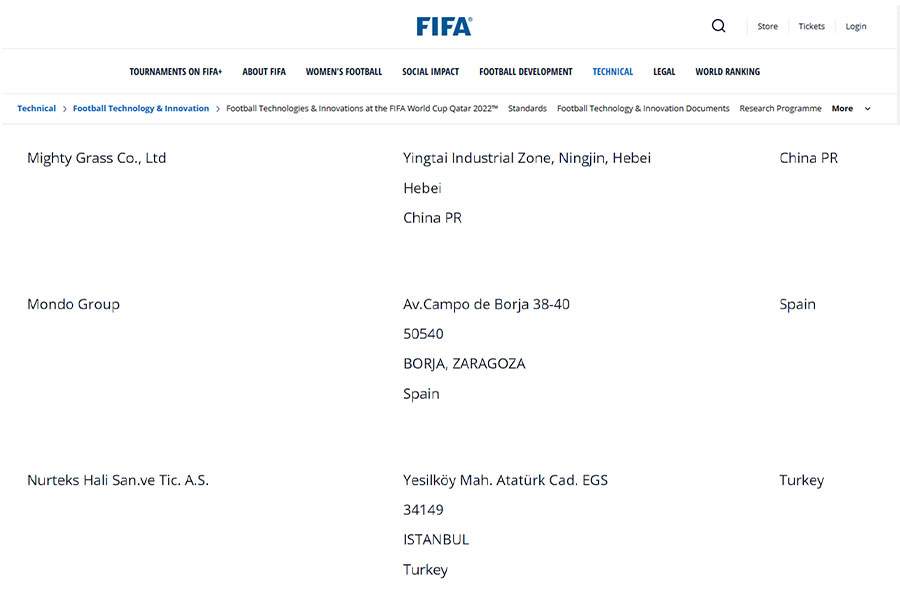
When selecting FIFA-certified turf suppliers, priority should be given to companies that are both certified manufacturers and can provide full-process services. In addition to providing one-time system packages that pass FIFA Lab, factories like MightyGrass can also connect with testing institutions, ensure installation quality, and provide post-certification maintenance to ensure that the project meets international competition standards in the long term.
Why Choose MightyGrass: FIFA Certified Manufacturer
As a FIFA-certified football turf manufacturer, MightyGrass is not only a producer of high-quality turf but also your full-cycle project partner. We provide clients with a one-stop solution from pre-sales technical consulting → system delivery → on-site testing, → post-certification maintenance, ensuring that every field passes FIFA certification successfully on the first attempt.
In 2013, the MightyGrass turf system was certified by Labosport, a FIFA-authorized testing institute. In 2023, MightyGrass officially became a FIFA QUALITY PRO certified manufacturer. To date, MightyGrass has delivered over 100 FIFA-certified pitches worldwide, with more than 20 field-valid certifications.
1. Pre-sales Phase: Lab-approved System Package for First-time Pass
- Optimized configuration: Offering complete system solutions that have already passed FIFA laboratory tests (Lab Approved), including turf fibers, backing, shock pads, and eco-friendly infill.
- Professional consulting: Recommending the most suitable FIFA system based on climate conditions, usage scenarios (training/professional competitions), and project budget.
- Compliance assurance: All systems are aligned with the latest FIFA Test Manual and Requirements, ensuring compliance is built into the project from the design stage.
2. Implementation Phase: Full Delivery of Installation & Certification
- Installation compliance: Providing installer training, on-site supervision, quality control documentation, and mock-up section inspections to ensure one-time successful installation.
- Third-party coordination: Direct liaison with FIFA-accredited independent testing institutes, managing scheduling, documentation, and the entire certification process.
- Efficient delivery: Shortening the timeline from installation completion to FIFA certification issuance (typically 3–6 months) and avoiding delays caused by process inefficiencies.
3. After-sales Phase: Long-term Maintenance & Re-certification Support
- Post-certification maintenance: Offering pre-inspection services before annual testing and “performance recovery maintenance,” with a focus on key performance parameters such as shock absorption, ball roll, and rotational resistance.
- Re-certification services: Assisting clients with FIFA certificate renewal and random re-testing, ensuring the pitch consistently meets international competition standards.
- Full lifecycle guarantee: From initial certification to re-certification after years of use, we provide continuous technical support and material supply.
Key Takeaways
- FIFA-certified factory: Consistently passing FIFA Quality / Quality Pro system tests with a strong track record of international projects.
- Integrated system provider: Not only manufacturing turf but also delivering end-to-end solutions covering base construction, installation, testing, and maintenance.
- International competition experience: Proven expertise in delivering compliant pitches for professional clubs, national sports centers, and international tournaments.
Data source reference:
FIFA certification website
FAQ
Who are the main suppliers of FIFA football turf to international clubs?
You typically work with FIFA-approved turf manufacturers such as Mighty Grass (China), FieldTurf (North America), and Limonta (Europe). These suppliers have verified track records delivering FIFA Quality and FIFA Quality Pro stadiums worldwide.
Where to order custom FIFA football turf for sports infrastructure projects?
You can order directly from a FIFA-certified manufacturer like Mighty Grass, who designs complete turf systems and supports certification, covering fibers, shock pads, infill, installation, and after-sales maintenance.
What is the process of verifying FIFA status for football turf suppliers?
You should check the FIFA official certification directory and confirm:
- The manufacturer holds a valid FIFA Licensee status
- Their products have FIFA laboratory approval
- Their fields have active FIFA Quality / Pro certificates
You can also request certificate numbers and verify them on the FIFA Resource Hub.
What advantages do FIFA football turfs offer over non-certified alternatives?
You gain:
- Higher athlete safety (better shock absorption & traction)
- Trustworthy durability verified under Lisport XL testing
- Consistent ball behavior aligned with natural grass
- Compliance with international standards for competition hosting
For clubs and investors, it protects both player performance and stadium branding value.
Which brands supply FIFA-approved grass for professional football fields?
You should look to manufacturers with FIFA Quality Pro certified systems — for example Mighty Grass, FieldTurf, and Limonta, capable of supporting top-tier competitions.
How to source FIFA standard grass for football pitch installations?
You contact a FIFA Licensee early in your stadium planning so they can:
- Recommend a certified turf system
- Match design requirements (climate, usage, budget)
- Handle installation + FIFA field testing to ensure one-time pass
Where can I buy FIFA quality grass for large sports complexes?
You can purchase directly from manufacturers with high annual capacity (≥500,000 m²/year) like Mighty Grass (≥10,000,000 m²/year), ensuring delivery speed for multi-pitch athletic parks and national football centers.
What are the benefits of installing FIFA-certified grass on football pitches?
You benefit from:
- Guaranteed performance for 40–60 hrs/week usage
- Longer lifecycle through durability testing
- Easier event hosting with recognized certification
It also increases government approval chances for funded sports projects.
How does FIFA grass certification impact football pitch quality and safety?
It ensures your pitch delivers:
- Controlled shock absorption & rotational grip
- Natural ball roll and rebound
- Reduced abrasion and injury risk
Certified turf guarantees fairness and safety for both daily training and competitive matches.
What steps are needed to achieve FIFA turf certification for a football pitch?
You follow a 3-phase process:
- Lab testing of the turf system (before installation)
- Controlled installation by experienced teams
- On-site testing by a FIFA-accredited institute. Once compliant, FIFA issues the field certificate.
Which products meet FIFA turf certification standards for sports fields?
Only complete turf systems, turf + infill + backing + shock pad — that pass laboratory tests and match the exact materials installed onsite can be certified.
How does FIFA turf certification benefit club and stadium owners?
You improve:
- Commercial value (host more professional competitions)
- Player recruitment appeal
- Long-term maintenance planning
It signals that your venue meets worldwide professional safety standards.
Where to find experts to assist with FIFA turf certification for stadiums?
You connect with a full-service FIFA Licensee like Mighty Grass, they coordinate installation, documentation, and third-party field testing so your pitch passes certification on the first attempt.
What should I know about the application process for FIFA turf certification?
You should plan for:
- 3–6 months from lab approval to field certificate
- Annual testing for FIFA Quality Pro fields
- Continuous maintenance records to retain compliance
Choosing the right system partner early avoids costly rework or test failure.
What is FIFA certified artificial turf?
FIFA certified artificial turf is a synthetic football turf system tested in FIFA-authorized labs to meet performance, durability, and safety standards. Mighty Grass offers FIFA Quality and Quality Pro systems that guarantee one-time certification approval.
How much does FIFA certified football turf cost?
The cost of FIFA football turf varies by system:
- Standard FIFA system: around 140 RMB/m²
- High-end FIFA 60mm system: around 180 RMB/m²
Mighty Grass provides full-system turnkey pricing, including turf, infill, shock pads, and installation.
What are the benefits of FIFA artificial turf?
- Consistent ball bounce and roll
- High shock absorption (protects athletes)
- Durability for high-frequency use
- Eco-friendly, UV-resistant, weatherproof fibers
How long does FIFA turf last?
With Mighty Grass FIFA systems, turf lifespan reaches 8+ years, even under intensive training and matches.
Where can I buy FIFA certified football turf?
You can purchase directly from Mighty Grass factory or via our local U.S. warehouse for small batch orders.


