
 English
  العربية
  Español
  Deutsch
  Français
  Português
  Русский
  日本語
日本語  Italiano
  Nederlands
  Svenska
  Suomi
Suomi  ไทย
ไทย  Dansk
Dansk  Ελληνικά
  Bahasa Melayu

Football is no longer just played on muddy natural fields. With the rise of artificial grass for football, modern stadiums and training facilities are transforming how the game is played and maintained.
Today, more than 60% of newly built football pitches worldwide incorporate a synthetic turf system, according to FIFA’s Quality Programme data. From community training grounds to professional arenas, artificial football pitches are now the preferred choice for durability, playability, and sustainability.
For over 20 years, Mighty Grass has been involved in artificial football pitches this transformation, producing FIFA-certified artificial turf football pitches that not only offer superior performance but also low maintenance costs. This article explains ten reasons why artificial turf has become the smarter choice for modern football, and we hope it will be helpful to you.
1. Artificial Grass for Football: Reliable and Consistent Playing Surface
Unlike natural turf, which wears unevenly after every match or training session, artificial grass for football provides a smooth, uniform surface year-round. Every player enjoys the same ball roll, bounce, and traction, regardless of where they stand on the pitch.
The even surface of an artificial grass football pitch ensures that both passes and shots remain predictable, reducing game-day surprises caused by divots, bare patches, or uneven moisture. This consistency is one of the main reasons why artificial pitches in football have become the preferred choice for professional and semi-professional clubs around the world.
2. Football Artificial Grass: Ready for Use in Any Weather Condition
Rain or shine, your artificial football field is always ready for play. Natural grass quickly turns into a muddy, waterlogged mess after heavy rain, forcing cancellations and costly repairs. Synthetic turf systems, however, feature advanced drainage layers that allow water to pass through instantly, keeping the surface dry and playable within minutes.
Even in colder climates, plastic pitch football systems resist frost and surface damage far better than natural alternatives. That means you’ll never have to postpone a match or training session again due to poor field conditions.

3. Artificial Football Pitches: It Keeps Your Players Safe
Modern artificial grass football grounds are engineered with player safety in mind. High-quality artificial grass systems use shock pads, resilient PE monofilament yarns, and infill particles materials designed to reduce impact injuries while supporting better foot grip and slide comfort.
Mighty Grass football turf, for instance, is built to achieve FIFA Quality and Quality Pro standards, ensuring optimal balance between softness and traction. The result? Fewer twisted ankles, less fatigue, and a more enjoyable playing experience for every athlete.
With our synthetic grass football systems, you can provide your players with a surface that performs consistently, and protects them game after game.
4. Synthetic Grass for Football: Little to No Maintenance
If you’re tired of mowing, watering, reseeding, and line marking, artificial grass for football offers a refreshing alternative. Unlike natural fields that demand constant upkeep, synthetic systems require minimal maintenance, just occasional brushing and infill leveling to keep fibers upright.
This not only saves time and labor but also drastically reduces your water and fertilizer costs. Many facilities report cutting annual maintenance budgets by up to 70% after switching to artificial football pitches. Over the turf’s 8–10 year lifespan, that’s a massive operational saving.
5. Football Artificial Turf: More Durable Than Natural Grass
Natural football fields wear down quickly under frequent use, especially in high-traffic zones like goal mouths or center circles. The MightyGrass artificial turf system has passed the FIFA LABOSPORT 500,000-cycle abrasion resistance test and 5,000-hour UV test. It can withstand approximately 2,000 hours of use per year without performance degradation.
Mighty Grass uses high-strength polyethylene (PE) monofilament yarns and double-layered backing structures, and incorporates functional masterbatches with UV resistance, antistatic properties, and flame retardancy. That maintains stability, elasticity, and color retention under heavy foot traffic and UV exposure. Whether it’s daily training or weekend tournaments, your artificial grass football pitch will stay green, level, and ready for action all year long.
Durability is also a financial advantage: less frequent replacements, fewer closures, and a longer return on investment make synthetic football fields the smarter long-term choice.

6. Synthetic Grass for Football: It’s Cost-Effective
At first glance, installing an artificial grass football field might seem like a larger upfront investment than laying natural turf. But when you look at the full lifecycle cost, synthetic turf wins by far.
You eliminate expenses for irrigation, fertilizers, and frequent pitch repairs. Maintenance staff hours drop dramatically, and you no longer need to close the field for recovery. Over time, these savings make artificial football pitches far more economical.
For facility owners and municipal managers, that means a faster ROI and a predictable maintenance budget for years to come. And with Mighty Grass’s durable, high-performance systems, you can expect a field lifespan of up to 10 years with minimal upkeep, making it a financially smart play.
7. Play and Train More at Your Home Football Turf
Whether you’re running a professional club, a school team, or a training academy, more playing hours equals more value. Natural grass often needs time to rest and recover, limiting how often teams can use it. In contrast, artificial grass for soccer pitches can handle continuous play without showing wear.
Your players can train every day, all year round, on a consistent and high-quality surface. That translates into better skill development, improved team scheduling, and maximum use of your investment.
For private field owners, it also means you can rent out your artificial football ground to local leagues or weekend players without worrying about surface damage, further boosting your return.
8. Artificial Football Pitches: Player Visibility & Fair Calls
A well-maintained artificial grass football pitch isn’t just safer, it’s visually sharper, too. The vibrant, even color and clearly marked lines provide superior visibility for players, coaches, and referees.
Referees benefit from clearer contrasts between turf and markings, leading to more accurate decisions. Players can easily track the ball in all lighting conditions, and coaches can better analyze performance.
In televised or recorded matches, synthetic grass football also delivers cleaner visuals, ensuring that every play looks professional. That’s why many modern football stadiums now favor high-quality artificial systems for their uniform look and media appeal.

9. Artificial Football Pitches: Make Money Out of It
An artificial football pitch isn’t just a sports investment, it’s a business opportunity. Because synthetic fields can be used more frequently and in all weather conditions, they open up new revenue streams.
Clubs, schools, and private investors often rent out their artificial grass football fields for tournaments, weekend leagues, and training sessions. Since the surface requires little downtime for recovery, you can host back-to-back events without worrying about turf damage.
Many Mighty Grass clients have turned their artificial pitches into profitable sports complexes, offering 11-a-side, 7-a-side, 5-a-side, and mini soccer. With minimal operating costs and high availability, your field can literally pay for itself.
10. Synthetic Football Grass: Perfect Inside and Out
The versatility of artificial grass sports surfaces makes them suitable for both indoor and outdoor field facilities. From enclosed training domes to open-air stadiums exposed to heavy rain, strong sun, or freezing temperatures, our synthetic turf systems maintain consistent traction and resilience year-round.
You can even use Mighty Grass turf in mixed-use venues, combining football with rugby, futsal, or multi-sport layouts. Our customizable artificial grass football pitches are designed to meet FIFA standards, ensuring that your surface looks professional and performs perfectly no matter where it’s installed.
For stadiums, this also means enhanced crowd appeal: lush green visuals, tidy lines, and a professional look year-round, without worrying about weather or wear.
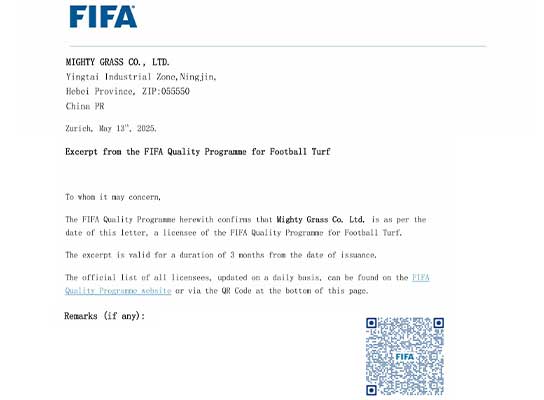
Expert Advice: Choosing the Best Artificial Grass for Your Football Field
Selecting the right artificial grass for football starts with understanding your needs. Consider your location, climate, and usage frequency. For heavy-use professional pitches, we recommend FIFA-MT-Diamond and FIFA MT-UBEST 50 a turf system with reinforced monofilament yarns, shock pads, and durable backing layers to maintain player comfort and consistent performance.
Based on FIFA standards and customer buyback experience, we have compiled a list of Mighty Grass football turf systems for your reference:
| Item | MT-Ubest (40mm) | MT-Ubest (50mm) | MT-Diamond (60mm) |
| Pile High | 40mm | 50mm | 60mm |
| Needle Density | 12600 Needle/m² | 10500 Needle/m² | 12600 Needle/m² |
| DTEX | 10000 / 4F | 10000 / 4F | 10000 / 6F |
| Quartz Sand Filling Amount | 20kg/m² | 26kg/m² | 10kg/m² |
| Particle Type | SEBS | R-T-H | SBR |
| Particle Filling Amount | 6kg/m² | 6kg/m² | 15kg/m² |
| Shock Pad Model | KS0710 | RX-32010G | Non |
Mighty Grass As a FIFA-approved artificial turf supplier and manufacturer, our can customize football turf solutions to meet your specific needs and tailor them to your project. For any questions regarding building community football fields, school training grounds, or large stadiums, please contact our expert team immediately.
Act now! Whether you’re building a new field or renovating an existing one, our FIFA football turf allows you to invest in the perfect blend of innovation and performance for soccer fields, year after year, with continuous excitement.
Conclusion
Artificial grass for football has redefined the way the game is played, offering consistency, safety, durability, and year-round usability. Whether your goal is to lower maintenance costs, maximize playtime, or generate revenue, artificial football turf systems deliver clear advantages over natural grass.
FAQ
Are football fields flat?
Not exactly — professional football fields are designed with a very slight slope or “crown” in the center, usually around 1% gradient (about 10–20 cm higher than the sidelines). This gentle slope helps water drain off the surface efficiently.
When you install an artificial grass football pitch, the base is engineered for precise leveling and drainage, ensuring the turf remains flat to the eye while still managing rainfall effectively. Mighty Grass turf systems include customized base construction to maintain both flatness and drainage stability, even after years of heavy use.
Are football fields made of real grass?
Traditionally, yes, but more and more football fields now use artificial grass for football instead of natural turf. According to FIFA, synthetic surfaces are used in thousands of professional and community stadiums worldwide due to their durability, safety, and all-weather usability.
Modern artificial football pitches mimic the look and feel of real grass but require far less maintenance. Mighty Grass designs its turf with advanced yarns and infill systems that replicate natural ball movement and traction, giving players the same experience with fewer interruptions or repairs.
Why is turf better than grass in football?
Artificial turf offers several advantages over natural grass for football. It provides a consistent, all-weather surface, reducing cancellations due to rain or mud. It’s also more durable, allowing thousands of play hours without surface damage, and it dramatically lowers water and maintenance costs.
For schools, clubs, and stadium owners, synthetic turf means lower long-term expenses and more playable hours. Mighty Grass systems are built to FIFA standards, ensuring comfort, safety, and performance for every player, season after season.
What does a football field include?
A standard football field consists of the main playing area (100–110 meters long, 64–75 meters wide), goal areas, penalty boxes, center circle, and corner arcs. Beyond the markings, a complete artificial grass football ground also includes a shock pad, drainage base, infill layer, and synthetic turf surface.
Mighty Grass provides fully integrated turf systems with each layer engineered for performance, from reinforced backing to high-resilience fibers, ensuring your field meets both FIFA and local sport facility standards.
How many blades of grass are in a football field?
A full-size artificial football pitch typically contains over 5 million synthetic grass blades, depending on pile density and field size. Each “blade” is made of polyethylene or polypropylene yarn, tufted into a durable backing to simulate natural grass texture.
For example, a 105 × 68 m field using Mighty Grass’s 12,600-stitch turf system will include roughly 5.3 million individual fibers, each engineered for UV resistance and long-term resilience. That’s what gives the surface its lush, natural appearance while maintaining top-level playability year-round.
How long does artificial grass for football last?
High-quality artificial grass football pitches can last 8–10 years or more with proper care. Longevity depends on player volume, climate, and maintenance frequency.
Mighty Grass uses UV-stabilized yarns and double-layered backings that resist wear, fading, and temperature fluctuations — making them ideal for both hot and cold climates. Regular brushing and infill leveling will help your turf maintain its performance and visual quality over the years.
Is artificial football turf used in professional stadiums?
Yes. Many professional stadiums around the world, including those certified by FIFA and UEFA, use hybrid or fully synthetic football pitches. These surfaces provide consistent performance, lower maintenance costs, and faster recovery after events.
Mighty Grass’s FIFA-certified systems are designed to meet international play standards, making them suitable for professional matches, training academies, and municipal facilities alike.


