English
  العربية
  Español
  Deutsch
  Français
  Português
  Русский
  日本語
日本語  Italiano
  Nederlands
  Svenska
  Suomi
Suomi  ไทย
ไทย  Dansk
Dansk  Ελληνικά
  Bahasa Melayu
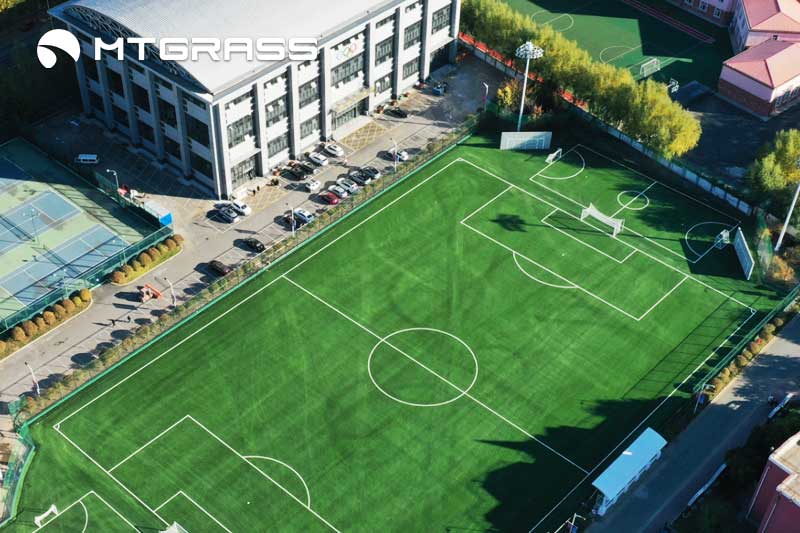
If you’re planning a synthetic turf for school sports field or campus landscaping project in the United States, durability is not just a preference—it’s a requirement. A typical K–12 field can see 300–800 hours of use per year, far beyond what natural grass can handle without constant repair. The result? Worn-out surfaces, rising maintenance costs, and limited field availability.
That’s why more schools are turning to synthetic turf systems designed specifically for high-traffic environments. But here’s the catch: not all artificial grass is built to last. Some products look good on day one but flatten, split, or fade within just a few seasons.
In this guide, you will gain in-depth insight into the key elements that endow artificial turf with the durability required for campus environments; we hope this proves helpful as you select the artificial turf system best suited to your future needs.
What Makes Synthetic Turf Durable for School Use?
Durability in artificial turf isn’t about one single feature. It’s the result of a carefully engineered system—fiber, structure, backing, and installation all working together. Schools that understand this tend to get 8–10 years of performance, while others replacing low-grade turf may struggle to reach 3–5 years.
Yarn Quality (PE vs Nylon vs PP)
The fiber material is the foundation of durability.
- Polyethylene (PE) is the most widely used for school sports fields. It offers a strong balance between softness, resilience, and cost. High-quality PE yarn can maintain shape even under heavy foot traffic.
- Nylon is the most durable option available, with excellent memory and wear resistance. It’s often used in high-impact zones or elite sports facilities, but comes at a higher price point.
- Polypropylene (PP) is less durable and more prone to flattening, the relative cost is lower, it is not recommended for use in school sports facilities.
For most U.S. schools, premium PE with reinforced cross-sections (such as U-, S-shape or Diamond fibers) delivers the best long-term value.
Dtex & Fiber Thickness
Dtex refers to the weight of the yarn per 10,000 meters, and it directly impacts how well the turf resists wear.
- Typical school-grade turf: 8,000–12,000 Dtex
- High-durability systems: 10,000–16,000 Dtex
Higher Dtex fibers are thicker and more resistant to splitting and deformation. However, Dtex alone isn’t enough—it must be matched with the right density and backing to perform properly.
Stitch Rate & Density
This is where many buyers make costly mistakes.
A turf with a high stitch rate (for example, 160–220 stitches per meter) and dense fiber coverage will:
- Better withstand repeated use
- Provide stronger fiber support
- Reduce matting over time
Low-density turf may look similar initially but tends to collapse quickly under school-level usage. In real projects, this is often the difference between a field lasting 8 years vs. 4 years.
Backing Structure
The backing holds everything together—literally.
Durable school turf systems typically use:
- Double-layer or triple-layer backing
- Reinforced latex or polyurethane coating
- High tear strength (often ≥40 N in standardized testing)
A weak backing leads to seam failure, fiber loss, and costly repairs. This is especially critical for large school fields where replacement is not an option.
At MightyGrass, all sports turf systems are designed with reinforced backing structures to ensure long-term dimensional stability, even in extreme climates.
Reduced Maintenance and Predictable Costs
Natural grass fields require mowing, irrigation, fertilization, and seasonal repair. In the U.S., this can cost $20,000–$50,000 per year per field, depending on location and usage.
Synthetic turf eliminates most of these variables. Maintenance becomes predictable—mainly brushing, occasional infill top-up, and cleaning—allowing schools to better manage operational budgets over time.
Year-Round Accessibility
One of the biggest durability advantages is not just how long turf lasts—but how often it can be used.
Artificial turf fields can typically handle 2,000–3,000 hours of annual use, compared to 300–500 hours for natural grass. This means:
- No downtime after rain
- No recovery periods
- More flexibility for scheduling sports and activities
For schools with limited space, this alone justifies the investment.
Consistent and Safer Playing Surface
Durability also impacts safety. A worn or uneven surface increases the risk of injuries.
Well-designed synthetic turf systems provide:
- Consistent shock absorption (often tested under ASTM standards)
- Stable footing and traction
- Even ball performance across the field
This is why many U.S. schools prioritize certified turf systems that meet both performance and safety benchmarks.
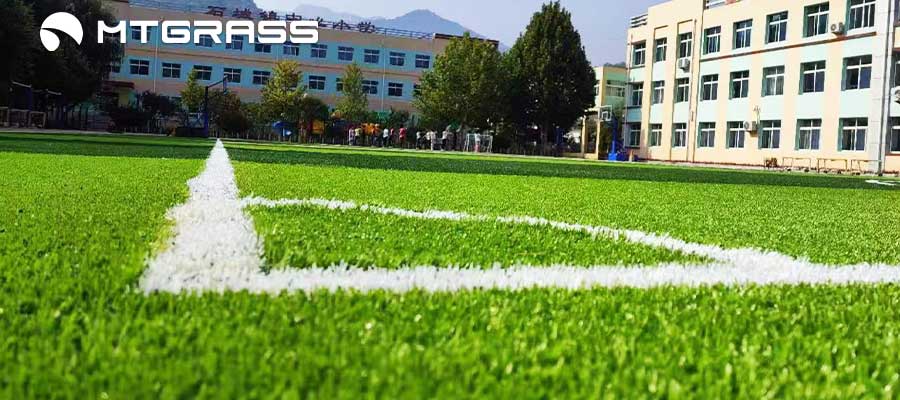
Best Types of Durable Turf for Different School Applications
Not all school projects require the same turf system. Choosing the right type depends on how the space will be used—and how much traffic it will handle.
Football & Soccer Turf Fields
These are the most demanding environments.
A durable system typically includes:
- Medium pile height (40–60 mm)
- High-density PE fibers
- Infill system (SBR, EPDM, or TPE) for shock absorption
These fields are designed to handle continuous running, cutting, and impact. At MightyGrass, many football systems use FIFA U-shaped,Diamond or S-shaped yarn structures to improve resilience and reduce flattening over time.
Softball/Baseball Synthetic Turf Fields
Baseball and softball fields require a balance between durability and ball performance.
Key considerations include:
- Shorter pile height for infield areas
- Controlled ball roll and bounce
- Reinforced backing for sliding zones
Durable turf ensures that high-impact areas like batter’s boxes and baselines maintain performance throughout the season.
Artificial Turf for Hockey Fields
Hockey surfaces demand precision.
These systems often feature:
- Short, dense fibers
- Smooth and fast ball movement
- Water-based or sand-filled systems depending on level of play
Durability here is less about pile height and more about fiber density and structural stability.
Artificial Grass for Cricket
Cricket surfaces require consistent bounce and wear resistance.
Durable cricket turf typically uses:
- Flat, tightly packed fibers
- Strong backing to prevent deformation
- High stitch density for long-term stability
This ensures reliable ball behavior even after extended use.
Multi-Sport School Fields
Many American schools require a single field to accommodate a wide range of uses—including American football, soccer, tennis, basketball, futsal, rugby, physical education classes, and various other activities.
In reality, no single turf product can perfectly meet the performance requirements of such a diverse array of sports; however, based on MightyGrass’s experience, these requirements can typically be categorized into the following common combinations:
- Soccer, Field Hockey, and Rugby (30–50 mm)
- Soccer and Rugby (40–60 mm)
- Field Hockey, Tennis, Padel, and Recreational Sports (10–30 mm)
We utilize artificial turf systems crafted from highly durable PE fibers, designed to strike a balanced performance profile across multiple types of sports. These systems are engineered to maximize field utilization efficiency while simultaneously minimizing the concentration of localized wear and tear.
Artificial Landscape Lawns
Not all school turf is for sports. Landscape areas—courtyards, walkways, and campus greens—also require durability.
Key features include:
- UV-resistant yarn to prevent fading (typically tested for 3,000–5,000 hours UV exposure)
- Natural appearance with multi-tone fibers
- Lower pile height for easy maintenance
For these applications, MightyGrass offers landscape turf solutions that combine aesthetic appeal with long-term performance, even in high-footfall zones.
Infill vs Non-Infill Turf: Which Lasts Longer for Schools?
This is one of the most common—and most misunderstood—questions in school turf projects. Many buyers assume that infill systems are always more durable. In reality, the answer depends on how the field is used.
Infill turf systems (typically filled with sand, SBR, EPDM, or TPE) are designed for high-impact sports like football and soccer. The infill acts as a support layer, helping fibers stay upright and absorbing repeated force. In well-built systems, this structure can significantly extend the usable life of the field.
In real school projects across the U.S., properly maintained infill turf can last 8–10 years, even under heavy use exceeding 1,500 hours annually.
However, infill systems come with trade-offs. They require periodic maintenance—brushing, leveling, and infill replenishment—to maintain performance. Without this, even high-quality turf will degrade faster.
Non-infill turf, on the other hand, is becoming increasingly popular for schools—especially in futsal court, indoor facilities, playgrounds, and multi-use areas. These systems rely on advanced yarn design and high density rather than loose infill.
Although traditional non-infill turf systems have historically faced limitations regarding durability. MightyGrass non-infill system which utilizes a filament structure composed of straight and curled, 100% pure curled or textured fibers, continues to demonstrate impressive wear resistance on your sports fields. Non-infill artificial turf is particularly well-suited for:
- Lower maintenance requirements
- Cleaner surfaces (no rubber granules)
- Better suitability for younger students
For your school, the final decision should be grounded in your specific requirements:
- High-performance sports field → infill system
- Multi-use, indoor, or safety-focused areas → non-infill system
The most durable choice is not about infill vs. non-infill—it’s about choosing the right system for the right application.
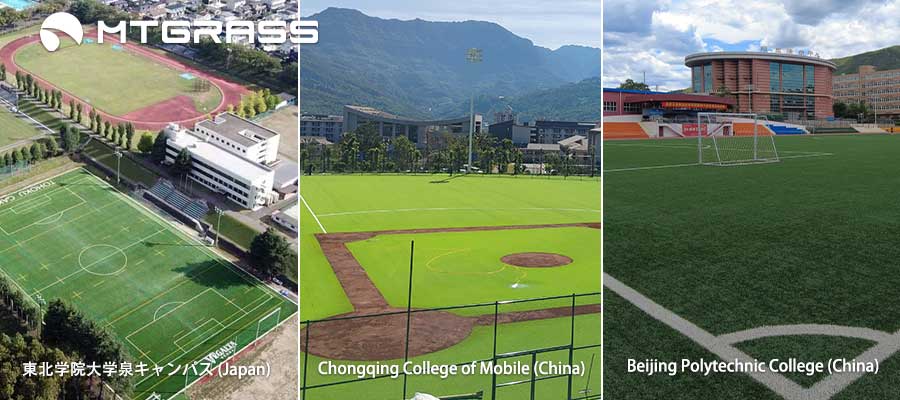
How Long Does Synthetic Turf Last in Schools?
A typical school field may experience:
- Daily PE classes
- After-school sports programs
- Weekend community use
This can push total annual usage well beyond 1,000–2,000 hours, far exceeding the capacity of natural grass.
MightyGrass believes that the following factors directly influence its service life:
- Fiber resilience (shape retention under repeated pressure)
- Installation quality (base preparation, drainage, seam strength)
- Maintenance practices (brushing, cleaning, infill management)
The lifespan of artificial turf in school settings varies significantly; however, in most U.S. projects—provided there is proper maintenance—high-quality turf typically lasts for 8 to 10 years or more. Conversely, if you opt for low-cost, low-density synthetic turf products for a school environment characterized by extremely heavy foot traffic, the lifespan may be shortened to as little as 3 to 5 years, or even less.
Key Certifications for School Turf in the USA
For schools in the United States, certifications are not just formalities—they are critical indicators of safety, durability, and compliance.
When evaluating synthetic turf, you should look for standards such as:
- FIFA Quality / FIFA Quality Pro
Common for soccer fields, ensuring performance consistency and durability. - ASTM Standards (American Society for Testing and Materials)
Widely used in the U.S. to evaluate shock absorption, traction, and surface safety. - UV Resistance Testing
High-quality turf is typically tested for 3,000–5,000 hours of UV exposure, ensuring long-term color stability. - Heavy Metal & Environmental Safety Tests (e.g., SGS)
Particularly important for playgrounds and younger students.
At MightyGrass, all turf systems are manufactured under strict quality control and can be customized to meet project-specific certification requirements for school and municipal use.
Why More Schools Are Switching to Artificial Turf
Across the United States, the shift from natural grass to synthetic turf is accelerating—and for good reason.
School administrators are under increasing pressure to maximize facility usage while controlling costs. Artificial turf offers a solution that aligns with both goals.
- First, there’s the issue of maintenance. Natural grass fields require constant care, and even then, they struggle to keep up with heavy use. In contrast, synthetic turf dramatically reduces ongoing maintenance while maintaining a consistent playing surface.
- Then there’s availability. A natural grass field may need days—or even weeks—to recover after heavy use or bad weather. Synthetic turf fields are ready almost immediately, allowing schools to schedule more activities without interruption.
- Water usage is another factor. In states facing drought conditions or water restrictions, eliminating irrigation can lead to substantial savings and improved sustainability.
- Perhaps most importantly, artificial turf provides predictable performance. Coaches, students, and facility managers know what to expect every time they step onto the field.
Why Choose MightyGrass for Durable School Turf Solutions
Choosing the right supplier is just as important as choosing the right product.
MightyGrass has been manufacturing artificial turf since 2003, with a fully integrated production system covering yarn extrusion, tufting, and backing. This level of control allows for consistent quality and customization based on real project needs.
For school projects, this translates into several practical advantages:
- Faster delivery and local support
- With a California warehouse, MightyGrass can better support U.S.-based projects with reduced lead times.
- Engineered durability
- Turf systems designed specifically for high-traffic environments, with optimized yarn structures and backing strength.
- Customization flexibility
- From pile height and density to color and roll size, products can be tailored for sports fields, playgrounds, or landscape areas.
- Proven project experience
- Serving schools, contractors, and distributors across North America and global markets.
- Certified quality
- MightyGrass Products tested to meet international standards for performance, safety, and environmental compliance and FIFA-approved artificial grass manufacturer.
Instead of offering one-size-fits-all products, MightyGrass focuses on helping you build a turf system that matches your specific project requirements and lasts.
Conclusion
Durability in school turf is not about choosing the most expensive option—it’s about choosing the right system.
From yarn quality and density to backing strength and application type, every detail plays a role in how long your turf will perform under real-world conditions. Schools that take a system-based approach consistently achieve longer lifespans, better performance, and lower long-term costs.
If you’re planning a school project in the U.S., the goal is simple:
build a surface that can handle daily use, minimize maintenance, and stay reliable year after year.
That’s exactly what the right synthetic turf system is designed to do.
If you’re planning a school field or campus project, choosing the right turf system early can save you years of maintenance costs and avoid premature replacement. At MightyGrass, you get more than just artificial grass—you get a durable, football fields, multi-sport areas, or landscape spaces project-specific solution built for high-traffic school environments.
FAQ
What is the most durable synthetic turf for schools?
The most durable synthetic turf for schools is typically a high-density PE (polyethylene) system with reinforced yarn structure (such as S-shape or diamond fibers), combined with strong backing and proper infill support if used for sports fields.
For high-traffic school environments, look for:
- Dtex range of 10,000–16,000
- Stitch rate above 160 stitches/m
- Double PP or triple-layer backing
Durability is not about one parameter—it’s the result of a well-designed system.
Is artificial turf safe for students?
Yes, modern artificial turf systems are designed to meet strict safety standards.
High-quality turf used in schools typically includes:
- Shock-absorbing layers to reduce impact injuries
- Non-toxic materials tested for heavy metals
- Compliance with ASTM and international safety standards
For younger students or playgrounds, non-infill turf systems are often preferred for added safety and cleanliness.
What is better for schools: infill or non-infill turf?
It depends on the application.
- Infill turf is better for high-impact sports like football and soccer, offering stronger support and longer durability under intense use.
- Non-infill turf is ideal for playgrounds, indoor facilities, and multi-use areas due to lower maintenance and cleaner surfaces.
Choosing the right system is more important than choosing one type over the other.
How much does synthetic turf cost for schools in the USA?
The cost of synthetic turf for schools typically ranges from:
- $8 to $25 per square meter (material only)
- Full installed systems can vary significantly depending on base construction, infill, and project size
Higher-quality turf may have a higher upfront cost but often reduces long-term expenses by extending lifespan and lowering maintenance needs.
What certifications should school turf have in the USA?
For school projects in the U.S., common certifications include:
- FIFA Quality / FIFA Quality Pro (for sports performance)
- ASTM standards (for safety and shock absorption)
- UV resistance testing (3,000–5,000 hours)
- Environmental and heavy metal testing (e.g., SGS)
How do I choose a reliable artificial turf supplier?
A reliable supplier should offer:
- In-house manufacturing (not just trading)
- Customization based on project requirements
- Proven experience with school or sports field projects
- Product certifications and testing support
- Sampling before bulk orders
Working with an experienced artificial grass manufacturer like MightyGrass helps ensure consistent quality and long-term performance.
Can synthetic turf handle heavy daily use in schools?
Yes. High-quality synthetic turf systems are specifically designed for heavy-use environments.
Compared to natural grass, which typically supports 300–500 hours of annual use, synthetic turf can handle 2,000+ hours per year, making it ideal for schools with continuous activities, PE classes, and sports programs.