
 English
  العربية
  Español
  Deutsch
  Français
  Português
  Русский
  日本語
日本語  Italiano
  Nederlands
  Svenska
  Suomi
Suomi  ไทย
ไทย  Dansk
Dansk  Ελληνικά
  Bahasa Melayu

Choosing synthetic grass for a football field in Peru is not simply a matter of comparing pile height or price per square meter. The right football turf needs to match your field’s location, climate, playing level, weekly usage, drainage conditions, maintenance plan, and certification requirements.
If you are planning a professional stadium, football academy, municipal pitch, school field, or commercial football facility, this guide will help you evaluate the most important factors before you select your synthetic football turf supplier.
Quick Answer: What Synthetic Grass Is Best for Football Fields in Peru?
The best synthetic grass for a football field in Peru is the one that matches your location, level of play, usage intensity, climate, drainage requirements, and budget.
For most outdoor football projects, you should look for a purpose-designed football turf system rather than general-purpose artificial grass. Your starting point should look something like this:
| Project requirement | What to prioritize |
| Professional football | High-performance system and FIFA Quality Pro |
| Academy or training center | FIFA Quality, Durable football turf designed for frequent use |
| Community or municipal field | FIFA Quality or an appropriate durable system |
| Commercial 5-a-side facility | High wear resistance and efficient maintenance |
| Strong UV exposure | UV-stabilized PE yarn |
| High rainfall | Permeable turf backing plus properly designed drainage |
| Heavy weekly usage | Durable yarn, suitable infill and stable field construction |
| Long-term procurement | Consistent manufacturing quality, technical support and replacement availability |
The important point is that there is no single “best” football turf specification for every project in Peru. You should select the complete turf system around the way your field will actually be used.
Contact MightyGrass Now for Solution
Climate Zones in Peru and What They Mean for Football Turf Selection
Based on the current national climate classification by Peru’s National Service of Meteorology and Hydrology (SENAMHI), three major regional characteristics have been identified and summarized:
- Coastal Peru (Lima, Trujillo, Piura, and other coastal cities). This is where most football turf demand in Peru is concentrated, and it’s also where UV degradation is the single biggest threat to a turf’s lifespan. SENAMHI, Peru’s national meteorological service, has repeatedly reported very high to extreme UV-index conditions across the country, with particularly intense readings in Lima and the highlands. Therefore, football fields yarn with strong, tested UV stabilization — not just a manufacturer’s claim of “UV protected,” it should explicitly specify, like MightyGrass, that it holds Labosport certification for ≥5,000 hours of testing.
- Andean Highlands (Cusco, Huancayo, Arequipa, and similar altitude regions). UV intensity here is even higher than on the coast because of elevation, and it’s compounded by wide temperature swings between day and night — sometimes 20°C or more within 24 hours. Fields at altitude also face occasional frost. A turf system that performs well in Lima can still underperform in the highlands if the backing and yarn aren’t rated for that kind of thermal cycling.
- Amazon and Tropical Lowlands. Here the priority flips: UV resistance still matters, but drainage becomes the dominant design factor. Heavy seasonal rainfall means a poorly drained base or backing will turn a football pitch into standing water within a season, regardless of how good the yarn is.
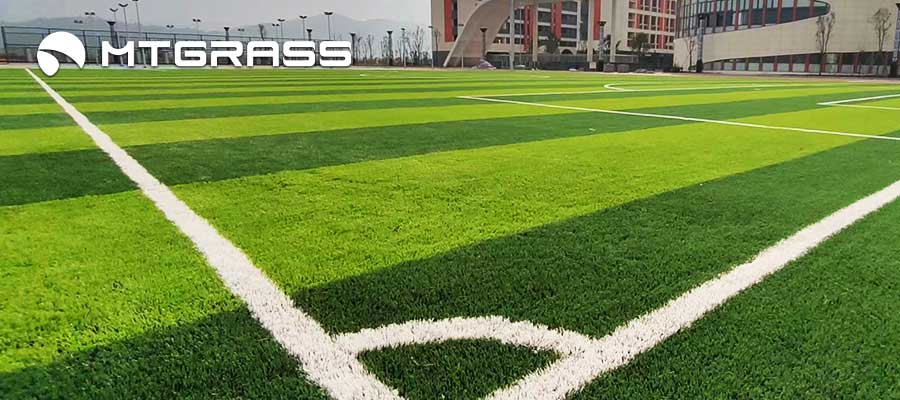
Choosing Synthetic Grass by Football Field Application
The right football turf also depends on who will use the field and how often. A professional stadium, football academy and municipal community field may all use artificial grass, but they do not necessarily need the same system.
Professional Football and High-Level Competition
If you are developing a professional football facility or a field intended for high-level competition, playing performance becomes the primary consideration. You may need:
- FIFA Quality Pro certification
- Carefully controlled ball-surface interaction
- Appropriate player-surface interaction
- Consistent shock absorption and traction
- High durability, professional installation and maintenance
You should therefore avoid selecting a professional pitch simply by looking for the highest Dtex or the thickest-looking grass. The complete system needs to satisfy the required FIFA performance criteria.
Football Academies and Training Centers
Academies can place enormous pressure on a football field because training may take place almost every day. Here, durability and maintenance efficiency become particularly important. Then you have to consider another question: How many hours per week will the pitch actually be used?
FIFA states that FIFA Quality pitches are tested for a capability of handling approximately 40–60 hours of play per week, making this certification particularly relevant to recreational, training and grassroots applications.
If your academy operates multiple training sessions every day, you should discuss the expected usage with your artificial turf manufacturer before choosing the specification.
Schools, Municipal and Community Football Fields
This is one of the categories with the highest demand in the Peruvian market. You do not necessarily need to purchase the highest-specification football turf, but you should weigh various factors: performance + durability + safety + maintenance + total project cost.
Peru has real, documented examples of this: the municipality of Lima opened a new high-traffic synthetic football field at the Limatambo sports complex designed for both 7-a-side and 11-a-side football, and a renovated facility in Villa María del Triunfo added a new synthetic pitch alongside a multi-use sports court. Municipal and public-sector projects like these typically go through formal procurement, if you’re sourcing for a school or municipal project.
Commercial, 5-a-Side Football Facilities
In Peru, it is often called ‘pasto para cancha de futbol’. These are revenue-generating facilities, which changes the calculation. Downtime costs money, so durability and fast drainage (to reopen quickly after rain) matter as much as appearance. Renting out a field with worn, matted turf also hurts repeat bookings — so fiber recovery and a consistently “green” look over years of use become a business consideration, not just an aesthetic one.
| Application | Primary Priority | Typical Pile Height | Certification Level |
| Professional / competition stadium | Ball performance, shock absorption, player safety | 50–60 mm | FIFA Quality Pro |
| Football academy / training center | High-frequency use, durability, consistent performance | 40–50 mm | FIFA Quality, project-dependent |
| School / municipal / community field | Safety, cost efficiency, procurement compliance | 40–50 mm | FIFA Quality or non-certified, depending on project requirements |
| Commercial / five-a-side pitch | Durability, drainage, appearance, and high uptime | 40–50 mm | FIFA Quality or commercial-grade |
How to Evaluate the Key Technical Parameters of Synthetic Football Turf?
Once you know your climate zone and your application, the technical spec sheet stops being abstract and starts being a checklist. The most common mistake is to compare products parameter by parameter without considering how those parameters work together. Here’s what actually drives performance.
| Parameter | What to Evaluate | What to Look For | Why It Matters |
| Pile height | Common football turf systems may use around 40–60 mm, depending on system design and intended use | Match pile height with playing level, infill system, usage intensity and performance requirements | Influences ball behavior, player interaction, surface feel and overall system construction |
| Yarn material | PE monofilament or other football-specific yarn constructions | Look for a balance of softness, resilience, UV resistance and durability | Affects player comfort, ball interaction, fiber recovery and service life |
| Dtex | Match yarn linear density to the yarn construction and intended application | Compare Dtex together with yarn shape, thickness, pile height and stitch density rather than in isolation | Indicates yarn linear density and contributes to yarn strength and material content |
| Gauge | Common football turf gauges include 5/8″ and 3/4″ | Evaluate together with stitch density, yarn construction and desired surface coverage | Influences tufting structure, fiber distribution and overall surface appearance |
| Stitch density | Evaluate together with gauge, Dtex and yarn construction | Look for sufficient fiber coverage and stable surface structure without relying on stitch count alone | Affects fiber coverage, surface stability and the amount of yarn installed per unit area |
| Fiber / yarn weight | Evaluate the total yarn weight per square meter | Compare yarn weight together with pile height, Dtex, gauge and stitch density | Helps indicate the amount of fiber material used and contributes to surface coverage and density |
| Yarn shape | S, U, diamond and other profile designs | Compare fiber recovery, resilience, softness and ball interaction | Influences how quickly fibers recover after use and how the surface behaves during play |
| Backing | Latex or PU backing, depending on system design | Check dimensional stability, bonding strength, moisture behavior and suitability for the installation environment | Affects turf stability, durability and long-term installation performance |
| Infill | Sand, performance infill or a combination, depending on system design | Check infill type, application rate, depth and compatibility with the turf system | Supports fibers and influences shock absorption, ball response, stability and playing characteristics |
| UV stabilization | Outdoor-grade UV stabilization for the yarn and system | Look for documented UV resistance, accelerated aging tests or relevant test reports | Helps maintain fiber strength, color and performance during long-term outdoor exposure |
| Drainage | Evaluate both turf permeability and the underlying drainage system | Check turf drainage performance together with sub-base design and site drainage capacity | Determines how quickly water is removed from the playing surface and how soon the field can return to use |
| Dimensional stability | Turf behavior under temperature and moisture changes | Look for low shrinkage, reliable backing and stable installation performance | Helps prevent wrinkles, movement and changes in surface dimensions over time |
| Wear resistance | Resistance to fiber wear, splitting and mechanical damage under repeated use | Consider usage intensity, yarn construction, fiber recovery and test results | Determines how well the turf maintains its appearance and playing performance under frequent use |
| System compatibility | Compatibility between turf, infill, shock pad and base system | Evaluate the complete system rather than individual components | Ensures that the finished field delivers the intended performance, safety and durability |
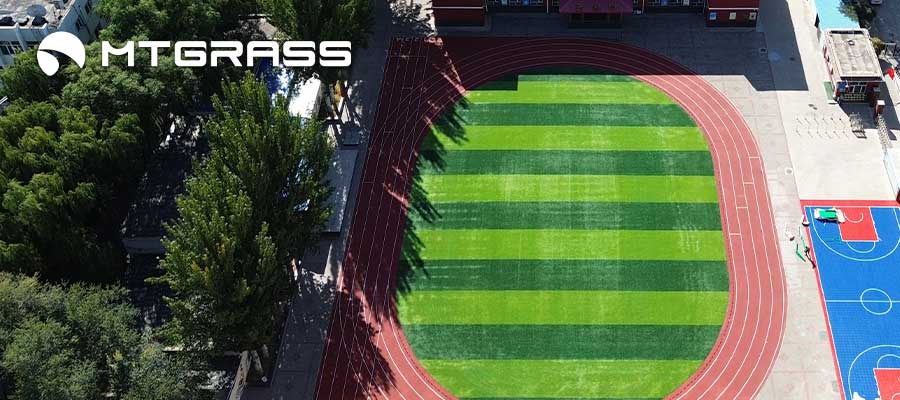
Standards & Certifications to Look For in an Artificial Football Pitch
If your project requires a recognized performance standard, FIFA certification deserves particular attention.
FIFA Quality and FIFA Quality Pro. FIFA Quality is generally suited to community, municipal, school, and recreational fields, while FIFA Quality Pro is designed for professional competition. Both assess multiple aspects of the complete turf system, and certification includes both laboratory and field testing. This means the turf itself is only part of the equation — base preparation and installation also affect certification performance.
Beyond FIFA: ISO 9001 and ISO 14001 demonstrate quality and environmental management systems, while independent laboratories such as LABOSPORT and SGS can provide additional testing for UV resistance, material safety, and other properties. These do not replace FIFA certification where required, but they provide useful supporting evidence for non-FIFA projects.
Kind tips: Before ordering, request the applicable FIFA certificate, laboratory test reports, and documented UV-resistance results. For example, MightyGrass football turf has not only obtained FIFA certification but also passed Labosport’s UV aging test, exceeding 5,000 hours of exposure.
Maintenance and Expected Lifespan of Artificial Football Grass in Peru
Even the right turf, correctly certified, won’t hold up on its own — maintenance is what actually protects your investment over time, and FIFA itself emphasizes that maintenance is fundamental to playing performance, safety, and longevity. In practice, that means regular:
- Brushing to keep fibers upright and prevent matting in high-traffic zones (goal mouths, center circles)
- Periodic infill redistribution and top-up
- Carry out routine disinfection to prevent the growth of mold and bacteria within the football grass system (this is particularly important in the Amazon region and during Lima’s humid months)
Skipping this doesn’t just shorten the turf’s cosmetic life; it changes how the ball actually behaves on the field, which matters a lot more on a competition or academy pitch than it does on a decorative lawn.
Why Choose MightyGrass Football Turf for Your Project?
Once you’ve worked through climate, application, and certification, the next question is simply: who can actually deliver a system matched to what you need, and back it up with real testing data.
MightyGrass has supplied football turf systems for markets with the same climate pressures Peru faces — intense UV, high humidity, heavy seasonal rainfall — for more than 20 years, with in-house yarn extrusion, tufting, and backing production under one roof. That matters because it means pile height, yarn type, face weight, stitch density, and backing can all be customized to a specific project rather than pulled from a fixed catalog. For competition-level and academy projects, MightyGrass offers both FIFA football turf systems, including products like FIFA-MT-Diamond and FIFA-MT-Ubest 50, backed by UV-resistant yarn tested to 5,000+ hours under LABOSPORT protocols — a meaningful buffer against the UV conditions SENAMHI has documented across coastal and highland Peru. For schools and community projects where lower maintenance is the priority, MightyGrass’s non-infill football turf line delivers a cleaner playing surface without sacrificing the durability those high-frequency-use fields demand.
If you are ready to proceed with the football field project, please provide MightyGrass with the specific specifications for the synthetic turf and any known certification requirements (e.g., FIFA Quality, FIFA Quality Pro). If you’re not sure yet, that’s fine too: describe the project and the technical team can recommend a system built for it, with free samples and documentation available before you commit.
Looking for the full picture on suppliers, importing, and general pricing across the Peruvian synthetic grass market? See our complete Artificial Grass in Peru: Best Suppliers and Buying Guide.
Request a Free Quote or Samples for Your Peru Football Field Project
FAQ
How much more does FIFA-certified football turf cost compared to non-certified turf?
As a general rule, FIFA-certified football turf systems can cost around 10–30% more than comparable non-certified systems, although the difference varies by specification, certification level, and supplier. FIFA Quality Pro systems typically sit at the higher end of this range because of their more demanding performance requirements and certification process. For projects where FIFA certification is not required—such as many school, community, and recreational fields—a well-specified non-certified system can often deliver the required performance at a lower cost.
Is there a real price difference between turf for a school field and a commercial five-a-side pitch in Peru?
Generally speaking, yes. When comparing usage intensity, commercial pitches require continuous operation, so their turf must withstand frequent wear and provide rapid drainage to minimize downtime—leading to the selection of higher-specification turf with greater long-term durability (and higher costs). In contrast, school pitches are used for only a few hours a day, so the requirements are relatively lower.
Do all football fields in Peru need FIFA certification?
No. FIFA Quality and FIFA Quality Pro are typically required for organized league play, professional competition, or when a project tender specifically calls for a FIFA quality mark. Many school, municipal, and community fields in Peru use non-FIFA football turf. However, it is recommended that you choose synthetic turf that meets ISO standards for safety and durability.
What’s the best pile height for a five-a-side pitch versus a full 11-a-side field?
Both typically fall in the 40–50mm range, but five-a-side pitches often lean toward the lower end for a faster, more controlled ball roll in tighter spaces, while full-size competition fields more often use 50mm-plus systems paired with a shock pad to meet FIFA performance requirements across a larger playing surface.
Practical Checklist for Selecting Football Turf in Peru
Before you request a quote:
- What type of football facility is being built?
- How many hours of usage per week are expected?
- In which region of Peru is the project located?
- Is it an indoor, outdoor, or covered facility?
- What are the local rainfall and drainage conditions?
- Does the project require FIFA Quality or FIFA Quality Pro certification?
- What are the appropriate pile height and yarn structure?
- Which infill system will be used?
- Is a shock pad required?
- What type of drainage system is included?
- Who will install the turf?
- What test documentation is available for review?
- What warranty and maintenance support are provided?


