
 English
 العربية
 Español
 Deutsch
 Français
 Português
 Русский
 日本語
 Italiano
 Nederlands
 Svenska
 Suomi
 ไทย
 Dansk
 Ελληνικά
 Bahasa Melayu


If you import, distribute or install artificial grass, you are not just buying a green surface. You are buying the result of dozens of manufacturing decisions: which polymer was used, how the yarn was extruded, how densely it was tufted, and how firmly it was bonded to the backing.
Why does the production process matter to you? Two rolls with the same pile height can look identical in a photo and still differ in weight, softness, fibre retention and long-term colour stability. The difference almost always starts on the production line.
This guide explains how artificial grass is made, step by step, and shows you what to look at at each stage when you assess a manufacturer.
Artificial Grass Manufacturing Process at a Glance
| Stage | What happens | What it affects |
| Raw material preparation | Polymers, colour masterbatch and additives are selected and blended | Softness, strength, colour, UV resistance, and flame retardancy performance, etc. |
| Yarn extrusion | Blended material is melted, extruded, stretched and wound | Fibre shape, thickness, resilience and durability |
| Twisting or texturing | Yarn is twisted or given a curl | Pile appearance, bulk and natural look |
| Tufting | Yarn is stitched into the primary backing | Density, pile height, appearance and material use |
| Backing coating and curing | Coating locks the yarn in place and is dried or cured | Tuft bind, dimensional stability and backing integrity |
| Finishing and in-process checks | Drainage perforation, trimming and surface finishing | Water drainage, finish quality and consistency |
| Final inspection and packaging | Rolls are checked, cut, labelled and packed | Order accuracy, traceability and transport protection |
Step 1. Raw Material Selection and Preparation
Everything starts with the polymer. Most artificial grass yarn is made from polyethylene (PE), polypropylene (PP) or a combination, and each has a different effect on the finished product. PE is widely used for softer, more natural-feeling blades. PP is stiffer and is commonly used where a firmer fibre or a supporting thatch layer is needed.
The polymer is blended with colour masterbatch and functional additives such as UV stabilisers. The quality and proportion of these ingredients influence how soft the fibre feels, how strong it is, and how well its colour holds up under sunlight and weather.
What you should check: Colour and pile height alone will not tell you what is inside the yarn. Ask your supplier which polymer types are used, and verify whether their claims regarding “UV resistance” or other functional performance attributes are supported by test data. For a closer look at how materials and constructions differ, see our guide to Types of Artificial Grass.

Step 2. Artificial Grass Yarn Extrusion
Yarn extrusion is where raw material becomes the blades of grass you see on the surface. The blended material is heated until molten, forced through a die, cooled, stretched to align its structure, and wound onto bobbins ready for tufting.
Three choices made at this stage have a direct effect on performance:
- Fibre type: Monofilament yarn is extruded as individual, shaped blades.
- Cross-section design: Blades can be extruded in S-shaped, diamond, flat, hollow and other profiles. The shape influences how the blade is wear-resistant, stands up, reflects light and recovers after foot traffic.
- Thickness and stretch: Thickness, stretching and cooling affect strength, flexibility and long-term resilience.
What you should check: Do not compare yarn only by Dtex. Two yarns with similar Dtex can behave very differently if their shape, polymer and extrusion quality are not the same. Ask whether the supplier extrudes its own yarn, and which profiles it can produce.

Step 3. Yarn Twisting or Texturing (When Required)
The extruded yarn is placed onto a creel, the finished artificial grass fibers are then twisted by a machine and wound onto a cylinder (with multiple fibers twisted together to form a single strand), resulting in a spool of yarn.
Twisting or texturing is typically used for products designed to look more natural. It can add bulk, create variation in the pile and give the blades a more relaxed form. The right treatment depends on the yarn design and the target use of the turf.
Step 4. Tufting the Grass Yarn into Primary Backing
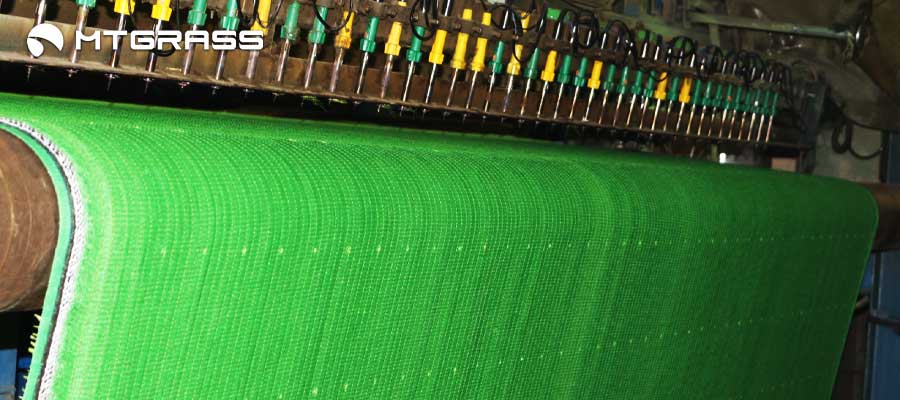
Tufting is the stage where yarn becomes turf. Tufting machines use rows of needles to stitch bundles of yarn into a woven primary backing, usually made of single-layer or double-layer polypropylene. The result is a roll of grass-like surface with yarn loops cut to the specified pile height.
Four parameters define the outcome:
- Pile height: the length of the visible yarn above the backing.
- Gauge: the distance between rows of needles.
- Stitch rate: the number of stitches per unit of length.
- Face weight: the weight of yarn per square metre, which reflects how much material is in the product.
Together they determine how full the lawn looks, how well it covers the backing, and how much yarn is used. That is why two products with the same pile height can look, weigh and cost very differently.
What you should check: Ask for gauge, stitch rate and face weight together with pile height. Check tuft alignment and uniformity across the roll width, because uneven tufting shows up as visible lines, thin areas or inconsistent colour once the turf is installed.

Step 5. Backing Coating and Curing
Tufted yarn is only held by the loops in the primary backing. A coating is applied to the back of the turf to lock each tuft in place and give the product structural stability. Latex and polyurethane (PU) are two common options, and the choice depends on the product design and application.
After coating, the product goes through drying or curing. Coating quantity, evenness and curing conditions all influence tuft bind, backing integrity and dimensional stability. A poorly bonded product may show pulled-out tufts, delamination or movement after installation.
What you should check: Do not judge a backing by its material name alone. A PU label does not automatically mean a more durable product. Ask for tuft-bind test results and information about the coating weight and curing control. For help comparing options, read our guide on How to Choose the Right Artificial Turf Backing.

Step 6. Finishing and Drainage Perforation
Once the turf is coated and cured, it moves to finishing. Depending on the product design, this can include drainage perforation, edge trimming and surface finishing.
Drainage is built in at this stage, either by perforating the backing or by using a permeable structure. One of our product data sheets lists 6 mm perforation holes and water permeability of about 60 ltr/m²/min before infill. A regular hole pattern delivers that rate evenly, while a patchy one leaves areas where water sits. In-process checks then confirm pile height, density, appearance, dimensions, backing condition and tuft bind against the specification.
What you should check: Ask for hole size, spacing and permeability figures on the data sheet, and request drainage data with the sample. Pooling will not show up in a photo.
Step 7. Final Inspection, Roll Packaging and Shipment
Before leaving the factory, finished turf is inspected again and compared with the order specification. It is then cut to the agreed width and length, rolled, labelled and packed for transport.
For wholesale and project orders, this stage matters as much as the production steps before it. Batch identification, clear labelling and consistent roll specifications let you match products to the approved sample, track them if a question arises later, and plan installation without surprises.

How Does the Production Process Affect Artificial Grass Quality?
Artificial grass quality depends on more than pile height, density or yarn type. The way the turf is manufactured also affects how consistently it performs, from the strength of individual grass fibres to the stability of the backing.
Each stage contributes to the final product, but no single manufacturing parameter determines quality on its own. For example, tuft bind depends on the interaction between the yarn, primary backing, tufting conditions and secondary coating. Similarly, UV resistance depends on the material formulation and the results of appropriate weathering tests, rather than the extrusion process alone.
For bulk buyers, this means comparing artificial grass by its technical specifications and verified performance, not just its appearance or quoted price. Ask manufacturers for product-specific test reports, consistent specifications and clear quality inspection procedures. These details provide a more reliable basis for evaluating whether a turf product meets the requirements of your intended application.
How to Evaluate an Artificial Grass Manufacturer’s Production Process
When you compare suppliers, the following four questions help you separate a true manufacturer from a trading company, and a consistent producer from an inconsistent one.
- In-house manufacturing capabilities: Find out whether key processes such as yarn extrusion, tufting and backing are carried out by the supplier itself. Control over these stages makes it easier to adjust specifications and keep quality consistent.
- Quality control procedures: Ask what is inspected at each stage, how samples are taken and whether batch records are kept. A clear answer shows a system. A vague answer suggests the checks are informal.
- Customisation capabilities: Check whether the manufacturer can adjust yarn structure, pile height, density, backing and roll dimensions to meet your market, project or brand requirements.
- Testing and documentation: Request test reports, certifications and quality documents that are relevant to your intended application, and check what each document actually covers.

How MightyGrass Approaches Production
At MightyGrass, our manufacturing system covers yarn extrusion, tufting and backing processes, so you can discuss specifications with a team that works across the production chain. You can learn more about our facilities and equipment on our Artificial Grass Factory page. If you are interested in sports applications specifically, see What Is Football Turf Made Of? for a closer look at the materials and tests behind football pitches.
Talk to MightyGrass About Your Next Order
If you are an importer, wholesaler, turf distributor, sports field contractor or project buyer, MightyGrass can help you match specifications to your market and application. Send us your target product, quantity and project requirements, and we will respond with sample options and technical details. Request samples, specifications or a quotation from MightyGrass.
FAQ
What are the main steps in the artificial grass production process?
The main steps are raw material preparation, yarn extrusion, yarn twisting or texturing when required, tufting into a primary backing, backing coating and curing, finishing with drainage perforation and in-process checks, and final inspection with packaging. Exact steps vary with the product design and the manufacturer’s equipment.
What materials are used to manufacture artificial grass?
The yarn is typically made from polyethylene, polypropylene or a combination of both, blended with colour masterbatch and additives such as UV stabilisers. The primary backing is commonly woven polypropylene, and the secondary coating is usually latex or polyurethane.
Why do artificial turf fibres shed or break?
A small amount of loose fibre in the first weeks after installation is common, because loose yarn left from production can come away. Persistent shedding or breakage usually points to one of three causes: yarn that is weak or poorly UV-stabilised, a weak tuft bind from the backing and coating stage, or heavy mechanical wear that the yarn was not designed for. To check before you order, ask for tuft-bind and UV test results and request a sample for your own inspection.
What does “Dtex” mean in the context of artificial turf?
Dtex is a measure of yarn thickness: one Dtex equals the weight in grams of 10,000 metres of yarn. In artificial turf, a higher Dtex generally means thicker or heavier yarn, but it does not show quality on its own. Confirm whether a quoted figure refers to a single yarn or a whole tuft, and compare it together with yarn shape, polymer type and face weight.
How can you check the quality of artificial grass before placing a bulk order?
Request a physical sample, a full technical specification and relevant test reports. Check pile height, face weight, tuft bind and backing condition, and confirm that the sample matches the specification you will receive in production. Ask how batch consistency is controlled.


