
 English
 العربية
 Español
 Deutsch
 Français
 Português
 Русский
 日本語
 Italiano
 Nederlands
 Svenska
 Suomi
 ไทย
 Dansk
 Ελληνικά
 Bahasa Melayu

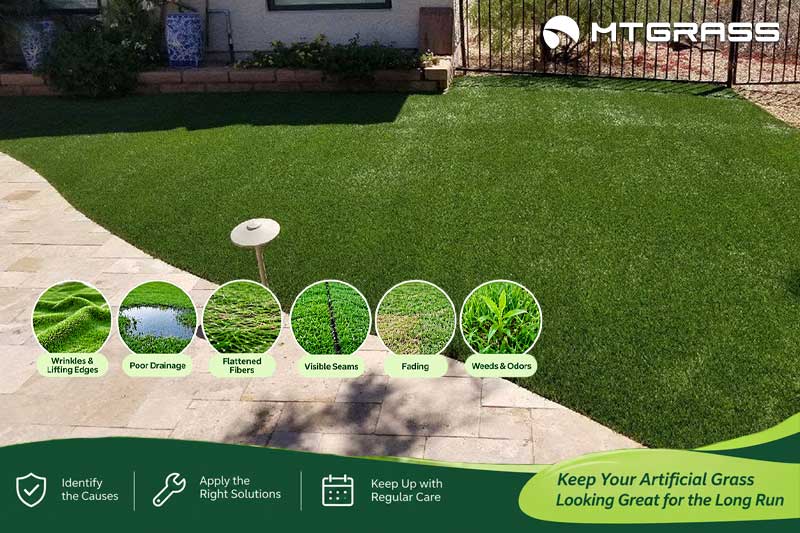
Artificial grass is designed to provide a durable and low-maintenance surface. However, over time, various issues may arise that affect its appearance and performance.
The cause is not necessarily always the grass itself. Product quality, ground preparation, installation methods, weather conditions, and maintenance all influence how artificial turf performs. Understanding what causes these problems helps you choose the right solution and prevent avoidable repairs.
What Causes Problems with Artificial Grass?
When an artificial lawn underperforms, the cause usually falls into one of four areas. Knowing which one you are dealing with makes the fix much more targeted.
| Cause category | What it covers | Problems it tends to produce |
| Product materials and construction | Fiber type, pile density, backing quality, UV stabilization | Matting, fading, backing damage |
| Base and drainage design | Sub-base depth, compaction, slope, permeability | Standing water, uneven surface, wrinkles |
| Installation and seaming | Seam adhesive and tape, edge fixing, stretching and trimming | Visible seams, lifting edges, ripples |
| Use and maintenance | Traffic level, pets, equipment, brushing and cleaning habits | Flattened fibers, odors, debris build-up |
In practice, two or three of these often combine. A lawn installed over an unevenly compacted base, for example, may hold water in one corner, which then loosens the nearby seam. Treating only the symptom rarely solves the problem for long.
6 Common Artificial Grass Problems and How to Prevent Them
#1. Wrinkles, Ripples, and Lifting Edges
What it looks like: Waves or ridges across the surface, or edges that curl up and no longer sit flat against the ground.
Common causes: An uneven or poorly compacted base, turf that was not stretched and fixed properly, insufficient edge fastening, and seams that were not bonded correctly. Temperature swings can also make turf expand and contract, which exposes weak fixing.
What to do: A small loose edge can often be re-secured with adhesive, nails or staples suited to the surface. Large areas of rippling are different. They usually point to a base or fixing problem, so the installer should lift the affected section, check and re-level the base, and re-lay the turf rather than simply pinning the surface down.
How to prevent it: Compact the base evenly in layers, check levels before laying, let rolled turf relax before cutting and fixing, and secure the full perimeter at a consistent spacing. For large projects, build a perimeter-fixing method into the installation specification.
#2. Poor Drainage and Standing Water
What it looks like: Puddles that linger after rain, damp patches, soft spots underfoot, or a musty smell from beneath the turf.
Common causes: It helps to separate two situations. In the first, water drains slowly through the turf itself, for example when the backing is blocked by fine debris. In the second, the turf drains fine but the base underneath cannot move water away, because of over-compaction, the wrong aggregate for the soil, low spots, or no outlet at the edges. Blaming the turf product for what is really a base problem is a common mistake.
What to do: Clear the surface first and observe where water actually collects. If it is only one spot, a localized repair may work: lift the turf, correct the base level or drainage layer, and re-lay. Persistent pooling across a larger area calls for a professional inspection of the base and drainage path.
How to prevent it: Choose a turf with a permeable backing and drainage holes suitable for the application, build a free-draining aggregate layer, give the surface a slight fall toward a drainage outlet, and make sure water can escape at the edges, especially over concrete or against walls and barriers.
#3. Flattened or Matted Grass Fibers
What it looks like: Fibers that lie down in high-traffic paths, play areas or pet zones and no longer spring back.
Common causes: Heavy and repeated foot traffic, fibers not designed for the level of use, uneven or insufficient infill where the system calls for it, and a lack of regular brushing. Some fiber shapes and constructions recover better than others.
What to do: Brush the pile against its lean with a stiff-bristled broom or a power brush suited to synthetic turf. Avoid metal-bristled brushes, which can damage fibers. For lawns with infill, redistribute or top up the infill as the system requires. Sports and play surfaces may have their own maintenance requirements, so follow the guidance for the specific system.
How to prevent it: Match the turf to its use. A decorative landscape turf and a play or sports turf are built differently. In addition, areas with high foot traffic should be assessed and reorganized on a regular, scheduled basis.
#4. Visible Seams, Tears, and Backing Damage
What it looks like: Seams that show as a line, gaps between turf pieces, torn sections, or fibers coming away from the backing.
Common causes: These are different problems that are often mistaken for one. Visible seams usually come from cutting too close or too wide, fibers trapped in the seam, or mismatched pile direction. Open seams point to weak adhesive, poor seam tape placement or movement in the base. Tears and backing damage are more often caused by sharp objects, dragging heavy items, or snagging on an uneven surface.
What to do: Judge by the size of the damage. A small open seam can often be re-bonded. A localized tear can be patched with a matching piece of turf. Widespread backing damage, or seams that keep re-opening, mean there is an underlying problem that needs a professional assessment and possibly replacement of the affected section.
How to prevent it: Keep pile direction consistent across pieces, use seam materials suited to the turf and conditions, avoid dragging heavy or sharp objects across the surface, and make sure the base is stable so the seam does not move.
#5. Fading and Fiber Deterioration
What it looks like: Color that lightens or shifts over time, fibers that become brittle or break down, and surfaces that look dull compared with the original appearance.
Common causes: Long-term UV exposure, fiber materials that are not suited to the climate, intense heat, and age. Reflected heat from nearby glass or metal surfaces can also put extra stress on a small area.
What to do: Mild, even fading is part of normal aging and is not a reason to replace turf. Patchy or rapid fading, or fibers that snap easily, may indicate a material-quality or application mismatch. At that point it is worth comparing the installed product against its specification.
How to prevent it: Do not judge quality by color when a sample first arrives. Ask for the fiber material, UV-resistance information and any available test data, and choose artificial turf that fits your climate and exposure. For sunny or hot sites, consider this early in product selection.
#6. Weeds, Odors, and Surface Contamination
What it looks like: Weeds poking through edges or seams, or a persistent smell and stains in pet areas.
Common causes: Weeds typically enter from the edges, seams or through a thin layer of organic debris that collects on the surface, rather than growing through the turf itself. Odors build up when pet waste or organic matter stays on the surface or collects in the base and does not drain away.
What to do: Pull weeds early, remove the debris they are rooting in, and check that edges and seams are sealed. For odors, remove solids promptly, rinse the area thoroughly, and use cleaning products suitable for synthetic turf. If the smell persists, check drainage, since moisture trapped in the base is often the real cause. For a full cleaning routine, see our artificial grass cleaning guide.
How to prevent it: Use a quality weed membrane under the base, finish the edges properly, keep debris off the surface, and pick a turf, infill and drainage design that suits the pet area.

How to Prevent Artificial Grass Problems
Most of the problems above can be avoided by two things: good decisions before installation, and light but consistent care afterwards.
Before Installation
- Choose the turf system for the actual use. Landscape, pet, play and sports applications place very different demands on fibers, backing and infill.
- Check the specification. Look at fiber material, pile height and density, backing type, drainage performance and weather resistance, not just appearance.
- Plan the base, drainage and seams. Agree on the base build-up, how water will leave the area, and how seams and edges will be fixed before work starts.
- For larger projects, set expectations in writing. Technical specifications, any required test documentation and installation responsibilities are much easier to settle before delivery than after a problem appears.
After Installation
- Clear leaves and debris regularly.
- Brush the pile based on turf type and traffic level.
- Inspect seams, edges and any worn areas from time to time.
- Watch how the lawn drains after rain, and look into any water that stays.
- Clean pet areas promptly with products suitable for artificial grass.
These checks take little time, and they catch small issues while they are still easy to fix.
When Should You Repair or Replace Artificial Grass?
Not every problem needs the same level of response. This table gives a practical way to decide.
| Situation | Typical examples | Suggested action |
| Routine maintenance | Stains, leaves, lightly flattened fibers | Clean and brush |
| Localized repair | Small loose edge, a short open seam, minor damage to one spot | Re-fix, re-bond or patch |
| Professional inspection | Repeated standing water, large-area wrinkling, damaged backing, seams that keep opening | Have the base, drainage and fixing checked |
| Possible replacement | Widespread material deterioration, serious structural damage, or problems that remain after repair | Consider replacing the affected area or the lawn |
Age alone is not a reason to replace turf. Look at how widespread the damage is, the condition of the base underneath, and the cost of repair compared with the value of what remains.
Conclusion
Artificial grass problems can usually be traced back to product choice, base preparation, installation quality or how the surface is used, and most are far easier to prevent than to repair. For buyers and contractors, choosing a turf that fits the real application, and agreeing on drainage, seaming and maintenance requirements before installation, is the most reliable way to protect the finished result.
If you are planning a project and want help matching a turf system to your use case, the MightyGrass team can discuss specifications and options with you.
FAQ
Can wrinkles in artificial grass be fixed?
Often yes. Small lifted areas can be re-secured, while widespread rippling usually needs the base checked and the turf re-laid.
Is standing water always a turf quality problem?
No. It is frequently a base, slope or drainage-outlet problem, so the whole system should be checked before drawing conclusions.
Does artificial grass fade?
All outdoor materials age under sun and heat. Quality and climate suitability affect how quickly and how evenly that happens, so review UV-resistance information when choosing turf.


