Ελληνικά
 English
 العربية
 Español
 Deutsch
 Français
 Português
 Русский
 日本語
 Italiano
 Nederlands
 Svenska
 Suomi
 ไทย
 Dansk
 Bahasa Melayu

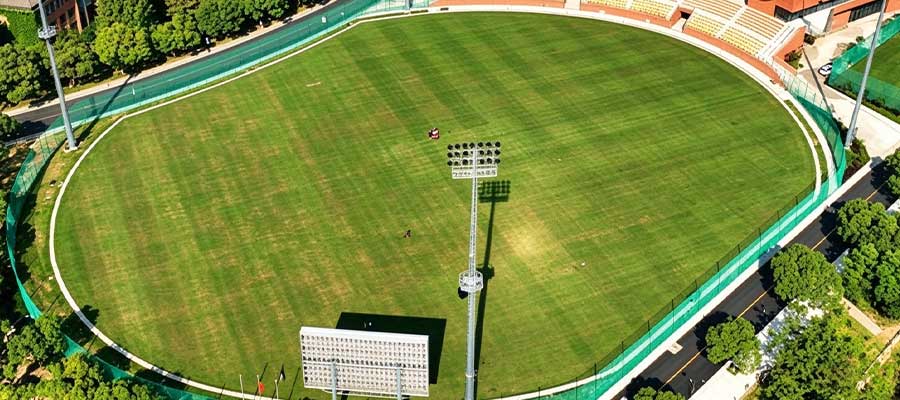
A cricket field has no fixed size. Most are oval and roughly 137–150 meters (about 450–500 feet) across, with a 22-yard pitch in the middle. The pitch itself is fixed: 20.12 meters long and 3.05 meters wide (66 feet by 10 feet). The sections that follow explain each one before moving on to practice facility space and the amount of artificial turf a cricket project needs. We hope this proves helpful to you.
Cricket Field Dimensions Glance
| Στοιχείο | Διαστάσεις |
| Field (oval) diameter, commonly cited | 137–150 m (about 450–500 ft) |
| Field area, approximate | 14,700–17,700 m² (about 159,000–196,000 ft²) |
| Boundary, international men’s (from center of pitch) | 59.43–82.29 m (65–90 yd) |
| Boundary, international women’s | 54.86–64.01 m (60–70 yd) |
| Inner circle radius (fielding restrictions) | 27.43 m (30 yd) |
| Cricket pitch length (between bowling creases) | 20.12 m (22 yd / 66 ft) |
| Cricket pitch width | 3.05 m (10 ft) |
| Cricket pitch area | about 61.4 m² (about 660 ft²) |
These figures come from the Laws of Cricket (MCC), ICC playing conditions και Cricket Australia community guidelines. Competition rules differ, so always confirm with your governing body before marking out a ground.
How Big Is a Cricket Field? Ground and Oval Size
Cricket is one of the few major sports without a fixed field size. The Laws of Cricket set exact dimensions for the cricket pitch but leave the size and shape of the playing area to each competition. In practice every ground is a little different, and the field is usually an oval, sometimes close to a circle.
A common reference range is a diameter of about 137–150 m (450–500 ft). Treating the oval as a circle, that works out to roughly 14,700–17,700 m², or about 1.5-1.8 hectares (3.6-4.4 acres). However, international rules allow the boundary to be as far as 82.29 meters (267 feet) from the center of the fairway. Boundaries are measured from the center of the pitch, not from the edges of the field. That is why grounds can have different shapes and still meet the same rules.
In addition, you will see the same space called a cricket field, a cricket ground or a cricket oval. “Ground” tends to be the everyday word in the UK and India, “oval” is widely used in Australia, and “field” is common in North America. “Pitch” means something different: it is only the strip in the middle of the field.
Cricket Field Diagram With Measurements
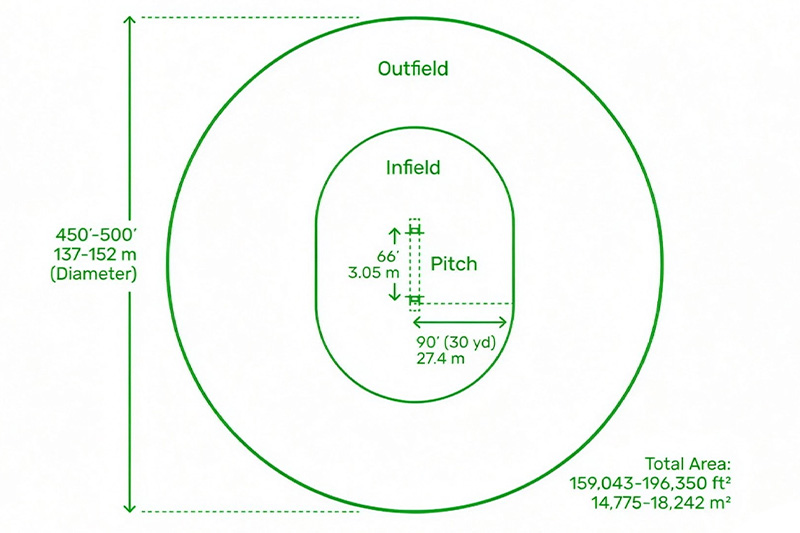
- Pitch: 20.12 m × 3.05 m (66 ft × 10 ft)
- Bowling creases: one at each end of the pitch, through the stumps
- Popping creases: 1.22 m (4 ft) in front of each bowling crease, i.e., 22.56 m (74 ft)
- Inner circle: semicircles with a 27.43 m (30 yd) radius at each end
- Boundary: 59.43–82.29 m (65–90 yd) from the center of the pitch in international men’s cricket
Cricket field layout showing the boundary, the 30-yard circle and the pitch. All distances are measured from the center of the pitch unless stated.
Boundary Distance and the 30-Yard Circle
The boundary is the outer edge of the playing area, marked by a rope, a painted line or flags. ICC Test match conditions, as summarized in Western Australia’s cricket dimensions guide, also set minimums for the playing area. In international men’s cricket it must be between 65 yards (59.43 m) and 90 yards (82.29 m) from the center of the pitch. For international women’s cricket the range is 60 to 70 yards (54.86–64.01 m).
For grounds with fencing or advertising boards, the boundary rope should sit at least 2.74 m (3 yd) inside them. For community grounds, a buffer of 20–40 m between the boundary and roads, car parks or playgrounds is preferable.
The 30-yard circle. Two semicircles with a radius of 27.43 m (30 yd) are drawn from the middle stump at each end of the pitch. In limited-overs formats, fielding restrictions are applied using this circle. It is marked with a continuous white line or with dots spaced 4.57 m apart. Many grounds also mark a smaller close circle with a 13.72 m (15 yd) radius, centered on the middle of the popping crease at each end. It is used for safety zones in some formats and age groups.
Cricket Pitch Dimensions: Length and Width
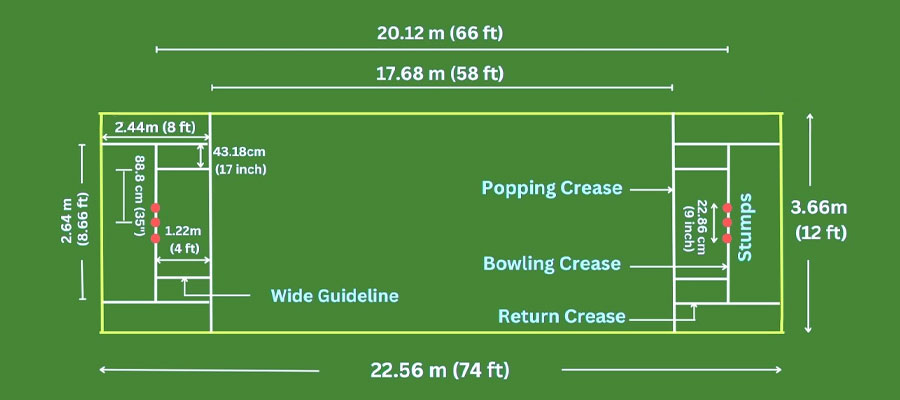
The pitch is the rectangular strip in the center of the field where the bowler and batter face each other. It is 22 yards (20.12 m, 66 ft) long, measured between the bowling creases, and 10 feet (3.05 m) wide. That gives a playing area of about 61.4 m² (660 ft²).
Turf pitches are normally prepared a little longer than 20.12 m, with at least 1.22 m behind the stumps for the return crease and the bowler’s approach.
In addition, synthetic turf is predominantly used in training ground and box cricket pitch. Synthetic pitches are 25-28 m long and 2.4-2.8 m wide, which is 60-78.4 m² of surface. The playing length is still 20.12 m. The extra length allows room behind the stumps.
Cricket Crease Measurements
Three sets of lines are marked at each end of the pitch. Together they tell the umpire where the bowler must deliver from and where the batter must stay.
| Crease | Position and Size |
| Bowling crease | Line through the centers of the three stumps, 2.64 m (8 ft 8 in) long |
| Popping crease | Parallel to the bowling crease and 1.22 m (4 ft) in front of it; marked at least 1.83 m (6 ft) either side of the middle stump, and unlimited in length |
| Return crease | At right angles to the popping crease, 1.32 m (4 ft 4 in) either side of the middle of the stumps; 2.44 m (8 ft) long |
The bowler’s front foot must land behind the popping crease, and the back foot must land inside the return creases. The batter must keep part of the body or bat grounded behind the popping crease to avoid being stumped or run out.
Cricket Field Size by Level: Pro, Club, Junior and Women’s
Field size changes with the level of play, and many local competitions set their own minimum and maximum boundaries.
Professional and International
Men’s international boundaries are between 59.43 m and 82.29 m from the center of the pitch. The pitch is always 20.12 m × 3.05 m.
Club and Community
Boundary limits are set by the local competition rules and by the land available, so they vary widely. Many community cricket grounds are shared with other sports, such as football or rugby. Consequently, their dimensions are often the result of a compromise between various stakeholders.
Junior Age Groups
Governing bodies shorten pitches and boundaries for younger players, and they revise the formats from time to time. As an example, Cricket Australia’s junior formats use:
| Στάδιο | Age group | Pitch length | Maximum boundary |
| Stage 1 | Under 10–11 | 16 m | 40 m |
| Stage 2 | Under 12–13 | 18 m | 45 m |
The ECB publishes its own recommended pitch lengths and boundaries for each age group in England and Wales, and other associations differ again. Check your association’s current rules.
Women’s Cricket
International women’s boundaries are 60–70 yd (54.86–64.01 m) from the center of the pitch. The pitch is the same size as in men’s cricket.
How Much Space Does a Cricket Practice Facility Need?
A standard cricket pitch is 20.12 m (22 yards) long and 3.05 m wide. However, a cricket practice facility requires enough space to accommodate practice pitches, bowling run-ups, safety netting, and player movement. The total area depends on the number of practice lanes, facility type, and level of play. The following dimensions provide useful planning references for cricket practice facilities:
| Διάσταση | Typical measurement |
| Cricket pitch length | 20.12 m (22 yards) |
| Cricket pitch width | 3.05 m |
| Practice lane width | 3.6–4.0 m |
| Bowling run-up | 10–18 m |
| Net enclosure height | 4.5–5.0 m |
These measurements are planning references rather than universal requirements. Actual specifications vary according to facility design, player age, and competition level.
If your practice facility requires a varying number of practice lanes, the overall footprint needed will increase accordingly. You may refer to the design dimensions provided below:
| Number of lanes | Approx. width | Approx. length | Approx. area |
| 3 lanes | 16.8 m | 36.62–41.62 m | 615–699 m² |
| 5 lanes | 24.0 m | 36.62–41.62 m | 879–999 m² |
| 7 lanes | 31.2 m | 36.62–41.62 m | 1,143–1,299 m² |
When planning a cricket practice facility, consider not only the dimensions of each lane but also the space needed for safety clearances, access routes, equipment storage, and player circulation. These additional requirements should be included when calculating the total site area.
Artificial Turf for Cricket: Which Parts of the Ground Use It?
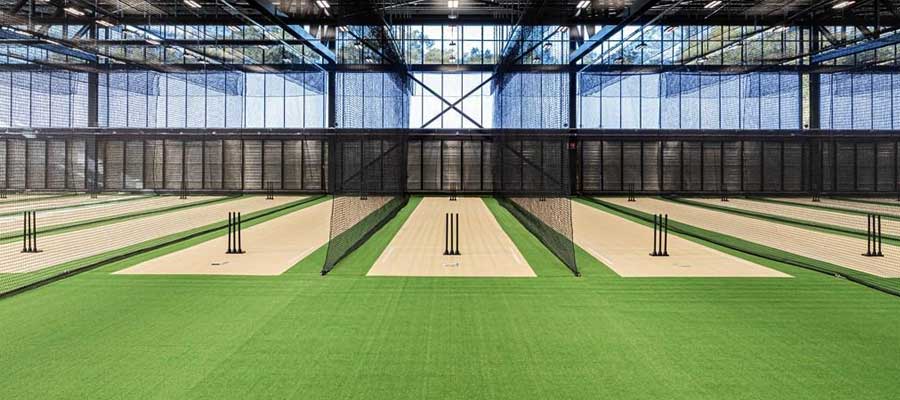
Τεχνητός χλοοτάπητας is most often used for pitches, practice lanes and indoor or box cricket courts. Full synthetic ovals are rare and mostly found at community multi-sport grounds. Professional match outfields are still natural grass.
- Cricket Pitches: Artificial pitches are widely used in schools, clubs, and community sports facilities, offering reliable all-weather playability and lower maintenance requirements than natural grass.
- Practice Lanes and Nets: Net lanes take heavy use, so a consistent, durable surface matters more than appearance.
- Box Cricket and Indoor Courts: These courts are usually built to the dimensions of the venue, so turf is typically supplied cut to size.
- Professional Outfields: Some professional grounds use hybrid pitches, which reinforce natural turf with around 5% synthetic fibers.
- Community Multi-Use Ovals: AFL and Cricket Australia have established a synthetic turf certification program for community-level football and cricket facilities. The program covers synthetic turf used for the oval outfield, rather than the central cricket pitch. Saltwater Reserve in Point Cook, Victoria, is Australia’s first full-sized, synthetic-turf multi-sport oval.
Key Parameter Comparison: Artificial Turf for Cricket Pitch vs. Outfield
| Παράμετρος | Central Pitch (Pitch / Wicket) | Outfield Area |
| Ύψος στοίβας | 8–20 mm (10–12 mm recommended for competitive play; 15–20 mm for practice facilities) | 20–40 mm (simulates closely mown natural grass while maintaining ball speed and player comfort) |
| Stitch Rate / Density | Very high density (30,000–50,000 stitches/m²; ≥40,000 stitches/m² recommended) | Medium to high density (approximately 15,000–25,000 stitches/m², with infill to help support the fibers) |
| Infill | Unfilled; some systems may include an underlying shock pad for impact absorption | Infilled (typically quartz sand combined with environmentally friendly rubber granules to stabilize the fibers and provide cushioning) |
| Yarn Material and Structure | Polyethylene (PE) or polypropylene (PP) monofilament or textured fibers, with a high yarn weight (8,000–12,000 Dtex) | UV-stabilized PE monofilament or a combination of PE monofilament and textured fibers to improve resilience and traction |
| Key Playing Performance | An exceptionally flat, low-friction surface that delivers consistent and predictable ball bounce and pace after pitching | Provides suitable shock absorption to reduce abrasion injuries when players dive, while allowing the ball to roll smoothly across the surface without obstruction |
Cricket Turf From MightyGrass
Η MightyGrass προσφέρει artificial cricket turf solutions specifically designed for cricket training grounds and cricket facilities. We can customize aspects such as pile height, density, roll dimensions (width and length), and color to help you create a cricket pitch with a more traditional aesthetic.
Whether your project involves a cricket training pitch, school cricket facilities, or a multi-sport area, please feel free to επικοινωνήστε με το MightyGrass. We are happy to provide product details, project consultation, or turf samples to help you evaluate and determine the best solution for your specific needs.
How to Calculate the Turf You Need?
To work out how much turf you need, multiply the length by the width of each turf zone, then add the zones together. Ask your supplier how much extra to allow for seams, edges and cutting waste, which depend on the roll width and the layout.
| Έργο | Calculation | Περιοχή |
| One practice lane, 30 m | 30 m × 3.6 m | 108 m² |
| Four-lane net facility, 30 m lanes | 5 × 10⁸ m² | 540 m² |
It is generally recommended to set aside an additional 5%–10% of material beyond the total area to account for seams, edge finishing, and waste from cutting. If you are unsure how much artificial grass to order, contact our team for a tailored material estimate based on your project dimensions and layout. If you need an installation guide, please visit our artificial grass installation guide page.
Download the Cricket Pitch & Field Marking Guide (PDF)
FAQ
How big is a cricket field?
There is no fixed size. A diameter of about 137–150 m (450–500 ft) is commonly cited. In international men’s cricket the boundary must be 59.43–82.29 m (65–90 yd) from the center of the pitch.
How far is the boundary in cricket?
In international men’s cricket the boundary must be 59.43–82.29 m (65–90 yd) from the center of the pitch. For international women’s cricket it is 54.86–64.01 m (60–70 yd). Local competitions set their own limits.
How long is a cricket pitch in meters and feet?
A cricket pitch is 20.12 m (66 ft, or 22 yd) long between the bowling creases and 3.05 m (10 ft) wide. It is the same at every level of adult cricket.
What is the difference between a cricket field, a ground and a pitch?
Field, ground and oval all describe the whole playing area. The pitch is only the 22-yard strip in the middle where the bowler and batter face each other.
What are the markings on a cricket field?
The main markings are the boundary, the 30-yard (27.43 m) inner circle, and the bowling, popping and return creases at each end of the pitch.
What are the areas of a cricket field called?
The field is described by fielding positions rather than named zones. Examples include slip, gully, point, cover, mid-off, mid-on, midwicket, square leg, fine leg and third man.
Is a cricket stadium bigger than a cricket field?
A stadium is the ground plus its stands and facilities, so it is larger overall. The playing field inside follows the same pitch and boundary rules.
Is there a standard size for box cricket?
We have not found a published standard size. Box cricket arenas follow the space available, you may refer to the following dimensions: typically 28–30 m (92–98 ft) long, 10.5-12 m (34-39 ft) wide, and 4-4.5 m (13-15 ft) high.
Can you use artificial turf on a cricket outfield?
Some community multi-use ovals in Australia use certified synthetic turf on the outfield. Professional match outfields remain natural grass. For example, Saltwater Reserve in Point Cook, Victoria, is described as Australia’s first full-size synthetic oval under the program, and Carlisle Park Recreation Reserve in Cranbourne opened as the City of Casey’s first synthetic football and cricket ground.