
 Suomi
Suomi  English
  العربية
  Español
  Deutsch
  Français
  Português
  Русский
  日本語
日本語  Italiano
  Nederlands
  Svenska
  ไทย
ไทย  Dansk
Dansk  Ελληνικά
  Bahasa Melayu
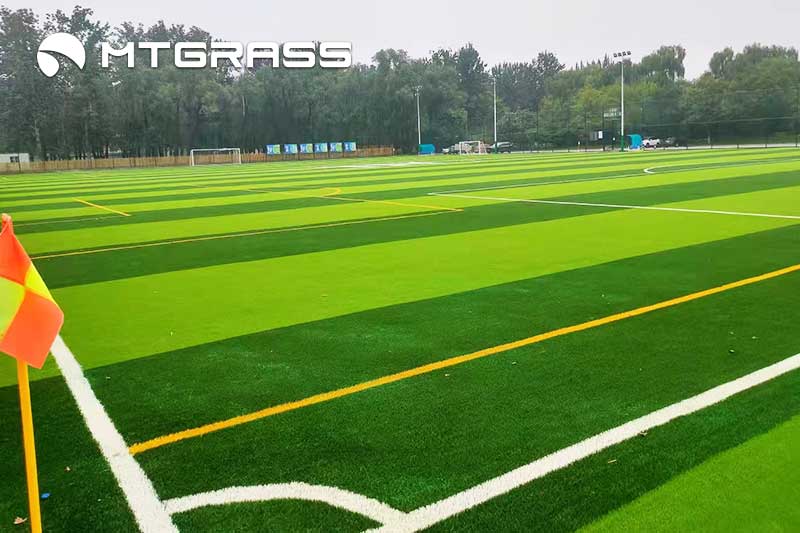
When you compare artificial grass prices in Chile, the number quoted per square meter is only the starting point. The same 40 mm artificial turf can represent very different products depending on the yarn, Dtex, stitch density, backing and production specifications.
For this reason, a useful price comparison is not simply “How much does the turf cost?” but “What product and project cost does this quotation represent?”
This guide looks at the main cost drivers behind synthetic grass in Chile and how they affect the price you ultimately pay.
What Determines Synthetic Grass Price in Chile?
The cost of artificial grass is best understood as a combination of product cost and project cost. A quotation for the turf itself is only one part of what you may eventually spend. We have briefly summarized the main factors affecting the price for your reference.
1. Turf Material and Manufacturing Specifications
The artificial grass itself is usually the biggest starting point for the price difference. PE and PP are two common polymers used in synthetic grass, but they are not interchangeable in every application. PE monofilament is widely used for high-quality landscape and urheilunurmi because it can provide a balance of softness, appearance and resilience, while PP can be used in more economical or application-specific constructions.
Then there are the specifications that are less obvious when you look at a sample: Dtex, stitch density, yarn shape and backing construction all affect manufacturing cost. For example, two synthetic grass products with the same blade height may differ in the amount of material used; a product with higher density and a higher Dtex. value typically implies greater material consumption and higher production investment.
Backing is another cost variable. Latex backing can be a practical choice for standard landscape applications, while PU-backed products may be selected where different moisture resistance, dimensional stability or performance characteristics are required.
So when you compare two prices, don’t ask only: “How many millimeters is the grass?” Ask for the yarn material, Dtex, stitch density and backing specification as well.
2. Import Costs, Freight and the USD/CLP Exchange Rate
Chile’s artificial grass market is closely connected to international supply chains, particularly Asian manufacturing.
If your synthetic grass is imported from China, the factory price is only the beginning. Your landed cost may include ocean freight, insurance, customs handling, port charges, inland transportation and local distribution.
If you are importing directly, ask whether the quotation is EXW, FOB, CIF or DDP, because different modes of transportation may result in variations in the final cost.
Furthermore, the exchange rate can also affect your budget. International suppliers commonly quote in US dollars, while your project may be budgeted in Chilean pesos. A change in the USD/CLP exchange rate can therefore change the effective cost even when the manufacturer’s USD price remains unchanged.
3. Chile’s Climate Can Change the Specification You Need
Chile’s 4,300 kilometers north-to-south geography means that artificial grass requirements can vary considerably by location. While the climate itself does not directly cause the price of turf to rise, it does influence the choice of specifications best suited to your project.
- In regions of northern Chile such as Antofagasta, Calama, and Atacama, strong solar exposure makes UV resistance an important consideration. You should pay particular attention to UV stabilization, yarn quality and long-term color stability rather than selecting the cheapest turf available.
- For projects in the vicinity of Santiago, central Chile, you may be looking for a balance between appearance, softness, UV resistance, traffic tolerance and price. For example, a residential garden does not necessarily require the same construction as a commercial landscape.
- In Valdivia and Puerto Montt in southern Chile, drainage becomes more important. The annual rainfall in these regions ranges from 1,800 to 2,400+ millimeters, you can’t avoid considering the rate at which water permeates the synthetic turf, as well as whether the underlying base can effectively drain away accumulated water.
4. Chile Artificial Grass Installation and Ground Preparation
When you compare artificial grass cost in Chile, don’t confuse the price of the turf with the cost of the finished project.
The existing surface can make a major difference. A flat, prepared surface is relatively straightforward. An existing lawn may require excavation and removal of vegetation. Uneven soil may need leveling and compaction, while poor drainage may require additional work before the turf is installed.
The shape of the area matters too. A simple rectangular garden usually requires less cutting and joining than a site with many corners, slopes or obstacles. For this reason, a quotation should clearly state whether it includes:
- Maaperän valmistelu
- Aggregate or base materials
- Drainage work
- Transportation
- Seaming and accessories
- Asennustyö
This is also why two suppliers can quote very different artificial grass installation costs in Chile even when they use a similar turf.

5. Your Synthetic Grass Application Determines the Required Product
For a residential garden, you may prioritize appearance, softness, UV resistance and everyday durability. A 25–40 mm landscape product may be sufficient depending on traffic and the look you want.
Commercial landscaping can justify higher density or stronger yarn construction because the surface may experience more frequent use.
Sports applications, football, padel and other sports surfaces require specifications such as yarn construction, Dtex, stitch density, pile height, backing, drainage and infill to be considered together.
For example, MightyGrass FIFA jalkapallonurmi products include configurations around 40/50/60 mm pile height, 10,000 Dtex and 10,500/12,600 stitches, depending on the model.
You therefore should not compare the price of a sports turf directly with a basic residential landscape product.
Rooftops and balconies can also require additional consideration because drainage, waterproofing, access and the existing surface all influence the installation system.
6. The Synthetic Turf Supplier Behind the Price
The final factor is who is selling you the artificial turf. A local retailer, importer, distributor, installer and direct manufacturer have different cost structures.
- A local installer may charge more for the material but include measurement, delivery, installation and after-sales service.
- A distributor may hold stock in Chile, which can be useful when you need smaller quantities or faster delivery, but warehousing and distribution costs are reflected in the price.
- A direct manufacturer can be more attractive for distributors, contractors and larger projects where you need consistent specifications, repeat supply or customized production. The advantage for a project buyer is not simply a lower tekonurmella tehdas price. It is having more control over the specification, consistency and supply chain behind the product.
Comparing Artificial Turf Price Quotes in Chile: A Comparison List
When you receive several quotations, put the important information side by side. This simple comparison can explain a large price difference very quickly.
| Kohde | What you should check |
| Kasan korkeus | Actual height in mm |
| Lanka | PE, PP, monofilament or other construction |
| Dtex | Yarn weight |
| Tiheys | Stitches/m² |
| Tausta | Latex, PU or other |
| UV-kestävyys | Specification or test information |
| Viemäröinti | Performance where relevant |
| Toimitus | EXW, FOB, CIF or DDP |
| Asennus | Included or excluded |
| Maaperän valmistelu | Clearly defined scope |
| Takuu | Coverage and conditions |
Artificial Grass Price Levels: What Are You Paying For?
Artificial grass quoted in Chile can fall into very different price ranges because suppliers are not always offering the same level of product. These are not fixed industry categories, but they can help you understand why price quotes for different products vary.
| Tier | Typical fiber | Face weight range | Tausta | Sopii parhaiten |
| Entry-level | PP or thin PE | Lower density, lighter gauge | Standard latex | Decorative areas, low-traffic display spaces |
| Keskiluokka | PE or PE monofilament + PP thatch | Moderate density | Reinforced latex or PU | Family gardens, patios, moderate pet use |
| Premium | Higher density, thicker Dtex | PU or ERET or Reinforced latex | High-traffic yards, heavy pet use, rooftop/commercial use |
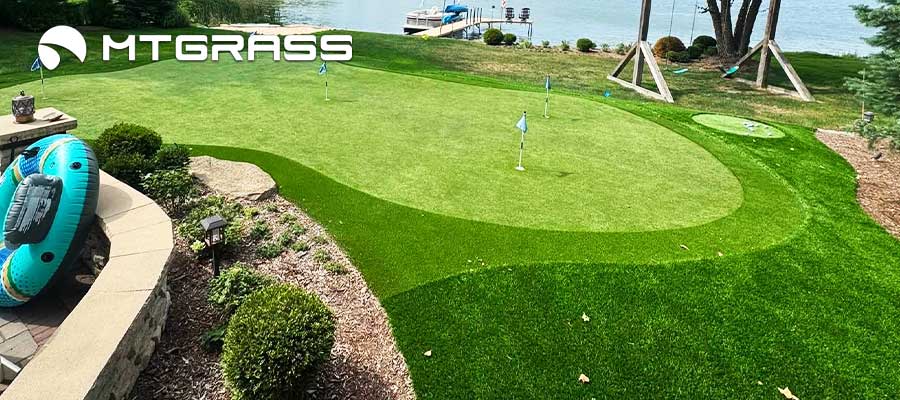
A football field, padel court or putting surface is designed around how the ball, player and surface interact. Here, the question is not whether the artificial turf is “premium,” but whether its construction is suitable for the way the surface will be played on. The surfaces therefore need to be assessed against different performance requirements, which can lead to a very different cost structure.
| Sovellus | Typical fiber structure | Täyttöjärjestelmä | Key performance spec |
| Football / futsal pitches | PE Monofilament or Ei-täytteinen tekonurmi | Sand, rubber granulate, or sand-rubber mix | Consistent ball roll, shock absorption, refer to FIFA |
| Padel courts | Monofilament or textured monofilament | Silica sand | Controlled ball bounce, low-slip surface texture |
| Mini-golf / putting surfaces | Very short, dense textured monofilament | None or minimal | Uniform, true ball roll at very low pile height |
How Can You Avoid Overpaying?
To achieve the ideal result, you should base your choice on your actual needs; there is no need to purchase the most expensive artificial turf.
- If you are comparing installation prices, make sure each contractor is quoting the same scope of ground preparation and finishing.
- And if you are comparing imported products, clarify the delivery terms and additional costs before making a decision.
- The most useful number is not simply artificial grass price per m².
- You can Ota yhteyttä immediately and let us know where the project is located, how the area will be used, how much traffic it will receive and what surface you are installing over. Subsequently, our professional sales team will provide you with the relevant technical specifications and price quotes for the artificial grass, helping you avoid unnecessary investment.
Get a Project-Based Artificial Grass Quote from MightyGrass
For Chilean distributors, contractors, developers and commercial buyers, instead of providing a generic quote for “artificial turf,” MightyGrass conducts a precise assessment and offers tailored recommendations by comprehensively considering factors such as the project location, intended use, installation area, foot traffic, and the installation environment.
MightyGrass manufacturing capabilities cover landscape and sports turf, with options including different pile heights, yarn constructions, densities, backing systems and drainage configurations. The company also provides FIFA-certified football turf for relevant sports applications.
So whether you are sourcing landscape turf for a residential development or looking for repeat supply for commercial projects, or a contractor for sports facility projects, the goal should be the same: Choose a specification that fits the project—not simply the lowest number on the quotation.
If you are planning an artificial grass project in Chile, send MightyGrass your location, application, approximate area and site conditions. Based on this detailed information, you will receive a more valuable quote, namely, an artificial grass price that will be customized to perfectly match the actual specifications and requirements of your project.
FAQ
How much does artificial grass cost per square meter in Chile?
Artificial grass prices in Chile vary widely depending on the product and application. Current retail listings range from low-cost short-pile products at around CLP 2,500–5,000 per m² to higher-specification maisemanurmi at roughly CLP 7,000–12,000 or more per m². These are product prices only; installation, base preparation, transport and other project costs can increase the final price.
What is included in the price of artificial grass in Chile?
A quoted price may refer to the turf only or to a more complete supply and installation package. Before comparing quotations, check whether the price includes the artificial grass, freight, local delivery, infill, joining materials, base preparation and installation. Chilean installation services commonly separate these components, so two quotations with the same price per square meter may not cover the same scope.
Why are artificial grass prices so different in Chile?
The main reason is that artificial grass is not a standardized product. Yarn material, Dtex, stitch density, backing, UV stabilization, drainage performance and manufacturing specifications can all affect the product cost. Import and logistics costs, order quantity and installation requirements can then create further differences between quotations.
Does thicker artificial grass always cost more in Chile?
Not necessarily. Pile height is only one part of the specification. A shorter turf with higher density, more advanced yarn construction or a different backing can cost more than a taller but simpler product. When comparing prices, look at the complete specification rather than using pile height alone as a quality or price indicator.
Is artificial grass cheaper to buy in Chile or import from China?
Importing directly from China can be more competitive for larger orders, but the factory price is not the same as the landed cost in Chile. You also need to consider freight, port and handling charges, inland transportation, exchange rates, order volume and any applicable import requirements. For smaller quantities, buying through a Chilean distributor may sometimes be more practical despite a higher product price.
Does the quantity of artificial grass affect the price per square meter?
Yes. Larger orders can generally achieve better unit economics because production, packing and international freight can be spread across a larger volume. This is particularly relevant for distributors, contractors and commercial projects. However, the actual price depends on the product specification, order volume, shipping method and delivery requirements.
How much does it cost to install artificial grass in Chile?
Installation costs vary according to the condition of the site and the work required. A simple installation on a prepared surface costs much less than a project requiring excavation, leveling, compacted aggregate, drainage or removal of existing material. Current Chilean references put complete residential projects, including material, basic preparation and installation, at roughly CLP 15,000–45,000 per m², but individual projects can fall outside this range.
Is expensive artificial grass always better?
No. The right product depends on how you plan to use it. A decorative area does not necessarily need the same density or backing as a high-traffic residential lawn, while sports turf requires a completely different performance specification. A higher-priced product only makes sense when its additional performance matches the requirements of your project.
How to actually compare quotes side by side?
A few habits make this whole process much less confusing:
- Ask for the face weight (oz/yd² or g/m²) and fiber type in writing, not just a swatch to touch.
- Confirm whether base preparation and disposal of excavated material are included or billed separately.
- Ask specifically whether the product recommended accounts for your region’s climate — UV exposure in the north, drainage in the south.
- Compare the total installed cost per square meter, not the roll price alone.
- Check what the warranty actually covers — fading, backing failure, and seam separation are the three that matter most in Chile’s climate range.


