English
  العربية
  Español
  Deutsch
  Français
  Português
  Русский
  日本語
日本語  Italiano
  Nederlands
  Svenska
  Suomi
Suomi  ไทย
ไทย  Dansk
Dansk  Ελληνικά
  Bahasa Melayu
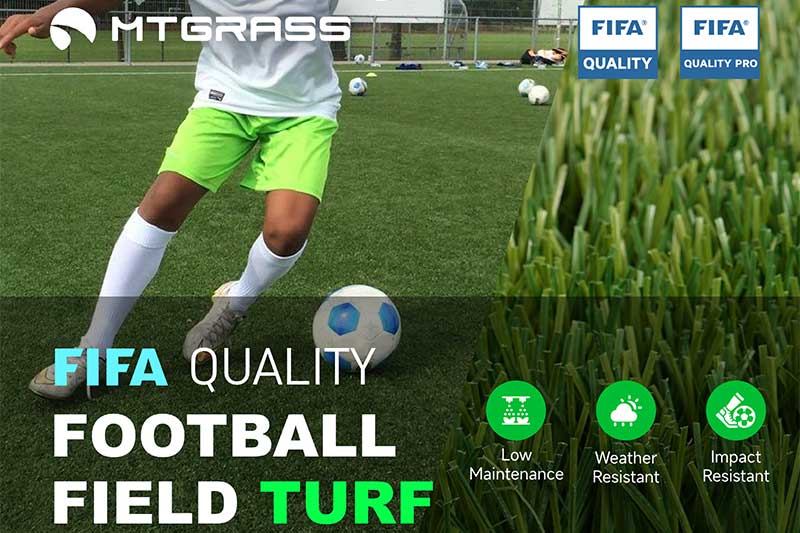
FIFA Quality Pro artificial turf must pass more than 20 professional tests (such as ball rebound, friction coefficient, durability, and safety), while ordinary soccer turf only meets basic sports or landscaping needs.
What is FIFA Certified Artificial Turf?
FIFA certified artificial turf (FIFA approved artificial turf) refers to artificial turf that has passed the FIFA Quality or FIFA Quality Pro certification system. It covers key indicators such as sports performance, safety, and durability.
This turf must pass independent laboratory testing, including:
- Ball performance tests: ball rebound, rolling distance, shock absorption
- Vertical rebound: 0.60–0.85 m (Pro)
- Rolling distance: 4–8 m (Pro)
- Deviation: must roll in a straight line
- Vertical rebound: 0.60–0.85 m (Pro)
- Turf fiber quality: wear resistance, UV resistance, weather resistance
- Lisport XL wear cycles ≥6,000 (Pro)
- Anti-UV, anti-aging, weather resistance
- High-quality polyethylene (PE) fibers, durable and weather-resistant
- Lisport XL wear cycles ≥6,000 (Pro)
- Safety standards: friction coefficient, impact resistance, ensuring reduced player injury rates
- Shock absorption: 60–70%
- Surface deformation: ≤15 mm
- Rotational torque: 30–45 N·m
- Shock absorption: 60–70%
- Drainage and lifespan: ensures stability under extreme weather conditions
- Rain-resistant, UV-resistant, usable all year round
- Rain-resistant, UV-resistant, usable all year round
Certified products will receive either the FIFA Quality or FIFA Quality Pro label. By contrast, ordinary soccer turf (non-FIFA artificial turf) is usually used in schools, training grounds, or leisure fields without strict international certification requirements.
- FIFA Quality: suitable for training fields, schools, or grassroots soccer fields.
- FIFA Quality Pro: used in the World Cup, professional leagues, and other high-level competitions with stricter standards.
Refer to the FIFA Program kvalitete trave za nogomet_Priručnik za testiranje II_uvjeti testiranja_izdanje lipanj 2024_ENG
Why Do These Indicators Matter to football builders?
- More stable match experience: ball rebound and rolling are within the defined range, closer to natural grass “foot feel and timing.”
- Reduced injury risks: shock absorption, deformation, and rotational torque are controlled, reducing knee and ankle stress as well as slipping or stud locking risks.
- Higher asset value: annual certification + field retesting keeps the venue in a “certified for play” status for the long term.
FIFA Football Turf vs Soccer Turf
| Comparison Dimension | FIFA Football Turf (FIFA Certified Turf) | Ordinary Soccer Turf |
| Standards & Certification | Passes FIFA Quality / FIFA Quality Pro rigorous tests, certificate valid for 1–3 years | No international certification, only meets basic needs |
| Sports Performance | Ball rebound: 0.60–0.85 m; ball rolling: 4–8 m; shock absorption: 60–70% | No unified range, unstable performance |
| Safety | Controls rotational torque (30–45 N·m), reducing injury risk | Friction and grip are random, prone to slipping |
| Durability | Lisport XL simulation ≥6,000 wear cycles (Pro) | No wear resistance test, short lifespan |
| Usage Scenarios | World Cup, professional leagues, national competition venues | Schools, parks, community fields |
| Investment Value | Enhances venue value, attracts professional events | Limited to recreational use, low investment value |
Tips: The artificial turf surface layer and infill must be sampled during initial inspection and compared with the manufacturer’s laboratory registered parameters. Allowable deviations (such as mass per unit area, tuft density, stitch spacing, yarn thickness/depth/width, color, Dtex, etc.) are clearly defined. For example, the non-filled turf surface infiltration rate must be ≥180 mm/h and ≥75% of laboratory results.
Contractors Purchasing FIFA Football Turf Factors
As a football field contractor, you are not only building a venue but also ensuring it meets FIFA turf standards, passes acceptance tests, and remains operational long term. Below are common pain points:
| Pain Point | Description | Solution |
| Product authenticity difficult to verify | Many turfs claim “FIFA certification” but actually have no certificate | Verify certificates in the official FIFA database; request laboratory and field test reports from suppliers |
| Parameters too complex | Professional data such as yarn Dtex, Lisport XL, and torque are difficult to understand | Work with professional suppliers who can provide simplified parameter comparison tables, highlighting which indicators affect FIFA certification and which only affect usage experience |
| Cost calculation errors | Contractors only focus on unit price, ignoring lifespan and retesting | Use Life Cycle Cost (LCC) calculations to avoid higher long-term costs |
| Construction and certification disconnect | Turf fails testing after installation, causing delays | Let suppliers participate throughout the construction process and FIFA testing support |
| Unclear certification level | Tender requires FIFA Quality Pro but mistakenly buys FIFA Quality | Suppliers should assist in interpreting tender documents and recommend the correct certification level |
Tips: Choosing the right FIFA approved artificial turf suppliers = saving time + reducing risk + increasing project value.
Why Choose MightyGrass?
At MightyGrass, we are not only FIFA approved artificial turf suppliers, but we also provide FIFA Quality Standard artificial turf to global clients. From yarn development and laboratory testing to FIFA field certification, we help clients build football fields that truly meet international standards.
If you are looking for FIFA approved artificial turf suppliers, contact us for a customized solution. We provide contractors with:
- One-on-one technical support (simplified indicators for clearer understanding)
- Complete certification process guidance (from material selection to on-site testing)
- Life-cycle solutions (save long-term costs, avoid rework)
If you are searching for FIFA certified artificial turf solutions, contact us today for customized procurement and construction support. This allows you to focus on construction delivery without worrying about certification or after-sales issues.
FAQ
Does FIFA play on artificial turf?
In the World Cup and top international events, FIFA tends to prefer natural grass or FIFA Quality Pro artificial turf. However, in some regions (such as North America), FIFA certified artificial turf is widely used in professional matches.
What are FIFA artificial turf requirements?
FIFA artificial turf must meet FIFA Turf Standards, including:
- Ball performance (bounce & roll)
- Turf safety (shock absorption)
- Durability (at least 2,000 hours of simulated sports wear testing)
- Environmental adaptability (drainage, UV resistance, temperature resistance)
What is FIFA Quality vs. FIFA Quality Pro?
- FIFA Quality: suitable for training grounds, schools, amateur competitions
- FIFA Quality Pro: suitable for professional matches and international events (such as the World Cup or continental tournaments)
How long does FIFA turf certification last?
- FIFA Quality: 3 years
- FIFA Quality Pro: 1 year, requires retesting
How can football contractors avoid procurement pitfalls?
- Verify certification: check suppliers and turf models in the official FIFA database
- Simplify parameters: request clear “contractor-friendly” indicator tables
- Calculate total costs: consider lifespan, retesting, and maintenance, not just unit price
- Certification support: ensure suppliers assist throughout the FIFA testing process
- Match requirements: choose FIFA Quality or FIFA Quality Pro depending on project needs
Who are the global FIFA certified football turf suppliers?
MightyGrass is a FIFA grass supplier with over 20 years of manufacturing FIFA football grass experience. Our turf has passed FIFA Quality certifications, serving professional football contractors and clubs worldwide.
Is the FIFA turf certification process complicated?
Not at all. MightyGrass provides one-stop certification support, from turf selection and installation to on-site testing with FIFA testing institutions, assisting contractors throughout the entire process.
Is FIFA approved artificial turf more expensive than ordinary turf?
Prices vary depending on specifications. While MightyGrass FIFA turf has a higher initial cost, its longer lifespan and lower maintenance costs make it more cost-effective in the long term.
How long does FIFA football turf last?
MightyGrass FIFA Quality Pro turf has passed Lisport XL ≥6,000 wear cycles, with a lifespan of up to 8–10 years, compared to 3–5 years for ordinary soccer turf.
Why choose MightyGrass FIFA certified artificial turf?
Because MightyGrass provides complete FIFA certification support, from product development and laboratory testing to on-site testing services, helping contractors pass FIFA acceptance in one go.