English
  العربية
  Español
  Deutsch
  Français
  Português
  Русский
  日本語
日本語  Italiano
  Nederlands
  Svenska
  Suomi
Suomi  ไทย
ไทย  Dansk
Dansk  Ελληνικά
  Bahasa Melayu
Installing football turf is a highly technical engineering process that requires precision, compliance with FIFA standards, and professional execution. In this guide, we break down the football turf installation process into five key sections:
- Construction Process
- Technical Standards
- Construction Tools List
- Acceptance Criteria
- Turf Maintenance & Care
Whether you are a football pitch contractor, a sports turf installation company, or a club owner, this guide provides a professional artificial turf football field installation manual to help you achieve a FIFA-certified playing surface.
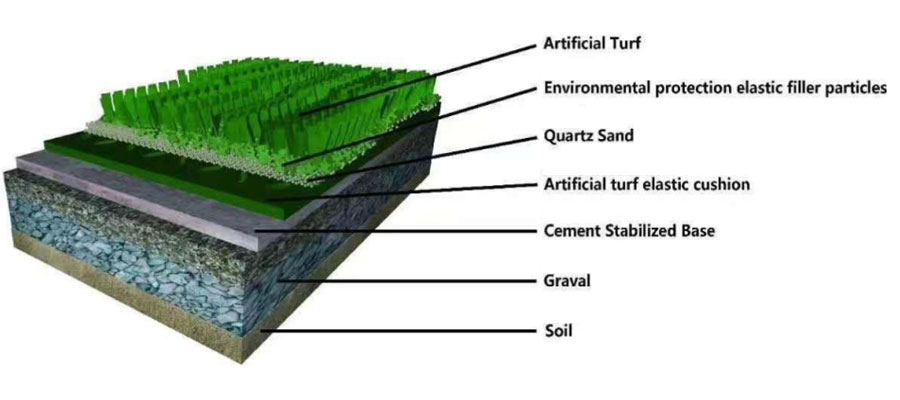
Before installing, you need to understand the Artificial Turf Football Field System – Comprehensive Proposal Illustrative Diagram of the Artificial Turf Football Field System Component.
Construction Process
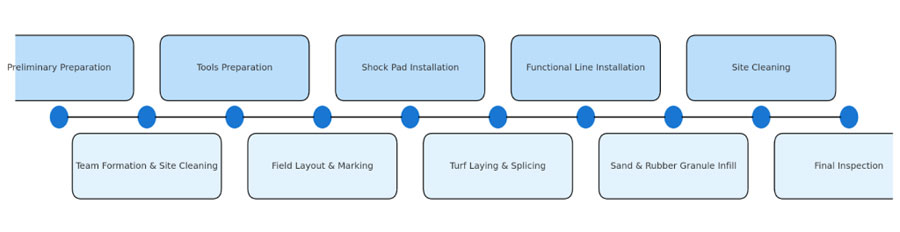
The football field turf installation follows a systematic process, each step ensuring durability, safety, and FIFA compliance.
1.1 Preliminary Preparation
- Review base foundation conditions (cement or asphalt).
- Confirm slope design: 0.4–0.8% drainage slope.
- Check curing: Concrete base (2–3 weeks), Asphalt base (24–30 days depending on temperature).
1.2 Construction Team Formation & Site Cleaning
- Typical project team: 1 project manager + 13 workers (3 skilled workers, 1 team leader, 9 laborers).
- Clear debris, dust, and ensure flatness before work begins.
1.3 Tools Preparation
Essential tools: steel tape, chalk line, knives, seam tape, adhesive spreaders, sand filling machines, grooming brushes. (See Tool List in Part 3).
1.4 Field Layout & Marking
- Measure and mark according to FIFA football pitch dimensions.
- Pre-mark functional lines: penalty box, corner area, goal area, center circle.
1.5 Shock Pad Installation
- Install rolls parallel to the baseline.
- Leave 8–10 cm unpaved margins.
- Fix seams with tape every 1.5–2.0m.
1.6 Turf Laying & Splicing
- Lay turf strips as per installation drawings, starting from the centerline.
- Ensure roll direction is consistent to avoid visual differences.
- Overlaps: 3–8 mm, seam gap ≤3mm.
1.7 Functional Line Installation
- Cut white turf strips for boundary lines.
- Use 30 cm seam tape + adhesive for secure bonding.
- Accuracy tolerance ≤2cm (per FIFA standards).
1.8 Sand & Rubber Granule Infill
- Quartz sand: 30–40 mesh, 80%+ roundness.
- Rubber granules: eco-friendly, applied in multiple layers.
- Ensure turf fibers extend 1–1.5 cm above infill.
1.9 Site Cleaning
- Remove leftover turf, adhesive residue, and impurities.
- Vacuum bonded areas before filling.
1.10 Final Inspection
- Joint seams must be tight and bonded.
- Surface evenness ≤3mm within 3m.
- Drainage passes ≥3mm/min test.
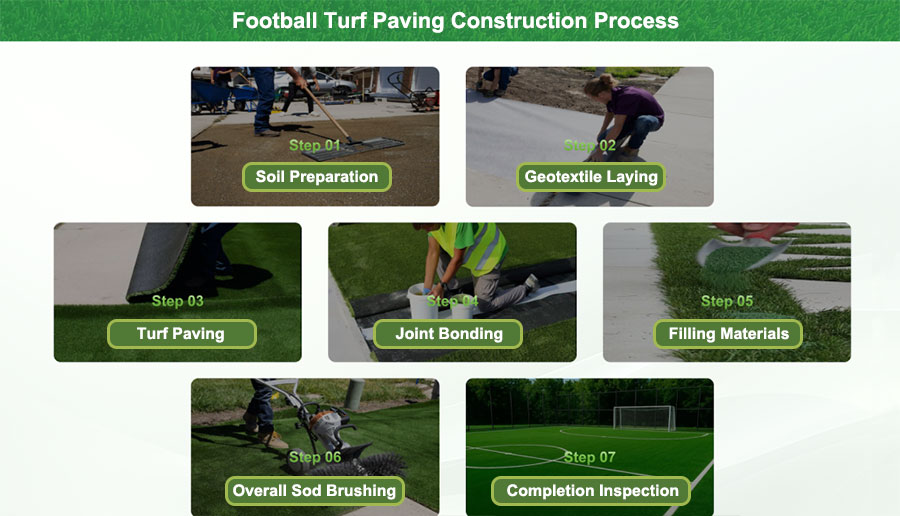
Part 2. Soccer turf installation Technical Standards
Artificial grass installation steps must follow strict FIFA requirements:
2.1 Turf Laying
- Unroll turf according to drawing sequence.
- Keep direction uniform to avoid shading.
- Trim edges to maintain ≥4m width.
2.2 Turf Splicing
- Use 20 cm wide seam tape.
- Apply adhesive evenly on seam tape & backing (not fibers).
- Press after 10–30 min airing time, when adhesive is tacky.
- Compact seams with rubber hammer.
2.3 Functional Line Installation
- Cut white turf strips per design width.
- Bond with 30 cm seam tape + adhesive.
- Ensure accuracy: tolerance ≤2 cm.
2.4 Infill Construction
- First layer: 40–60 mesh quartz sand (bottom).
- Second layer: 16–24 mesh rubber granules (top).
- Each layer applied separately, brushed, and compacted.
- Grass tips must remain visible (1–1.5 cm).
Data Reference (FIFA Quality Pro Standard)
- Ball rebound rate: 40% ±3% (1m drop = 40cm rebound).
- Rotational resistance: 25–50 Nm.
- Shock absorption: 55–70%.
Drainage Design:
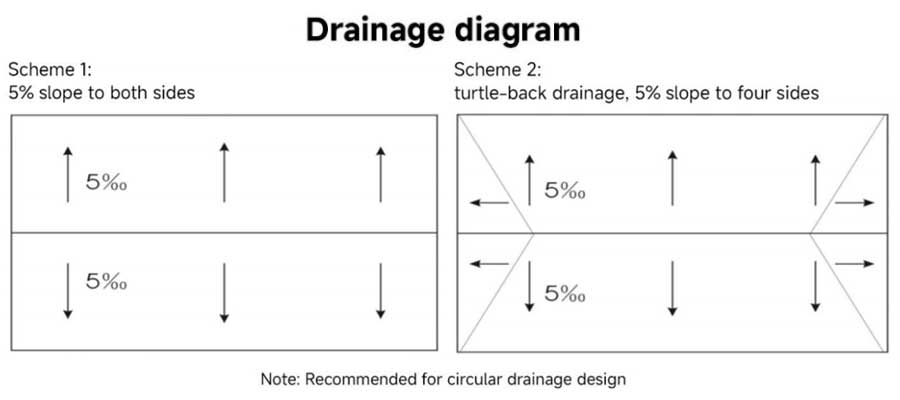
- To prevent the infill material from flowing out of the field, a height difference of 30–40mm (depending on turf fiber height) should be maintained between the field surface and the surrounding perimeter. To drain water efficiently, install a bend pipe and floor drain every 3–4 meters around the field perimeter, directing water into the perimeter drainage ditch.
(A) Cement Concrete Base
The base must have sufficient strength, stability, and flatness.
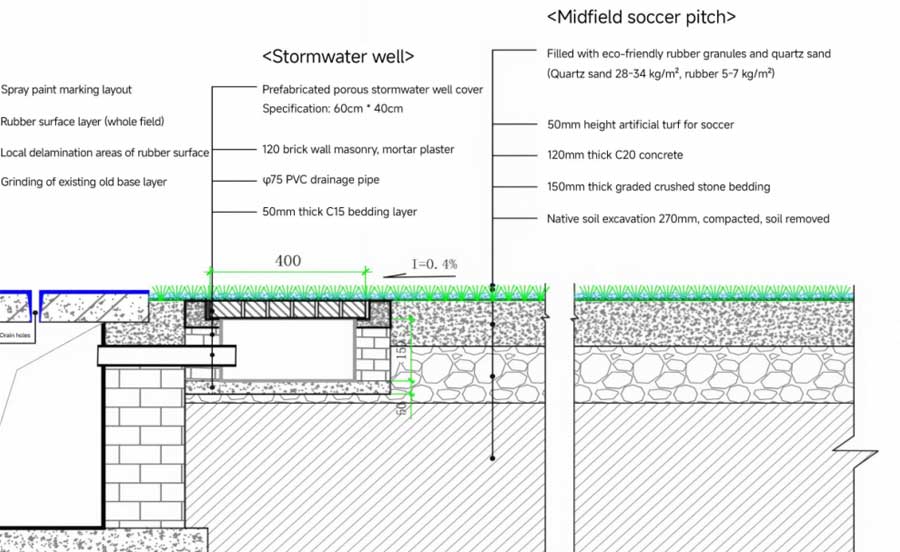
The crushed stone sub-base should be compacted, typically 150mm thick, with particle sizes ranging from 20–30mm (up to 30–60mm). The stone strength should be 600 kg/cm² with a compaction rate above 95%. The compacted density must reach 2.2 tons/m³. Water should be sprayed during compaction.
The concrete base layer is generally 120–150mm thick. The surface should be uniform, solid, free of cracks, broken edges, or honeycombs.
Joints should be straight and smooth. It is recommended to cut sections of approximately 6000mm × 5000mm. Expansion joints should be reserved with a width of about 5mm.
The curing period for the base is 2–3 weeks.
(B) Asphalt Concrete Base
High requirements are placed on surface flatness to ensure uniform thickness and elasticity of the artificial turf layer. The flatness qualification rate must exceed 90%, with a 3-meter ruler deviation of no more than 3mm. Slope requirements: transverse 6–8‰, longitudinal 3–5‰, semicircle area 3–4‰. The surface must be smooth and flat, ensuring drainage along the designed slope.
(C) Asphalt Concrete Layer:
Coarse layer: 50mm (or 60mm) thick, max aggregate size ≤35mm, compacted using rollers ≥12 tons.
Fine layer: 30mm thick, max aggregate size ≤15mm (or 5mm), compacted using rollers ≥12 tons.
Notes:
(1) Asphalt paving temperature must be above 100°C, and the setting temperature must remain above 60°C.
(2) Rollers should be cleaned with clean water only; diesel or heavy oils are strictly prohibited to avoid affecting adhesion between asphalt and the synthetic layer.
Required surface compaction ≥97%.
(3) Curing period:
If outdoor temperature >25°C: 24 days.
If 15–25°C: 30 days.
Football Turf Installation Technical Standards
| Installation Step | FIFA Standard Requirement | 3G Pitch Standard | 4G Pitch Standard |
| Turf Laying | Roll direction uniform, trim edges ≥4m width | 50–60 mm pile height, sand + rubber infill, consistent shading | Non-infill or minimal infill system, pile height 45–55 mm, recyclable turf option |
| Turf Splicing | 20 cm seam tape + adhesive, press after 10–30 min, compact with rubber hammer | Seam strength ≥30 N/cm, glued seams aligned with turf rows | Seam tape & hot-melt adhesive for eco systems, advanced seam locking technology |
| Functional Line Installation | White turf strips bonded with 30 cm seam tape + adhesive, tolerance ≤2 cm | FIFA line accuracy ±2 cm, pre-cut penalty & center lines | Laser-guided cutting, pre-integrated white yarn in some 4G systems |
| Infill Construction | Layer 1: 40–60 mesh quartz sand; Layer 2: 16–24 mesh rubber granules; grass tips visible 1–1.5 cm | Silica sand bottom + SBR rubber infill top, total infill depth 30–40 mm | Non-infill structure (ERET recyclable turf) or minimal TPE/EPDM granule layer |
| Ball Rebound | 40% ±3% (1m drop = 40cm rebound) | Meets FIFA Quality / Pro standard | Meets FIFA Quality / Pro standard, improved rebound consistency |
| Shock Absorption | 55–70% | FIFA standard 60% ±5% typical | Enhanced resilience pads give 60–68% |
| Rotational Resistance | 25–50 Nm | Within FIFA range, supports natural foot grip | Stable rotational grip with non-infill design, ≥25 Nm |
Part 3. Installation Football Turf Tools List
| Tool Name | Quantity | Purpose |
| Steel Tape (50–100m) | 1 | Measuring field layout |
| Ink Fountain & Chalk Line | 1 | Marking layout lines |
| Utility Knife + Blades | 1 per worker | Cutting turf edges |
| Seam Tape (20cm / 30cm) | As needed | Turf bonding |
| Adhesive Spreaders & Brushes | 15–20 | Applying glue |
| Rubber Hammer | 3–5 | Compacting seams |
| Sand Filling Machine | 1 | Even sand infill |
| Grooming Brush | 1 | Upright grass fibers |
| Vacuum Sweeper | 1 | Cleaning bonded areas |
| Sand & Pellet Trucks | 2 | Transport infill materials |
Part 4. Acceptance Criteria
4.1 Appearance
- Turf color uniform, no shade difference.
- Lines straight, accurate, and bright.
4.2 Infill Thickness
- Bottom: 40–60 mesh quartz sand.
- Top: 16–24 mesh rubber granules.
- Even distribution, no mixing.
4.3 Flatness & Slope
- Evenness deviation ≤3mm (within 3m).
- Drainage slope ≥0.4%.
4.4 Line Accuracy
- All markings per FIFA regulations.
- Tolerance ≤2cm.
4.5 Performance Testing
- Ball rebound: 40% (1m drop = 40cm bounce).
- Shock absorption: 55–70%.
- Rotational resistance: 25–50 Nm.
- No bulging, cracks, or delamination.
FIFA-certified fields undergo independent laboratory testing before approval.
Part 5. Turf Maintenance & Care
Daily Cleaning
- Remove debris after every match.
- Brush turf every 2 weeks.
- Redistribute infill monthly or after frequent use.
- Natural rain washes dust; manual rinsing if needed.
Stain Removal
- Juice, milk, blood → Soap water, rinse with clean water.
- Ink, sunscreen → Sponge with perchloroethylene.
- Asphalt, chewing gum → Freeze with Freon, scrape.
- Mold → 1% hydrogen peroxide solution.
Prohibited Actions
- Stud length >9mm shoes prohibited.
- No smoking, fireworks, or welding on turf.
- No motor vehicles or heavy equipment.
- No throwing events (javelin, shot put, discus).
- In snow, remove snow before play resumes.
Part 6. Construction Scale & Timeline
The construction time and installer arrangement of football grass paving depend on the football pitch size, base structure (asphalt/concrete), weather conditions, and whether it includes the FIFA certification process. The following are reference data for common football venues:
| Field Type | Standard Size (m) | Team Members (Typical) | Construction Time (Base + Turf + Infill) | Notes |
| FIFA Standard 11-a-side Pitch | 105 × 68 (7,140 m²) | ~15–20 workers (incl. 3 skilled installers, 2 machine operators, 10 laborers) | 25–35 working days (including base preparation 15–20 days, turf laying 7–10 days, infill 3–5 days) | Requires full FIFA testing & certification |
| 7-a-side Pitch | 60 × 40 (2,400 m²) | ~10–12 workers | 12–18 working days (base 7–10 days, turf & infill 5–8 days) | Popular in schools & training grounds |
| 5-a-side Pitch | 40 × 20 (800 m²) | ~6–8 workers | 7–10 working days (base 4–5 days, turf & infill 3–5 days) | Often built in community centers & commercial venues |
Key Tips :
- Number of construction teams:
- Large FIFA standard courses require more workers (15–20 people) and are equipped with dedicated machinery (road rollers, quartz sand filling machines, lawn carding machines).
- Small and medium-sized stadiums (7 football pitches, 5 soccer fields) can reduce installation and construction periods, allowing for greater flexibility.
- Construction cycle:
- FIFA-certified stadiums usually have a cycle of 25–35 days, most of which is spent on foundation layer construction and maintenance.
- The small site cycle is shortened to 7–18 days, suitable for rapid completion and commissioning.
- Customer decision-making reference:
- School & Community Project: More suitable for 5 person system/7 person system, with more controllable costs and construction periods.
- Professional Club & Large Events: FIFA standard venues are required to ensure international certification.
- Weather factors
- The construction period of football stadium installation needs to be adjusted according to the weather conditions in the region. In some areas, 8-10 days should be reserved in advance in the rainy season to avoid affecting project delivery.
Conclusion
Installing a football turf system is not just about laying artificial grass—it is a highly technical process involving base construction, shock pad installation, turf laying, splicing, line marking, infill, cleaning, and final inspection. Each step must follow strict FIFA installation standards, ensuring the pitch provides excellent ball performance, player safety, and long-term durability.
When planning a football turf project, key points to remember include:
- Proper slope and drainage design to prevent flooding and infill loss
- Professional turf bonding and line marking for accuracy within FIFA tolerance
- Correct use of quartz sand and rubber granules for consistent playability
- Strict acceptance inspection covering appearance, evenness, rebound rate, and shock absorption
- Regular maintenance to extend turf lifespan and maintain performance
Choosing the right partner is as important as the installation itself. A reliable football turf supplier can provide not only high-quality turf but also professional installation guidance and after-sales service.
At MightyGrass, we are more than just an artificial turf manufacturer—we are also a FIFA-certified installer with proven experience in 200+ FIFA football turf projects worldwide. From 5-a-side community pitches to full-size FIFA stadiums, MightyGrass delivers turnkey solutions that ensure your pitch meets international standards and provides safe, enjoyable play for years to come.
If you want your football pitch project to succeed, partner with MightyGrass—the trusted football turf supplier and installer for global sports facilities.
Football Turf Installation – FAQ
1. What are the main steps in football turf installation?
The process includes:
- Base preparation (cement/asphalt)
- Shock pad installation
- Artificial turf laying and splicing
- Functional line installation
- Quartz sand and rubber infill
- Site cleaning
- Final acceptance inspection
2. How long does it take to install a football pitch?
- FIFA 11-a-side field (105×68m): 25–35 working days
- 7-a-side field (60×40m): 12–18 working days
- 5-a-side field (40×20m): 7–10 working days Time depends on base curing, weather, and installation team size.
3. What is the typical football turf installation cost?
Costs vary depending on pitch size, base construction, and turf system:
- 5-a-side: $40,000–$70,000 USD
- 7-a-side: $100,000–$180,000 USD
- 11-a-side FIFA-certified pitch: $350,000–$500,000 USD
4. What are FIFA’s technical requirements for artificial turf football fields?
According to FIFA turf certification:
- Ball rebound: 40% ±3%
- Shock absorption: 55–70%
- Rotational resistance: 25–50 Nm
- Line accuracy: ≤2 cm tolerance
- Evenness: ≤3 mm deviation within 3m
- Drainage slope: ≥0.4%
5. What materials are used in artificial football turf installation?
- Turf fibers: PE/PP monofilament, 45–60 mm pile height
- Backing: double or triple-layer with PU/latex coating
- Shock pad: elastic foam or prefabricated pad
- Infill: quartz sand (40–60 mesh) + rubber granules (16–24 mesh)
6. What is the difference between 3G, 4G, and 5G football pitches?
- 3G Pitch: Turf + sand + rubber infill (most common today)
- 4G Pitch: Non-infill or minimal infill systems, improved safety, less maintenance
- 5G Pitch: Next-generation recyclable turf (eco-friendly, meets global sustainability policies)
7. How many workers are needed for a football turf project?
- FIFA 11-a-side: ~15–20 workers
- 7-a-side: ~10–12 workers
- 5-a-side: ~6–8 workers
8. How do you maintain an artificial football field?
- Brush turf every 2 weeks to keep fibers upright
- Redistribute infill monthly
- Remove debris after each game
- Rinse surface in hot weather to cool down
- Clean stains with mild solutions (soap water, perchloroethylene, acetone, etc.)
- Prohibit stud length >9mm, smoking, welding, or vehicle entry
9. Why choose MightyGrass for football turf installation?
- FIFA-certified manufacturer & installer
- 200+ FIFA-certified football fields installed worldwide
- 20+ years of production and installation experience
- Patented non-infill 4G turf and eco-friendly 5G recyclable turf solutions
- One-stop service: design, production, installation, and maintenance