コンテンツを編集

フットボールフィールド寸法設計ガイド2026

Macyの写真

メイシー

執筆者

フットボール場

Football fields are a familiar sports field in our daily lives. Whether for professional competition or as a hobby, they carry the dreams and passions of countless people. In this article, I’ll take a closer look at soccer field dimensions, including standard sizes and the differences between different types of fields. This will not only help us better understand football field design specifications but also provide greater flexibility in practical application.

First, we will introduce football field standards to ensure fair and safe competition. Football, one of the most popular sports worldwide, has strict standards for field dimensions. This article will detail the standard dimensions for 11-a-side football fields, as well as 5-a-side, 7-a-side, and 9-a-side football fields, beach football fields, and cage football fields, providing a comprehensive understanding of field layout and design.

Common Standard Football Field Sizes

The soccer field must be a flat rectangular shape with the sidelines longer than the goal line. While the rules apply, the actual field dimensions may be adjusted slightly to accommodate different environments and training and match requirements. Are you wondering now how long is a football field and how wide is a football field?

5 a side football pitch

5-a-Side Football Pitch Dimensions

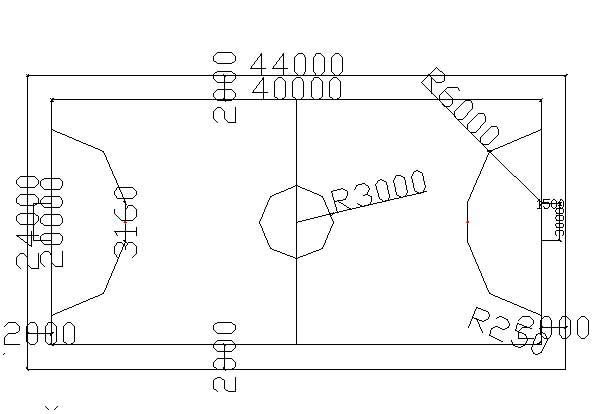
Futsal fields are typically 25 to 42 m long and 15 to 25 m wide. All boundary markings (including the touchlines, goal line, center circle, penalty area line, corner arc, and substitution area) are 8 cm wide white turf lines.

  • The radius of the center circle of the teeing area is 3m.
  • The penalty area is defined by an arc extending across the field:
    • For fields between 15 and 20 m wide, the arc has a radius of 5 m.
    • For fields between 20 and 25 m wide, the radius increases to 6 m.
  • Each corner arc has a radius of 0.25 m , ensuring a clear reference for corner kicks.

This compact field layout fosters a fast-paced atmosphere that emphasizes tight ball possession, quick decision-making, and teamwork. MightyGrass ノンフィル人工芝 system is ideal for community competitions and training on futsal fields.

7 a side football pitch

7-a-Side Football Pitch Dimensions

A 7-a-side football pitch typically measures 50 to 65 m in length and 35 to 45 m in width, covering an overall area between 1,750 and 2,900 square meters. The entire field is marked with white turf lines 10 cm wide, ensuring clear visibility and consistent play boundaries.

  • The center circle has a radius of 7.32 m, used for kick-offs and restart positioning.
  • Each corner arc is drawn with a 1-meter radius, marking the area for corner kicks.
  • The penalty spot is placed 9.15 m from the goal line, while the penalty area (large box) extends 32 m in length and 12.82 m in width. Inside it, the goal area (small box) measures 16.5 m long and 4.5 m wide, providing structure for goalkeeping play and defensive positioning.

With moderate field size and well-defined zones, 7-a-side football offers the perfect balance between space and speed. You can install MightyGrass’s MT-ダイヤモンド そして MT-ステムXL durable artificial turf systems for youth training, community leagues, and semi-professional competitions.

9-a-Side Football Pitch Dimensions

A 9-a-side football pitch generally measures 70 to 80 m in length and 45 to 55 m in width, offering a more spacious layout that bridges the gap between small-sided formats and full-size 11-a-side fields. All boundary markings are applied using white turf lines 10 cm or 12 cm.

  • The center circle features a radius of 7.5 m, maintaining standard proportions for kick-offs.
  • Each corner arc has a 1m radius, clearly defining corner kick positions.
  • The penalty spot is 9.15 m from the goal line. The penalty area (large box) typically measures 32 m long and 13 m wide, while the goal area (small box) extends 16.5 m in length and 5 m in width, ensuring consistent gameplay dynamics and goalkeeping zones across the pitch.

This format combines the tactical complexity of full-field football with the faster rhythm of small-sided games. Use MightyGrass high-performance MT-HTUベスト そして MT-HTマキシ artificial turf systems in your school, training center, and amateur club.

11 a side football pitch

11-a-Side Football Pitch Dimensions

A standard 11-a-side football field length 90 to 120 m in length and 45 to 90 m in width, with international matches commonly played on pitches sized 105 × 68 m. All field markings are made with white turf lines 12 cm wide.

  • The center circle has a radius of 9.15 m, while each corner arc measures 1 meter in radius. The penalty spot is positioned 11 m from the goal line.
  • The penalty area (large box) extends 40.32 m in length and 16.5 m in width, and the goal area (small box) measures 18.32 m long and 5.5 m wide.
  • A 2 m safety buffer on each side, the total green turf area equals the field’s actual length and width plus the buffer zone, ensuring safe play and sufficient runoff space.

This full-size configuration is primarily used in professional soccer training fields. You can choose the FIFA-MT-ダイヤモンド-50 そして フィファMT-ubest 50 artificial turf systems from FIFA公認の芝メーカー for professional stadiums, training bases, and FIFA-certified facilities.

タイプLength (m)Width (m)Field Area (m²)Suitable Scenarios
5-a-サイド25–4216–25400–1,000Schools, communities, youth training
7-a-サイド50–6535–451,750–2,900Youth matches, corporate leagues
9-a-side70–8045–553,150–4,400Semi-professional training
11-a-side (FIFA Standard)90–12045-904050–10800Professional and international competitions

FIFA Regulation Football Field Dimensions

項目International Matches (FIFA)Domestic / Amateur Matches
長さ100–110 m (recommended 105 m)90–120 m
64–75 m (recommended 68 m)45–90 m
Field Area≈7,140 m²4,000–10,800 m²
Centre Circle Radius9.15 m9.15 m
Goal Area5.5 × 18.32 mSame as above
Penalty Area16.5 × 40.32 mSame as above
Penalty Mark11 m from the goal lineSame as above
Penalty Arc Radius9.15 mSame as above
Goal Width7.32 m (24 ft)Same as above
Goal Height2.44 m (8 ft)Same as above

Football Field With Measurements

football field how many acres

Football Field Measurement Principles

  1. Unit of Measurement
    • Meter (m) is adopted internationally as the unit of measurement;
    • In the United States, the United Kingdom and other countries, feet (ft) or yards (yard) are also commonly used;
      • 1 yard = 0.9144 m
      • 1 m ≈ 1.094 yard
  2. Measurement standrand
    • All dimensional measurements are calculated from the outside edge of the white line (ie: outside edge to outside edge of the court markings).
    • MightyGrass expert advice: This is very critical when laying turf and shock pads to avoid errors caused by calculating the inner edge.
  3. Measurement tools
    • Tape measure or distance meter (Laser Distance Meter)
    • Measuring positioning stakes (used to determine the position of the goal area, penalty area, and center circle)
    • Theodolite (used to ensure right angles and symmetry)
    • Rope marking line (used for drawing circles and positioning arcs)

How to measure a football field?

  • Determine the centerline: Use a theodolite or a crosshair to locate the center of the field and draw a center circle (9.15m radius).
  • Determine the goal lines and sidelines: Determine the length of the field longitudinally from the center and draw the touch line and goal line on either side.
  • Locate the goal and penalty area: Measure 5.5m from the inside of the goal line – draw the goal area. Measure 16.5m from the inside edge of the goal line → draw the penalty area.
  • Draw the penalty spot and arc: The penalty spot is 11m from the goal line. Draw a penalty arc with a radius of 9.15m, centered on the penalty spot.
  • Draw the corner arc and center line: Draw a 1m radius corner arc at each corner and a center line in the middle of the field with its center point marked.

Special Football Field Area Calculation

On artificial turf soccer fields, “special areas” generally refer to areas of the field that are made up of turf of other colors (usually white or yellow) in addition to the primary green grass. These areas include: sidelines, goal lines, center line, center circle, penalty box lines, penalty marks, corner arcs, and other areas such as substitution areas, coaching areas, and marking lines.

Although these special areas account for a very small proportion of the total field area (Generally < 3%), their length and quantity must be calculated separately during production, cutting, and laying to ensure that the appropriate turf quantity is provided during prefabrication at the factory.

Using the example of white grass, to calculate its area: Actual length of the white grass [(Width of small penalty area × 2 + Length of small penalty area + Width of large penalty area × 2 + Length of large penalty area × 2 + 3.14 × Diameter of center circle × 2 (Center circle + Circumference of two free throw arcs) + Total length × 2 + Total width × 3 + 2 × 1 × 3.14 (4 corner kicks)] × Width of white grass line * 1.2

無料見積もり

Football Pitch Architectural Design

Football field size design is more than just drawing boundaries; it integrates a wide range of disciplines, including architecture, civil engineering, drainage planning, and turf system design. A professionally designed football field ensures optimal performance, durability, and efficient maintenance.

  • Field Planning and Orientation: The first step in football field design is field selection and preparation. FIFA recommends a north-south orientation to minimize direct sunlight during play. The field should also have a uniform slope (0.5-1%) that facilitates surface drainage.
  • Subbase and Drainage System: The subbase typically consists of compacted gravel, geotextile, and leveled sand. Horizontal and vertical drainage channels are installed beneath the turf, with a drainage rate of at least 150 mm/hour for football field FIFA.
  • Shock Pad and Turf System Design: The artificial turf system is a visible green surface with ショックパッド installed underneath to absorb impact during play and provide player safety against maximum g-forces and vertical deformation. Artificial turf varies depending on the level of competition (5-a-side, 7-a-side, or 11-a-side). During installation, hot melt adhesive or joint tape is used to ensure consistent surface finish. After installation, you can fill the artificial grass with silica sand and rubber granules.
  • Boundary Marking and Layout: Mark the boundaries of your artificial turf field based on your specific pitch. For pitches between 400–1,000 m2, follow a standard 5-a-side pitch layout; for pitches between 1,750–3,000 m2, follow a 7-a-side pitch layout; for pitches larger than 4,000 m2, refer to the 11-a-side pitch layout standard.
  • Lighting, Fencing, and Auxiliary Facilities: A complete pitch design includes supporting infrastructure such as an LED lighting system (training fields require 200–500 lux), fencing, and netting (4–6 meters high).
high school football field dimension

Factors Influencing Football Pitch Size Planning

Football field yards area planning can be a complex decision-making process influenced by a variety of external factors. Geographical location is a primary consideration. In urban centers, due to limited field resources, designers often opt for mini-fields or five-a-side pitches to maximize limited space. In suburban or rural areas, on the other hand, with ample land, standard-sized 11-a-side pitches can be planned, and even multiple training or competition areas can be reserved to accommodate the sports needs of a wider audience. Climate also significantly influences area planning. In cold, tropical, or rainy regions, designs often require indoor or semi-enclosed pitches to ensure year-round use, with space for ventilation, lighting, and air conditioning systems. Budget and community needs directly determine the scale and purpose of the project. If the budget is sufficient and the community has a strong interest in football, building a standardized field can enhance its value and social impact. Conversely, if the budget is limited or the community prefers multi-functional sports facilities, a smaller field or a flexible layout can maximize resource utilization. Scientific and rational football field area planning should strike a balance between spatial conditions, climate adaptability, economic investment, and user needs to create a practical and sustainable sports space.

Football Field Design Considerations

Soccer Field Budgeting

Budget planning is the foundation of every soccer field design. The total cost depends on field size, subgrade construction, turf type, drainage, and lighting systems. Artificial turf offers long-term cost benefits; while the initial investment may be higher, maintenance and water costs are significantly lower than natural grass.

Soccer Field Size

Choosing the appropriate field size depends on the intended use, such as daily training, school, or professional competition. FIFA sets precise standards for 11-a-side football fields, while smaller 5-a-side, 7-a-side, and 9-a-side fields are adapted to accommodate youth or recreational fields.

Soccer Field Turf

The turf system is central to field performance. During the planning process, it is important to consider how the artificial turf structure (including yarn type, infill, and cushioning) affects play, drainage, and comfort. When calculating the turf area, include the overall field dimensions as well as any additional margins for mowing and joining to ensure an accurate estimate of the total turf coverage.

Goalposts and Fences

Goals and fences are crucial for both play and safety. Goal sizes vary depending on the format of the game, while surrounding fencing protects spectators and prevents balls from flying off the field. For artificial turf fields, the fencing foundation must be consistent with the foundation design to maintain structural stability.

Lighting Design

A professional lighting system ensures consistent visibility during evening matches and televised events. Designers must strike a balance between brightness, uniformity, and energy efficiency while also preventing glare. For training or school fields, LED lighting is a cost-effective and environmentally friendly solution.

Spectator Facilities

Seating, aisles, restrooms, and shelters enhance the user experience and determine the field’s capacity. The layout should ensure smooth traffic flow, easy maintenance, and comply with local building codes.

Ventilation System

For indoor or semi-enclosed football fields, air circulation is crucial to maintaining player comfort and preventing moisture accumulation. Designers should plan for adequate ventilation or mechanical airflow systems.

Acoustic Design

The use of sound-absorbing materials (such as soundproof panels and soundproof wall structures) can reduce the generation of noise and echoes that affect communication within the venue. This reduces disruption for players and spectators in multi-purpose stadiums or community centers.

Safety Measures

Safety design encompasses player protection and facility management. Field perimeter matting, non-slip surfaces, fire exits, and emergency lighting must all meet safety standards. You can choose マイティグラス football turf, which is certified to FIFA standards for non-toxic and heavy metal-free materials, to ensure long-term environmental safety for your football field.

サッカー場芝

Design Considerations: 4 Overlooked Details

The Impact of Turf Height and Area

Top-level turf maintenance requirements (grass height of 3-4 cm) require an additional 5-8 meter buffer zone, which means the actual usable playing area is 3-5% less than the theoretical value. A Premier League 2024 study showed that for every 1% increase in turf maintenance costs, field utilization decreased by 0.7%.

Edge Restraint and Turf Fixing System

The boundary area between the turf and surrounding structures often receives little attention. Without a secure edge restraint, the turf edge can warp or wrinkle over time, especially in areas with frequent temperature fluctuations.

Drain Positioning

Designers often focus on the primary drainage layer, overlooking the importance of aligning drain outlet orientation with slope. If drain outlets are improperly positioned, water can accumulate in corners or near sidelines, causing turf deformation and base instability.

Joint Alignment

Artificial turf seams may appear minor, but their alignment with player movement and light direction can impact both aesthetics and safety. Misaligned seams can result in an uneven surface and create different visual effects under lighting.

MightyGrass Professional Advice: In every football field design, meticulous attention to detail determines the long-term value of your investment. With our FIFA公認の芝 and expert design and planning team, we provide the right artificial turf selection and technical guidance on layout, base construction, and edging, helping you create professional results from the ground up.

無料見積もり

よくある質問

How much artificial turf do I need to build a football pitch?

The total turf area depends on your field type, we use familiar football field as an example:

  • 5-a-side: 25–42 m (L) × 15–25 m (W) → around 400–1,000 m²
  • 7-a-side: 50–65 m × 35–45 m → around 1,750–2,900 m²
  • 11-a-side (FIFA standard): 105 m × 68 m → 7,140 m²

Always add at least 2 meters of buffer zone around the field. For a football field dimensions FIFA, ease of cutting and seaming you may need 7,500–8,500 m² of artificial turf in total.

How to calculate the total turf area for installation?

Using a rectangular football field as an example, to estimate the total turf required:

Area of ​​Green Grass: Measure the full field dimensions (length × width), multiply to get total turf area (m²). Include waste allowance (3–5%) for cutting and seam alignment.

Area of White Grass: Actual length of the white lines [(Width of small penalty area × 2 + Length of small penalty area + Width of large penalty area × 2 + Length of large penalty area × 2 + 3.14 × Diameter of center circle × 2 (Center circle + Circumference of two free throw arcs) + Total length × 2 + Total width × 3 + 2 × 1 × 3.14 (4 corner kicks)] × Width of white grass line * 1.2

The MightyGrass team will allocate an additional 3-5% of white and green grass to your field’s actual area to account for artificial grass waste from cutting or seaming.

FIFA Standard Football Pitch Example (105 m × 68 m field): You need to prepare a 2-meter buffer zone on all sides, which means the length and width should be 109 x 72 meters. Multiply this by 5% to get: 109 × 72 × 1.05 ≈ 8,240 m²

How much does it cost to build a football pitch?

The total cost depends on your pitch size, turf type, and base structure:

フィールドタイプTurf Area (m²)Estimated Turf Cost (USD)Total Project Cost (USD)*
5-a-サイド~800$6,000–$10,000$15,000–$30,000
7-a-サイド~2,500$15,000–$25,000$40,000–$70,000
11-a-side~7,500$45,000–$80,000$120,000–$250,000

*Including base construction, shock pad, infill, and installation labor.

Which artificial turf is best for football fields?

For football pitches, MightyGrass recommends:

  • 3G/4G Sports Turf Systems: with infill or non-infill options
  • Monofilament PE yarns: soft yet resilient for intensive play
  • Shock pad underlay: to reduce impact and improve safety
  • UV-resistant and FIFA-certified models: for long-term outdoor durability

プロのヒント: Choose turf with ≥50mm pile height and triple backing reinforcement for professional football fields.

Where can I download football field CAD drawings?

You can access standard football field CAD layouts (5-a-side, 7-a-side, and 11-a-side) directly from:

  • FIFA official website – for standard pitch markings and dimensions
  • AutoCAD community libraries – for reference templates
  • Contact Mighty Grass engineers for customized CAD drawings tailored to your turf dimensions and drainage system.

Where can I buy football turf, shock pads, and installation materials?

You can purchase all football turf materials directly from MightyGrass, including:

  • Artificial football turf (FIFA Quality & Quality Pro certified)
  • Shock pads and drainage base systems
  • Infill materials and joint adhesives
  • Edge restraint and accessories

MightyGrass offers global shipping and local support, supplying you with high-quality artificial grass from our two artificial grass factories in China and Saudi Arabia, as well as our warehouse in California, USA.

What are the standard high school football field dimensions?

A standard high school football field typically measures between 90 to 100 meters (295–328 ft) in length and 55 to 65 meters (180–213 ft) in width, giving a total playing area of around 5,000–6,500 square meters.

For safety and maintenance, schools should also include a 1.5–2 meter buffer zone around the playing area, bringing the total artificial turf installation area to roughly 6,000–7,000 m².

著者について

こんにちは、メイシーです。

私は人工芝業界で10年以上の経験があり、デジタル・マーケティング戦略を専門としてきました。過去10年以上にわたり、メーカー、施工業者、販売業者、野球クラブ、学校、商業スポーツ施設と密接に協力し、人工芝システムが実際の用途でどのように機能するかについて実践的な見識を深めてきました。

私は、野球の芝生システム、バッティングケージの芝生、スポーツトレーニングのサーフェス、商業施設の床材など、さまざまな人工芝の用途について、耐久性、使いやすさ、投資対効果に重点を置いて綿密な調査を行ってきました。

バッティングケージの芝生、野球のトレーニング用サーフェス、人工芝システム全般に関するご質問は、お気軽にお問い合わせください:Eメール お問い合わせ

Macyの写真

メイシー

執筆者

投稿タグ:

最近の投稿

世界中に配送

信頼できる人工芝メーカー&サプライヤーをお探しですか?FIFAフィールドから景観プロジェクトまで、 MTグラス は、信頼できる品質と競争力のある価格を一箇所で提供します。

関連している 記事

大草アイコン

にしておこう。 マイティグラス ビジネスをサポート