日本語
日本語  English
  العربية
  Español
  Deutsch
  Français
  Português
  Русский
  Italiano
  Nederlands
  Svenska
  Suomi
Suomi  ไทย
ไทย  Dansk
Dansk  Ελληνικά
  Bahasa Melayu

真剣に野球に取り組む選手にとって、バッティングケージこそが真の成長が生まれる場所です。自宅の庭にあるバッティングケージで練習する場合でも、クラブや屋内施設にあるプロ仕様のバッティングケージで練習する場合でも、熱心な選手の多くは週に5~10時間をバッティングケージで過ごし、スイング、タイミング、安定性を磨き上げています。 選手の視点から見れば、バッティングケージの良し悪しは、その床面次第です。バッティングケージの人工芝は、ネットやフレームよりもはるかに大きな影響を、足元の安定性、ボールの跳ね方、耐久性、そして長期的なトレーニングの質に及ぼします。 だからこそ、選手が販売中のバッティングケージを探す際、最も重要な決定事項である「適切なバッティングケージ用人工芝の選択」が見過ごされがちです。この購入ガイドでは、実際の使用において真に重要な点に焦点を当て、選手、クラブ、施設所有者が、長期にわたり安定した性能を発揮するバッティングケージと人工芝システムを選定できるよう支援します。
バッティングケージとは何ですか?
数十種類にも及ぶバッティングケージ用人工芝の中から選ぶ前に、ひとまず一歩引いて、野球のトレーニングという観点から、バッティングケージとは一体何なのかを明確に理解しておくことが役立ちます。
バッティングケージは、反復練習を行うために設計された管理された環境です。その目的は、打者がボールを追いかけることや周囲のスペースを傷つけることを気にすることなく、ピッチングマシンや生きた投手からの投球を何度も繰り返し打てるようにすることです。
バッティングケージとは、どのようなものですか?
バッティングケージとは、以下の目的のために設計された野球専用の練習エリアです:
- 反復打撃練習
- 投球の精度向上トレーニング
- 制御されたボールの戻りとリバウンド
通常、以下の要素で構成されています:
- バッティングケージのネット
- 固定式または可搬式のフレーム
- 野球のピッチングマシン、または実投練習場
- そして、厳選された野球用人工芝の表面
バッティングケージには次のようなものがあります:
- トレーニングセンターや倉庫内にある屋内バッティングケージ
- コンクリート、アスファルト、または締固められた土台の上に設置された屋外バッティングケージ
- 季節ごとに設置場所を変更できるポータブルバッティングケージ

バッティングケージの人工芝が、多くの人が考えている以上に重要な理由
バッティングケージの中:
- ボールは高速で何度も地面にぶつかる
- 打者は長い時間、同じ場所に立ち続ける
- 摩耗がごく狭い範囲に集中する
つまり、バッティングケージの人工芝は、次のようなものとは大きく異なる必要があるということです:
- ランドスケープグラス
- ジムの人工芝
- あるいはゴルフ場の芝生でさえも
表面はバランスが取れていなければなりません:
- 耐久性
- ボールコントロール
- 牽引力
- そして長期的な一貫性
だからこそ、プロ仕様の設備のほとんどは、バッティングケージと 野球用人工芝 汎用の人工芝ではなく、打撃練習やトレーニング用に特別に設計されています。
バッティングケージが最も人気のある場所
バッティングケージは、以下の場所で広く利用されています:
- 北米(米国およびカナダ)
- 日本(バッティングケージ文化が特に根強い)
- 韓国
- ラテンアメリカの一部
例えば日本では、屋内バッティングケージは単なる練習施設にとどまらず、日常的な野球文化の一部となっており、多くの場合、自動投球機とコンパクトなレイアウトが組み合わされています。
バッティングケージの一般的なサイズとレイアウト
デザインは様々ですが、ほとんどの野球用バッティングケージは、次のような比率になっています:
- 幅:3.8~4.5メートル
- 長さ:20~30メートル
- 面積:1ケージあたり90~150 m²
レイアウトには、次のようなものがあります:
- 単一の直線型ケージ
- 複数の並列ケージ
- あるいは、投球ゾーンと打撃ゾーンを組み合わせたモジュール式レイアウト

一般的なバッティングケージの種類(人工芝)
実用的な観点から言えば、バッティングケージはその用途によって分類することができ、人工芝の仕様も通常はその分類に従っています。
屋内の商業用バッティングケージは、最も利用頻度が高い傾向にあります。こうした施設では一日中営業が行われ、選手たちが絶え間なく入れ替わります。このような環境下では、人工芝は踏み固められにくく、グリップ力を維持し、何千回ものスイングを経ても性能が安定している必要があります。
Outdoor fixed batting cages are often installed on concrete or asphalt bases. Here, turf must also deal with temperature changes and, in some climates, UV exposure. Durability becomes just as important as performance.
Portable batting cages are different again. They are often seasonal, sometimes temporary, and the turf used here tends to favor flexibility and ease of installation, while still needing to behave like real baseball turf.
Across these applications, there are two main batting cage turf system approaches:
クッション材なしのバッティングケージ用人工芝
Installed directly over a hard base, offers a firmer feel and faster ball roll. It is commonly chosen for lighter use or budget-conscious setups.
- Installed directly on concrete or firm subfloor
- Faster ball roll
- 初期コストが低い
- Best for light to moderate use
クッション付きバッティングケージ用人工芝システム
Which include an integrated shock pad, are increasingly standard in professional and commercial facilities. A common example is 5mm padded indoor turf, which balances firmness with impact absorption. This configuration reduces stress on joints, improves comfort during long sessions, and extends turf lifespan under heavy use.
- Turf + integrated shock pad
- Reduced joint impact
- 芝の寿命が長い
- Better comfort for high-frequency training
5mm パッド入り屋内用人工芝
- Designed specifically for indoor batting cages
- Balances firmness and shock absorption
- Ideal for commercial facilities and serious training environments

クイックセレクション・バッティングケージ(購入者向け)
| アプリケーション・シナリオ | Recommended Batting Cage Turf |
| Commercial Training Facilities | 5mm パッド入り屋内用人工芝 |
| Professional Teams / Universities | Padded Batting Cage Turf |
| Schools / Community Fields | Non-Padded or Lightly Padded Turf |
| Backyard Batting Cages | Roll-Out Non-Padded Turf |
| Temporary / Seasonal Use | Lightweight Non-Padded Turf |
Mighty Grass Expert tips :Different batting cage applications require different turf systems. High-frequency indoor facilities benefit most from padded batting cage turf, while backyard and portable cages prioritize flexibility and cost efficiency.
適切なバッティングケージ用人工芝の選び方とは?
Choosing batting cage turf requires a different mindset than choosing ジムの人工芝 または ゴルフ・ターフ. Baseball places very specific demands on the surface, and ignoring those differences usually leads to regret later.
The right batting cage turf is defined by space, usage frequency, player level, installation method, and supplier capability. Matching turf specifications to real training conditions ensures consistent performance, longer lifespan, and lower long-term cost.
バッティングケージのエリアとレイアウトの決定
The first step is understanding your space. Is the cage permanent or portable? Indoor or outdoor? Single-lane or multiple cages side by side?
A backyard batting cage might only require 60–100 square meters, while commercial setups commonly exceed 100–150 square meters per cage. These dimensions directly affect turf roll widths, seam placement, and whether padding is advisable.
使用頻度とプレイヤーのレベル
Usage matters more than almost anything else. A cage used a few hours per week by beginners can tolerate a simpler turf. A cage used daily by advanced players cannot.
Higher frequency means higher density, stronger backing, and better fiber resilience. Professional or commercial environments almost always justify heavier batting cage turf with padding.
設置方法:業者依頼またはDIY
Installation decisions influence turf choice. Professional installations allow for padded systems, cleaner seams, and longer lifespan. DIY installations tend to favor roll-out turf without shock pads and are better suited for backyard batting cages.
| インストール | 芝生の種類 | ショックパッド | ベストユース |
| プロフェッショナル | Heavy-duty batting cage turf | はい | Commercial facilities |
| 手作り | Roll-out batting cage turf | いいえ | Backyard cages |
メーカー対小売業者
This is where working with a baseball turf manufacturer makes a real difference. A factory can adjust turf density, size, color, or even add logos based on the actual batting cage layout. It also means clearer warranties, professional installation guidance, and long-term maintenance advice — things that are often missing from retail-only products.
バッティングケージ用人工芝の選び方ガイド
| Decision Factor | Light Use / Backyard | Club / School | Commercial / Professional |
| Area Size | 60–100 m² | 80–130 m² | 100–150 m² per cage |
| Layout | Single / Portable | Fixed or Semi-fixed | Fixed, Multiple Lanes |
| 使用頻度 | 低い | 中くらい | High (Daily) |
| Player Level | Beginners | Intermediate | Advanced / Professional |
| 芝の密度 | 中くらい | ミディアム-ハイ | 高い |
| ショックパッド | 不要 | オプション | おすすめ |
| インストール | 手作り | Professional preferred | Professional required |
| サプライヤー・タイプ | Retailer or Factory | Factory preferred | Factory direct |
購入者向けの重要なポイント
The best batting cage artificial turf is not the most expensive one—it is the one that matches your space, training intensity, and long-term goals. By clearly defining layout, usage frequency, player level, installation method, and supplier type, you can select a batting cage turf system that performs consistently and lasts for years.
バッティングケージの人工芝と天然芝の違いは何ですか?
Natural grass may sound appealing at first, especially for outdoor batting cages. In practice, it rarely works well.
Batting cages concentrate wear in small areas. Natural grass struggles to recover from repeated impact, requires constant maintenance, and becomes unusable in wet conditions. Indoor batting cages make natural grass essentially impossible.
人工芝, by contrast, provides consistency, predictable ball behavior, and year-round usability. Over several years, total ownership cost is usually lower, especially for clubs and training facilities.
When evaluating batting cage surfaces for a commercial baseball training facility,“Which surface delivers the lowest total cost per training hour over its usable life?”
Below are the core dimensions that truly matter to buyers, players, and facility operators.
1. トレーニングの一貫性とパフォーマンスの安定性
Batting cages are built for repetition. A hitter may take hundreds of swings from the same stance position in a single session.
- Natural grass changes constantly depending on moisture, soil compaction, grass length, and recovery state. Even small variations affect footing and ball response.
- Batting cage artificial turf is engineered to deliver consistent traction and predictable ball behavior session after session.
This dimension matters because baseball skill development depends on repeatable feedback, not environmental variation.
2. 集中使用時の摩耗パターンと耐久性
Unlike open fields, batting cages experience extreme localized wear:
- batter’s box
- landing zones
- pitching machine target areas
- Natural grass is biologically unable to recover fast enough from this type of concentrated stress without constant intervention.
- Batting cage turf is designed specifically to handle point-impact wear and repeated ball strikes.
This is one of the most decisive technical differences between the two surfaces.
3. あらゆる天候・季節における使いやすさ
From a practical standpoint, training availability directly affects development and facility value.
- Natural grass is vulnerable to rain, freezing temperatures, and seasonal dormancy. Training cancellations are common.
- Batting cage artificial turf remains usable year-round, especially in indoor batting cages or covered facilities.
For buyers, this dimension directly translates into reliability and scheduling confidence.
4. 保守の負荷と運用上の労力
Maintenance is not just a cost—it is an operational burden.
- Natural grass requires mowing, irrigation, fertilization, aeration, repair, and recovery time.
- Artificial batting cage turf requires routine inspection, brushing, and basic cleaning, with no growth cycles or recovery downtime.
From a buyer’s perspective, this dimension determines how much time and manpower the surface will demand after installation.
5. 安全性と選手への影響(足元の安定性と関節への負荷)
Batting cages involve repetitive lower-body stress.
- Natural grass can become slippery or uneven, especially when wet or worn.
- Batting cage turf, particularly when paired with a shock pad, offers stable footing and controlled impact absorption.
This dimension is especially important for facilities training youth, high-frequency users, or professional players.
6. 長期的なコストと投資収益率(ROI)
The initial cost alone is misleading.
- Natural grass may appear cheaper at first, but ongoing maintenance, downtime, and surface degradation significantly increase long-term cost.
- Batting cage artificial turf has a higher upfront cost but a predictable lifespan and lower total cost per training hour.
For buyers, ROI must be evaluated over years of use—not installation day.
7. 屋内バッティングケージへの適性
This dimension often ends the comparison immediately.
- Natural grass is generally impractical or impossible for indoor batting cages.
- Artificial batting cage turf is fully compatible with indoor environments and modern training facilities.
コストとROIの比較表(購入者視点)
| ROI Dimension | 天然芝 | Batting Cage Artificial Turf | Buyer Insight |
| 初期設置費用 | Lower or moderate | 中程度 | Upfront cost favors natural grass |
| 年間メンテナンス費用 | High & recurring (labor, water, reseeding, downtime) | 低水準で予測可能 | Maintenance kills grass ROI |
| Usable Days per Year | Limited (weather, recovery time) | 365 days | Turf maximizes revenue hours |
| Downtime Risk | High (rain, wear, seasonal damage) | 最小限 | Downtime = lost bookings |
| Wear in High-Impact Zones | Rapid degradation | Designed for concentrated wear | Batting cages are not even-wear spaces |
| Consistency for Training | 可変 | 非常に一貫性が高い | Consistency improves customer retention |
| Replacement Cycle | Frequent patching or re-turfing | 5–8 years typical | Turf lifespan is predictable |
| Operational Complexity | High (ongoing care) | 低い | Less management overhead |
| Revenue Stability | 天候に左右される | Stable year-round | Key for commercial ROI |
In batting cages, where training consistency, durability, and reliability matter more than appearance, artificial turf systems are the technically and operationally superior choice over natural grass.
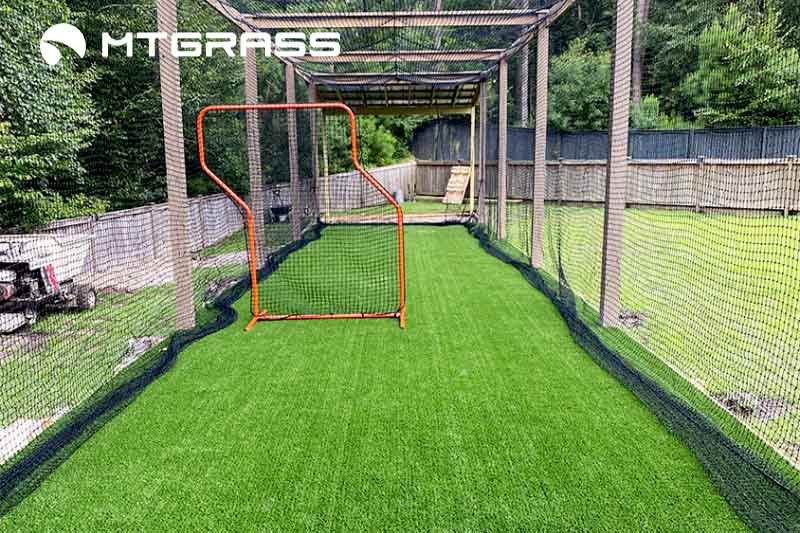
バッティングケージの設置費用:実際の事例
Consider a typical indoor commercial setup:
- Three parallel cages
- Each cage 4 meters wide and 25 meters long
- Total turf area: 300 square meters
In such projects:
- Turf itself often accounts for roughly half the cost
- Shock pads add around 15–20%
- Installation labor typically represents 20–25%
- Nets, frames, and pitching machines are separate items
In reality, batting cage turf is the most important controllable cost — and the least forgiving place to cut corners.
避けるべきよくある購入時の失敗
Buying batting cage turf is one of those decisions where the expensive mistakes don’t show up on day one. They show up after a few months—when the turf starts flattening, seams open up, ball bounce becomes unpredictable, or your facility suddenly needs repairs you didn’t budget for.
Below is a detailed “avoid-this” checklist that helps buyers save money by preventing the most common, most costly errors.
間違い #1:ジムの芝を購入し、それをバッティングケージ用の芝と呼ぶこと
Why it wastes money: Gym turf and batting cage turf may look similar in photos, but they are engineered for different stress patterns. Gym turf is built for sled pushes, foot traffic, and general fitness. Batting cages create repeated ball impact and extreme localized wear (batter zones and landing zones). Gym turf often flattens faster, wears unevenly, and produces inconsistent ball behavior.
How to avoid it:
- Ask the seller: “Is this turf designed specifically for baseball training and ball impact?”
- Request a spec sheet that clearly states batting cage / baseball training use (not “multi-purpose gym turf”).
- Look for evidence of batting cage applications or reference projects.
間違い #2:使用頻度ではなく価格だけで芝を選ぶこと
Why it wastes money: Low-cost turf can be perfectly fine for a backyard cage used a few hours per week. But for clubs, schools, or commercial facilities, high usage will destroy budget turf quickly. The result is early replacement, downtime, and extra labor—meaning the “cheaper” option becomes the most expensive.
How to avoid it:
- Estimate realistic training hours per week (and assume growth).
- For daily or high-traffic use, choose higher density + stronger backing.
- Think in cost per training hour, not cost per square meter.
間違い #3:集中摩耗箇所を無視すること(およびそれに対する対策を講じないこと)
Why it wastes money: Batting cages are not evenly worn surfaces. The batter’s box area and ball landing zones take the majority of the punishment. If you don’t design around this, you’ll see premature wear in the same few square meters—even if the rest of the turf still looks new.
How to avoid it:
- Avoid seams in the batter’s box area.
- Ask about reinforcement options or localized replaceable sections.
- Consider padding or heavier turf for high-impact zones.
間違い #4:「予算を節約する」ためにショックパッドを省略する
Why it wastes money: This is one of the most common regrets, especially in commercial facilities. Over concrete floors, turf without a shock pad can feel hard over long sessions, and heavy usage accelerates turf fatigue. Shock pads also help extend turf life by reducing stress on fibers and backing.
How to avoid it:
- If your cage is indoor and on concrete, strongly consider 5mm padded indoor turf.
- If training is frequent or sessions are long, shock pads become a long-term cost saver, not a luxury.
間違い #5:設置作業を過小評価する(DIY 対 プロ)
Why it wastes money: Turf performance depends heavily on correct installation. Bad seams, poor adhesive work, uneven subfloors, or wrong seam direction can create safety issues, visible joints, and early failure—especially in commercial cages.
How to avoid it:
- For commercial or club facilities: use professional installation.
- For backyard cages: DIY is possible, but choose roll-out turf systems and keep seams out of high-impact zones.
- Ask for a recommended installation guide or technical support.
間違い #6:人工芝ロールの幅をケージのレイアウトに合わせていない
Why it wastes money: If the roll width doesn’t match the cage width, you create unnecessary seams—more labor, more visible lines, and more failure points. Seams are where problems often begin.
How to avoid it:
- Confirm cage width first (commonly 3.8–4.5m).
- Select roll widths that minimize seams.
- Plan seams to avoid the batter’s box and main landing zones.
間違い #7:カーペットの仕様(パイルの高さ、密度、裏地)を確認せずに購入してしまう
Why it wastes money: Many buyers rely on product photos or a single “sports turf” label. Without confirming actual specifications, you may end up with turf that feels wrong, wears faster, or performs inconsistently.
How to avoid it:
- Ask for key parameters (at minimum):
- pile height (commonly 10–15mm for cages)
- density / tufting rate
- backing type and strength
- Choose specs based on usage frequency, not appearance.
間違い #8:メンテナンスや交換の計画を怠ること
Why it wastes money: Even high-quality turf needs basic maintenance. If you don’t brush, clean, and inspect seams periodically, the surface will wear faster and replacement will come sooner than expected. Buyers also forget to plan for the fact that concentrated zones will age first.
How to avoid it:
- Ask your supplier for a simple maintenance schedule.
- Plan inspections around high-wear zones.
- Choose suppliers who provide clear guidance on wear patterns and turf lifespan.
間違い #9:「人工芝」だけを販売する(システムではない)サプライヤーを選んでしまうこと
Why it wastes money: A trustworthy supplier should be able to advise on sizing, layout, seam placement, padding, and maintenance—not just quote a price. Without that guidance, buyers often choose the wrong spec and pay later.
How to avoid it:
- Ask supplier questions like:
- “Where will this turf wear first in a batting cage?”
- “What spec do you recommend for my training frequency?”
- “Do I need a shock pad for my subfloor?”
- Choose suppliers who can explain performance in real batting cage use.
MightyGrassがバッティングケージ用人工芝を「野球システム」として捉える理由
Batting cage turf should never be treated as a standalone product. In real baseball training environments, the batting cage is not an isolated space—it is an extension of the baseball field itself. At MightyGrass, we design batting cage turf as part of a complete baseball turf system, fully aligned with infield training areas, bullpens, and indoor practice zones. This system-based approach ensures that players experience consistent footing, ball response, and training feedback across every part of their daily routine.
野球用人工芝に関する深い専門知識に基づいて開発
マイティグラス is not new to baseball turf. With over 20 years of artificial turf manufacturing experience, we understand how baseball training differs fundamentally from other sports. Batting cages create concentrated wear, repeated ball impact, and fixed stance zones—conditions that generic sports turf is not designed to handle. Our baseball turf products are engineered specifically for these realities, balancing durability, surface stability, and predictable ball behavior.
This depth of understanding comes from long-term collaboration with baseball clubs, schools, and installation contractors worldwide, not from adapting gym turf or multi-purpose grass for baseball use.
世界規模での工場直結型製造
As a manufacturer, MightyGrass operates two advanced production bases with a combined annual capacity exceeding 10 million square meters. This scale allows us to offer:
- Factory-direct pricing without middleman markups
- Stable quality control across large projects
- Reliable lead times for club, school, and commercial facilities
Our minimum order quantity of 1,100 square meters is specifically suited to real batting cage projects—multi-lane training facilities, school programs, and contractor-led installations—where consistency across multiple cages matters.
実際のトレーニング環境に合わせて設計されたカスタマイズ
Every batting cage is different. That’s why MightyGrass offers full customization to match actual training requirements, not just standard product rolls:
- Turf dimensions tailored to cage width and length
- Density and pile height adjusted to training frequency
- Custom colors for branding or zone differentiation
- Logo integration for clubs, schools, or training centers
This level of customization is only possible at the factory level, ensuring the turf fits the space—and the training purpose—exactly.
バッティングケージのワンストップ・パッケージサポート
Beyond turf production, MightyGrass supports customers with a complete batting cage package approach. For baseball clubs, schools, and installers, this means:
- Batting cage turf selection matched to usage level
- Shock pad recommendations for concrete or indoor floors
- Installation guidance based on cage layout and wear zones
- Maintenance advice to extend turf lifespan
- Coordination support for multi-cage projects
Instead of sourcing turf, padding, and technical advice from different suppliers, customers receive one integrated solution designed for long-term performance.
MightyGrassのアプローチから最も恩恵を受けるのは誰か
- Baseball clubs benefit from consistent training surfaces across cages and fields
- Schools and universities gain safe, durable systems with predictable maintenance
- Installers and contractors receive factory-level technical support and stable supply
- Facility owners gain better long-term value through durability and reduced downtime
最後に
Anyone who truly loves baseball understands that progress comes from repetition. Batting cages are where that repetition lives.
The turf beneath your feet may look simple, but it shapes every swing, every bounce, and every training session. Choosing the right batting cage turf is not about decoration. It is about building a surface you can trust, day after day, season after season.
よくある質問
商業野球クラブ向けにバッティングケージ用人工芝を設置するには、どれくらいの費用がかかりますか?
For commercial baseball clubs, batting cage turf installation typically represents 20–30% of the total batting cage project cost.
Most projects include turf material, optional shock pads, adhesives, labor, and finishing. For multi-lane facilities, installation efficiency improves as scale increases, which often lowers cost per square meter compared to single-cage setups.
設置費用はケージごと、それとも平方メートルごとに計算されますか?
Installation cost is usually calculated per square meter, not per cage. Each batting cage varies in width, length, seam count, and subfloor condition. Installers base pricing on surface area, seam complexity, and preparation work. A typical commercial cage (100–130 m²) gives buyers a reliable reference point for budgeting.
コンクリートの上にバッティングケージ用人工芝を敷設すると、費用は高くなりますか?
Yes, but only slightly—and it is very common in commercial facilities.
Concrete requires surface cleaning, leveling, and adhesive bonding. If a shock pad is added (highly recommended for indoor concrete floors), material and labor costs increase, but this also improves comfort and extends turf lifespan, reducing long-term replacement cost.
ショックパッドを取り付けることで、設置費用にどれくらいの追加費用がかかりますか?
A shock pad typically adds 15–25% to the turf system cost.
The added cost includes the pad material and additional installation steps. Commercial clubs often accept this increase because padded systems reduce joint stress, improve player comfort, and help turf last longer under daily use—lowering total cost of ownership.
業務用バッティングケージの設置には、専門業者による設置が必要ですか?
Yes—professional installation is strongly recommended for commercial baseball clubs.
Commercial cages involve higher usage, safety liability, and visibility. Poor seam placement or uneven bonding can lead to early failure and downtime. Professional installation ensures proper seam alignment, adhesion, and long-term surface stability.
バッティングケージを複数設置すると、総設置費用は安くなりますか?
Yes—multi-cage projects usually lower the average installation cost per square meter.
Labor efficiency improves when installers work on several cages at once. Adhesive usage, layout planning, and crew time are optimized across lanes, making multi-cage installations more cost-effective than single-cage projects.
商業施設の場合、バッティングケージの人工芝の敷設にはどれくらいの時間がかかりますか?
Most commercial projects take 2–5 days, depending on the number of cages.
A single cage may be completed in 1–2 days, while multi-lane facilities require additional time for layout, seam curing, and finishing. Planning installation during off-peak periods helps minimize business disruption.
どのような設置上の要因が、予期せずコストを押し上げる可能性があるか?
Uneven subfloors, excessive seams, last-minute layout changes, and poor base preparation are the most common cost drivers.
These issues increase labor time and material waste. Proper planning—confirming cage dimensions, roll widths, and seam locations in advance—helps control installation budgets.
バッティングケージのフルセットを購入するのと、人工芝だけを購入するのと、どちらが安くなりますか?
For many commercial clubs, a batting cage package is more cost-efficient. Packages reduce coordination costs between turf suppliers, installers, and cage system vendors. Integrated solutions often include layout guidance, compatible materials, and optimized installation sequencing, reducing errors and delays.
商業クラブは、長期的な設備の更新や維持管理について、どのように予算を組むべきでしょうか?
Clubs should plan for localized turf replacement in high-wear zones after several years, not full-lane replacement.
Batting cages experience concentrated wear in batter and landing areas. With proper planning, clubs can replace small sections instead of entire cages, significantly lowering long-term capital expenses.