
 日本語
日本語  English
  العربية
  Español
  Deutsch
  Français
  Português
  Русский
  Italiano
  Nederlands
  Svenska
  Suomi
Suomi  ไทย
ไทย  Dansk
Dansk  Ελληνικά
  Bahasa Melayu

If you’re planning to build or renovate a football pitch in Russia, you’ve probably already noticed how confusing the sourcing process can get. Between vague price quotes, suppliers who disappear after the first invoice, and specs that don’t hold up in a Siberian winter, it’s easy to end up overpaying for football turf that won’t last five years, let alone ten.
This guide explains what you should look at when buying football field turf in Russia, including indicative turf prices, supplier selection, certification, logistics, and the technical considerations that matter in cold regions.
Why Artificial Turf Makes Sense for Football Fields in Russia?
Natural grass can be difficult to maintain across much of Russia. Outside the country’s warmer southern regions, the growing season is relatively short, while prolonged cold and snow can limit the period during which a natural grass football field remains playable. For clubs, schools, training centers, municipalities, and sports facilities, this creates a practical problem: you need a playing surface that can handle regular use without depending entirely on a short growing season.
人工芝 provides a more consistent playing surface throughout the year and generally requires less ongoing maintenance than natural grass. However, you should not assume that every artificial turf system is suitable for Russian conditions. The right system needs to be evaluated according to your region, expected playing intensity, infill system, drainage design, and temperature range. For example, synthetic turf products developed for mild climates may fail to deliver the same performance when subjected to repeated freezing and thawing.
How much does football field turf cost in Russia?
There is no single price for football field turf in Russia. If a supplier provides a price before asking about your football field size, expected frequency of use, football turf specifications, and delivery requirements, you should disregard it, as it is not an accurate quote. We have summarized several factors influencing the football turf price for your reference:
- Yarn material: Monofilament PE is widely used for football pitches — durable, natural ball roll, decent UV resistance. And its cost-performance ratio strikes a balance between PP and nylon.
- Pile height and density: Football turf typically runs 50–60mm, with density affecting both cost and durability. Lower density looks fine in photos and falls apart under routine match play.
- Infill system: Sand + SBR rubber is the budget option. EPDM/TPE costs more but handles temperature swings better and doesn’t smell in summer heat. Additionally, if you are building an indoor soccer field, you can choose Non-infill football grass.
- Certification: If your field needs to meet a specific competition or performance requirement, FIFA Quality or FIFA Quality Pro may be relevant. In that situation, you should compare certified systems based on their documented performance rather than simply choosing the lowest-cost turf.
| Turf grade | Approximate price (USD/m²) | Typical application |
| Training grade | $5–15 | School fields, community pitches |
| Standard match grade | $15–30 | Amateur clubs, regional leagues |
| FIFA-certified grade | $30+ | Professional clubs, licensed venues |
* The aforementioned Russian artificial football turf prices are for reference only and should not be used directly as the final project budget. Your actual quotation can change significantly according to order volume, exchange rates, product configuration, shipping route, certification requirements, and installation conditions. You can contact the professional MightyGrass team directly to receive a quote tailored to your project.
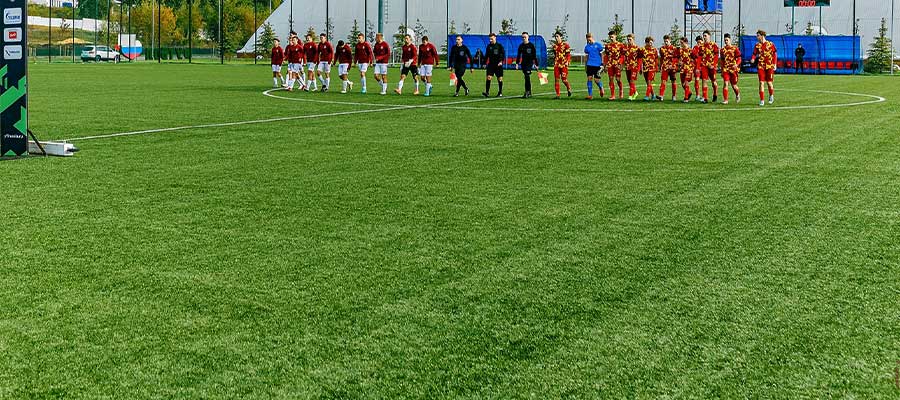
How to Choose a Football Turf Supplier in Russia?
When buying football turf in Russia, you generally have two options: purchase through a local distributor or work directly with a Chinese artificial grass manufacturer.
Local Distributor or Installer
A local distributor can be convenient when you need readily available stock, local communication, or faster delivery (e.g. MASTERSPORT). You may also have an easier time coordinating smaller orders or local installation services. The downside is that this comes at the cost of a relatively limited product selection and less flexibility regarding custom specifications.
Chinese Artificial Grass Manufacturer: MightyGrass
Buying directly from a manufacturer can give you greater control over product specifications, customization, production, and pricing. For larger football projects, this can be particularly useful when you need specific yarn construction, field dimensions, line markings, branding, or a customized turf system.
The downside is the longer waiting period compared to dealing with local distributors. However, if you choose an artificial grass manufacturer like マイティグラス—which possesses extensive R&D and production capabilities, export experience, efficient communication, and warranty services, as well as the ability to provide end-to-end project support ranging from sample provision to final installation—the longer lead time can be offset by better control over specifications, quality consistency, customization and project coordination.
For distributors, contractors and project buyers purchasing substantial quantities, the potential cost and supply advantages may therefore outweigh the additional lead time, provided that the project schedule allows for advance planning.
What Should You Check Before Choosing a Football Turf Supplier?
Before signing any documents, we recommend that you verify the following:
- International certification: FIFAクオリティまたはFIFAクオリティ・プロ test reports, not just a claim on a brochure.
- Local football field project in Russia: Inquire about completed football field projects, particularly those located in Russia, the CIS, Northern Europe, or other regions where high cold resistance is required for synthetic turf.
- Documentation: Suppliers should be able to provide clear and authentic documents, such as technical specifications, test reports, and shipping information (in English or Russian).
- Manufacturer’s customization capability. If your project requires specific field dimensions, line colors, logos, or other branding elements, confirm that the factory can manufacture these requirements rather than simply reselling standard artificial grass rolls.
Red Flags to Watch for When Buying Football Turf: If a supplier is unwilling to provide independent laboratory test reports for areas such as abrasion resistance, UV performance, or fire safety. Your contract should clearly define the applicable Incoterm, such as FOB or CIF, so you understand which party is responsible for transportation, insurance, customs-related responsibilities, and risk at each stage.

How to Buy Football Field Turf for a Russian Project
1. Define Your Field and Intended Use
First determine what you’re building. A professional match field, regional competition pitch, youth training ground, school field, and community football facility can have very different technical requirements and budgets.
2. Request Samples and Technical Documents
Once you know your requirements, ask shortlisted suppliers for physical samples and technical documentation. Look beyond the color and appearance of the grass. Compare yarn construction, pile height, density, backing, stitch rate, and other specifications relevant to the proposed system.
3. Confirm Cold-Climate Performance
Your supplier should be able to explain how the proposed turf system is expected to perform in your region. For colder parts of Russia, ask specifically about yarn flexibility at low temperatures, infill behavior, backing performance, drainage, and freeze-thaw conditions.
4. Confirm the Commercial and Logistics Terms
Once you have selected a system, confirm the turf quantity, packaging, production lead time, shipping terms, destination, customs responsibilities, payment terms, and warranty.
Once the venue dimensions, expected usage intensity, competition level, climatic conditions, and certification requirements are clearly established, MightyGrass will precisely recommend the right synthetic football turf type to help you avoid the financial losses associated with over-specification or premature replacement. If testing or certification is required, request the corresponding reports at this stage rather than after you have already selected a product.
Why Work With MightyGrass for Football Turf in Russia?
- We understand the cold climates of Northern Europe and Russia, MightyGrass as a FIFA公認人工芝メーカー, produces and exports football turf systems specifically designed to withstand harsh weather conditions.
- When your football fields in Russia require a specific turf structure rather than an off-the-shelf product, this in-house manufacturing capability—covering yarn extrusion, tufting, backing processing, and product development—offers you greater flexibility.
- MightyGrass also supports international projects with product documentation, testing reports, samples, OEM/ODM services, and export experience across multiple markets.
- For projects in Russia, the practical advantages of choosing us lie not only in obtaining customized specifications for your football turf but also in securing more favorable factory-direct pricing.
最後に
Ready to Compare Football Turf Suppliers for Your Russian Project? If you’re currently sourcing artificial football turf for a Russian field, don’t compare suppliers on price per square meter alone.
Start with your field dimensions, intended level of play, climate, certification requirements, and installation conditions. Then compare the complete quotation, including 人工芝, freight, customs-related costs, installation, and maintenance requirements.
Send MightyGrass your field dimensions and project requirements, and we’ll help you evaluate the appropriate football turf system and prepare a transparent quotation for your project.
よくある質問
What Should You Consider for Football Turf in Russian Winters?
- Choose yarn that’s specifically tested for cold-flexibility — standard fibers can stiffen and snap in sustained sub-zero temperatures, even if they look fine to the eye.
- Pick an infill designed to stay consistent in the cold, since standard SBR rubber hardens as temperatures drop, changing how the ball rolls and how safe the surface feels underfoot.
- Make sure the drainage and sub-base are engineered around freeze-thaw cycles, not just rainfall — trapped meltwater that refreezes overnight causes frost heave, which means partial reconstruction rather than a simple fix.
How are artificial football pitches maintained in Russia?
Managing football turf during harsh Russian winters requires careful preparation to prevent deep frost damage, maintain drainage, and protect synthetic or natural grass.
- Drainage and Melting: High-performance drainage systems prevent standing water from freezing into solid sheets of ice.
- Infill Levels: Top-off turf infill before snow arrives to protect synthetic fibers from compaction and heavy traffic.
- Snow Removal: Use plastic shovels or soft-bristle brooms instead of metal tools to clear snow safely without tearing the turf.
How much does a standard football-size turf field cost in Russia?
A full-size 11-a-side football field covers roughly 7,140 m² based on a typical field footprint. Depending on the turf grade, site conditions, and logistics and installation requirements, the reference price range for the project—including turf materials, transportation, and installation—is approximately 4,000 RUB to 10,000+ RUB (roughly $45 to $110 USD) per square meter. Smaller training fields can cost considerably less.
Does artificial turf work in Russian winters?
Yes, but you need to specify the complete system for the local climate. Cold-resistant yarn, suitable infill, effective drainage, and a sub-base designed to handle freeze-thaw conditions are important considerations, particularly in regions with prolonged periods of sub-zero temperatures.
人工芝の寿命は?
Quality football turf can typically provide around 8–10 years of service under appropriate use and maintenance conditions. Actual lifespan depends on product construction, playing intensity, UV exposure, infill management, brushing, drainage, and other maintenance factors.


