
 English
  العربية
  Español
  Deutsch
  Français
  Português
  Русский
  日本語
日本語  Italiano
  Nederlands
  Svenska
  Suomi
Suomi  ไทย
ไทย  Dansk
Dansk  Ελληνικά
  Bahasa Melayu

For five years, MightyGrass football turf has been standing up to year-round training, official matches, and public fitness programs at Футбольный манеж имени Владимира Ершова (Vladimir Ershov Football Manege) in Belgorod, Russia — one indoor field and two outdoor fields, MightyGrass football turf was supplied for one indoor and two outdoor football fields, and construction and installation are being carried out by the local contractor MASTERSPORT.
When evaluating artificial football turf, a newly completed field can tell you about the product and installation. A field that has already been used for several years can tell you more about its real application.
Project Overview: Vladimir Ershov Football Manege
| Item | Details |
| Project Name | Vladimir Ershov Football Manege |
| Location Address | 4B Belinskogo Street, Belgorod, Russia |
| Facility Type | Year-Round Football Training & Competition Complex |
| Fields | 3 Football Fields (1 Indoor + 2 Outdoor) |
| Indoor Football Field Size | 105m × 65m |
| Outdoor Football Field Size | 109m × 71m (×2) |
| Total Turf Area | Approx. 23,000 m² |
| Turf Specification | MightyGrass 60mm Football Turf |
| Backing Structure | Dual PP + PU |
| Yarn Structure | Arc-shaped yarn |
| Years in Service | 5 years |
| Local Project Construction | MASTERSPORT |
Project Background
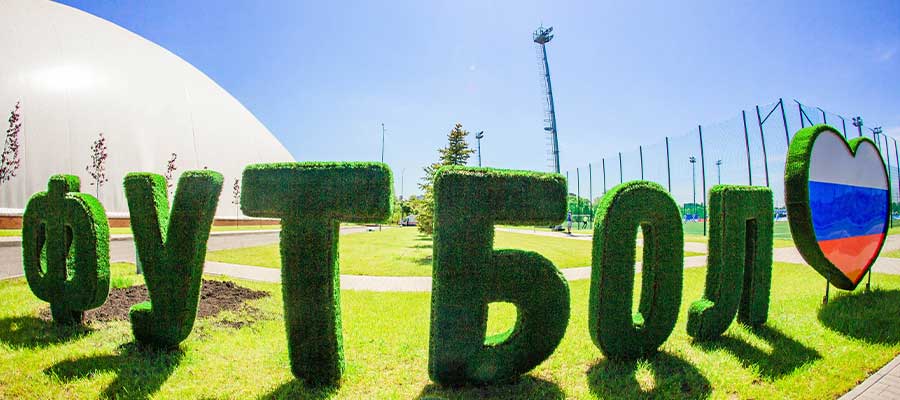
The Vladimir Ershov Football Manege was built as part of the federal project «Спорт – норма жизни» (“Sport is the Norm of Life”), under the national project «Демография» (“Demography”) — a state initiative aimed at expanding access to year-round sports infrastructure across Russia’s regions. Located at Belinskogo Street 4Б in Belgorod, the complex was designed to give the city a training, competition, or community football venue that isn’t limited by weather or season.
Facility Overview
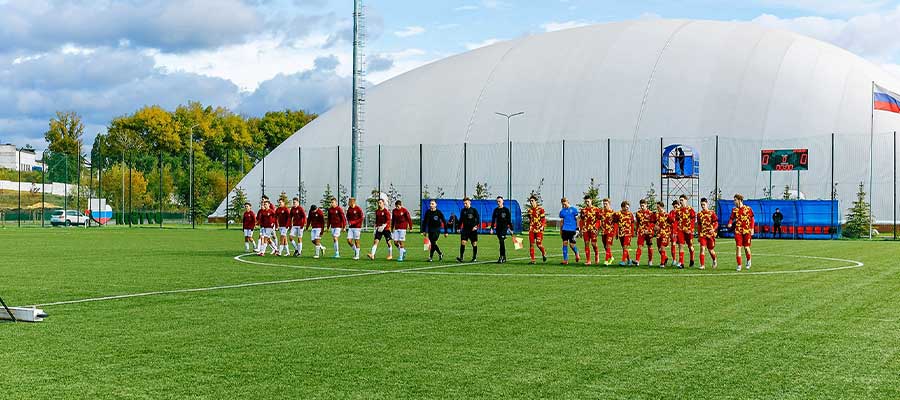
The centerpiece of the complex is the indoor manege itself — an air-supported structure with a membrane roof made of polyester fabric, enclosing a full-size 105m x 65m football pitch. Beyond the field, the building is organized into a full set of supporting spaces: a lobby, medical room, waiting area, locker rooms, classrooms for theory sessions and press conferences, referee and coaching rooms, a cloakroom, ticket office, showers, restrooms, an equipment room, and its own heating and electrical utility rooms.
Adjacent to the football manege sit two outdoor football fields, 109m x 71m each, also finished with artificial turf. Together, the three fields allow the facility to run a continuous training cycle throughout the year, hosting official football competitions as well as fitness and recreational programs for the local population.
The Turf System MightyGrass Supplied
For a facility expected to carry this volume and variety of use — from youth training to official matches to public recreation — MightyGrass 60mm artificial grass built on a double PP+PU backing with an Arc-shaped yarn structure
- Double PP+PU backing — combines the dimensional stability of polypropylene with the tuft-lock strength and durability of polyurethane coating, giving the system the strength to hold up under high rotation and heavy foot traffic without seams pulling or tufts loosening.
- Arc yarn structure — the curved fiber profile helps the blades resist matting and lie-over, keeping the pile upright and the ball roll consistent even after years of intensive play.
- 60mm pile height — sits within the range recommended for competitive football turf, supporting stable infill retention and realistic ball behavior comparable to natural grass.
Meeting RFS Standards
The football pitch meets the safety and operational requirements stipulated by the Russian Football Union (RFS) standards and has received official RFS certification. This certification matters in practice: it means the surface has been reviewed against the RFS’s own construction and operation requirements for artificial turf football fields, giving the facility’s operators, coaches, and the athletes training their confidence that the pitch is built to the national standard expected for official competition use — not just general-purpose synthetic turf.
5 Years On: How the Turf Performs After Long-Term Use
What makes this project worth revisiting is simply that it has now been five years since installation — and the turf is still doing its job across all three fields, indoors and out, through Belgorod’s full range of seasons and a demanding, multi-purpose usage schedule that few single-sport venues have to handle. That’s the real test for any football turf system: not how it performs on day one, but how it performs after thousands of hours of training sessions, matches, and public use.
The long-term performance of the facility is the result of several factors, including the quality of the football turf supplied by MightyGrass, the installation work completed by MASTERSPORT, the construction of the base and drainage systems, and ongoing maintenance by the facility operators. Five years after installation, the Vladimir Ershov Football Hall continues to deliver reliable playing performance under regular use, providing a practical example of how turf quality, installation, site construction, and maintenance work together over the long term.
Planning a Football Turf Project in Russia?
Every venue has different demands — indoor or outdoor, training or official competition, harsh winters or heavy year-round scheduling. Before finalizing your turf specification, it’s worth confirming the certification requirements, expected usage intensity, and climate conditions for your specific project.
Talk to MightyGrass directly — as a FIFA-approved artificial grass manufacturer based in China, we understand the demands of cold-climate markets like Russia and Northern Europe, and we produce football turf systems specifically engineered to withstand harsh weather conditions and heavy multi-year use. Ensure your facility is built right the first time and designed for long-term durability, rather than just lasting a few seasons.
Get a Football Turf Consultation for Your Project
FAQ
What is a double PP+PU backing and why does it matter?
A double PP+PU backing combines a polypropylene (PP) primary layer for dimensional stability with a polyurethane (PU) coating that locks the tufts in place. This combination resists delamination and tuft pull-out under heavy rotational stress — a key factor in fields that see continuous training, matches, and public use across multiple pitches.
What is Arc-shaped yarn, and how is it different from standard turf fibers?
Arc yarn has a curved fiber profile (rather than a flat or straight one), which helps the blades resist matting and lie-over after repeated impact. This keeps the pile standing upright for longer, maintaining a more consistent ball roll and playing surface appearance over years of use compared to standard monofilament yarns.
Can artificial football turf handle Russia’s cold winters and freeze-thaw cycles?
Yes. Cold climates put extra stress on backing materials and yarn through repeated freeze-thaw cycles and temperature swings. MightyGrass Turf built with reinforced PU backing and durable yarn structures is designed to resist cracking and stiffening in low temperatures.
Who tests and certifies a football field for RFS or FIFA standards?
Certification testing is carried out by accredited third-party laboratories, which assess criteria such as ball roll, shock absorption, vertical deformation, and rotational resistance. Test results are then reviewed by the relevant certifying body (the RFS commission for Russian national standards, or FIFA-approved test institutes for FIFA Quality/Quality Pro) before a certificate is issued.
How long does artificial football turf typically last?
A well-maintained artificial turf field generally lasts anywhere from 8 to 15 years, depending on turf quality, usage intensity, climate exposure, and maintenance routine. Fields under heavy year-round use — like a multi-field training complex — need a more durable construction to reach the higher end of that range, which is why backing quality and yarn structure matter as much as pile height.
What maintenance does football turf need to stay compliant over time?
Regular brushing to keep infill evenly distributed and fibers upright, periodic infill top-ups, drainage checks, and routine inspection for seam or backing wear. Facilities with certification requirements should also plan for periodic retesting, since RFS and FIFA certificates typically need to be renewed or re-verified over a set validity period.


