Bahasa Melayu
  English
  العربية
  Español
  Deutsch
  Français
  Português
  Русский
  日本語
日本語  Italiano
  Nederlands
  Svenska
  Suomi
Suomi  ไทย
ไทย  Dansk
Dansk  Ελληνικά
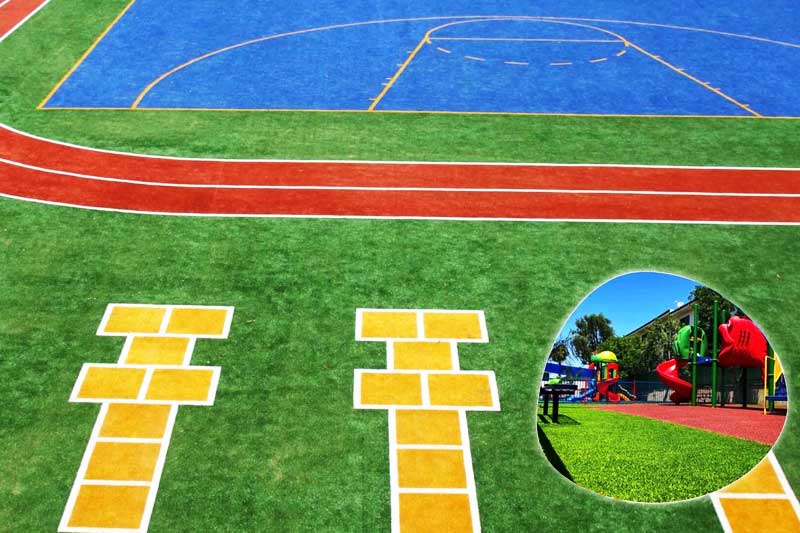
Choosing the right artificial turf for playground surfacing isn’t just a design decision—it’s a long-term safety and cost concern for schools.
Data shows that over 60% of playground injuries are related to falls, which makes surfacing performance critical. At the same time, many schools struggle with natural grass that wears out quickly under heavy use—often losing 50–70% of coverage within a single year, leading to ongoing repair and maintenance costs.
Artificial playground turf offers a more durable and consistent alternative. But here’s the real challenge:
not all turf systems are built the same. Differences in pile height, fiber structure, infill, and shock pad design can significantly affect safety, durability, and lifecycle cost. In some cases, poorly designed systems can see impact absorption performance decline by 20–40% over time, increasing risk instead of reducing it.
So how do you choose a rumput tiruan system that actually performs in school environments?
This guide breaks it down step by step, helping you select the right playground turf based on safety requirements, usage scenarios, and budget.
What Is Playground Turf for Schools?
Playground turf is a specialized type of artificial grass playground surface designed specifically for child safety, impact absorption, and high-frequency use in school environments.
Unlike landscaping turf, artificial grass for play areas is engineered as a system, not just a surface layer. A complete playground turf system typically includes:
- Synthetic grass (PE or PP fibers)
- Shock-absorbing pad (critical for fall protection)
- Infill (optional, depending on system type)
- Stable base layer (crushed stone or asphalt)
This system is often referred to as turf under playground systems, and its performance depends on how well these layers work together—not just the grass itself.
From a usage perspective, schools choose artificial turf for school playgrounds because it solves several real problems:
- Natural grass wears out quickly under constant foot traffic
- Mud, dust, and uneven surfaces increase injury risk
- Maintenance costs (watering, mowing, reseeding) continue to rise
In contrast, outdoor playground turf provides:
- Year-round usability (rain or shine)
- Consistent surface performance
- Lower maintenance over 8–10 years lifecycle
At MightyGrass, playground turf is developed as a system-based solution, meaning you are not just buying artificial turf—you are getting a matched combination of yarn, backing, and shock pad designed to meet safety standards like ASTM and EN.
What Ensures That Artificial Grass Playground Surfaces Are Safe for Children?
Safety is the single most important factor when selecting the best artificial grass for playground environments. And it is not determined by appearance—it is defined by measurable performance playground standards.
1. Critical Fall Height (CFH) & Impact Attenuation
The most important safety metric for any artificial turf for playground surfacing is its ability to absorb impact.
- In the U.S., ASTM F1292 measures shock absorption using G-max and Head Injury Criterion (HIC)
- In Europe, EN1177 defines Critical Fall Height (CFH)
Synthetic Turf Surfacing Safety System Reference
| Equipment Height | Required CFH | Recommended System |
| Up to 1.5 m (5 ft) | ≥ 1.5 m | Turf + 10–20 mm shock pad |
| 1.5–3.0 m (5–10 ft) | ≥ 2.0–3.0 m | Turf + 30–50 mm shock pad |
A well-engineered system can reduce G-max values below 165, which is considered safe for playground use.
2. Shock Pad: The Hidden Safety Layer
Many buyers focus only on the grass, but the real safety comes from what’s underneath the shock-absorbing layer.
Shock-absorbing pads ensure that the entire surface of the site provides consistent impact absorption. Unlike loose-fill materials such as bark chips, they prevent compaction and hardening over time, thereby ensuring long-term compliance with all safety standards.
3. Non-Toxic & Skin-Friendly Materials
Children’s skin comes into direct contact with playground surfaces. For this reason, artificial turf playground flooring must meet specific safety requirements: it must be free of heavy metals—such as lead and cadmium—comply with safety regulations such as REACH or CPSIA, and feature a non-irritating fiber structure.
In terms of artificial grass materials, high-quality artificial turf used for school projects typically utilizes polyethylene (PE) fibers, a material that is softer and more skin-friendly than polypropylene (PP).
4. Surface Stability & Slip Resistance
Humid environments can make certain surfaces slippery, increasing the risk of slips or falls. Non-slip playground turf surfaces help ensure children’s safety, particularly in wet weather. A safe playground surface must also:
- Stay even (no holes or displacement)
- Provide traction in both dry and wet conditions
- Avoid loose materials that can shift or scatter
MightyGrass outdoor playground turf offers significantly better surface stability—especially in high-traffic school environments.

Types of Playground Turf Systems for Schools
Choosing the right playground turf system is not about picking a product—it’s about selecting a solution that matches your school’s safety requirements, usage intensity, and long-term budget. Not all Lapisan rumput di taman permainan systems are built the same. The right choice depends on how your playground will be used, your budget, and local safety requirements.
| Jenis Sistem | How It Works | Terbaik Untuk | Typical Specs | Key Advantages | Considerations |
| Infill Playground Turf | Sand or rubber infill is brushed into turf fibers to add weight, stability, and cushioning | Large school playgrounds; Budget-conscious projects; Multi-use fields | Pile height: 25–40 mm; Infill: Silica sand / EPDM/TPE rubber; Shock pad: Optional (recommended) | Lower upfront cost; Widely used and proven system; Good initial stability | Infill may migrate or scatter over time; Requires periodic maintenance and replenishment |
| Non-Infill Playground Turf | Dense yarn structure replaces infill; relies on fiber density + shock pad for performance | Kindergartens; Early childhood playgroundsIndoor / semi-covered areas; Low-maintenance schools | Pile height: 20–30 mm; No infill; Shock pad: Required | Cleaner surface (no loose particles); Lower maintenance; More consistent performance | Higher initial cost; Performance depends heavily on fiber quality and shock pad |
| Hybrid Playground Turf System | Integrated system combining turf + shock pad + optimized fiber design for overall performance | Most modern school projects; Projects requiring safety + durability balance; Long-term investment scenarios | Custom pile height & density; Shock pad: Engineered & matched; Certified (ASTM / EN) | Best long-term shock; absorption; Consistent performance; Lower lifecycle cost; Adaptable to different climates | Higher upfront investment; Requires reliable supplier with system design capability |
How to Choose the Best Playground Turf (Step-by-Step)
Choosing the best artificial grass for playgrounds is not about picking the “thickest” or “cheapest” option—it’s about matching the system to how your school actually operates.
We have summarized several steps for selecting synthetic turf—commonly followed by schools—for your reference, and we hope this proves helpful in making your choice.
Step 1 — Choose the Right Pile Height
Pile height directly affects both safety performance and durability.
For school playgrounds, the ideal range is typically between 20 mm and 35 mm—but the right choice depends on usage:
- 20–25 mm → better for kindergartens, low fall heights, and non-infill systems
- 25–30 mm → balanced option for most schools (comfort + durability)
- 30–40 mm → suitable for higher fall zones when combined with infill or thicker shock pads
A common misconception is that “taller grass = safer.” In reality, the primary component responsible for absorbing impact is not the height of the grass fibers, but rather the shock-absorbing pad located underneath. Excessively tall fibers can actually flatten faster in high-traffic areas.
Step 2 — Select the Right Fiber Type
Fiber type determines how your artificial grass playground surface feels, performs, and lasts over time. The two most common materials are:
| Jenis gentian | Feel | Ketahanan | Penggunaan Tipikal |
| Polyethylene (PE) | Soft | tinggi | Playgrounds, schools |
| Polipropilena (PP) | Stiffer | Sederhana | Budget or decorative areas |
For schools, PE fibers are strongly recommended because:
- They are softer on skin (important for children)
- Better UV resistance (8–10 years lifespan in outdoor use)
- More resilient under repeated foot traffic
At MightyGrass, advanced yarn structures like U-shape, S-shape or diamond-shaped fibers are often used to improve recovery (less flattening) and maintain a natural appearance longer.
Step 3 — Decide on Infill vs Non-Infill
This decision has a major impact on maintenance, cleanliness, and long-term cost.
Instead of asking “which is better,” you should ask: what fits your school environment?
Choose infill systems if you:
- Need a lower upfront cost
- Are building a large playground or multi-use area
- Have maintenance staff available
Choose non-infill systems if you:
- Want a cleaner environment (no loose particles)
- Are building for younger children
- Prefer lower maintenance over time
Industry trend: More schools—especially in North America and Europe—are shifting toward non-infill playground turf systems due to hygiene concerns and lifecycle savings.
Step 4 — Don’t Ignore the Shock Pad
If there is one place you should not cut costs, it’s the shock pad.
A properly selected shock pad:
- Determines your Critical Fall Height (CFH) compliance
- Maintains performance over time (no compaction like rubber mulch)
- Reduces injury risk significantly
Typical thickness ranges:
- 10–20 mm → ≤5ft low fall height areas
- 30–50 mm → ≤10ft standard playground equipment zones
- 50 mm+ → ≤12ft high fall risk areas
Real-world insight: Over 70% of playground safety failures are linked to improper or missing shock pads, not the turf itself. MightyGrass provides matched turf + shock pad systems, ensuring your entire surface—not just the top layer—meets ASTM and EN standards.
Step 5 — Verify Certifications & Supplier Capability
Even the best-looking fake grass for outdoor play areas means nothing without verified performance.
Before choosing a supplier, make sure you can confirm:
- ASTM F1292 / EN1177 compliance (impact attenuation)
- Heavy metal and chemical safety (REACH / CPSIA)
- UV resistance and aging test results
- Factory production capability (not just trading)
This is where many buyers take risks—especially when sourcing from unknown vendors or “playground turf warehouse” resellers without system-level expertise.
With MightyGrass, you get in-house manufacturing (from yarn to backing), full certification support, and custom system engineering for your project.
Best Playground Turf for Different School Scenarios
Different schools have different priorities. The best artificial turf for playground surfacing should always be tailored—not standardized.
| Scenario | Key Priority | Ketinggian timbunan yang disyorkan | Jenis gentian | Jenis Sistem | Why It Works / Key Insight |
| High-Traffic Schools | Durability & wear resistance | 25–40 mm | High-resilience PE (S-shape / reinforced yarn) | Infill or hybrid + shock pad | Balances durability and safetyPrevents early fiber flatteningMaintains surface performance under heavy daily use |
| Early Childhood Playgrounds | Safety & cleanliness | 20–25 mm | Soft PE | Non-infill + shock pad | No loose infill (cleaner)Softer for direct contactLower maintenance and easier cleaning |
| Budget-Limited Projects | Cost control with basic safety | ~25 mm | Standard PE or PE+PP blend | Sand infill + basic shock pad | Reduces upfront costAllows flexibility in yarn density. Shock pad should not be eliminated if safety compliance is required |
| Hot Climate Areas | Surface temperature control | 20–30 mm (typical) | Heat-reducing yarn (light color / hollow fiber) | Non-infill or coated infill + optional cooling system | Helps reduce heat buildupImproves usability in high-temperature environmentsCan lower surface temp by ~10–15°C vs standard turf |
Different scenarios require different system designs. MightyGrass A tailored solution ensures better performance, safety, and long-term value.
How Much Does Playground Turf Cost for Schools
The cost of playground turf for schools varies depending on system design, materials, and project size.
Instead of looking at price per square meter alone, you should evaluate the total system cost (~$2.3 – $5.5 per sq ft).
What Impacts Your Cost Most?
- Shock pad thickness (biggest safety cost factor)
- Yarn quality and density
- Infill type (TPE/EPDM rubber is more expensive than sand)
- Project size (larger projects reduce unit cost)
Cost vs Lifecycle Value
- A cheaper system may save you 10–15% upfront—but:
- Wears out faster (3–5 years vs 8–10 years)
- Requires more maintenance
- May fail safety compliance
- For schools, the smarter approach is to optimize for cost per year, not just initial price.
Why Choose MightyGrass as the Partner for Your School Playground Turf?
When you choose a supplier, you are not just buying artificial grass for playgrounds—you are choosing a long-term partner.
MightyGrass is built for that role. You benefit from:
- System-Based Solutions: You get a complete playground turf system—turf, shock pad, and base recommendations designed to work together.
- In-House Manufacturing Control: From yarn extrusion to backing production, everything is controlled internally for consistent quality.
- Global Certification Support: Systems designed to meet ASTM, EN1177, REACH, and environmental standards for your target market.
- Customization for Your Market: Whether your project is in the U.S., Middle East, or Southeast Asia, solutions are adapted to climate, usage, and regulations.
- Proven Project Experience: From school playgrounds to sports facilities, MightyGrass systems are already installed worldwide under demanding conditions.
Choosing the right playground turf system doesn’t have to be complicated—when you have the right partner.
Whether you are planning a new school playground or upgrading an existing one, share your project details—such as playground size, usage level, target fall height, and budget—and the MightyGrass team will help you define a solution that meets your safety requirements and performance expectations. Get a tailored playground turf system recommendation today.
Kesimpulan
Choosing the right playground turf for schools is not about finding a single “best product.” It’s about building the right system.
Only through the seamless integration of elements such as appropriate pile height, durable and child-safe fiber materials, a well-conceived infill strategy (or infill-free design), and certified shock-absorbing underlayment can this be achieved—you create a surface that is not only safe, but also durable and cost-efficient over time.
As school standards continue to rise in 2026 and beyond, more decision-makers are shifting toward engineered playground turf systems instead of standalone products.
If you want a playground surface that performs reliably for years—not just months—start with the system. And make sure every layer is working for you.
Soalan Lazim
Which type of synthetic grass surface is best suited for school playgrounds?
School playground surfaces must be capable of withstanding frequent wear and tear. Since hundreds of students and children utilize the playground daily, the surfacing material should be robust, durable, easy to maintain, and capable of enduring various weather conditions.
For schools, an increasing number of projects are now adopting artificial turf systems for playgrounds as their preferred solution. Compared to traditional poured-in-place rubber or rubber tiles, artificial turf not only offers excellent shock-absorbing properties (particularly when paired with a shock-absorption underlayment) but also provides a more natural aesthetic and a more comfortable user experience.
When selecting artificial turf as the surfacing material for a school playground, the following factors should be taken into consideration:
- Durability: Can the surface withstand the wear and tear resulting from high foot traffic and outdoor play?
- Weather Resistance: Can the surface endure exposure to rain, snow, or high temperatures?
- Lifecycle Cost: Consider the long-term costs associated with installation and maintenance. While the initial investment for some artificial turf playground surfaces may be higher, they can actually result in cost savings over the long run due to significantly lower maintenance requirements.
What factors should schools consider before selecting playground turf materials?
Before making a decision, please consider the following factors:
- Budget: Both the initial cost of the surfacing and its long-term maintenance requirements are critical considerations.
- Accessibility: Ensure that the surfacing is suitable for use by children with mobility impairments.
- Climate: Different types of artificial turf systems perform differently under varying climatic conditions. For instance, in hot regions, priority should be given to turf fibers with cooling properties (such as lighter colors or hollow fibers) or to infill-free systems to minimize surface heat accumulation; conversely, in rainy or humid environments, systems featuring excellent drainage capabilities and structural stability are more suitable, as they ensure the site remains dry, safe, and usable over the long term.
What regulations apply to playground surfacing at schools and daycare centers?
All playground surfacing materials are subject to safety standards designed to ensure the safety of children while they play. Schools and daycare centers must comply with these standards to maintain regulatory compliance.
- ASTM F1292: This standard covers the impact attenuation of playground surfacing, specifying the amount of force that must be absorbed in the event of a fall.
- ADA Compliance: Ensures that playground surfacing is accessible to children with disabilities.
- Critical Fall Height Requirements: Playground surfacing must be tested to ensure it provides adequate protection at specified fall heights.
Please consult your state’s guidelines to ensure compliance with daycare playground requirements and other local regulations.