Bahasa Melayu
  English
  العربية
  Español
  Deutsch
  Français
  Português
  Русский
  日本語
日本語  Italiano
  Nederlands
  Svenska
  Suomi
Suomi  ไทย
ไทย  Dansk
Dansk  Ελληνικά

Football turf has become the global standard for football fields (soccer fields), from school pitches to FIFA-certified stadiums. Whether you are a sports contractor, football club, or facility owner, understanding the different types of football turf is the first step in selecting the right system.
This guide explains the structure of football turf (sports turf), including turf yarn, turf backing, and turf coating, while comparing 3G football turf, 4G sports pitch, and indoor football turf systems. We also cover the role of pengilang rumput bola sepak and key performance factors like durability, UV resistance, and recyclability.
What Makes Up Football Turf?
A professional football field turf is mainly composed of three layers:
- Football Turf Yarn (Grass Fiber) – defines the performance, resilience, and comfort.
- Football Turf Backing – provides stability and binding strength.
- Turf Coating (Backing Glue) – locks yarn and backing together for long-term durability.
These elements together determine the quality of rumput sukan used in different stadiums and training fields.
Football Turf Yarn – Materials, Shapes, and Performance
Turf Yarn Materials
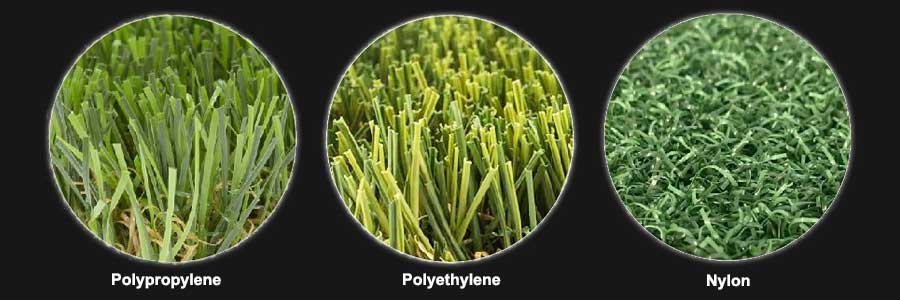
The yarn (grass fiber) is the most visible part of the turf. Football turf yarn is usually made from Nylon (PA), Polypropylene (PP), or Polyethylene (PE).
- Nylon (Polyamide, PA):
Known for high strength, hardness, and abrasion resistance. It offers good low-temperature performance, but has poor dyeing properties. Mostly used in premium indoor football turf.- Its naming is determined by the specific number of carbon atoms in the synthetic monomer, such as Nylon-6, 66, 1010, 610, etc. It is characterized by high crystallinity and a distinct melting point; high surface hardness, wear resistance, a low coefficient of friction, self-lubrication, and noise reduction.
- It has good low-temperature performance and a certain degree of heat resistance (can be used below 100 degrees Celsius). It is non-toxic, odorless, and does not mildew.
- It is self-extinguishing, has good weather resistance, but poor dyeability.
- Polipropilena (PP):
Lightweight and low-cost, with good stiffness and fatigue resistance. However, it has weaker low-temperature resistance and is less common in football field turf today.- The non-toxic, odorless, odorless, milky white and highly crystalline polymer has a density of only 0.90~0.91g/cm3, making it one of the lightest varieties of all plastics at present. It is particularly stable to water, and its water absorption rate in water for 24 hours is only 0.01%, and its molecular weight is about 80,000 to 150,000.
- The most prominent performance is its resistance to bending fatigue, good support performance, and its dry friction coefficient is similar to nylon, but it is not as good as nylon under oil lubrication. Poor low temperature resistance (minimum service temperature can reach -30℃)). For example, this material is not recommended for use in severe cold areas in Canada.
- Polietilena (PE):
The most widely used material in modern football turf manufacture. It is soft, UV-resistant, durable, and offers natural grass-like elasticity—ideal for FIFA turf systems.- It has excellent low temperature resistance (the minimum operating temperature can reach -70~-100℃), good chemical stability, can withstand the corrosion of most acids and alkalis (not resistant to acids with oxidation properties), is insoluble in general solvents at room temperature, has low water absorption, good anti-aging performance, excellent electrical insulation performance, and has the elasticity of natural lawns. It is an excellent material for artificial turf grass silk.
- It has excellent low temperature resistance (the minimum operating temperature can reach -70~-100℃), good chemical stability, can withstand the corrosion of most acids and alkalis (not resistant to acids with oxidation properties), is insoluble in general solvents at room temperature, has low water absorption, good anti-aging performance, excellent electrical insulation performance, and has the elasticity of natural lawns. It is an excellent material for artificial turf grass silk.
Turf Yarn Shape
The turf shape directly impacts ball roll, resilience, and player safety. Common shapes include:
- Flat fiber (extruded tape yarn) – widely used in astro turf football field installations. Straight grass is divided into: extruded flat wire, single wire yarn, and mesh wire。
- Extruded flat fiber is currently the commonly used grass silk structure in football grass worldwide
- Process: Use a special extrusion process to form at one time. The grass silk is round and full, and the edges and corners are moderately twisted. Monofilament fibers are individually squeezed from a machine called a spinneret. Each grass wire is independently processed, so that different shapes of grass wire can be produced.
- Features : full, soft, good anti-abuse and burn effect, good anti-aging and wear resistance. The grass seedlings are plump and soft in shape, which can effectively reduce abrasions and burns on the skin of athletes; the lawns have excellent anti-ultraviolet, anti-aging, and wear resistance.
- Application : Suitable for 5-side football stadiums, 7-side football stadiums, 11-side football stadiums, hockey stadiums, and multi-functional sports venues.
- Grass fiber shape: S, U, W, sword, willow leaves, arc shape, hollow grass, olive shape. Representative products: MT-JCUX, MT-JCWX (U and W-type grass), U and W-type structure grass filament leaf wings produce natural coiling force, enhancing the elasticity and flexibility of grass filament; U and W-type groove water storage channels can retain a certain amount of moisture, naturally adjust the blade temperature, and have good grass filament elasticity and flexibility.
- Monofilament yarn – each fiber is extruded individually, allowing various shapes. Standard in professional 11-a-side 3G pitches.
- Fibrillated yarn (mesh-like) – outdated; once common, but now avoided in modern football fields due to poor durability.
Contoh: U- and W-shaped fibers create natural resilience and heat regulation, maintaining upright performance even in heavy play.

Turf Yarn Performance Factors
When evaluating different types of football turf, performance standards include:
- Tensile Strength: minimum elongation of 15% (longitudinal) and 8% (transverse).
- Abrasion Resistance: linked to DTEX weight—higher DTEX = stronger fibers.
- Anti-static Properties: reduces friction-based static buildup.
- UV Resistance & Aging: ensures long life under sunlight.
- Flame Retardancy: delays fire spread, critical for stadium safety.
Grass Pile Height :
Grass height refers to the height of the grass silk from the base backing, in millimeter units.
The range of height can be achieved: 10mm-60mm, and the commonly used specifications are 10mm, 20mm, 25mm, 30mm, 35mm, 40mm, 50mm, and 60mm. The height of artificial turf grass for football fields is 40mm-60mm or more, and the height of artificial turf grass for casual decoration is generally less than 40mm. The height of artificial turf grass depends on the purpose of the site.
- 40–45 mm → training grounds, 5-a-side and 7-a-side pitches.
- 50–60 mm → professional football field turf for 11-a-side matches. Applied international football matches, hockey, and grassball. Used for general training purposes, badminton, volleyball, and even as a track.
Football Turf Backing
The turf backing provides dimensional stability and binds turf yarns. Common types:
- Double-layer Backing: PP woven cloth + mesh reinforcement (standard in most football pitches).
- Triple-layer Backing: PP woven + nonwoven + mesh (reinforced edition, used in FIFA-certified stadiums).
The quality of backing determines tear resistance, water permeability, and lifespan of synthetic turf sport systems.
Football Turf Coating
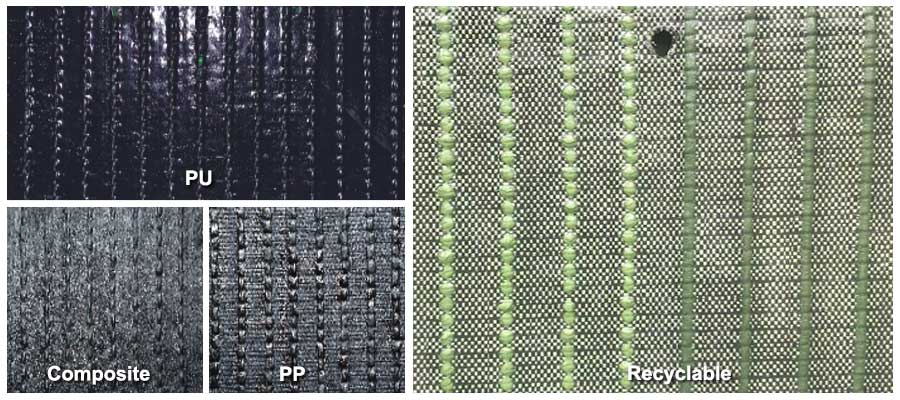
The coating secures fibers into the backing. Main types:
- SBR Latex (Styrene-Butadiene Rubber): traditional, cost-effective, widely used.
- It is generally prepared by emulsion polymerization, such as polybutadiene latex, styrene butadiene latex, etc. It is mainly used in industrial departments such as carpet, papermaking, textile, printing, coatings and adhesives.
- It is generally prepared by emulsion polymerization, such as polybutadiene latex, styrene butadiene latex, etc. It is mainly used in industrial departments such as carpet, papermaking, textile, printing, coatings and adhesives.
- PU Coating (Polyurethane): lightweight, flexible, eco-friendly, higher cost.The PU has four major features:
- First: PU backing football Turf is very light. The density is only 1.25, slightly larger than that of water. It also has fireproof, waterproof, mothproof, mildewproof, crack-proof and other properties. It is very suitable for indoor and outdoor decorative materials. It is a new green decorative material.
- Second: easy to process. PU products can be nailed, sawed, planed, milled, bent, etc., and can be used indoors and outdoors without cracking, deformation, or insects.
- Third: environmental protection. Because of the use of synthetic fiber as raw materials, forest deforestation is reduced and the standards for non-toxic and harmless green products can be met.
- Fourth: waterproofness. It is non-absorbent, non-water-seepage, non-deforming, and is anti-mold.
- Recyclable Coating: advanced innovation supporting sustainable football turf manufacture and compliance with global recycling policies.
Coating Process:
Turf is passed through coating machines, glue is applied, excess is removed, then dried in heating tunnels. This locks yarns firmly and preserves upright memory effect, critical for long-term football turf performance.
Identify the Quality of Football Turf – Yarn, Turf Backing, and Turf Coating
How to distinguish virgin vs recycled material?
Use the burn-and-draw test: ignite the yarn and use the ash to draw on white paper.
- Black-purple line → Virgin material
- Green line → Recycled material (due to unstable color molecules, prone to fading).
Observation 1: Whether the Turf Yarn Uses 100% Virgin Material
High-quality football turf yarn should be produced from virgin, high-purity PP and PE materials, modified in a single process to ensure stability. Fiber Dtex should range between 8,800–11,000 DTEX. During the football turf manufacture process, anti-UV, antioxidant, anti-static, and anti-laydown additives are included, ensuring a lifespan of at least six years without premature aging, abrasion, or fading.
Observation 2: Turf Yarn Hand Feel and Surface Smoothness
- Premium soccer turf yarn feels smooth, elastic, evenly colored, and soft in appearance, with neat cuts and no burrs.
- Inferior products feel rough, dry, and prickly; show uneven color, thin transparency, and irregular edges. With simple materials and missing additives, their quality and safety cannot be guaranteed.
Observation 3: Turf Yarn Resilience, Uprightness & Abrasion Resistance
- High-quality football turf types should recover quickly after pressure, ensuring safety and performance for athletes.
- MightyGrass artificial football turf offers superior uprightness through innovative turf shape design (S, U, W, oval fibers), improving natural aesthetics.
- Verified by FIFA turf laboratory tests (LABOSPORT): over 500,000 abrasion cycles, guaranteeing durability and long lifespan of synthetic football turf.
Observation 4: Turf Backing Stability
- PP woven cloth + nonwoven fabric (60g) + mesh backing (MightyGrass standard) is superior to simple PP woven + mesh backing commonly found in the market.
- The nonwoven layer enhances glue absorption during the turf coating process, ensuring better stability and bonding of the entire football field turf system.
Observation 5: Turf Coating Quality
- Premium turf coating uses composite elastic structures (1.5–2mm thick), processed with high-temperature vulcanization formulas.
- PU coating is superior to normal latex, offering stronger penetration, non-solubility, and improved yarn pull-out resistance.
- A reliable football turf coating should appear glossy, uniform, without cracks or delamination when bent.
MightyGrass rumput sukan adopts eco-friendly, high-quality coating solutions. No cracking, no detachment, with strong corrosion resistance, ensuring long-lasting stability for football turf manufacture.
Kesimpulan:
Evaluating football turf types requires checking turf yarn (virgin material, smoothness, resilience), turf backing (layer strength), and turf coating (adhesion & durability). With the right sports turf system, contractors and clubs can guarantee safe play, long lifespan, and compliance with FIFA turf standards.
Types of Football Turf Systems
Modern football turf is often described by generation systems (3G, 4G, 5G):
- 3G Turf (Infill System):
Uses sand + rubber infill for stability. Most common for outdoor football field turf and FIFA-approved pitches. - 4G Sports Pitch (Non-Infill System):
No loose infill material. Cleaner, lower maintenance, suitable for indoor football turf and futsal courts. - 5G Eco Turf (Recyclable Systems):
Next-generation, recyclable with innovative backing and coating. Meets future Padang FIFA sustainability standards.
How to Choose 3G, 4G, and 5G Football Turf Based on Yarn, Backing, and Coating
| Dimensi | 3G Infill Football Turf | 4G Non-Infill Football Turf | 5G Recyclable Football Turf |
| Turf Yarn (Grass Fiber) | – Usually PE monofilament fibers with S, U, W shapes.- Requires infill support for resilience.- Ball roll is natural, suitable for football field turf. | – Dense high-DTEX monofilament yarns, stronger upright memory.- No infill needed, so yarn must handle resilience alone.- Popular for indoor football turf and futsal. | – Advanced eco-friendly yarns with recyclable materials.- Includes anti-UV, anti-static, and improved elasticity.- Meets FIFA turf sustainability standards. |
| Turf Backing | – Standard double-layer PP + mesh backing.- Ensures strength when infill is present. | – Enhanced triple-layer backing for higher stability without infill.- Prevents turf deformation in non-infill football turf types. | – Innovative recyclable backing, compatible with yarn and coating recycling.- Designed for long-term synthetic turf football fields. |
| Turf Coating (Glue) | – Usually SBR latex coating, cost-effective.- Works well with infill systems, widely used in schools & clubs. | – PU coating preferred for better yarn pull-out force and clean finish.- Needed for heavy indoor and multipurpose rumput sukan. | – Recyclable PU or hot-melt coating, eco-friendly.- Supports full recycling of football turf manufacture waste. |
Key Tips:
- 3G Football Turf: Best for traditional outdoor pitches with infill, durable and FIFA-approved.
- 4G Football Turf: Clean, low-maintenance choice for indoor football turf or futsal; relies on strong yarn and coating.
- 5G Football Turf: Future-proof, recyclable, eco-friendly system; ideal for sustainable

football field turf projects and FIFA-certified stadiums.
Choosing the Right Football Turf Type
| Football Turf Type | Structure | Kebaikan | Keburukan | Aplikasi |
| 3G Infill Turf | Sand + Rubber infill | Realistic bounce, durable | Requires infill top-up | Stadiums, schools, training fields |
| 4G Non-Infill Turf | Dense monofilament yarn, no infill | Low maintenance, clean | Less natural ball roll | Indoor pitches, futsal, small-sided |
| 5G Recyclable Turf | Recyclable yarn + backing + coating | Eco-friendly, sustainable | Higher cost | FIFA projects, eco-certified sports facilities |
Kesimpulan
Memahami football turf types helps contractors, clubs, and schools choose the right system. From PE-based monofilament yarns ke triple-layer backings dan PU or recyclable coatings, each component defines the performance of a synthetic turf football field.
When selecting a supplier, always consider:
- Experience of the pembuat rumput tiruan bola sepak
- Compliance with Pensijilan rumput FIFA
- Innovation in eco-friendly turf backing and coating
A reliable partner ensures your sports turf project delivers safety, performance, and long-term value.
FAQ: Choosing the Right Football Turf Types
What makes MightyGrass football turf yarn different from other manufacturers?
MightyGrass uses imported polyethylene (PE) from Saudi Arabia and advanced additives (anti-UV, anti-static, anti-aging). This ensures our football turf yarn offers superior resilience, durability, and lifespan compared to standard rumput bola sepak buatan.
How does turf yarn material affect football turf types?
Nylon yarn is strong but less common in outdoor football field turf, PP yarn is cost-effective but weaker in cold weather, while PE yarn is the most popular for rumput sukan due to its softness and UV resistance. MightyGrass focuses on PE-based yarns to meet FIFA standards.
What turf shapes are available in MightyGrass football turf manufacture?
We produce multiple turf shape designs, including S, U, W, and oval fibers. U and W shapes provide natural resilience and uprightness, making them ideal for rumput bola sepak and professional football field turf.
How can you tell if football turf yarn is virgin or recycled material?
Ber mutu tinggi football turf yarn should be made from virgin materials. MightyGrass uses the burn-and-draw test to verify raw material purity, ensuring no recycled plastics are used in our synthetic football turf manufacture.
What is the role of turf backing in football turf types?
Turf backing provides stability and bonding strength for the entire system. MightyGrass offers double-layer PP + mesh backing for standard rumput padang bola sepak dan triple-layer backing for FIFA-certified synthetic turf football fields.
How does MightyGrass improve turf coating durability?
Kami football turf coating uses PU or eco-friendly recyclable coatings. This ensures higher yarn pull-out resistance, better elasticity, and long-term stability, unlike conventional SBR latex used by many suppliers.
Which football turf type is best for indoor projects?
Indoor football turf usually requires 4G non-infill turf. MightyGrass designs dense monofilament yarns with triple-layer backing and PU coating, ensuring low maintenance and clean play surfaces for futsal and gyms.
What makes MightyGrass 5G recyclable football turf unique?
MightyGrass is one of the first manufacturers in China to launch 5G recyclable football turf types. With recyclable yarns, backings, and coatings, our synthetic football turf meets future FIFA turf sustainability standards.
How does MightyGrass ensure abrasion resistance in football field turf?
Kami football turf yarns are tested with 500,000 abrasion cycles (LABOSPORT standard). With DTEX values between 8,800–11,000, the yarn ensures excellent wear resistance for professional football field turf.
Why is PU turf coating better than SBR latex?
PU coating in rumput sukan provides stronger adhesion, higher elasticity, and better resistance to cracking. MightyGrass uses PU and recyclable coatings for premium rumput bola sepak buatan, ensuring longer lifespan.
What backing system does MightyGrass recommend for FIFA turf projects?
For high-performance Lapisan rumput bola sepak FIFA, MightyGrass recommends triple-layer turf backing (PP woven + nonwoven + mesh). This ensures superior glue absorption during coating and maximum dimensional stability.
How do MightyGrass football turf types compare for 3G, 4G, and 5G pitches?
- 3G Football Turf: PE yarn + SBR coating + double-layer backing, ideal for traditional football field turf with infill.
- 4G Football Turf: Dense monofilament yarn + PU coating + triple-layer backing, perfect for indoor football turf.
- 5G Football Turf: Eco yarn + recyclable coating + recyclable backing, the future of sustainable synthetic football turf manufacture.