Bahasa Melayu
  English
  العربية
  Español
  Deutsch
  Français
  Português
  Русский
  日本語
日本語  Italiano
  Nederlands
  Svenska
  Suomi
Suomi  ไทย
ไทย  Dansk
Dansk  Ελληνικά
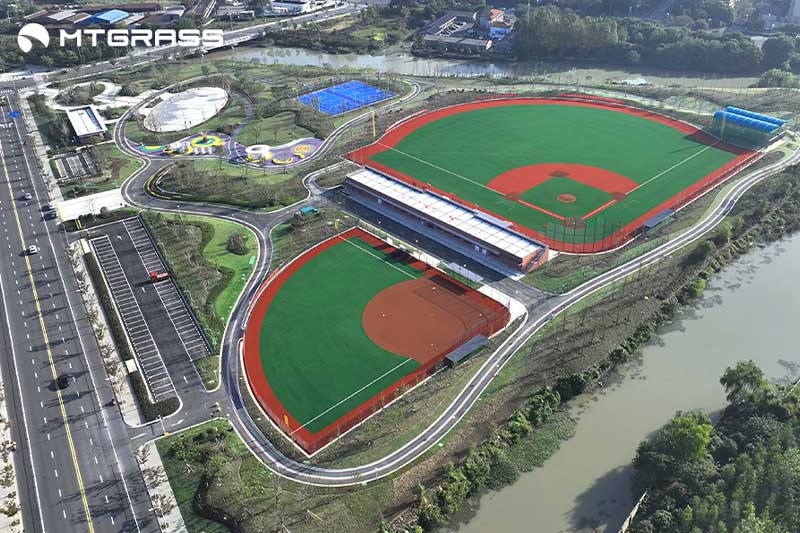
Besbol dan sofbol mungkin kelihatan serupa pada pandangan pertama, tetapi sebaik sahaja anda melangkah ke padang, perbezaannya menjadi jelas. Daripada saiz bola dan gerakan melempar hingga susun atur padang dan strategi permainan, setiap sukan mempunyai identiti dan tuntutan prestasi tersendiri. Dan jika anda sedang membina atau menaik taraf padang (terutamanya dengan rumput tiruanMemahami perbezaan antara softball dan besbol bukan sahaja berguna, malah amat penting.
Sebagai pemilik kemudahan, kontraktor, atau pengarah program sukan, anda memerlukan sistem padang yang menyokong permainan yang konsisten, pergerakan atlet yang selamat, dan ketahanan jangka panjang. Besbol dan sofbol bergantung pada bentuk kawasan dalam padang yang sangat berbeza, zon pengukuhan rumput, dan interaksi bola dengan permukaan. Mengetahui perbezaan teras membolehkan anda membina padang yang berfungsi tepat seperti yang dijangkakan oleh atlet.
Dalam panduan ini, anda akan menemui perbezaan utama antara besbol dan sofbol, serta bagaimana perbezaan tersebut diterjemahkan secara langsung kepada reka bentuk padang yang lebih bijak dan pemilihan sistem rumput.
Sejarah Besbol dan Sofbol
Besbol muncul pada pertengahan abad ke-19 sebagai hiburan kebangsaan Amerika, berkembang daripada perlawanan kelab tidak formal menjadi sukan profesional sepenuhnya yang diatur oleh Major League Baseball (MLB). Peraturannya, saiz padang, kelajuan lontaran, dan struktur permainan berkembang selama beberapa dekad, akhirnya membentuk susun atur padang berlian moden yang anda lihat hari ini.
Softbol, sebaliknya, bermula pada tahun 1887 sebagai versi besbol dalaman musim sejuk. Lama-kelamaan, ia berkembang menjadi sukan luar yang pantas dengan peraturan, peralatan, dan dimensi padang tersendiri. Laluan pangkalan yang lebih pendek, bola yang lebih besar, dan lontaran kincir angin bawah tangan yang menjadi ciri khas memberikan softbol gaya uniknya, mengutamakan tindak balas pantas dan pergerakan bertempo tinggi.
Apabila kedua-dua sukan ini berkembang secara global di sekolah, kolej, perbandaran, dan liga kompetitif, permintaan untuk padang yang lebih selamat dan boleh digunakan dalam semua cuaca meningkat. Hari ini, banyak organisasi memilih rumput sintetik untuk mengekalkan kebolehmaian permainan yang konsisten dan mengurangkan penyelenggaraan, terutamanya dalam iklim yang mengalami hujan lebat atau pendedahan sinaran UV yang tinggi. Seterusnya, mari kita teliti perbezaan antara besbol dan sofbol.
Saiz Bola Softball vs. Bola Besbol
Salah satu perbezaan paling ketara antara kedua-dua sukan ini ialah bola itu sendiri, dan bola softball jauh lebih lembut daripada bola besbol.
Saiz Bola Besbol
- Diameter: ~2.86–2.94 inci (7.3–7.5 cm)
- Berat: ~5–5.25 oz (142–149 g)
- Terasa: Pusat gabus/getah dengan benang yang digulung kemas
Biasanya berwarna putih, saiz bola besbol direka untuk lontaran berkelajuan tinggi melebihi 90 batu sejam dan pukulan jarak jauh.
Saiz bola softball
- Diameter: ~3.8–4.1 inci (9.7–10.2 cm)
- Berat: ~6.25–7 oz (177–198 g)
- Bahagian luaran berwarna kuning fluorescent.
Luas permukaan yang lebih besar meningkatkan rintangan, menjejaskan pergerakan pitch dan masa tindak balas.

Pukulan softball vs. pukulan besbol
Walaupun pemukul mungkin kelihatan seperti peralatan yang mudah, pembinaannya mencerminkan dinamik pemukulan yang sangat berbeza antara besbol dan sofbol.
Pukulan besbol
- Panjang: Panjang maksimum boleh mencapai 42 inci
- Diameter laras: sehingga 2⅝ inci
- Bahan: Kayu (MLB), Aluminium, atau Komposit Serat Karbon (remaja & kolej)
Pukulan softball
- Panjang: Panjang maksimum boleh mencapai 34 inci
- Diameter laras: Biasanya 2¼ inci
- Bahan: Kayu, Aluminium atau Komposit Serat Karbon
Walaupun terdapat perbezaan dalam panjang maksimum, panjang pemukul yang paling biasa digunakan dalam kedua-dua sukan adalah antara 32 dan 34 inci. Dan pemain dalam liga besbol profesional mesti menggunakan pemukul kayu (seperti maple, birch).
Pengukuran Padang Softbol vs. Besbol
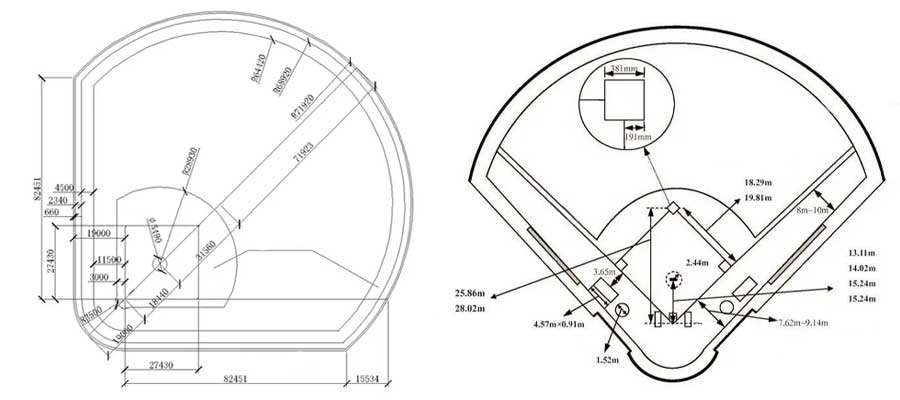
Bentuk dan saiz kawasan dalam padang
Ukuran Padang Besbol: Padang besbol piawai berbentuk kipas bersudut tegak. Infieldnya adalah rombus dengan sisi sepanjang 27.43 meter. Batas kiri dan kanan outfield sekurang-kurangnya 99.06 meter, dan tengah outfield sekurang-kurangnya 121.92 meter, dengan keluasan keseluruhan kira-kira 9,500 meter persegi atau lebih.
Ukuran Padang Softball: Padang softball piawai juga berbentuk kipas bersudut tegak, tetapi kawasan dalam padang adalah segi empat sama yang mengukur 18.3 meter (60 kaki) pada setiap sisi. Titik paling jauh garisan homerun adalah sekurang-kurangnya 60.96 meter (200 kaki) dari hujung home plate.
| Item | Padang Sofbol | Padang Besbol |
| Panjang sisi dalam padang | 18.3 m | 27.43 m |
| Jarak lontaran | 13.10 m | 18.44 m |
| Jarak Garis Home Run | 60.96–68.58 m | 99.06 m atau lebih |
| Jumlah kawasan | Anggaran 8,000–12,000 m² | Anggaran 10,000–15,000 m² |
Pinggan pelempar dan kotak pelempar
Ukuran Padang Besbol: Piring pelempar diperbuat daripada getah putih, panjang 61 sentimeter dan lebar 15 sentimeter. Perlu ada platform selebar 86.4 sentimeter dan sepanjang 152 sentimeter mengelilingi piring pelempar. Piring pelempar hendaklah rata dengan platform. Piring pelempar dan platform mesti 25 sentimeter lebih tinggi daripada piring rumah. Alur pelempar, sebuah bukit berbentuk belakang kura-kura dengan diameter 5.48 meter (terpusat 46 sentimeter tepat di hadapan tengah piring pelempar), ialah kawasan pelemparan. Cerun di hadapan piring pelempar hendaklah bermula 1.83 meter ke hadapan dari tepi platform, menurun sebanyak 2.54 sentimeter setiap 30.5 sentimeter ke hadapan. Cerun ini hendaklah konsisten di semua padang.
Ukuran Padang Softball: Piring pelempar diperbuat daripada getah, sepanjang 60 sentimeter dan lebar 15 sentimeter, dan rata dengan tanah. Satu bulatan dengan jejari 2.5 meter dilukis dengan titik pusat di hujung hadapan piring pelempar; keliling bulatan ini juga termasuk dalam lekukan pelempar.
Pitching Sofbol vs. Besbol
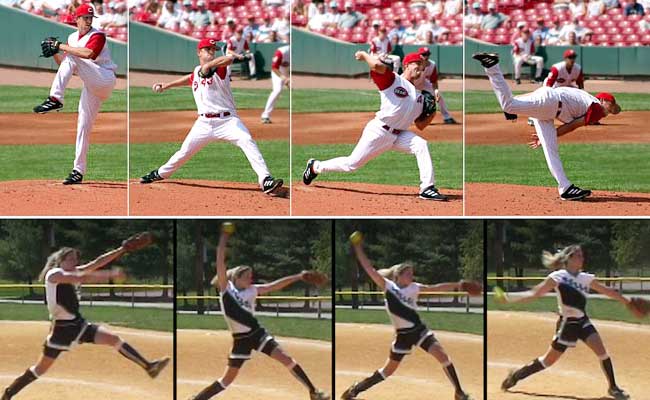
Salah satu perbezaan paling ketara dan jelas antara softball dan besbol terletak pada cara pelempar melempar bola. Secara ringkas, pelempar besbol menggunakan lontaran atas atau sisi, manakala pelempar softball menggunakan lontaran bawah. Selain itu, pemain besbol melempar dari bukit pelempar yang tinggi dan padat, manakala pemain softball melempar dari bulatan pelempar rata yang ditetapkan.
Dalam softball, pelempar melempar dari jarak hanya 13 meter, dan kelajuan bola boleh melebihi kira-kira 97 km/j pada alat ukur kelajuan. Dalam baseball, jarak antara pelempar dan pemukul ialah 18.6 meter, dan kelajuan bola biasanya sekitar 145 km/j. Walaupun bola pelempar baseball bergerak lebih laju, perbezaan kelajuan bola antara kedua-dua sukan itu tidak ketara disebabkan jarak yang lebih dekat dalam softball.
Berapa banyak inning dalam permainan softball dan besbol?
Perlawanan besbol kolej dan profesional dimainkan dalam sembilan inning, manakala perlawanan softball dimainkan dalam tujuh inning (jika keputusan seri, masa tambahan boleh dimainkan). Walau bagaimanapun, perlawanan softball boleh berakhir lebih awal jika satu pasukan mempunyai kelebihan besar, seperti kelebihan 15 larian selepas tiga inning atau kelebihan 7 larian selepas lima inning (dalam softball NCAA, pasukan boleh menamatkan perlawanan lebih awal jika mereka mendahului dengan sekurang-kurangnya lapan larian selepas lima inning).
Berapa ramai pemain dalam softball dan besbol?
Besbol, tanpa mengira tahap persaingan, mempunyai sembilan pemain luar padang: pelempar, penangkap, pemain pangkalan pertama, pemain pangkalan kedua, pemain pangkalan ketiga, pemain tengah padang, pemain luar padang kiri, pemain luar padang tengah, dan pemain luar padang kanan. Kecuali liga membenarkan pemukul menggantikan pelempar, kesemua sembilan pemain akan memukul.
Softbol: Selain pemain di padang besbol, terdapat seorang lagi pemain luar, menjadikan sepuluh pemain luar keseluruhannya. Pasukan juga boleh menambah sehingga dua pemain lagi ke susunan pemukul mereka.
Sarung Tangan Besbol vs. Sofbol
Kerana besbol dan sofbol menggunakan saiz bola yang berbeza, saiz sarung tangan yang digunakan untuk menangkap bola juga berbeza.
Terdapat poket di antara ibu jari dan jari telunjuk sarung tangan yang digunakan untuk menangkap bola. Oleh kerana bola softball lebih besar, poket itu lebih dalam dan lebih besar berbanding sarung tangan besbol, satu ciri khas sarung tangan softball.
Apabila membeli sarung tangan, kadang-kadang ia dilabel sebagai sarung tangan "softball/softball gabungan" atau "softball/hardball gabungan", dan sebagainya. Pilih mengikut keperluan anda.

Besbol vs. Sofbol: Ketinggian timbunan rumput tiruan
Besbol dan sofbol telah dimainkan di atas rumput dan tanah sejak permulaan mereka, dan sehingga hari ini, sukan-sukan ini kebanyakannya dimainkan di atas rumput. Walau bagaimanapun, bermain besbol dan sofbol di atas rumput tiruan bukanlah sesuatu yang luar biasa. Sebagai contoh, Chase Field, tempat kelab Arizona Diamondbacks dalam MLB, bertukar daripada rumput semula jadi kepada rumput tiruan pada tahun 2019; Golden Eagle Regional Park di Nevada, sebuah kompleks sukan pelbagai guna yang besar, mempunyai beberapa padang besbol dan sofbol (termasuk liga belia/dewasa, perlawanan besar, acara komuniti, dan lain-lain) dengan keluasan rumput kira-kira 1.4 juta kaki persegi. Rumput tiruan hampir menggantikan rumput semula jadi kerana prestasinya sama atau bahkan lebih tahan lama, dan kos penyelenggaraannya lebih rendah. Jika anda juga menggunakan rumput sintetik di padang besbol dan sofbol anda, kami mengesyorkan anda mempertimbangkan perbezaan ketinggian serat rumput antara rumput tiruan untuk besbol dan sofbol.
Besbol Standard Ketinggian Timbunan
Norma industri yang digunakan di seluruh NCAA, NFHS, dan padang sintetik profesional:
| Kawasan | Ketinggian Longgokan | Bimbingan Profesional |
| Lapangan luar | 40–55 mm | Meniru rasa rumput semula jadi; putaran bola yang stabil |
| Rumput dalam padang | 35–45 mm | Mengurangkan kelajuan untuk bola di tanah; hentian yang lebih selamat |
| Lorong pangkalan / Bukit pelempar / Kotak pemukul | 20–30 mm | Tahan lasak, tapak yang kukuh, pantulan yang tepat |
| Lorong Amaran | 15–25 mm | Memberi kontras sentuhan & perlambatan yang selamat |
Sofbol Standard Ketinggian Timbunan
Digunakan secara meluas dalam acara WBSC, sofbol NCAA, dan kompleks fastpitch elit:
| Kawasan | Ketinggian Longgokan | Bimbingan Profesional |
| Lapangan luar | 35–45 mm | Sedikit lebih rendah berbanding besbol kerana saiz padang |
| Rumput dalam padang | 30–40 mm | Laju lebih pantas; meminimumkan lompatan yang tidak dapat diramalkan |
| Permukaan dalam padang / Laluan pangkalan | 18–28 mm | Kekerasan dan kawalan seperti tanah liat |
| Lingkaran Pelempar | 20–26 mm | Ketumpatan tinggi; mencegah pergeseran stud |

Mengapa memilih rumput tiruan MightyGrass untuk padang besbol dan sofbol?
Apabila anda memilih MightyGrass Dengan padang rumput tiruan untuk besbol dan sofbol, anda memilih permukaan yang direka untuk tindak balas bola yang tepat, perlindungan atlet, dan prestasi jangka panjang. Anda mendapat sistem yang direka berdasarkan tiga teras utama: benang berketahanan tinggi, lapisan sokongan yang diperkuat, dan bahan pengisi yang selamat serta stabil, semuanya dibina untuk memenuhi keperluan padang besbol dan sofbol kompetitif di seluruh dunia.
Struktur gentian rumput (Bentuk Intan / Bentuk U / Bentuk S / Bentuk W):
- Struktur separa berkedut: Mengurangkan geseran permukaan dan meningkatkan konsistensi kelajuan bola.
- Reka bentuk rusuk berbilang pusat: Meningkatkan memori serat rumput dan mengekalkan kedudukan tegak.
- Peningkatan 20–30% dalam anti-penggumpalan dan ketahanan terhadap abrasi: Menyesuaikan diri dengan gelungan pangkalan yang kerap, larian pecut, dan hentian mengejut.
- Serat pilihan dua atau tiga warna: Memberi penampilan rumput semula jadi yang realistik.
Kain asas poliester berketumpatan tinggi (struktur lapisan berganda atau bertiga PP/Poliester)
- Menjaga daya tarikan kuat bagi serat rumput.
- Memberi kestabilan permukaan yang sekata.
Lem PU atau lapisan belakang boleh dikitar semula.
- Sifar VOC.
- Ketahanan hidrolisis yang lebih tinggi, tidak hancur menjadi serbuk di kawasan basah.
- Ketahanan cuaca yang tinggi, ketahanan sinaran UV yang unggul dan sifat anti-penuaan.
Berbanding dengan lapisan lateks SBR tradisional, pelekat PU MightyGrass atau lapisan belakang boleh dikitar semula menawarkan ketahanan yang dipertingkatkan sebanyak 30–50%, kestabilan dimensi yang lebih baik, dan pengecutan serta pengembangan terma yang dikurangkan.
Kesimpulan
Besbol dan sofbol berkongsi akar yang sama, tetapi perbezaan antara kedua-duanya menentukan cara atlet bergerak, tingkah laku bola, dan reka bentuk padang. Daripada saiz bola dan gaya lontaran hingga susun atur padang dan dinamik kawasan dalam padang, setiap sukan memerlukan sistem rumput khas yang memberikan keselamatan, konsistensi, dan prestasi berkekalan.
Dan apabila anda bekerjasama dengan MightyGrass, anda akan mendapat padang yang direka khas untuk memenuhi tuntutan tersebut—diperbuat dengan teknologi benang canggih, sistem sokongan tahan lama, dan prestasi khusus sukan yang terbukti serta dipercayai jurulatih dan pemain.
Soalan Lazim
Apakah bahan yang digunakan dalam rumput tiruan untuk padang besbol dan sofbol?
Rumput tiruan untuk padang besbol/softbol terdiri daripada beberapa lapisan. Lapisan paling bawah biasanya terdiri daripada kerikil atau pasir. Daun rumput MightyGrass diperbuat daripada gentian nilon, polipropilena, atau polietilena berkualiti tinggi dan diikat pada lapisan sokongan poliester. Isiannya boleh berupa pasir silika, getah granul, atau campuran kedua-duanya, membantu gentian berdiri tegak sambil menyerap hentakan dan memberikan sokongan.
Adakah rumput tiruan sesuai untuk padang besbol dan sofbol?
Sudah tentu. Rumput tiruan tidak popular pada awal 1960-an kerana ia merupakan punca utama kecederaan atlet pada masa itu. Permukaannya mempunyai penyerapan hentakan yang lemah, mengakibatkan impak yang lebih besar, termasuk daripada terjatuh dan berlari. Pada masa kini, kebimbangan utama keselamatan dengan generasi terkini rumput tiruan ialah prestasi penebat haba dalam iklim panas dan bahan kimia yang terkandung dalam pengisi getah.
Dengan penambahbaikan berterusan pada serat, bahan pengisi, dan bahan asas, keselamatan rumput tiruan telah bertambah baik dari tahun ke tahun. Rumput tiruan menawarkan ketahanan, cengkaman, dan penyerapan hentakan yang unggul, mewujudkan padang permainan yang lebih selamat.
Stadium Besbol Yokohama dan Stadium Besbol Fukushima Azuma, venue bagi perlawanan besbol dan sofbol di Sukan Olimpik Musim Panas Tokyo 2020, kedua-duanya telah diubah menjadi rumput tiruan.
Apakah kelebihan rumput tiruan berbanding rumput semula jadi?
Rumput tiruan menawarkan beberapa kelebihan berbanding rumput semula jadi dalam besbol dan sofbol:
- Kestabilan: Rumput tiruan menyediakan permukaan permainan yang lebih stabil kerana ia tidak mudah dicungkil atau rosak seperti rumput semula jadi. Ini juga menghasilkan penampilan yang lebih sekata.
- Ketahanan: Rumput tiruan boleh menahan jumlah trafik yang tinggi dan keadaan cuaca melampau.
- Penyelenggaraan: Rumput tiruan lebih murah dan lebih mudah diselenggara berbanding rumput semula jadi dan tidak memerlukan rawatan kimia.
Pasukan MLB mana yang menggunakan rumput tiruan?
Pada masa ini, lima pasukan Liga Utama Besbol (MLB) bermain di padang rumput tiruan:
- Arizona Diamondbacks – Chase Field, Phoenix, Arizona
- Toronto Blue Jays – Rogers Centre, Toronto, Ontario
- Tampa Bay Rays – Pure Connor Field, St. Petersburg, Florida
- Miami Marlins – Loandepot Park, Miami, Florida
- Texas Rangers – Universal Life Field, Arlington, Texas
Banyak tradisionalis percaya bahawa rumput semula jadi adalah padang terbaik untuk besbol, itulah sebabnya hanya lima pasukan MLB menggunakan rumput tiruan. Walau bagaimanapun, NCAA telah mula menggunakan rumput tiruan secara lebih meluas untuk padang besbol dan sofbol.
Berapa kos rumput tiruan untuk padang besbol atau softball?
Kos pemasangan rumput tiruan untuk padang besbol dan sofbol di Taman Sapsong biasanya antara $400,000 hingga $700,000. Walaupun pelaburan awal ini kelihatan besar berbanding rumput semula jadi, kos penyelenggaraan rumput tiruan jauh lebih rendah. Kos penyelenggaraan tahunan padang besbol buatan adalah kira-kira $5,000, manakala kos penyelenggaraan tahunan rumput semula jadi adalah kira-kira $20,000. Selain itu, rumput buatan boleh digunakan sepanjang tahun.