Bahasa Melayu
  English
  العربية
  Español
  Deutsch
  Français
  Português
  Русский
  日本語
日本語  Italiano
  Nederlands
  Svenska
  Suomi
Suomi  ไทย
ไทย  Dansk
Dansk  Ελληνικά

When we break down the cost of 40mm artificial grass, one thing becomes very the “soul” of the turf — the fiber material (PE, Nylon, or PP) — accounts for 45%–60% of the total cost, which equals about USD 1.3–1.7 per square meter. This single component determines most of the turf’s performance, durability, and lifespan.
The second major contributor is the backing system, which represents 12%–20% of the total cost. Climate differences in each country also influence backing selection. For example, South Africa performs better with PU backing, which offers superior heat resistance but comes at a higher cost.
Then there are the “invisible” cost items: primary backing, production energy, labor, quality control, and packaging. Individually, they seem small, but together they make up another 10%–20%, forming an essential part of the overall cost of a 40mm football turf system.
In the end, a factory-direct price of USD 2.5–3.9 per square meter for a Rumput tiruan 40mm is not only reasonable — it is fully aligned with global market standards.
If you truly want to understand the price of 40mm football turf, you don’t need to get overwhelmed by dozens of quotation sheets from different manufacturers.
Just remember this simple logic:
- The fiber determines the base cost.
- The backing determines stability.
- The density and Dtex determine lifespan.
- The supplier’s manufacturing capability determines how much you will ultimately spend.
Once you understand this framework, you will immediately know whether any quotation is reasonable or not.
What raw materials are used to produce 40mm artificial grass ?
The fiber material is the primary factor that determines the price of 40mm artificial grass. Fiber accounts for 50%–60% of the total cost per square meter, making it the largest component in the global artificial turf cost structure. In the artificial grass industry, the three most common fiber materials are Polyethylene (PE), Polypropylene (PP), and Nylon (Polyamide).
PE is the preferred choice for most sports and football turf contractors.
It provides superior softness, enhanced safety, better abrasion resistance, and more stable ball roll and rebound—meeting the performance requirements of the FIFA artificial turf system.
When wholesalers or sports facility contractors evaluate artificial turf, the first thing they must consider is the fiber material—because raw material cost determines the price, and fiber quality determines durability and lifespan. For a 40mm football pitch, PE monofilament yarn is always recommended, as it offers the best combination of sports performance and cost-effectiveness.
PP is currently the cheapest fiber material, which can significantly reduce turf manufacturing cost. However, PP is not suitable for football or sports turf, due to its lower abrasion resistance and weaker performance.
Most landscape grass and pet turf products use PP and typically last 1–2 years or even less, making it essentially a “short-term” or “disposable” turf material.
Nylon is the most expensive fiber in the industry, costing 2.5–3 times more than PE.
Its abrasion resistance is far superior to both PE and PP, and it maintains excellent structural integrity under extreme friction.
Nylon is widely used in high-end, high-performance applications, such as military training grounds, indoor sports facilities, and rumput putting green.
PE / PP / Nylon – Artificial Turf Fiber Comparison
| Material Type | Industry Positioning | Advantages (Professional Explanation) | Critical Drawbacks / Why It’s Not Suitable |
| PE (Polyethylene) | The global mainstream material for football pitches; FIFA-recommended; ideal for 40mm / 50mm / 60mm football turf | – Soft foot feel, safe, non-abrasive to skin- Excellent abrasion resistance for high-frequency training- Strong UV stability, suitable for high-sun regions like South Africa & the Middle East- Superior fiber resilience—stable ball roll and rebound- Low water absorption; does not deform with humidity- Moderate cost with the best price-performance ratio- Available in multiple Dtex options (8,000–12,000) to meet different budgets and project needs | – Slightly more expensive than PP- Not as extremely abrasion-resistant as Nylon (though fully sufficient for all football applications) |
| PP (Polypropylene) | The most economical fiber; widely used for landscape turf and for the thatch (curly layer) in landscaping products | – Lowest material cost; significantly reduces turf price- High stiffness, producing full and resilient thatch- Very low water absorption; does not swell- Stable processing performance and easy to manufacture | – Not soft; foot feel is stiff and uncomfortable- Poor abrasion resistance—fiber loss in 1–2 years- Weak UV stability—easily chalks or becomes brittle outdoors- Cannot meet football turf performance or durability requirements📌 Not suitable for real sports or football turf |
| Nylon (Polyamide) | Premium, high-performance fiber; used in golf putting greens, indoor athletic turf, and extreme-use applications | – Industry-leading abrasion resistance- Highest elasticity—recovers instantly after compression- Exceptional thermal stability- Long lifespan: 10–15 years- Ideal for extreme-use areas and putting greens | – Highest raw material cost (2.5–3× PE)- High moisture absorption—can be affected by humidity outdoors- Not suitable for large football fields; performance exceeds requirements and cost is too high- Firmer foot feel—not as comfortable as PE |
conclusion:Whether you are a sports field contractor or a landscape turf installer, PE remains the first-choice fiber, because it offers the best balance of safety, abrasion resistance, UV stability, and cost-effectiveness. PE is the gold standard of artificial turf、
PP is the economical choice for landscape grass、Nylon is the performance ceiling for high-end sports turf.
How does pile height affect the price of 40mm artificial turf?
The pile height of artificial grass refers to the vertical height of the turf fibers measured from the surface of the backing—essentially, the visible length of the green fibers above the base.
In football field construction, common specifications include FIFA 40mm artificial grass, FIFA 50mm artificial grass, and FIFA 60mm artificial grass.
In the United States, landscape turf commonly uses 45mm synthetic grass and 50mm synthetic turf, while rumput haiwan peliharaan typically uses 25mm pet grass.
In the artificial turf industry, pile height is one of the key factors that determine the price. Although it may seem like only the length of the fibers, it actually affects raw material consumption, manufacturing processes, installation methods, and long-term maintenance costs.
The higher the pile height, the more raw materials are required, and the higher the production cost becomes. At the same time, taller fibers mean that football fields require more infill materials, which increases both installation and after-sales maintenance costs.
40mm artificial grass is the global mainstream choice for schools and community sports fields because it offers the best balance between cost, ball roll, safety, and everyday maintenance.
50mm astro turf is more suitable for clubs seeking a professional training experience, while 60mm artificial turf is typically used only for official FIFA-level match fields.
As long as you choose the pile height based on the project application, you can always find the best balance between budget and performance.
Artificial Turf Pile Height — Cost Impact
| Ketinggian Longgokan | Impact on Production Cost | Impact on Installation Cost | Impact on Maintenance Cost | Typical Recommended Applications |
| 35–40mm | ✔ Lowest material usage✔ Lower fiber weight (1.0–1.2kg/m²)✔ Faster manufacturing → lowest cost | ✔ Minimal infill required (sand/rubber)✔ Lighter rolls → lower freight cost✔ Faster installation speed | ✔ Less rubber infill → easier maintenance✔ Fibers stand up more easily; lower brushing frequency | ⭐ School sports fields⭐ Community fields⭐ Multi-purpose sports grounds⭐ Children’s play areasBudget-friendly projects |
| 50mm | ▲ Increased material usage (1.3–1.6kg/m²)▲ Longer fibers → slower production▲ Cost increases by 15–25% | ▲ 30–40% more infill required▲ Heavier rolls → higher freight cost▲ Longer installation time | ▲ Requires more rubber infill → more frequent brushing▲ Medium maintenance cost | ⭐ Football club training fields⭐ Semi-professional fields⭐ High-frequency training environments |
| 60mm | ▲▲ Highest material usage (1.6–1.9kg/m²)▲▲ Slowest manufacturing▲▲ Highest production cost | ▲▲ 50–70% more infill required▲▲ Heavy rolls (4m × 25m ≈ 330–360kg) → highest freight cost▲▲ Most complex installation | ▲▲ Maximum rubber infill → higher maintenance▲▲ Highest brushing and infill-top-up frequency | ⭐ Professional football match fields⭐ FIFA Quality Pro systemsBudget-ample projects seeking top-tier performance |
How does Dtex (fiber thickness) influence 40mm turf pricing?
DTEX (Decitex) is the unit used to measure the thickness dan weight of artificial turf fibers. It indicates how many grams a 10,000-meter length of yarn weighs.
Untuk rumput sukan, the Dtex value typically ranges from 12,000–18,900, while landscape and leisure turf usually falls between 8,800–12,000 Dtex.
Dtex is one of the most critical technical parameters affecting the price, durability, and overall performance of artificial turf.
Many football turf contractors focus only on grass height and density, but the factor that truly determines the turf’s strength and lifespan is often Dtex — the thickness and weight of the fiber.
Even for the same 40mm artificial grass, different Dtex levels can create a 20%–30% price difference.
This is because higher Dtex means thicker fibers, more material consumption, and therefore higher production cost.
If your field has higher usage frequency, selecting a higher Dtex value is recommended. Thicker fibers provide better abrasion resistance, making the turf more durable for long-term sports use.
| Dtex | Fiber Thickness | Ketahanan abrasi | Jangka hayat | kos | Recommended Applications |
| 8000 Dtex | Fine | ★★★☆☆ | Sederhana | Low-cost | Community fields, budget training fields |
| 10000 Dtex | Standard | ★★★★☆ | Long | sederhana | Schools, community fields, multi-purpose sports grounds (most common) |
| 12000 Dtex | Thick & strong | ★★★★★ | Very long | Slightly higher | Club training fields, high-frequency sports fields |
| 13000–14000 Dtex | Very thick | ★★★★★+ | Extremely long | Paling tinggi | Special professional training fields, heavy-duty usage projects |
Kesimpulan
If the project is a school, community, or multi-purpose sports field, 10000 Dtex is the safest and most balanced choice.
If you are dealing with a club training ground or a high-frequency sports center, 12000 Dtex offers superior abrasion resistance, extending the turf’s lifespan by more than a year.
For entry-level or budget-sensitive projects, 8000 Dtex can still meet basic usage requirements.
In short, Dtex determines the thickness and durability of the fiber. Choosing the correct Dtex means choosing a turf system that lasts longer and delivers better long-term value.
What is the gauge in artificial grass, and why does it affect price?
The gauge refers to the horizontal spacing between two adjacent rows of turf fibers. It is usually measured in inches, with common gauge sizes for football turf and landscape turf being 3/4″, 5/8″, and 3/8″.
A narrower gauge means higher turf density, better abrasion resistance, and consequently a higher price.
Untuk rumput padang bola sepak, the most common gauges are:
- FIFA TURF: 3/4 inch
- High-end football training fields: 5/8 inch
Globally, approximately 95% of football turf uses a 3/4-inch gauge.
Untuk padang rumput besbol, the most common gauge is 5/8 inch, while some premium infield systems use 1/2 inch, which offers even higher density and higher cost.
Artificial Turf Gauge Selection
| Jenis Medan | Recommended Gauge | Reason |
| Football fields (40/50/60mm) | ⭐ 3/4 inch | Global standard, stable ball roll, cost-effective |
| Lapangan latihan kelab | 5/8 inch | Higher density, more durable |
| Baseball fields | ⭐ 5/8 inch | Shorter fibers + high-density requirements |
| Residential landscaping | ⭐ 3/8 inch | Plush appearance, soft foot feel |
| Commercial landscaping | 3/8″ or 1/2″ | Balance between budget and visual density |
| Decorative turf | 5/8″ | Low-cost structure |
Gauge is the horizontal spacing between two rows of turf fibers. A narrower gauge means denser, thicker, more durable, and more expensive turf. Football turf typically uses 3/4″, while landscape turf commonly uses 3/8″. Gauge directly affects turf density, material usage, ball roll, lifespan, and overall pricing.
Does the backing system (SBR vs PU) affect the price of 40mm artificial turf?
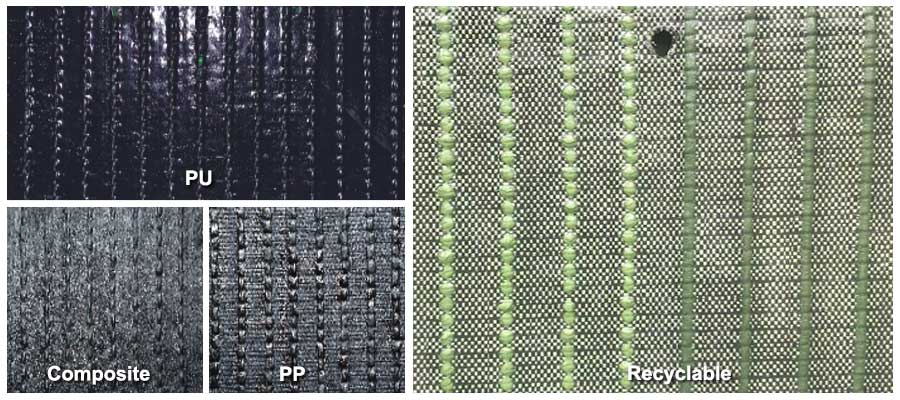
In a roll of 40mm football turf, the backing system is the second-largest cost component after the fiber material. Even with the same specifications, the price of 40mm football turf can vary by USD 0.25–0.40 per m² simply because of different backing materials.
The type of backing directly determines the turf’s service life and pulling force strength. In the artificial grass industry, the three primary backing systems are:SBR Latex Backing, PU Backing, and PP Backing.
SBR Latex Backing:
- Advantages: low cost (USD 0.40–0.70/m²), affordable, and easy to install. It is widely used in community fields and government projects.
- Drawbacks: prone to aging in high-temperature environments and poor water resistance.
PU Backing:
The most widely used premium backing material in the global artificial turf industry. It is 15–30% more expensive than SBR and requires more advanced production processes and higher-end equipment.
Its advantages include superior aging resistance, longer service life, excellent drainage, and outstanding high-temperature stability (does not soften at 50–70°C).
PP Backing:
- Priced between SBR and PU.
- Advantages: provides better structural stability and improved bending resistance for the turf. It is used for specific applications but is not as versatile or widely applicable as PU backing.
| Jenis Projek | Best Backing Choice | Reason |
| School / community fields (cost-effective) | ⭐ SBR | Controlled cost, sufficient durability, fully meets daily training needs |
| Football club training fields (high-intensity use) | ⭐ PU | Better abrasion resistance + heat resistance + aging resistance; lasts 1–2 years longer than SBR |
| High-temperature regions (South Africa, Middle East, Australia) | ⭐⭐ PU (highly recommended) | Anti-aging and high-temperature performance far superior to SBR |
| High-end landscape turf / commercial lawns | ⭐ PP+Mesh or PU | Lighter, more stable, non-absorbent, and visually superior |
| Ultra-low-budget projects | ⭐ SBR | Lowest-cost option |
Do artificial grass roll sizes impact the final price?
In the artificial turf industry, the size of the artificial grass roll not only affects material cost, but also influences production cost, transportation cost, installation efficiency, and on-site wastage.
Most artificial grass manufacturers (including MightyGrass) typically produce artificial turf rolls in 4m width and 25m length.
The reason is that 4 meters is the industrial machine standard, providing the highest production efficiency and making layout planning easier for schools, stadiums, and standard construction sites.
A 4m width also means fewer seams during installation, resulting in faster installation and better appearance.
A 5m wide artificial grass roll requires special wide-width machinery, generates more raw-material waste, produces heavier rolls, and increases shipping costs.
If a project requires a 5m wide artificial grass roll, you must confirm with the manufacturer whether their equipment supports this specification.
If you want the most economical, efficient, and stable project execution, 4m × 25m is the global standard and the most reasonable synthetic grass roll size for 40mm football turf.
A 5m custom width should only be considered for special projects or complex design requirements—while keeping in mind that both production lead time and cost will be higher.
Artificial Grass Roll Size Comparison
| kategori | 4m × 25m (Industry Standard Roll) | 5m × 25m (Custom Wide Roll) | Penjelasan |
| Sea Freight Cost | ⭐ LowestRoll weight: 230–260 kg | ▲ Higher (+10–18%)Roll weight: 280–330 kg | Larger diameter & heavier rolls reduce container loading efficiency → higher freight cost |
| Land Transport Cost | ⭐ Standard load, no oversize fee | ❗ Oversized load in many countries → extra charges | 5m width often requires special permits (South Africa, Pakistan, Middle East) |
| Loading & Unloading | ⭐ Easy handling (2 people + normal forklift) | ▲ Difficult; requires larger forklift + more manpower | 5m rolls are bulky, harder to rotate and position |
| On-Site Installation Speed | ⭐ Fastest installation | ▲ Slower installation | Extra manpower needed to control the wider roll during unrolling |
| Number of Seams | ⭐ Low | △ Slightly lower | Difference is small and does not justify the added cost |
| Material Waste (Cutting Loss) | ⭐ Lowest waste | ❗ Higher waste (+8–12%) | 5m width doesn’t match standard football field module sizes |
| Labor Cost | ⭐ Most economical | ▲ +10–20% higher | Wider & heavier rolls slow down installation significantly |
| Installation Risk | ⭐ Lower risk (stable, easy alignment) | ▲ Higher risk | Large rolls are harder to flatten → wave risks & uneven areas |
| Total Project Cost | ⭐ Most cost-efficient | ▲ 15–25% higher overall cost | Higher freight + higher waste + higher labor = larger total budget |
| Best Application | ⭐ Football fields, schools, sports centers (global standard) | ❗ Only special custom projects | 5m width is rarely necessary and brings more disadvantages |
How to check an artificial turf quotation list ?
When you receive an artificial turf quotation from an artificial grass manufacturer, don’t look only at the price—look at the structure behind it.
The factors that truly determine the price are Dtex, Gauge, Stitch Rate, Face Weight, Backing System, and overall material quality. A professional artificial turf quotation must include specifications, cost structure, and product quality.
To evaluate an artificial grass quotation correctly, you must understand these key parameters. Only then can you determine whether a quotation represents high-value, high-quality turf—or a low-price trap.
| Item | What a Professional Factory Quotation Should Include | Mengapa Ia Penting |
| 1. Turf Model / Item Code | Turf model | Used to trace yarn type, backing system, and all parameters |
| 2. Pile Height | 40mm / 50mm / 60mm | Determines sports performance and cost |
| 3. Dtex (Fiber Thickness) | 8,000 / 10,000 / 12,000 | Determines fiber abrasion resistance |
| 4. Gauge | 3/4″ / 5/8″ | Determines turf density and price |
| 5. Stitch Rate | 160–200 stitches/m | Needles per 10cm (defines density) |
| 6. Face Weight / Total Weight | Fiber weight per m² (kg/m²) | The most accurate indicator of true cost |
| 7. Fiber Material | PE / PP / Nylon | Determines lifespan and foot-feel quality |
| 8. Backing System | SBR / PU / PP-Mesh | Determines durability and cost differences |
| 9. Roll Size | 4m × 25m (standard) | Affects transport cost and installation efficiency |
| 10. Unit Price (USD/m²) | Factory unit price | Must be evaluated together with all above parameters |
Kesimpulan
In the artificial turf industry, a low price is never truly “cheap”—it usually means specifications have been cut.
By checking just five parameters—Dtex, Gauge, Stitch Rate, Face Weight, and Backing—you can instantly identify 90% of low-price traps.
If you are interested in 40 mm artificial turf and would like to learn more, please click to Hubungi kami now for free samples and a quote!
Soalan Lazim
What affects the cost of 40mm artificial grass the most?
Key factors include:
- Yarn type (PE monofilament, S-shape, V-shape, W-shape)
- Stitch density & gauge
- UV-resistant additives
- Backing system (single PU, reinforced, recycled ERET backing)
- Kuantiti pesanan
Is 40mm artificial grass good for pets?
It can be, but not all 40mm turf is suitable. Choose high-drainage backing (MT-Charming), antibacterial options, and non-infill models if you want easier cleaning.
Is 40mm the best pile height for backyards?
You’ll like 40mm if you prefer a lush, natural, premium look. But if your priority is durability for pets or sports, a 30–35mm turf may be more practical.
Can you install 40mm grass without infill?
MightyGrass can provide 40mm thick infill-free artificial turf to meet your needs. High-density infill-free artificial turf may be slightly more expensive due to its tighter stitching.
Is it cheaper to buy 40mm turf directly from a manufacturer?
Yes, when you buy directly from factories like MightyGrass, you avoid distributor markups. This often reduces costs by 15%–35% and allows OEM/ODM customization.