
 Bahasa Melayu
  English
  العربية
  Español
  Deutsch
  Français
  Português
  Русский
  日本語
日本語  Italiano
  Nederlands
  Svenska
  Suomi
Suomi  ไทย
ไทย  Dansk
Dansk  Ελληνικά
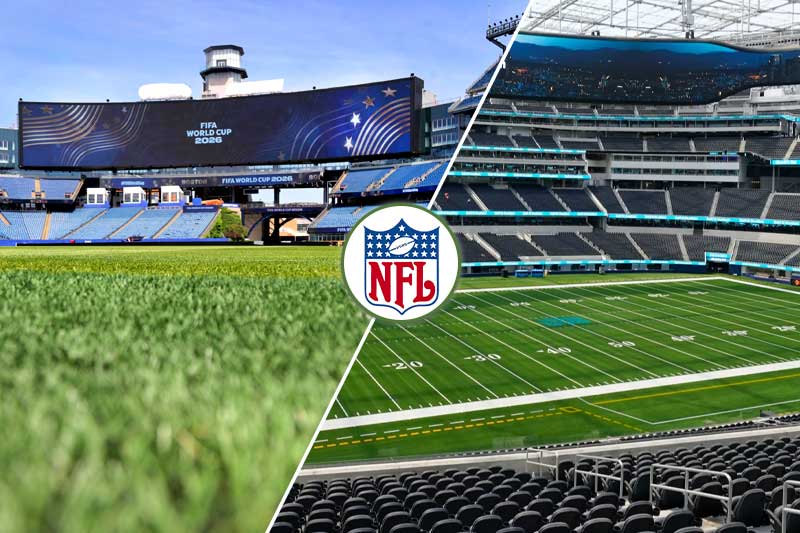
On the surface, all NFL stadiums look the same: 120 yards by 53⅓ yards, with the same markings. What changes from stadium to stadium is the surface itself. There’s no league-wide rule, so teams choose between natural grass and artificial turf. So which is more common?
This guide lists every NFL stadium by playing surface for the 2026 season, explains why teams choose what they choose, and covers the player-safety debate and the NFL’s new surface standards.
Jawapan pantas
For the 2026 season, 14 of the NFL’s 30 primary stadiums use artificial turf, and 16 use natural or hybrid grass.
The league has 32 teams but 30 primary stadiums, because the Giants and Jets share MetLife Stadium and the Rams and Chargers share SoFi Stadium. Counted by team, then a temporary event configuration, artificial turf and grass are used by roughly half of the league’s teams each.
Which NFL Stadiums Have Turf and Which Have Natural Grass?
How Many NFL Stadiums Have Artificial Turf?
Fourteen stadiums use rumput tiruan, serving 16 teams:
| NFL Team(s) | Stadium | Artificia Turf |
| Atlanta Falcons | Mercedes-Benz Stadium | FieldTurf CORE |
| Carolina Panthers | Bank of America Stadium | FieldTurf |
| Cincinnati Bengals | Paycor Stadium | UBU Speed Series S5-M Synthetic Turf |
| Dallas Cowboys | AT&T Stadium | Hellas Matrix Turf |
| Detroit Lions | Ford Field | FieldTurf CORE |
| Houston Texans | NRG Stadium | Hellas Matrix Turf |
| Indianapolis Colts | Lucas Oil Stadium | Shaw Sports Momentum Pro |
| Los Angeles Chargers | SoFi Stadium | Hellas Matrix Turf |
| Los Angeles Rams | SoFi Stadium | Hellas Matrix Turf |
| Minnesota Vikings | U.S. Bank Stadium | Act Global Americas synthetic turf |
| New England Patriots | Gillette Stadium | FieldTurf CORE |
| New Orleans Saints | Caesars Superdome | Turf Nation S5 |
| New York Giants | MetLife Stadium | FieldTurf CORE |
| New York Jets | MetLife Stadium | FieldTurf CORE |
| Seattle Seahawks | Lumen Field | FieldTurf Revolution 360 |
| Tennessee Titans | Nissan Stadium | Matrix Helix Turf |
MetLife Stadium and SoFi Stadium each host two teams, which is one reason both use artificial turf.
How Many NFL Stadiums Have Natural Grass?
Fourteen stadiums use conventional natural grass for the 2026 NFL season. They include venues in a range of climates, from Buffalo and Chicago to Miami and Arizona.
| NFL Team(s) | Stadium | Grass Type |
| Arizona Cardinals | State Farm Stadium | Bermuda grass |
| Baltimore Ravens | M&T Bank Stadium | Bermuda grass |
| Chicago Bears | Soldier Field | Bermuda grass |
| Cleveland Browns | Cleveland Browns Stadium | Kentucky bluegrass |
| Denver Broncos | Empower Field at Mile High | Kentucky bluegrass |
| Buffalo Bills | Highmark Stadium | Kentucky bluegrass |
| Jacksonville Jaguars | EverBank Stadium | Bermuda grass |
| Kansas City Chiefs | GEHA Field at Arrowhead Stadium | Bermuda grass |
| Las Vegas Raiders | Allegiant Stadium | Bermuda grass |
| Miami Dolphins | Hard Rock Stadium | Bermuda grass |
| Pittsburgh Steelers | Acrisure Field | Kentucky bluegrass |
| San Francisco 49ers | Levi’s Stadium | Bermuda grass and Perennial Ryegrass mixture |
| Tampa Bay Buccaneers | Raymond James Stadium | Bermuda grass |
| Washington Commanders | FedExField | Bermuda grass |
The Bills moved from artificial turf at their former stadium to natural grass at the new Highmark Stadium for 2026.
How Many NFL Stadiums Use Hybrid Grass Systems
Lambeau Field and Lincoln Financial Field utilize a hybrid turf system composed of 95% natural grass and 5% synthetic fibers.
| NFL Team(s) | Stadium | Grass Type |
| Green Bay Packers | Lambeau Field | Rumput Hibrid |
| Philadelphia Eagles | Lincoln Financial Field |
How the 2026 World Cup Changed NFL Fields
FIFA requires natural grass for World Cup matches. Seven of them temporarily installed natural grass for the tournament: SoFi Stadium, MetLife Stadium, Mercedes-Benz Stadium, AT&T Stadium, NRG Stadium, Gillette Stadium, and Lumen Field. After the tournament, they returned to their regular NFL artificial turf surfaces.
The conversions were more than a change of covering. According to reports, FIFA used reinforced grass systems with synthetic fibers stitched into the pitch for added consistency and durability. Some venues also needed engineered base layers, irrigation, sand, and supplemental lighting to keep grass healthy inside demanding stadium environments.
Why NFL Stadiums Choose Artificial Turf or Natural Grass
No surface is universally better. Each stadium’s choice reflects a handful of practical factors:
| Faktor | Favors Artificial Turf | Favors Natural Grass |
| Stadium design | Indoor or partly enclosed venues with limited sunlight | Open-air stadiums with good sun exposure |
| Iklim | Conditions that make growing and recovering grass difficult | Climates that support healthy grass |
| Event schedule | Football plus concerts, soccer, and other events | Primarily football use |
| Penyelenggaraan | Durable, consistent surface; needs specialized upkeep | Intensive, ongoing field management |
| Player feedback | Generally rated lower by players | Generally rated higher by players |
Why Some Stadiums Go with Artificial Turf
- Heavy use: Grass needs recovery time after heavy wear. A stadium that hosts concerts, soccer matches, and other events can’t always give it that time. Synthetic turf doesn’t rely on biological recovery.
- Stadium conditions: Grass depends on sunlight, water, drainage, and temperature. Those are harder to manage in enclosed or partly enclosed buildings.
- Engineered performance: Modern artificial turf is a full system: fibers, infill, backing, shock-absorbing components where used, and drainage. The Tennessee Titans, for example, moved Nissan Stadium to artificial turf in 2023 after struggling with natural grass there.
Why Others Stay with Natural Grass
- Player preference: The NFL Players Association has repeatedly pushed for natural grass, and player feedback in the league’s surface discussions tends to favor it.
- Climate fit: Outdoor stadiums in the right climate can grow and maintain high-quality grass. Cooler regions tend toward cool-season grasses, while warmer regions favor varieties like Bermuda.
- Playing characteristics: A living surface feels different underfoot than a synthetic system, and for many players and coaches, that difference is the deciding factor.
Neither choice removes the work. Natural grass demands constant management of irrigation, mowing, nutrition, aeration, and recovery, and weather can change firmness and traction from one game to the next. Artificial turf swaps that work for engineering, installation quality, and testing. In the end, the “best” surface is the one that fits a stadium’s climate, schedule, and standards.
NFL Stadiums Turf vs. Grass: The Player-Safety Debate in the NFL
Player safety is one of the most discussed issues in the turf-versus-grass debate. The NFLPA has repeatedly advocated for natural grass, while the NFL has increasingly focused on measurable field characteristics across both natural and synthetic surfaces.
The NFL says it has not found statistically significant differences in lower-extremity injuries or concussions that can be attributed to surface type alone. The league also recognizes that factors such as workload, fatigue, previous injuries, footwear, and field conditions can affect injury risk.
That does not mean every field performs identically. A poorly maintained synthetic field and a well-maintained synthetic field are not equivalent, just as natural-grass fields can differ substantially depending on weather and maintenance.
This is why the current NFL approach is increasingly focused on measurable field performance and consistency, rather than treating “turf” or “grass” as a sufficient description of field quality.
How NFL Turf Is Evaluated
The new artificial turf was installed at Gillette Stadium following the 2026 World Cup, but it was replaced before the Patriots’ preseason opener. According to Yahoo Sports, while the new turf passed all NFL field tests, it was deemed non-compliant because it had not been laid over an elastic layer. The stadium went back to the version it had used before the tournament.
Beginning with the 2026 season, the NFL introduced updated playing-surface requirements developed with the NFLPA through the Joint Surfaces Committee. They apply to natural, synthetic, and hybrid fields, and all stadiums are expected to comply by the start of the 2028 season.
For new synthetic turf installations, the league’s mandatory practices set out a screening and testing process. Two key tests are:
- BEAST (Biomechanical Elite Athlete Shoe-Turf Tester): measures how footwear interacts with the surface. The reported criterion for new synthetic installations is a peak torque of 180 Nm or lower.
- STRIKE impact tester: measures the surface’s impact response. The reported range for new synthetic installations is 45 to 90 g.
The standards also address consistency within a system, including infill depth. The overall shift is from labels (“turf” or “grass”) toward measurable performance: how a surface handles traction, impact, and consistency from one part of the field to another.
A Final Thought
For an artificial turf manufacturer, this is an important shift. Modern sports turf should not be evaluated only by how the fibers look. Yarn construction, pile characteristics, infill, backing, drainage, traction, impact response, installation quality, and maintenance all contribute to the final playing surface.
If you are sourcing artificial turf for a professional or high-use football project, you should engage in an in-depth discussion with the manufacturer regarding the entire turf system, rather than focusing solely on individual specifications such as blade color, pile height, or face weight.
Sebagai a Pengeluar rumput tiruan yang diluluskan oleh FIFA, MightyGrass leverages its proprietary capabilities in grass fiber extrusion, tufting, underlay production, and sports turf R&D to develop synthetic turf systems that comprehensively consider performance, durability, drainage, climate conditions, and project-specific needs. For MightyGrass, this is where NFL-level surface requirements connect with our approach to sports turf manufacturing.
Whether a project requires a football turf system for professional competition, training, or a high-use multi-sport facility, the right specification starts with the playing environment and performance requirements rather than a one-size-fits-all product.
If you are interested in purchasing artificial turf for your facility, we invite you to browse MightyGrass’s range of rumput sukan products or Hubungi kami today to request a free sample.
Soalan Lazim
Is artificial turf more dangerous than grass?
The NFL has stated that it has not found statistically significant differences in lower-extremity injuries or concussions attributable to surface type alone. Field condition, maintenance, footwear, workload, and other factors also matter. The league therefore evaluates measurable characteristics of individual fields rather than treating all artificial turf or natural grass as identical.
What brand of artificial turf do NFL teams use?
There is no single turf brand used across all NFL stadiums. Multiple synthetic turf suppliers have supplied NFL venues, and specific systems can change when fields are replaced. FieldTurf is a well-known U.S. supplier of sports turf; while its products are currently installed in numerous NFL stadiums, it is not the league’s officially designated turf brand.
For the NFL, the performance of the entire system is more important: including yarn construction, pile characteristics, backing, infill, drainage, traction, durability, and available performance testing. MightyGrass is one of the manufacturers serving this broader sports-turf market. As a Pengeluar rumput tiruan Cina, MightyGrass independently develops and produces sport turf, while also providing customized solutions for professional match venues, training facilities, and multi-purpose sports complexes.


