English
  العربية
  Español
  Deutsch
  Français
  Português
  Русский
  日本語
日本語  Italiano
  Nederlands
  Svenska
  Suomi
Suomi  ไทย
ไทย  Dansk
Dansk  Ελληνικά
  Bahasa Melayu

Are you planning to build padel court facilities but are uncertain about the standard padel court dimensions, installation requirements, and padel turf material selection? Whether you’re a sports facility builder or contractor, understanding precise dimensions of a padel court is crucial for creating a regulation-compliant facility that delivers exceptional player experience.
This comprehensive padel court installation guide covers everything from standard padel court size specifications to choosing reliable padel court turf suppliers, helping you navigate the entire padel court construction process with confidence.
Standard Padel Court Size: Official Padel Tennis Court Dimensions
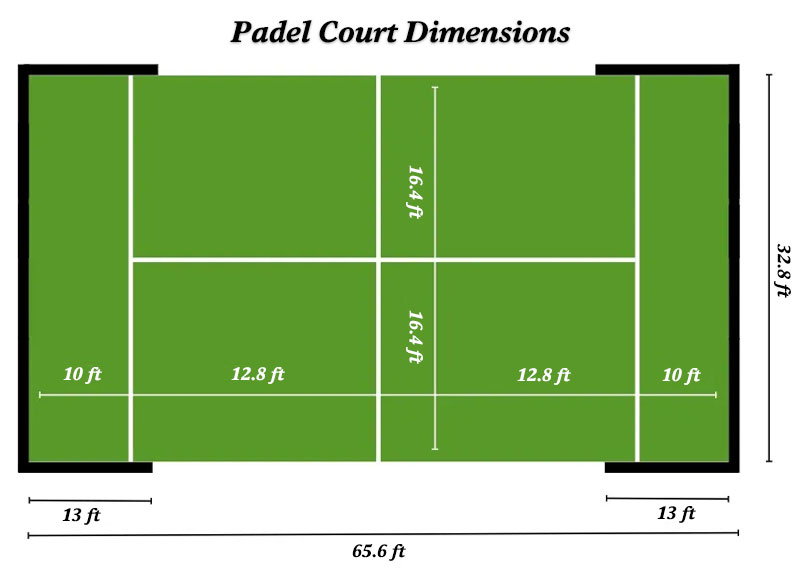
Understanding the correct padel tennis court dimensions is fundamental to any successful padel tennis court construction project. The International Padel Federation (FIP) has established specific size of padel court standards that ensure consistency across global facilities built by professional padel court builders.
Official Padel Court Dimensions in Meters and Feet
| Component | Dimensions (Meters) | Dimensions (Feet) | Notes |
| Court Length | 20m | 65.6 ft | End-to-end measurement |
| Court Width | 10m | 32.8 ft | Side-to-side measurement |
| Total Playing Area | 200m² | 2,153 sq ft | Including all markings |
| Wall Height (Back) | 3m | 9.8 ft | Minimum requirement |
| Wall Height (Sides) | 3m | 9.8 ft | First 3m from back wall |
| Side Wall Height (Remaining) | 2m | 6.6 ft | Last 7m toward net |
| Net Height | 0.88m | 2.9 ft | At center |
| Net Height (Posts) | 0.92m | 3.0 ft | At side posts |
Padel Court Size in Feet: Detailed Layout Specifications
The padel court size in feet and padel court dimensions in meters include several critical zones that affect gameplay and padel tennis court installation requirements:
Service Boxes:
- Length: 6.95m (22.8 ft) from net to service line
- Width: 5m (16.4 ft) each side
- Service line distance from net: 6.95m (22.8 ft)
Playing Zones:
- Backcourt depth: 13.05m (42.8 ft) from service line to back wall
- Side safety zones: Minimum 0.5m (1.6 ft) from side walls
- Back safety zones: Minimum 0.5m (1.6 ft) from back wall
International Standards for Padel Tennis Court Size
While FIP padel tennis court dimensions are globally recognized, some regional variations exist among padel court manufacturers:
European Standards (FIP Approved):
- Standard dimensions as listed above
- Minimum ceiling height: 6m (19.7 ft) for indoor facilities
- Wall material specifications: Tempered glass or concrete
American Padel Association (APA) Requirements:
- Same court dimensions
- Enhanced safety clearances for liability considerations
- Additional drainage specifications for outdoor courts
Climate-Specific Modifications:
- Hot climates: Enhanced drainage systems
- Cold regions: Frost-resistant foundation requirements
- Coastal areas: Corrosion-resistant materials for metal components
Professional Padel Court Construction and Installation Guide
Constructing a regulation padel court with proper dimensions of a padel court requires meticulous planning and execution by experienced padel court builders. Here’s a comprehensive breakdown of the padel court construction process:
Phase 1: Site Preparation and Foundation
Site Assessment and Planning:
- Land Survey and Measurement
- Required space: Minimum 21m x 11m (68.9 ft x 36.1 ft) for standard padel court size
- Recommended space: 23m x 13m (75.5 ft x 42.7 ft) for maintenance access
- Slope requirements: Maximum 1% gradient for proper drainage
- Excavation and Grading
- Excavation depth: 40-50cm (15.7-19.7 inches)
- Sub-base preparation: Compacted aggregate base
- Laser grading for precise level achievement
- Drainage System Installation
- Perimeter drainage channels
- Subsurface drainage pipes every 5m
- Connection to main drainage system
- Drainage capacity: 50mm/hour rainfall management
Phase 2: Foundation and Base Construction
Base Layer Construction:
- Primary Base: 20cm (7.9 inches) compacted crushed stone
- Secondary Base: 10cm (3.9 inches) fine aggregate
- Final Base: 5cm (2.0 inches) specialized sports base material
- Compaction: 98% standard Proctor density
Surface Preparation for Padel Court Installation:
- Smooth, level finish within 3mm tolerance for accurate padel tennis court dimensions
- Proper crown for water runoff
- Shock-absorbing pad installation (optional for enhanced comfort)
- Surface cleaning and debris removal
Phase 3: Wall and Net Installation
Install fencing and glass walls according to padel court dimensions in meters:
- Back Walls: 3m height meeting padel tennis court size requirements
- Side Walls: Variable height (3m decreasing to 2m)
- Foundation: Reinforced concrete footings
- Anchoring: Chemical anchor systems for stability
Net System Installation:
- Net Material: High-tensile strength synthetic materials
- Post Installation: Galvanized steel posts with proper foundation
- Tension System: Adjustable tensioning mechanism
- Height Verification: Multiple measurement points for padel court size accuracy
Phase 4: Padel Turf Installation
Choose high-quality artificial turf suitable for padel courts.:
- Fiber Height: 10-15mm for optimal padel ball bounce characteristics
- Fiber Density: 16,000-20,000 stitches per square meter
- Backing Material: Latex or polyurethane backing from quality padel court manufacturers
- Drainage Rate: Minimum 300mm/hour
Installation Process:
- Turf Acclimatization: 24-hour site conditioning
- Layout and Cutting: Precise measurement and cutting
- Seaming: Heat welding or tape seaming methods
- Adhesion: Specialized adhesive application
- Infill Application: Silica sand infill distribution
- Brushing: Multi-directional brushing for fiber positioning
- Line Marking: Heat-applied or sewn-in court lines
Choosing Professional Padel Turf Materials
Selecting appropriate materials from reputable padel turf suppliers significantly impacts court performance, maintenance requirements, and player satisfaction. Professional padel court builders recommend a comprehensive evaluation of supplier capabilities for padel court construction projects. Here’s the key factors evaluation framework:
Padel Turf Performance Requirements:
- Ball Bounce Consistency: 135-145cm from 2m drop height for regulation padel ball performance
- Surface Friction: Controlled slip resistance for player safety across entire size of padel court
- Shock Absorption: Reduced impact on joints
- Durability: Minimum 8-year lifespan under normal use
Turf Specification Comparison
| Specification | Professional Grade | Commercial Grade | Budget Option |
| Fiber Height | 13-15mm | 10-13mm | 8-10mm |
| Fiber Density | 18,000+ stitches/m² | 14,000-18,000 stitches/m² | 10,000-14,000 stitches/m² |
| Backing Weight | 1,200+ g/m² | 800-1,200 g/m² | 600-800 g/m² |
| Expected Lifespan | 10-12 years | 6-8 years | 4-6 years |
| Cost per m² | $25-35 | $15-25 | $8-15 |
Evaluating Padel Court Manufacturers vs. Distributors
Factory Direct Advantages from Padel Court Manufacturers:
- Cost savings: 20-30% lower pricing for padel court for sale projects
- Customization capability: Specific color and padel court size modifications
- Quality control: Direct communication with the manufacturing team
- Warranty terms: Comprehensive coverage and support
- Technical expertise: Engineering support throughout padel tennis court installation
Distributor Benefits:
- Local support and service
- Immediate availability for smaller quantities
- Established relationships with local contractors
- Regional expertise and compliance knowledge
Professional Padel Court Supplier Selection Framework
- Manufacturing Capability
- ISO 9001 certification from established padel court manufacturers
- FIFA or similar sports surface certifications
- Production capacity and scalability for padel court construction
- Quality control processes
- Technical Support for Padel Tennis Court Construction
- Padel court installation guidance and training
- Maintenance program recommendations
- Performance testing and certification for proper padel court dimensions
- Warranty and after-sales service
- Project Experience
- Completed padel court installations
- Reference projects and testimonials
- Climate-specific experience
- Problem resolution track record
Case Study: MightyGrass Factory Direct Advantage As a leading artificial turf manufacturer, MightyGrass exemplifies factory-direct benefits:
- Custom Manufacturing: Tailored fiber specifications for padel courts
- Cost Efficiency: Direct pricing eliminates distributor markups
- Technical Expertise: The Engineering team provides installation support
- Quality Assurance: ISO-certified manufacturing processes
- Global Experience: 500+ padel courts across 40+ countries
Padel Court Construction Breakdown
Understanding padel court construction costs helps in accurate project budgeting and financial planning for standard padel tennis court size facilities.
Construction Cost Breakdown
| Component | Cost Range (USD) | Percentage of Total | Notes |
| Site Preparation | $8,000-15,000 | 15-20% | Including excavation, drainage |
| Foundation & Base | $12,000-18,000 | 20-25% | Concrete work, compaction |
| Walls & Glass | $15,000-25,000 | 25-30% | Tempered glass, installation |
| Padel Turf | $6,000-12,000 | 10-15% | Quality dependent |
| Net System | $1,500-3,000 | 3-5% | Posts, net, accessories |
| Lighting | $5,000-8,000 | 8-10% | LED systems, controls |
| Labor & Installation | $8,000-12,000 | 12-18% | Professional installation |
| Total Range | $55,500-93,000 | 100% | Complete turnkey facility |
Material Costs for Standard Padel Court Size
- Playing Surface: 200m² (2,153 sq ft) for regulation dimensions of a padel court
- Wastage Allowance: 5-8% additional material
- Total Material Required: 210-216m² (2,260-2,325 sq ft) for complete padel court installation
Cost per Quality Level from Padel Court Suppliers:
- Premium Materials: $5,250-7,560 total material cost
- Standard Materials: $3,150-5,400 total material cost
- Budget Materials: $1,680-3,240 total material cost
Regional Cost reference
North America:
- Higher labor costs increase total project cost by 20-30%
- Stricter building codes may require additional engineering
- Premium material preferences drive specification upgrades
Europe:
- Moderate cost structure with emphasis on quality
- Standardized regulations reduce variation costs
- Established supplier networks provide competitive pricing
Asia-Pacific:
- Variable cost structure based on local economic conditions
- A growing market creates a competitive supplier environment
- Focus on long-term durability and performance
Padel Court Installation Best Practices
Successful padel tennis court installation by experienced padel court builders requires attention to critical details that significantly impact long-term performance and maintain proper padel tennis court dimensions.
Critical Factors for Proper Padel Court Installation
Drainage System Excellence:
- Surface Drainage: 1-2% slope toward drainage points maintaining padel court size specifications
- Subsurface Drainage: Perforated pipes every 3-5 meters
- Drainage Testing: Water infiltration testing before surface installation
- Maintenance Access: Cleanout points for system maintenance
Surface Installation Precision for Accurate Padel Tennis Court Dimensions:
- Fiber Direction: Consistent orientation for uniform padel ball behavior
- Seam Quality: Invisible seams through proper technique
- Infill Distribution: Even sand distribution for consistent surface across entire size of padel court
- Edge Security: Proper perimeter fastening prevents lifting
Common Padel Court Construction Mistakes and Professional Solutions
Foundation Issues:
- Problem: Inadequate compaction leading to settling affecting padel court dimensions
- Solution: 98% Proctor density verification at each layer by qualified padel court builders
- Prevention: Third-party testing and certification
Drainage Failures:
- Problem: Standing water after rainfall compromising padel tennis court size playability
- Solution: Comprehensive drainage redesign by professional padel court suppliers
- Prevention: Professional hydraulic engineering design
Surface Performance Issues:
- Problem: Inconsistent padel ball bounce across surface
- Solution: Surface preparation re-leveling and material adjustment
- Prevention: Precise padel court installation following manufacturer specifications
Maintenance and Longevity Considerations
Proper maintenance extends padel court lifespan and maintains optimal playing conditions.
Routine Maintenance Schedule
Weekly Maintenance:
- Surface brushing to maintain fiber position
- Debris removal and cleaning
- Drainage system inspection
- Net tension verification
Monthly Maintenance:
- Comprehensive surface inspection
- Infill level assessment and redistribution
- Wall and glass cleaning
- Lighting system check
Annual Maintenance:
- Professional deep cleaning
- Seam inspection and repair
- Drainage system flush and testing
- Surface performance testing
Long-Term Performance Optimization
Surface Rejuvenation:
- Infill top-up every 2-3 years
- Fiber decompaction through professional brushing
- Seam maintenance and reinforcement
- Color restoration for UV-faded areas
Technology Integration and Smart Court Features
Modern padel court construction is increasingly incorporating technology to enhance user experience and facilitate efficient facility management.
Smart Court Technologies
Automated Systems:
- LED lighting with programmable controls
- Automated irrigation for surrounding landscaping
- Security systems with court access control
- Usage tracking and booking integration
Performance Monitoring:
- Surface condition sensors
- Weather station integration
- Usage analytics and reporting
- Maintenance scheduling automation
Future-Proofing Considerations
Sustainable Design Elements:
- Solar panel integration for lighting
- Rainwater collection and reuse systems
- Recyclable turf materials for end-of-life replacement
- Energy-efficient LED lighting systems
Building Excellence Padel Court
Successfully constructing a professional padel court facility requires meticulous attention to padel court dimensions, the selection of high-quality materials from established padel court suppliers, and professional padel tennis court installation practices. The standard padel tennis court size of 20m x 10m, combined with proper wall heights and surface specifications, creates the foundation for exceptional playing experiences.
Key success factors for padel court construction include:
- Precise dimensional compliance with FIP dimensions of a padel court standards
- Quality material selection from experienced padel court manufacturers
- Professional installation by certified padel court builders
- Reliable supplier partnerships for materials and ongoing support
- Comprehensive maintenance planning for long-term padel court size performance
Whether you’re developing a single court or multi-court facility, partnering with experienced suppliers like MightyGrass provides the technical expertise, quality materials, and padel court installation support necessary for project success. Their factory-direct approach offers cost advantages while ensuring access to the latest technology and performance innovations for optimal padel ball characteristics.
Take Action: Start Your Professional Padel Tennis Court Construction Project
Ready to begin your padel court construction project with proper padel tennis court dimensions? Consider these immediate next steps:
- Site Assessment: Conduct a professional survey for padel court size feasibility analysis
- Supplier Consultation: Engage with experienced padel court manufacturers for technical guidance
- Design Development: Create detailed padel tennis court construction plans meeting local regulations
- Contractor Selection: Choose padel court builders with proven installation experience
- Budget Finalization: Develop a comprehensive project budget, including padel court for sale contingencies
Contact leading padel court suppliers today to discuss your specific padel tennis court size requirements, receive customized material recommendations, and access professional padel court installation support. Quality construction begins with understanding precise padel court dimensions and professional-grade materials that deliver lasting performance.
Invest in excellence from the foundation up, and create a facility that provides decades of exceptional padel ball playing experiences while maximizing your return on investment through superior durability and padel tennis court dimensions consistency.
FAQ Padel Court Size
Can I modify standard padel court dimensions for smaller spaces?
Official tournament play requires exact FIP dimensions of a padel court (20m x 10m). However, recreational courts can be slightly smaller (minimum 18m x 8m) with appropriate scaling of all elements. This affects padel ball dynamics and may not be suitable for competitive play. Consult experienced padel court builders for space optimization solutions.
What climate conditions affect padel tennis court construction?
Extreme temperatures require specific considerations for padel court installation:
- Hot climates: Enhanced drainage, UV-resistant materials, cooling features
- Cold climates: Frost-resistant foundations, heated systems for indoor courts
- High humidity: Improved ventilation, moisture-resistant materials from quality padel court suppliers
- Coastal areas: Corrosion-resistant hardware, salt-air compatible materials
How long does professional padel court construction typically take?
Complete padel tennis court construction timeline:
- Site preparation: 1-2 weeks
- Foundation work: 2-3 weeks
- Wall installation: 1-2 weeks
- Surface installation: 3-5 days for a standard padel court size
- Final details and testing: 1 week
- Total project duration: 6-10 weeks, depending on weather and complexity
What permits and approvals are required?
Typical requirements include:
- Building permits for permanent structures
- Electrical permits for lighting installation
- Drainage permits if connecting to municipal systems
- Zoning compliance verification
- Environmental impact assessments (if required locally)
- Sports facility licensing (varies by jurisdiction)
How do I choose between indoor and outdoor construction?
Consider these factors:
- Climate: Harsh weather conditions favor indoor construction
- Usage patterns: Year-round play benefits from indoor facilities
- Cost: Outdoor courts cost 30-40% less than enclosed facilities
- Maintenance: Indoor courts require less weather-related maintenance
- Revenue potential: Climate-controlled facilities command premium pricing
How do I find reliable padel court manufacturers and suppliers?
Select established padel court manufacturers with:
- Proven track record in padel tennis court construction
- ISO certifications and quality standards
- Experience with your climate conditions
- Comprehensive padel court installation support
- Padel court for sale options matching your budget and specifications
- References from completed projects with accurate padel tennis court dimensions
What warranty should I expect from professional padel court suppliers?
Standard warranty terms from reputable padel court suppliers:
- Surface integrity: 8-10 years against premature wear
- Backing stability: 5-8 years against delamination
- Color fastness: 3-5 years against UV fading
- Drainage performance: 2-3 years against system failure
- Installation workmanship: 1-2 years comprehensive coverage for padel court dimensions accuracy