 English
  العربية
  Español
  Deutsch
  Français
  Português
  Русский
  日本語
日本語  Italiano
  Nederlands
  Svenska
  Suomi
Suomi  ไทย
ไทย  Dansk
Dansk  Ελληνικά
  Bahasa Melayu


Design
Provide CAD drawings & field plans.
Based on the field’s size, terrain, and usage, we help design a solution that maximizes field utilization.

20+ years of experience in softball artificial grass system solutions, customized services, and international WBSC standards. Low maintenance, year-round availability, high-performance softball fields for infields, outfields & softball complexes.
MightyGrass simulates the performance of softball sports in natural lawn fields, develops special formulas and processes, optimizes four aspects: wear resistance, anti-aging, rebound buffering, anti-slip stability, and stain resistance and corrosion resistance, and complies with the standards of international softball fields.
Softball Turf is an artificial grass designed specifically for softball fields (also known as softball diamonds or softball complexes). It is made of high-performance fibers such as polyethylene (PE), polypropylene (PP), and, combined with shock pads and fillers, it can accurately simulate the true motion trajectory of softballs on natural grass, rebound performance, and provide sports performance beyond natural grass, but it is more durable than natural grass and has lower maintenance costs. Meet the needs of schools, clubs, softball field contractors, and government projects, which can not only improve usage efficiency but also reduce long-term costs.

In a standard softball field, the infield area is called the infield, and it is the most critical part of the game. Traditionally, the infield is made of natural clay. Still, it has many problems: excessive dust, muddy conditions on rainy days, high maintenance costs, and an increased risk of abrasions when sliding.
Compared with natural clay, the infield area uses artificial turf with short fibers in a reddish-brown color design, which greatly reduces dust and soil maintenance requirements, maintains field consistency, and thus ensures fairness and safety in the game.

The outfield area of a softball field has different requirements for artificial turf compared to the infield. Longer fibers are needed here to mimic the appearance and performance of natural grass.
Outfield Turf uses green long-fiber grass, which is not only highly realistic in appearance but also very close to natural grass in terms of ball speed and bounce. In terms of playing experience, it is superior to traditional natural grass.
Outfield Turf also has excellent drainage capacity, allowing the field to recover quickly after rain and preventing delays or cancellations due to weather conditions.

For some large softball complexes, simply using artificial turf in the infield or outfield is not enough. The Integrated Softball Turf System is an infield + outfield integrated design that provides consistent turf performance and visual effects across the entire softball field.
This system seamlessly combines Infield Turf (red short fibers) and Outfield Turf (green long fibers), with an additional shock pad and drainage system underneath. In this way, whether in the pitcher’s circle, sliding areas, or outfield catching zones, athletes can enjoy the same stable and safe playing experience.
| Item | Natural Grass | Softball Artificial Turf |
| Usage Time | About 20–25 hours per week | Up to 60+ hours per week |
| Weather Impact | Muddy and damaged in rainy weather | All-weather use, playable 20 minutes after rain |
| Maintenance | Requires watering, fertilizing, mowing | Almost zero maintenance, occasional cleaning |
| Cost | Low initial cost, high long-term expense | High initial investment, more economical in the long run |
| Safety | Irregular bounce, increased risk | Even surface, reduces injuries and abrasions |
Softball fields are smaller than baseball fields but require the same level of precision in design. A regulation softball field typically requires 2–4 acres depending on fence length and outfield layout.
Below are the most common regulation softball field dimensions:
Field Element | Fastpitch (Women’s) | Slowpitch (Men’s) | Notes | ||
Bases (distance) | 60 ft (18.29 m) | 65–70 ft (19.8–21.3 m) | Determines infield size | ||
Pitching distance | 43 ft (13.11 m) | 50 ft (15.24 m) | From mound to home plate | ||
Outfield fence | 200–220 ft (61–67 m) | 250–300 ft (76–91 m) | Varies by level/league | ||
Foul lines | 200 ft (61 m) min. | 250 ft (76 m) min. | Typically rounded arc | ||
Acres (full field) | 2–4 acres | 3–5 acres | Depending on layout | ||
Our offer professional turf softball field design solutions,From sizing to drainage design to material breakdowns ,ensuring Every project comes with technical layouts, sports contractors can install correctly.design includes:

Designed with high-density turf (pile height 40mm) to withstand sliding and high-impact play.

Wider gauge synthetic grass for natural ball bounce and reduced maintenance.

Sub-base engineering with ≥200 mm compacted stone layer + drainage pipes for all-weather play.
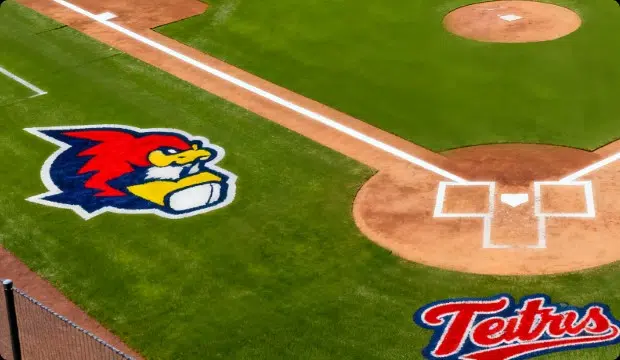
Factory customization for foul lines, logos, and team branding.

Four bases form a diamond, dividing the infield and outfield.
The traditional softball diamond is the foundation of all softball fields. It consists of four bases arranged in a diamond shape, divided into the infield and the outfield. The infield includes the pitcher’s plate, home plate, and bases, serving as the most critical area of the game. The outfield extends from the boundary of the infield to the outfield fence, used for catching and defense. For contractors, building a softball diamond requires precise dimensions: the base paths are typically 60 feet (18.29 m), the distance from the pitcher’s plate to home plate in women’s games is 43 feet (13.11 m), and 46 feet (14.02 m) for men’s games.
Multiple softball fields combined into a sports center.
A softball complex is a sports park composed of multiple softball fields, often used to host large tournaments or provide training facilities for several teams at the same time. A standard softball complex usually includes 4–6 softball diamonds, along with bleachers, locker rooms, lighting systems, and parking areas. For builders, the key to a successful softball complex is unified design and an integrated drainage system, ensuring that multiple fields can operate simultaneously while maintaining excellent performance. Although these projects require larger investments, their utilization rate and commercial value are also higher.


Outfield fences 200–220 ft for women, 225–250 ft for men.
A standard softball field shows gender-based differences in outfield fence distances: women’s fields typically measure 200–220 feet (61–67 m), while men’s fields range from 225–250 feet (68–76 m). The total field area is about 7,500–8,500 square meters, equivalent to 1.8–2.1 acres. For contractors, designing a standard softball field means not only adhering to dimensional regulations but also planning the turf system properly, including the combination of infield turf and outfield turf, to ensure a professional playing experience that meets international standards.
Compatible with soccer (soccer softball) and football (football softball).
Many schools and communities choose to build multi-sport fields, combining soccer softball or football softball with a turf softball field to create comprehensive facilities. These venues allow different sports to be played on the same turf, increasing utilization and maximizing return on investment

In softball field construction, compared with traditional natural grass and clay, the softball turf field provides a more stable, efficient, and economical solution, becoming the preferred surface material for sports builders and contractors.

High-quality softball artificial turf has a lifespan of 8–10 years, and can maintain stable performance even under high-frequency training and competition conditions. Natural grass can only withstand about 20–25 hours of use per week, while a softball turf field can endure 60+ hours per week, greatly improving field utilization. For contractors, this means investors can recover costs faster while reducing the risk of frequent repairs and reconstruction.

Natural grass fields require constant watering, mowing, fertilizing, and reseeding, which result in considerable annual maintenance expenses. The daily upkeep of softball artificial turf is very simple, requiring only periodic cleaning and light grooming to keep the field in good condition. Statistics show that a softball turf field can help operators save 40–60% of annual maintenance costs, which is particularly attractive for schools, clubs, and community sports facilities with limited budgets.

Player safety is the top priority for any softball field. MightyGrass softball artificial turf has a flat, non-slip surface that reduces the risks of irregular bounces and accidental falls. Combined with professional shock pad and infill systems, the field offers excellent shock absorption, effectively reducing sliding abrasions and joint impacts. Compared with natural clay infields, Infield Turf also avoids dust-related respiratory issues, making it especially suitable for youth and professional competitions.

Although the initial investment in softball artificial turf is relatively high, its advantages are very clear when considering long-term costs. Natural grass requires continuous maintenance inputs, while a softball turf field can achieve cost recovery within 5–7 years. The overall expenditure during its lifecycle is lower, and the return on investment (ROI) is higher, making this one of the most persuasive arguments for contractors presenting budgets to investors.

Weather is the biggest obstacle affecting the usability of natural grass fields. Rain often causes muddy clay infields and waterlogged grass surfaces, forcing games to be canceled or postponed. A softball turf field is equipped with a professional drainage system that makes the field playable 20 minutes after rain, unaffected by rain or snow. For clubs or schools with intensive schedules, this means higher operational efficiency and more consistent training programs.
One-stop solution: From softball field design → turf supply → installation guidance → after-sales service. Fast delivery for North American projects.
Based on the field’s size, terrain, and usage, we help design a solution that maximizes field utilization.


According to the project budget and certification requirements, we recommend cost-effective products that meet international standards. The factory supports customization of different colors, logos, and dimensions.
We can provide a complete softball facility one-stop package service according to your needs.


We can offer installation guidance based on your project’s construction schedule and requirements.


At Mighty Grass, our softball turf systems (From the pitcher’s circle to the outfield grass blade) are not an after-thought, they’re built from the ground up for the sport.
Looking you to build a high-performance softball field that delivers consistent ball bounce, fast play, and low maintenance? In this video, you’ll discover how premium softball turf is installed from the ground up, including sub-base, drainage, shock pad, turf roll laying, infill application, and final field inspection.
For Installers & Wholesalers: Supply your clients with a surface that reduces maintenance, increases play hours and elevates athlete experience. Whether converting a high-school field, community complex or tournament venue, we offer in‐depth technical support, design flexibility and global supply chain responsiveness.


Still have questions about grass softball field? We’ve compiled answers to some frequently asked questions about softball turf. If you can’t find the information you need here, please contact us now.
Softball turf is synthetic grass designed for softball fields, offering durability, low maintenance, and all-weather play.
A softball facility can be a single softball field or a multi-field softball complex with turf systems.
Yes, MightyGrass designs multi-sport complexes that integrate both soccer and softball turf systems.
Standard softball fields are 7,500–8,500㎡, depending on gender and competition level.
Yes, multi-use turf complexes can combine football and softball fields.
Examples include Rosemont Softball Stadium (USA), Liberty University Softball Stadium, and projects supported by MightyGrass.
Turf provides consistent bounce, safe sliding, and reliable ball speed.
On average USD 120,000–180,000 depending on turf type, shock pad, and installation.
Material $8–25/㎡ + shock pad $3–8/㎡ + installation $12–20/㎡ = total project cost.
Turf infield baseball refers to synthetic turf used in the infield area, designed for durability and consistent ball bounce.
The average turf softball field cost ranges between USD 120,000–180,000 for a full-size field (≈7,500–8,500㎡). The final cost depends on turf type (infield vs. outfield), shock pad, infill material, and local installation fees.
With MightyGrass factory-direct supply, contractors can save 20–30% compared to U.S. domestic suppliers.
A complete cost of turf softball field includes:
To build a turf softball field from scratch, including excavation, base construction, turf, and installation, the total project budget is typically USD 150,000–220,000.
To turf a softball field (replace natural grass or dirt with artificial turf), the cost is usually USD 80,000–120,000, depending on the existing base condition. Renovation is cheaper than building a new field, since the foundation may already be prepared.
Contractors benefit from MightyGrass’s custom infield turf (red fibers replacing dirt) + outfield turf (green fibers) system, designed for seamless conversions.
Turfing a full-size softball field typically costs USD 120,000–400,000 depending on turf type, infill, and installation.
A regulation softball field is usually 2–4 acres in size depending on whether it’s fastpitch or slowpitch.
MightyGrass supplies softball turf fields across the US with fast delivery from our California warehouse.
MTGRASS® manufactures and installs high-quality synthetic turf products for a wide range of sports, leisure, and landscape applications. With a low MOQ starting from just 1,100㎡, we make it easier for you to start projects of any scale. Backed by our factory-direct supply chain, you benefit from consistent quality and competitive pricing without middlemen. Plus, our global delivery network ensures your turf arrives on time, wherever your project is located. We are committed to providing expert knowledge and advice on synthetic turf systems, along with exceptional customer service before, during, and after your purchase.
MTGRASS® is your trusted artificial turf manufacturer. With factories in China and Saudi Arabia, and wholesale warehouses in California, USA, we deliver FIFA-certified quality and localized service to give you a competitive edge.





Mighty Grass
Typically replies within minutes
Any questions related to mightygrass?
WhatsApp Us
🟢 Online | Privacy policy
WhatsApp us


