
 Svenska
  English
  العربية
  Español
  Deutsch
  Français
  Português
  Русский
  日本語
日本語  Italiano
  Nederlands
  Suomi
Suomi  ไทย
ไทย  Dansk
Dansk  Ελληνικά
  Bahasa Melayu

Inomhusfaciliteterna för fotboll växer snabbt i Nordamerika, Europa, Mellanöstern och Sydostasien. Från små futsalhallar till stora fotbollsplaner med konstgräs inomhus väljer investerare i allt högre grad konstgräs för inomhusbruk.
För många anläggningsägare börjar dock den största utmaningen redan innan bygget ens har påbörjats: hur mycket kostar konstgräs för inomhusfotboll?
Ett konstgrässystem för fotboll som är avsett för sporadisk fritidsanvändning skiljer sig avsevärt från ett system som är anlagt för ett kommersiellt träningscenter som är i drift tolv timmar om dagen. Att välja fel specifikation kan visserligen spara pengar i början, men leder ofta till tillplattade fibrer, synliga skarvar, obekvämt underlag och kostsamma utbyten mycket tidigare än väntat.
I den här guiden förklaras hur priserna på inomhusgräs egentligen är uppbyggda, vad som påverkar byggkostnaden för en inomhusfotbollsplan samt Hur man väljer rätt konstgrässystem för inomhussport för er anläggning utan att lägga för mycket pengar på onödiga specifikationer.
MightyGrass är en FIFA-godkänd tillverkare av konstgräs, vilket innebär att du samarbetar direkt med en erfaren leverantör av konstgräs som specialiserar sig på konstgräs för fotbollsplaner, futsalplaner och konstgrässystem för inomhusbruk, utformade för kommersiella idrottsanläggningar över hela världen. Kontakta oss redan idag för att få vår mest konkurrenskraftiga offert så snabbt som möjligt.
Vad är den genomsnittliga kostnaden för ett inomhusfotbollsunderlag?
De flesta projekt med konstgräs för inomhusfotboll ligger mellan $6 och $15+ per installerad kvadratfot, även om det slutliga värdet i hög grad beror på vilken typ av anläggning som byggs.
Själva konstgräsmattan utgör bara en del av budgeten. Ett komplett system för en inomhusplan med konstgräs omfattar vanligtvis konstgräs, stötdämpande underlag, fyllnadsmaterial, skarvtejp och lim samt installationskostnader.
Av den anledningen kan två inomhusfotbollsplaner med samma mått leda till helt olika projektkostnader.
Tabellen nedan visar en typisk prissättningsstruktur för kommersiella projekt av inomhusfotbollsplaner:
| Komponent | Genomsnittligt kostnadsintervall |
| Inomhusfotbollsmatta | $3 – $8 / kvadratfot |
| Stötdämpningssystem | $1 – $3 / kvadratfot |
| Infill-material | $0,50 – $3 / kvadratfot |
| Installationsarbete | $2 – $5 / kvadratfot |
| Totalt antal installerade system | $6 – $15+ / kvadratfot |
Till exempel kostar standardfyllmaterial av SBR-gummi, som ofta används i inomhusfotbollsbanor, vanligtvis omkring $0,50–$1,00 per kvadratfot. Högkvalitativa EPDM- eller TPE-fyllnadsmaterial, avsedda för förstklassiga inomhusanläggningar, kan höja kostnaden till $1,50–$3,00 per kvadratfot, beroende på fyllnadsdjup och materialkvalitet.
Olika typer av konstgräs för inomhusfotboll (och vad de kostar)
Inomhussystem för sportgräs är inte längre standardprodukter som passar alla. Olika anläggningar prioriterar olika prestandaegenskaper beroende på vilka idrottare som ska använda anläggningen, driftschemat och förväntningarna på underhållet.
Vissa inomhusfotbollsplaner är utformade för att ge bollen optimal respons och grepp. Andra prioriterar enklare rengöring, minskat underhåll eller mångsidighet för flera olika sporter. Härnäst kommer vi att tillsammans med er gå igenom de olika typerna av inomhusfotbollsunderlag utifrån följande två perspektiv.
Fotbollsgräs med infill jämfört med fotbollsgräs utan infill
Ett av de första besluten vid anläggning av en inomhusfotbollsplan är om man ska lägga in fyllnadsmaterial eller icke-infyllnadsgräs systemet.
Traditionellt konstgräs för inomhusfotboll använder löst fyllnadsmaterial – vanligtvis gummi eller sand – mellan fibrerna. Fyllnadsmaterialet bidrar till att stabilisera fibrerna, förbättra greppet och skapa mer realistiska rörelser hos spelarna. Denna typ av konstgräs för inomhusfotboll är fortfarande populär i tävlingsinriktade träningsmiljöer eftersom det uppför sig på ett liknande sätt som matchunderlag utomhus.
De flesta fyllnadsmaterialsystem använder mellan 4–8 pund fyllnadsmaterial per kvadratfot, beroende på höjden på fyllnaden. Det innebär vanligtvis en ökning av den totala kostnaden för en konstgräsplan inomhus med cirka $0,50–$2,50 per kvadratfot.
Inomhusgräsmattor utan fyllnadsmaterial fungerar på ett annat sätt. Istället för att i hög grad förlita sig på lösa granulat använder de tätare garnstrukturer och förstärkta underlag för att upprätthålla stabiliteten. Dessa ytor har blivit alltmer populära inom:
- anläggningar för futsal med konstgräs
- ungdomsakademier
- konstgräs för inomhusbattingbur
- träningscenter för flera idrottsgrenar
eftersom de minskar underhållsbehovet och bidrar till en renare inomhusmiljö.
| System för gräsmatta | Typisk installationskostnad | Underhållsnivå | Gemensam användning |
| Fyllnadsmaterial för inomhusfotbollsplaner | $7–$15/kvadratfot | Måttlig | Tävlingsfotboll |
| Inomhusgräsmatta utan fyllnadsmaterial | $6–$12/kvadratfot | Lägre | Futsal och träning |
Hos MightyGrass används i många småskaliga inomhusfotbollsprojekt fyllnadsfria konstgrässystem med högkvalitativa monofilament i S-form eller med diamantprofil i kombination med förstärkta, krullade fibrer. Genom att använda PE-fibrer med hög densitet uppnår dessa system en balans mellan prestanda, spelarkomfort och långsiktig underhållseffektivitet. Professionella tävlingsarenor fortsätter dock att använda konstgräs för utomhusbruk som uppfyller FIFA-standarden (3G konstgräs).
Olika material för fotbollsplaner
Den typ av garn som används i konstgräs för inomhusbruk har stor inverkan på hållbarheten, komforten och de totala priserna på inomhusgräs.
De flesta konstgräsmattor för inomhusfotboll tillverkas av polyeten (PE), polypropen (PP) eller nylonbaserade fibrer. Även om dessa material kan se likadana ut vid installationen, uppför de sig mycket olika efter flera års intensiv idrottsanvändning.
| Gräsmattematerial | Typiskt pris på gräsmatta | Den största fördelen | Vanliga användningsområden inomhus |
| Polypropylen (PP) | $3–$5/kvadratfot | Lägre initialkostnad | Används ofta för konstgräs i slagburar inomhus och i träningsmiljöer med lägre belastning där kostnadskontroll är prioriterat. |
| Polyeten (PE) | $4–$7/kvadratfot | Bättre mjukhet och spänst | Det mest populära materialet för inomhusfotbollsgräs, eftersom det ger en mjukare känsla och bättre fiberåterhämtning vid upprepad användning flera gånger i veckan. |
| Nylon | $6–$9+/kvadratfot | Maximal slitstyrka | Används ofta i professionella inomhusarenor med hög besöksfrekvens, där konstgräset utsätts för ständig rörelse från idrottare och intensiv användning. |
MightyGrass tillverkar produkter för inomhusbruk sportgräsmatta med hjälp av en helt integrerad egenproduktion som omfattar garnextrudering, tuftning och underlagstillverkning. Detta möjliggör en striktare kvalitetskontroll genom hela grässystemet och bidrar till att förbättra den långsiktiga prestandan i kommersiella inomhusanläggningar.
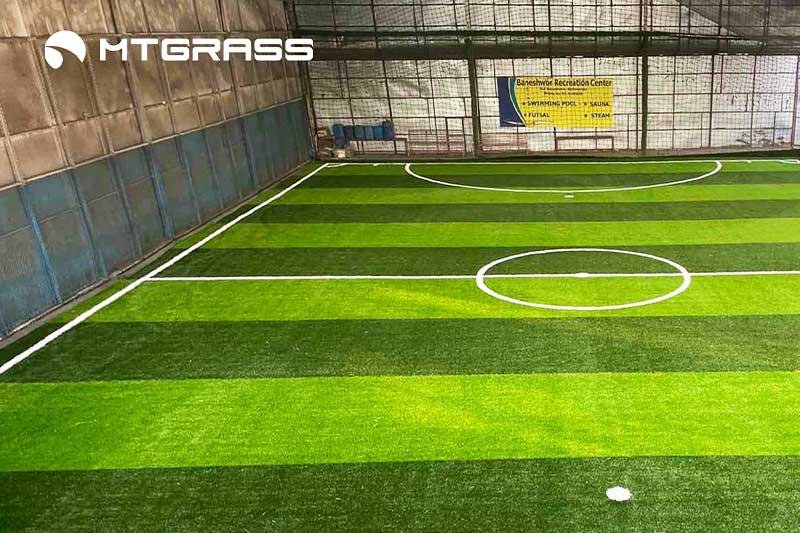
Kostnad för inomhusfotbollsunderlag efter anläggningstyp
Kostnaden för en inomhusfotbollsplan varierar kraftigt beroende på hur anläggningen faktiskt kommer att drivas. Ett fritidscenter för futsal och en professionell inomhusarena kan se likadana ut rent visuellt, men deras konstgrässystem är konstruerade för helt olika användningsförhållanden.
Inomhusplan för 5-a-side-fotboll
Anläggningar för 5-a-side inomhusfotboll har blivit oerhört populära eftersom de kräver mindre utrymme samtidigt som de genererar en hög bokningsfrekvens under hela dagen.
De flesta projekt i denna kategori använder konstgräs för inomhusfotboll med medellång lugg på mellan 30 mm och 40 mm, eftersom det ger en bra balans mellan spelarnas komfort, bollkontroll och hanterbara underhållskrav.
Typiska projektbudgetar ligger ofta inom följande intervall:
| Anläggningstyp | Beräknad budget för gräsmattesystemet |
| Samhällsanläggning | $120 000–$180 000 |
| Utbildningscenter för näringslivet | $180 000–$250 000 |
| Förstklassig inomhusarena | $250 000–$350 000+ |
Ungdomsutbildningscentrum
Ungdomsakademier prioriterar oftast säkerhet och komfort framför maximal bollhastighet.
Eftersom spelarna tränar flera gånger under veckan blir stötdämpningen oerhört viktig. Många inomhusanläggningar med konstgräs som är avsedda för ungdomar använder mjukare PE-trådar, tjockare stötdämpande lager och en konstgräskonstruktion med högre densitet för att minska tröttheten och förbättra komforten under fötterna.
En stötdämpande matta för idrottsanvändning med en tjocklek på 10–15 mm kan öka projektbudgeten med cirka $1,50–$3,00 per kvadratfot, men den förbättrar avsevärt spelarnas komfort på lång sikt under upprepade träningspass.
Föräldrar och tränare kanske inte känner till de tekniska specifikationerna för konstgräs, men de märker snabbt när en plan känns för hård eller slits ojämnt redan efter en kort tids användning.
Professionella inomhushallar
Professionella konstgrässystem för inomhusfotboll är utformade för att upprätthålla en jämn prestanda även vid intensiv användning.
Dessa anläggningar prioriterar vanligtvis:
- stabilt grepp
- förutsägbart bollbeteende
- sömmarnas hållbarhet
- förstklassigt utseende på planen
Detta leder till att kostnaden för konstgräs på inomhusfotbollsplaner stiger, eftersom själva systemet blir mer tekniskt avancerat.
Många professionella arenor använder monofilamentgarn av PE, förstärkta underlagssystem och högkvalitativa fyllnadsblandningar som kan få priset på konstgräsmaterialet att stiga över $7–$9 per kvadratfot innan installationen ens påbörjas.
Inomhusarenor för flera idrottsgrenar
Moderna inomhusanläggningar används sällan enbart för fotboll. Många inomhusplaner med konstgräs kan numera användas för:
- futsal
- fotbollsträning
- träningsprogram
- Idrottslektioner
- ungdomsläger
Detta förändrar strategin för utformningen av gräsmattan avsevärt.
I stället för att enbart optimeras för fotbollsspel fokuserar inomhusgräsmattor för flera idrottsgrenar oftast mer på hållbarhet, enklare rengöring och anpassningsbarhet för olika aktiviteter, samt lägre lugghöjder på mellan 20 och 30 mm.
MightyGrass skräddarsyr ofta system med konstgräs för inomhusbruk till multifunktionella idrottsanläggningar genom att anpassa lugghöjden, garnstrukturen och baksidestekniken efter kundens faktiska driftsbehov.
Vilka faktorer påverkar kostnaden för konstgräs till inomhusfotboll?
Två inomhusfotbollsplaner med identiska mått kan ändå ha mycket olika driftskostnader på lång sikt. Skillnaden beror oftast på systemutformningen snarare än enbart planens storlek.
Kvaliteten på gräsfibrerna
Garn av högre kvalitet återfår sin form bättre efter upprepad kompression och bibehåller en mer jämn spelyta över tid. Fibrer av lägre kvalitet kan inledningsvis sänka priset på inomhusgräs, men områden med hög trafik slätas ofta ut snabbt vid intensiv användning.
Detta märks särskilt tydligt nära målområdena, sidlinjerna och träningsbanorna.
För anläggningar som är i drift dagligen innebär en investering i teknik för starkare garn ofta att utbytesfrekvensen minskar och att de långsiktiga ägandekostnaderna sänks.
Pålhöjd och densitet
Luddhöjden påverkar bollens hastighet, spelarens komfort och underhållskraven.
Konstgräs för inomhusfotboll har vanligtvis en tjocklek på mellan 30 mm och 50 mm, beroende på användningsområdet.
| Pålhöjd | Typisk användning |
| 20 mm–35 mm | Futsal och flera idrotter |
| 35 mm–45 mm | Vanlig inomhusfotboll |
| 45 mm–50 mm | Avancerade dämpningssystem |
Även tätheten spelar roll. En högre stygntäthet förbättrar slitstyrkan och bidrar till att gräsmattan behåller sitt fylliga utseende längre, även om det också ökar materialkostnaden eftersom det går åt mer garn per kvadratmeter.
Krav på stötdämpare
Stötdämpare är en av de aspekter som oftast förbises när det gäller byggkostnaderna för en inomhusfotbollsplan.
Utan tillräcklig dämpning kan konstgräs som läggs direkt på betonggolv bli fysiskt ansträngande under långa träningspass. Stötdämpande underlag förbättrar komforten, minskar belastningen på lederna och fördelar stötarna jämnare över hela planen.
Enkla stötdämpande skumunderlag kan kosta från cirka $1 per kvadratfot, medan högkvalitativa elastiska skiktsystem avsedda för professionell idrottsverksamhet kan kosta över $3 per installerad kvadratfot.
För ungdomsakademier och träningscenter med hög träningsfrekvens betraktas stötdämpning i allt högre grad som en nödvändighet snarare än ett tillval.
Alternativ för utfyllnad
Material för utfyllnad påverka fältprestanda, underhållsarbetsbelastningen och driftsrenligheten.
SBR-gummi är fortfarande det mest prisvärda och vanligaste fyllnadsmaterialet för inomhusfotbollsplaner. Fyllnadsmaterial av EPDM och TPE är dyrare, men ger vanligtvis bättre luktkontroll och färgstabilitet.
| Typ av infill | Typisk kostnad |
| SBR-gummi | $0,50–$1,00/kvadratfot |
| EPDM-gummi | $1,50–$2,50/kvadratfot |
| TPE-infyllnad | $2,00–$3,00/kvadratfot |
| Organisk fyllning | $2,00–$4,00/kvadratfot |
Installationskomplexitet
Även högkvalitativt konstgräs för inomhusfotboll kan slitas ut i förtid om installationen inte utförs korrekt.
Vid installation av konstgräs inomhus ingår ofta utjämning av betongunderlaget, förstärkning av skarvar, fuktmätning och justering av stötdämpande underlag.
Vid stora projekt med konstgräsplaner inomhus kan enbart installationskostnaden utgöra 20–30% av den totala systemkostnaden.
MightyGrass stödjer projekt för inomhusfotbollsplaner med integrerad tillverkning, skräddarsydda rekommendationer för grässystem och teknisk vägledning som syftar till att hjälpa idrottsanläggningar att uppnå långsiktig prestanda.
Dolda kostnader som många köpare glömmer bort
Många budgetar för inomhusfotbollsarenor lägger stor vikt vid själva konstgräset, samtidigt som man underskattar de sekundära kostnaderna som tillkommer efter att inköpsprocessen har inletts.
Inomhusplaner med konstgräs kräver stora materialmängder, vilket innebär att frakt och logistik kan utgöra en betydande del av projektets totala kostnad.
När det gäller internationella projekt kan fraktkostnaderna variera avsevärt beroende på:
- tillgänglighet av containrar
- bränslepriserna
- avgifter i ankomsthamnen
- tullavgifter
En standardplan för inomhusfotboll kan kräva flera containrar med konstgräs, fyllnadsmaterial och stötdämpande underlag. I vissa fall kan enbart fraktkostnaden öka projektkostnaden med tiotusentals dollar.
MightyGrass driver en Lager i Kalifornien för att hjälpa nordamerikanska kunder att förkorta ledtiderna, förenkla logistiken och minska lagerriskerna i samband med projekt för konstgräsplaner för inomhussport.
Hur man sänker kostnaderna för inomhusfotbollsunderlag utan att kompromissa med kvaliteten
Att sänka projektkostnaden innebär inte nödvändigtvis att man ska välja det billigaste gräsmattan som finns.
I många fall är det klokare att anpassa grässystemet efter anläggningens faktiska användning.
Välj rätt grässystem utifrån hur mycket du använder det
Det är inte alla anläggningar som behöver ett professionellt konstgrässystem av FIFA-klass.
Ett ungdomsutbildningscenter eller en futsalplan i ett bostadsområde kan fungera utmärkt med ett konstgräs av mellanklass och ett måttligt fyllnadsdjup. Att välja en alltför avancerad utformning av planen leder ofta till högre anläggningskostnader.
Det bästa konstgrässystemet för inomhusbruk är oftast det som passar:
- trafikintensitet
- spelarens nivå
- underhållskapacitet
- driftsbudget
Samarbete med tillverkare av integrerade lösningar
Ett av de enklaste sätten att minska risken i långsiktiga projekt är att samarbeta med tillverkare som har kontroll över hela produktionsprocessen.
Integrerade tillverkare kan vanligtvis erbjuda:
- en mer konsekvent kvalitetskontroll
- anpassade specifikationer
- bättre teknisk support
- förbättrad produktionsstabilitet
MightyGrass Företaget bedriver en helt integrerad produktion som omfattar garnextrudering, tuftning och tillverkning av underlag. Detta gör det möjligt för inomhussportanläggningar att skräddarsy konstgrässystem efter sina faktiska driftsbehov, istället för att förlita sig på generiska katalogprodukter. För distributörer, entreprenörer och utvecklare av idrottsanläggningar innebär detta ofta en mer förutsägbar långsiktig prestanda hos konstgräsytorna och en lägre risk för att behöva byta ut dem.
Hur MightyGrass stöder projekt med konstgräs för inomhusfotboll
Inomhusanläggningar står inför en unik utmaning: planen måste tåla kontinuerlig användning samtidigt som den bibehåller spelarnas komfort och ett enhetligt utseende. MightyGrass är en professionell tillverkare av konstgräs med mer än 20 års erfarenhet av produktion och stödjer projekt för inomhusfotbollsplaner genom helt integrerad tillverkning, skräddarsydd teknik och projektinriktad teknisk support.
Från ungdomsakademier till inomhusanläggningar för flera idrottsgrenar – MightyGrass hjälper kunderna att utveckla grässystem som är utformade för:
- användningsintensitet
- spelarens nivå
- förväntningar på underhåll
- lokala klimatförhållanden
- budgetmål
Med egen garnproduktion, avancerade tuftningssystem och global projekterfarenhet erbjuder MightyGrass distributörer, entreprenörer och utvecklare av idrottsanläggningar världen över följande:
- gräsmatta för inomhusfotboll
- futsalmatta
- konstgräs för inomhusbattingbur
- inomhussystem för flera idrottsgrenar med konstgräs
- skräddarsydda OEM-lösningar
Målet är inte bara att sälja konstgräs, utan att hjälpa anläggningar att bygga inomhusplaner med konstgräs som håller en jämn prestanda under många år, samtidigt som de långsiktiga driftskostnaderna hålls under kontroll.
Oavsett om du planerar att starta ett företag inom inomhusfotboll eller bygga en professionell inomhusanläggning handlar valet av rätt system för konstgräs inomhus i slutändan om att skapa en yta som håller en jämn prestanda år efter år – inte bara om att hitta det lägsta priset vid köpet.
FAQ
Hur mycket kostar konstgräs för inomhusfotboll per kvadratfot?
Priset för konstgräs till inomhusfotboll ligger vanligtvis mellan $3,50 och $9,50 per kvadratfot, inklusive installation, beroende på gräsets kvalitet, lugghöjd, typ av fyllnadsmaterial, krav på stötdämpande underlag och installationens komplexitet. Priset för enbart materialet för konstgräs för inomhusbruk varierar vanligtvis mellan $1,80 och $7,00 per kvadratfot.
Hur mycket kostar det i genomsnitt att bygga en inomhusfotbollsplan?
Ett komplett byggprojekt för en inomhusfotbollsplan kostar mellan $80 000 och $1 000 000+, beroende på planens storlek, byggnadens konstruktion, belysning, VVS-system, studsväggar och specifikationer för konstgräset. Själva installationen av konstgräset utgör endast en del av den totala projektinvesteringen.
Vilken typ av konstgräs passar bäst för inomhusfotboll?
De flesta inomhusanläggningar för fotboll använder antingen:
- Futsal-konstgräs utan fyllnadsmaterial för snabbare bollrullning och mindre underhåll
- Fyllnadsmaterial för inomhusfotbollsplaner för bättre stötdämpning och hållbarhet
Syntetgräs av polyeten (PE) för inomhusbruk är ett mycket populärt val eftersom det ger en mjukare känsla, bättre återfjädring och ökad komfort för spelarna.
Är konstgräs utan fyllnadsmaterial bättre för futsalplaner?
Ja, futsalgolv utan fyllnadsmaterial föredras ofta för inomhusarenor för futsal eftersom det erbjuder:
- Snabbare och mer förutsägbar bollrörelse
- Renare inomhusmiljöer
- Lägre underhållsbehov
- Minskad gummimigrering
Hur länge håller ett konstgräsunderlag för inomhusfotboll?
Konstgräs för inomhusfotboll håller i allmänhet:
| Användningsnivå | Förväntad livslängd |
| Lätt fritidsanvändning | 8-10 år |
| Måttlig kommersiell användning | 5-8 år |
| Intensiv daglig användning | 3-5 år |
Livslängden beror i hög grad på fiberkvaliteten, underhållsfrekvensen och det dagliga antalet speltimmar.
Vilken lugghöjd är bäst för konstgräs till inomhusfotboll?
Rekommenderade stapelhöjder varierar beroende på användningsområde:
- 15–25 mm för futsalplan
- 25–40 mm för träning i inomhusfotboll
- 40–60 mm för professionellt inomhusfotbollsunderlag
Lägre stapelhöjder ger i allmänhet ett snabbare spel och kräver mindre underhåll.
Behöver konstgräs för inomhusfotboll fyllnadsmaterial?
Inte alltid. Många inomhusfotbollsplaner använder numera konstgrässystem utan fyllmaterial, särskilt när det gäller futsal och träningsanläggningar för ungdomar. Större inomhusfotbollsplaner som utsätts för intensiv användning kan dock fortfarande ha nytta av fyllmaterial i form av gummi eller sand för bättre dämpning och hållbarhet.
Hur mycket kostar ett futsal-konstgräs?
Kostnaden för futsalbeläggning varierar vanligtvis mellan $3,50 och $6,50 per kvadratfot (installerat), beroende på garnkvalitet, täthet, underlagssystem och stötdämpningsskiktets utformning.
Är konstgräs för inomhusbruk billigare än konstgräs för utomhusbruk?
I många fall, ja. För konstgräs inomhus används ofta:
- Lägre stapelhöjder
- Minskade krav på UV-skydd
- Mindre fyllnadsvolymer
Detta kan sänka de totala materialkostnaderna jämfört med konstgrässystem för fotbollsplaner utomhus.
Vilket underhåll kräver konstgräs för inomhusfotboll?
Underhåll av konstgräs inomhus omfattar vanligtvis följande:
- Borstfibrer
- Rengöring av skräp
- Omfördelning av fyllnadsmaterial (om tillämpligt)
- Desinficering av ytor som används ofta
- Kontroll av sömmar och kanter
Kommersiella inomhusanläggningar avsätter ofta mellan $3 000 och $15 000 per år för underhåll av konstgräs.
Kan konstgräs inomhus användas för flera olika sporter?
Ja. Många konstgrässystem för inomhussport är utformade för:
- Fotboll
- Futsal
- Basebollträning
- Lacrosse
- Funktionell träning
- Battingburar inomhus
Vid inomhuskonstgräs för flera idrotter prioriteras vanligtvis hållbarhet och mångsidighet framför idrottsspecifik prestanda.
Varför ska man välja MightyGrass för projekt med konstgräs för inomhussport?
MightyGrass tillhandahåller skräddarsydda sportgrässystem för inomhusbruk med:
- Egen tillverkning av garn och tuftning
- FIFA-certifierade produktalternativ
- Stöd för OEM- och egna märken
- Integrering av stötdämpare
- Anpassade höjder och tätheter på staplarna
- Erfarenhet av globala projekt
Företaget tillhandahåller inomhusanläggningar för fotboll, futsal, slagburar och multifunktionella inomhusanläggningar med konstgräs över hela världen.


