Svenska
  English
  العربية
  Español
  Deutsch
  Français
  Português
  Русский
  日本語
日本語  Italiano
  Nederlands
  Suomi
Suomi  ไทย
ไทย  Dansk
Dansk  Ελληνικά
  Bahasa Melayu
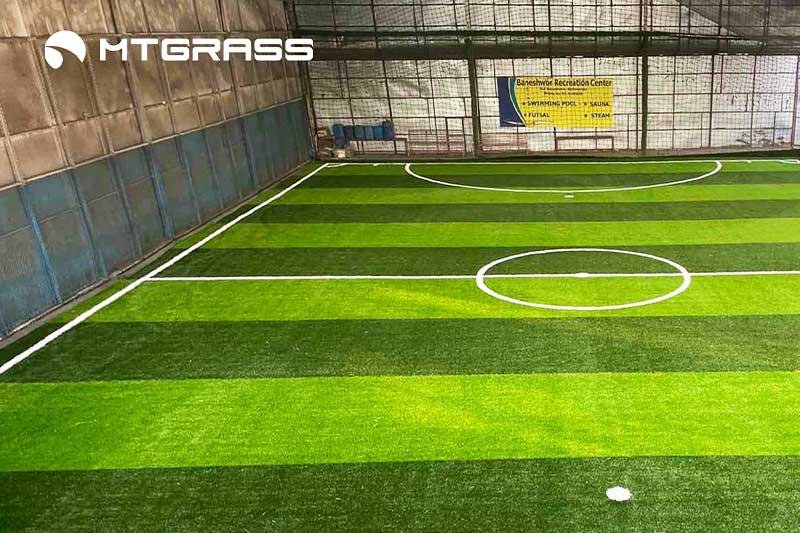
If you’ve ever compared multiple indoor sports turf options, you’ve probably noticed something frustrating—on paper, they all look quite similar.
Same materials. Similar pile heights. Comparable pricing.
But once installed and used over time, the differences start to show. Some surfaces flatten within months. Others lose traction or feel harder than expected. And in high-traffic facilities, small design flaws quickly turn into real operational problems.
That’s why choosing the right indoor sports turf isn’t just about specs—it’s about understanding how those specs translate into real-world performance.
This guide is written to help you do exactly that. I hope this proves helpful for your future choices.
What Is Indoor Sports Turf?
Indoor sports turf is not simply “artificial grass used indoors.” It’s a system that’s been optimized for a completely different environment.
Unlike outdoor artificial grass, which is built to survive weather, indoor turf is designed around how people use it—how it feels underfoot, how it responds to movement, and how it holds up under repeated use.
In most projects, you’ll see indoor turf used in:
- indoor soccer/football facilities
- indoor baseball training areas
- gym and fitness zones
- indoor multi-purpose sports spaces
From a technical standpoint, indoor artificial turf usually sits within a narrower specification range. Pile heights are typically between 10 mm and 40 mm, and many systems are designed without infill, especially in gym or training environments.
What matters more is not exposure resistance, but things like:
how stable the structure remains after months of use, how consistent the surface feels across the entire field, and how easy it is to maintain.
This is where a well-designed system—like those developed by MightyGrass—tends to make a noticeable difference over time.
Indoor vs Outdoor Turf: What’s the Difference?
At a glance, indoor and outdoor turf may look almost identical. But they’re built with very different priorities in mind.
Outdoor turf is engineered to handle environmental stress. It needs UV resistance for 8–10 years, efficient drainage (often above 60 liters per minute per square meter), and the ability to withstand temperature changes.
Indoor turf doesn’t deal with any of that. Instead, it focuses on controlled performance—traction, comfort, and durability under repeated use.
That difference shows up in the details.
Indoor turf is usually shorter, more compact, and often installed without infill. Outdoor turf, by contrast, tends to rely on sand or rubber infill to support longer fibers and manage drainage.
A common mistake is using outdoor turf indoors because it feels “more durable.” In reality, it often leads to higher costs and a less refined playing experience.
Indoor turf field environments don’t need more resistance to rain—they need more consistency under pressure.
Key Factors to Consider Before Buying Indoor Sports Turf
When you start reviewing suppliers, you’ll likely be presented with a long list of technical specs.
But in practice, only a handful of factors will truly determine whether your synthetic sport turf performs well after six months, one year, or longer.
1. Type of Sport & Usage Scenario
Everything starts with how your space will actually be used.
An indoor soccer field, for example, demands a very different surface compared to a gym turf zone. Soccer requires controlled traction and predictable ball movement, while gym turf needs to handle sled pushes, quick direction changes, and constant foot traffic.
If the turf doesn’t match the application, issues tend to show up quickly—uneven wear, inconsistent performance, or even safety concerns.
In real projects, this is MightyGrass often where experienced suppliers add the most value—not by offering more options, but by helping you narrow them down based on actual usage.
2. Pile Height & Density
Pile height is usually the first thing people look at, but it’s only part of the picture.
Yes, different applications follow general ranges—around 10–15 mm for gym turf, and up to 20–40 mm for indoor soccer or multi-sport use fields. But without the right density, even the “correct” height won’t perform well.
Density, we often measured in stitches per square meter or yarn weight, is what determines how the sport turf holds up over time. In higher-end indoor athletic turf systems, you’ll typically see densities in the range of 16,000 to 25,000 stitches per square meter.
If density is too low, the fibers won’t support each other, and the surface can start to flatten or shift under pressure.
A lot of buyers initially focus on taller grass, but in practice, increasing density slightly often delivers better long-term results than simply increasing pile height.
3. Yarn Material & Structure
The yarn is where comfort and durability meet.
MightyGrass Most indoor sport turf uses polyethylene (PE) for its softer feel, sometimes blended with polypropylene (PP) for added structure. In more demanding environments, nylon may be introduced for its higher wear resistance.
But beyond the material itself, the structure matters just as much.
Yarn thickness—typically in the range of 6,000 to 12,000 Dtex for indoor applications—affects how well the fibers recover after use. U-, S-, or Diamond-shaped monofilament structures tend to hold their shape better over time, while fibrillated yarns are often more cost-effective but less resilient.
What you’re really looking for is balance: an artificial grass sports surface that feels comfortable on day one, but still performs consistently after thousands of hours of use.
This is precisely where MightyGrass’s manufacturing processes and expertise play a decisive role—a level of excellence that could never be achieved by relying solely on the raw materials themselves.
4. Shock Absorption & Safety
In high-frequency indoor turf field environments, shock pad is not just a comfort feature—it’s a performance factor.
Most indoor turf systems aim for shock absorption values between 20% and 50%, depending on the application. This helps reduce impact on joints and improves overall usability, especially in training or commercial settings.
In some cases, an additional shock pad layer—usually around 5–15 mm thick—is installed beneath the turf to enhance cushioning.
Facilities that invest in better shock absorption often see indirect benefits as well. Users stay longer, training feels more comfortable, and the surface remains more consistent under repeated stress.
It’s one of those details that’s easy to overlook during purchasing, but very noticeable in daily use.
5. Backing & Stability
If there’s one component that quietly determines how your synthetic grass performs long-term, it’s the backing system.
Most indoor turf uses a double-layer structure with a primary backing (PP) and a secondary coating—MightyGrass offers latex or polyurethane (PU). This is what holds everything together.
A stronger backing improves dimensional stability, meaning the turf stays flat, resists wrinkling, and doesn’t shift over time.
For indoor sports field environments, drainage is usually not the priority. Instead, the focus shifts to stability, durability, and how well the system handles repeated use without breaking down.
This is also where differences between manufacturers become more apparent.
While many products may look similar on the surface, the backing quality—and the consistency of how it’s produced—often determines whether the turf still performs well a year later.
It’s one of the reasons why some buyers, after trying multiple suppliers, eventually prioritize reliability over minor price differences—and why systems like those from MightyGrass are often evaluated based on long-term performance rather than just initial specifications.
Types of Indoor Sports Turf
Indoor sports turf is not a monolithic product category. In actual projects, even if the surface appearance is similar, different application scenarios require distinct structural designs. These differences typically manifest in aspects such as pile height, density, and cushioning systems. Understanding these distinctions helps avoid the selection of “generic” products—solutions that tend to perform poorly in any specific context.
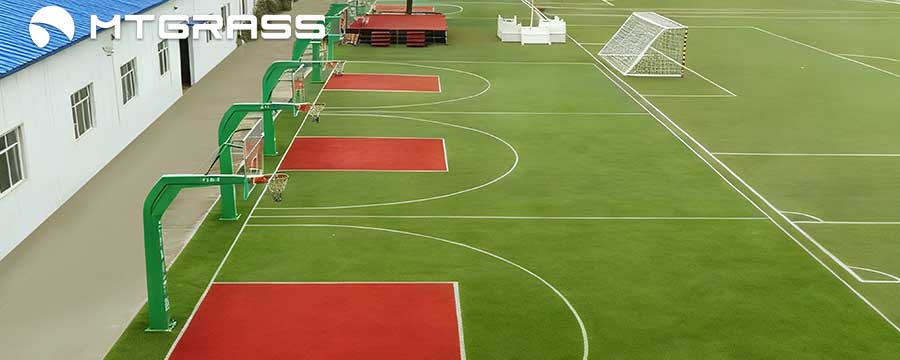
Indoor Soccer Turf
Indoor soccer turf is all about balance. You need enough traction for quick direction changes, but not so much that it feels “sticky.” At the same time, ball roll needs to stay predictable across the entire field.
Most indoor soccer systems fall into a relatively narrow range:
pile heights around 30-40 mm, often paired with medium-to-high density non-infill or low-infill to keep the surface stable under repeated use.
Where many projects go wrong is not in the initial feel, but in how the turf ages.
Lower-density systems tend to flatten unevenly, which affects both player movement and ball behavior.
In high-usage venues and facilities, superior structural design—precisely the core strength on which MightyGrass, a FIFA-godkänd tillverkare av konstgräs, focuses—begins to demonstrate its unique value. This turf not only performs exceptionally well immediately upon installation but also consistently maintains its performance over time.
Indoor Baseball Turf
Baseball training surfaces tend to be more demanding than people expect.
Unlike general sports use, here the baseball/softball turf is constantly interacting with both athletes and equipment. Ball bounce, roll speed, and surface consistency all matter—and even small variations become noticeable.
In batting cages or training lanes, certain areas take concentrated impact. If the turf lacks structural strength, wear patterns appear quickly.
This is why many baseball-focused systems lean toward:
slightly lower pile heights (often 12–25 mm) and tighter construction, sometimes with higher Dtex yarns for improved resilience.
Buyers who have worked on these projects usually shift their focus away from “softness” and toward predictability and durability—because that’s what defines long-term usability.
Gräsmatta för multisport
Multi-sport environments are where compromise becomes necessary—but also where smart configuration makes the biggest difference.
These spaces are used for everything: light training, casual play, group activities. No single performance metric dominates.
Instead of optimizing for one use case, the goal is to avoid extremes.
Most multisportgräs systems sit in the middle range:
around 15–20 mm pile height, with balanced density and moderate shock absorption.
What matters here is consistency. If more than 70% of your usage time is dedicated to a single activity, optimize for that activity rather than pursuing “versatility.”
In practice, a well-balanced indoor sports turf system will reduce complaints, extend usability, and make the space more flexible—especially in commercial or community environments.
Gym & Fitness Turf
Gym turf looks simple—but it’s one of the most technically demanding applications.
The stress it handles is very different from traditional sports.
Instead of ball movement, you’re dealing with repeated foot impact, sled pushes, and lateral force.
Most gym turf systems are shorter—typically 10–20 mm—but require significantly higher density and strong backing support.
Traction is critical. If the surface slips during sled training or agility drills, it immediately affects usability.
At the same time, compression resistance matters just as much. Lower-quality turf may show visible indentations after only a few months of heavy use.
This is where non-infill artificial turf systems have become especially popular in recent years. They provide a cleaner, more stable surface for indoor training, with fewer maintenance concerns.
For many commercial gyms, the shift toward non infill gym turf is less about trend, and more about operational efficiency.
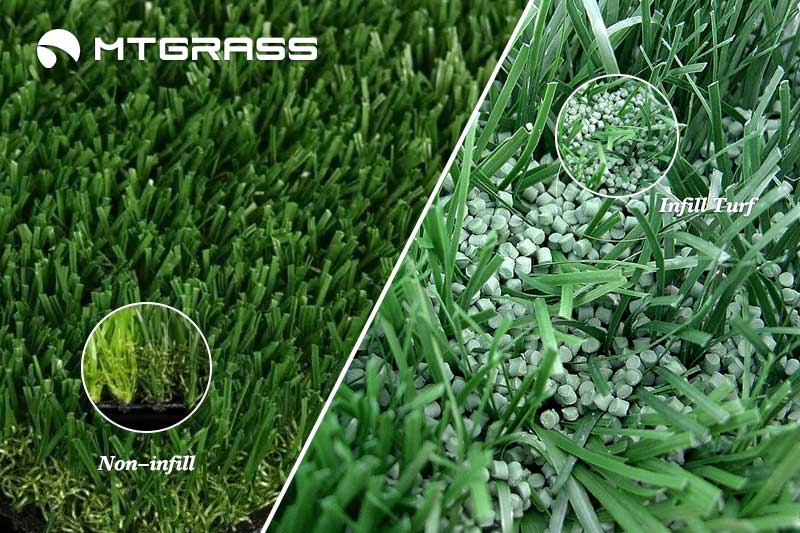
Infill vs Non-Infill Indoor Turf: Which Should You Choose?
This decision has become much more relevant in the past few years.
Traditionally, infill systems—using sand or rubber—were widely used because they helped stabilize longer fibers and improve cushioning.
But in indoor environments, the drawbacks are hard to ignore.
Infill turf often requires more complex installation, and over time, particles can migrate, scatter, or require replenishment. In enclosed spaces, that becomes a maintenance issue—especially for facilities that run daily sessions or host multiple users.
Non-infill turf, by contrast, simplifies the system.
Instead of relying on loose materials, it uses higher density and structural design to maintain performance. This approach has gained significant traction, especially in gym and fitness facilities, training centers, and multi-use indoor spaces.
What’s interesting is that this trend is no longer limited to fitness environments.
Even in indoor five-a-side soccer (futsal-style) fields, where infill used to be considered standard, more operators are beginning to explore non-infill solutions.
For example, MightyGrass has developed non-infill indoor soccer turf systems specifically for small-sided indoor fields. By optimizing fiber resilience, pile density, and backing stability, these systems are able to deliver consistent ball roll and player traction—without relying on sand or rubber infill.
This makes daily operation noticeably easier. There’s no need for infill redistribution, less downtime for maintenance, and a cleaner playing environment overall.
It’s not that infill is outdated—it still has its place in certain sport-specific applications. But for many indoor projects today, non-infill systems offer a cleaner, more predictable solution.
You’re essentially trading a bit of traditional “field feel” for greater consistency, lower maintenance, and a more controlled indoor experience—which, for many facility operators, is a trade-off worth making.
How Much Does Indoor Sports Turf Cost?
Pricing can vary widely, and at first glance, it may seem inconsistent.
You might see indoor sports turf quoted anywhere from $2 to $10+ per square meter, depending on specifications and volume.
But those numbers don’t tell the full story.
Cost is influenced by several underlying factors:
- yarn material and Dtex level
- pile height and density
- backing type (latex vs PU)
- whether a shock pad layer is included
More importantly, the lowest price rarely represents the lowest cost over time.
In real-world projects, turf that costs slightly more upfront but maintains its structure for 8+ years often delivers better value than cheaper alternatives that require earlier replacement.
This is why more buyers are starting to evaluate turf based on lifecycle performance rather than just initial pricing.
Why Choose MightyGrass for Indoor Sports Turf
At a glance, many turf products look similar.
But over time, the differences tend to come from things that are not immediately visible.
What many buyers appreciate about MightyGrass is the focus on system-level consistency.
Instead of optimizing a single parameter, the approach is to balance:
material selection, structural design, and manufacturing precision.
This shows up in a few practical ways.
- Product consistency across batches
- Something that matters a lot if you’re managing large projects or distribution.
- Application-based customization
- Rather than pushing a fixed product, solutions are adjusted based on how the turf will actually be used.
- Proven Durability and Certifications
- MightyGrass FIFA-certifierad gräsmatta for performance, SGS and ISO tested for fireproof resistance, tensile strength, and environmental safety. Designed for 8–10+ years of high-frequency use with minimal maintenance.
- And finally, long-term performance.
- Turf that maintains its shape, traction, and stability after extended use tends to reduce both maintenance effort and replacement frequency.
For buyers who have experienced the gap between “sample quality” and “real-world performance,” this difference becomes especially important.

Slutsats
Choosing indoor sports turf is not just about selecting specifications—it’s about understanding how those specifications translate into daily use. The right surface should feel consistent, perform reliably, and hold up under pressure over time.
Instead of asking which product looks best on paper, ask: Which system will still perform well after thousands of hours of use? That’s usually where the real value lies.
Whether you’re planning a futsal arena, multi-sport training hall, or a high-traffic gym, selecting the right indoor turf is critical for performance, safety, and durability. Avoid costly mistakes by consulting with an experienced manufacturer before placing your order. At MightyGrass, we provide tailored recommendations, sample options, and project guidance to help you choose a solution that fits your facility’s specific needs. Measure your space, define your usage, and reach out today to see how the right turf can transform your indoor sports environment.
FAQ
What is the best indoor sports turf for gyms?
The best indoor sports turf for gyms is typically a short-pile, high-density, non-infill turf designed for durability and stability.
Gym environments involve repetitive, high-intensity movements such as sled pushing, sprint drills, and strength training. A shorter pile height provides better footing, while higher density ensures the surface can withstand heavy use without flattening quickly.
Should indoor sports turf have infill?
It depends on the application.
For gyms and fitness facilities, non-infill turf is usually preferred because it is cleaner, easier to maintain, and more stable for functional training.
For indoor soccer or multi-sport fields, non-infill or light infill systems may be used to improve cushioning and ball behavior.
The decision should be based on how the surface will be used rather than a fixed rule.
What pile height is best for indoor turf?
The ideal pile height varies by application.
For gym and fitness use, shorter pile heights (around 10–20 mm) provide better stability and durability.
For indoor soccer or multi-sport use, medium pile heights (approximately 25–40 mm) offer a better balance between comfort and performance.
Choosing the wrong pile height can affect both safety and user experience.
Is indoor artificial turf safe for athletes?
Yes, when properly designed and installed, indoor artificial turf is safe for athletes.
Safety depends on factors such as shock absorption, traction, and surface stability. Turf systems with proper cushioning and balanced friction help reduce the risk of joint stress and slipping.
Poor-quality turf or incorrect installation, however, can increase injury risk.
How do you maintain indoor sports turf?
Indoor turf requires relatively low maintenance compared to outdoor systems, but regular care is still important.
Typical maintenance includes:
- Removing dust and debris
- Occasional brushing to maintain fiber position
- Cleaning spills or sweat to prevent odor buildup
Proper ventilation and periodic deep cleaning help extend the turf’s lifespan.
Can indoor turf be installed on concrete?
Yes, indoor turf is commonly installed over concrete surfaces.
However, the subfloor must be clean, level, and dry before installation. In some cases, adding a shock pad layer on top of concrete is recommended to improve comfort and reduce impact stress.
Is indoor turf worth the investment?
For most commercial and training facilities, indoor turf offers strong long-term value.
Although the initial cost may be higher than some flooring options, it provides:
- Hållbarhet vid tung användning
- Konsekvent prestanda
- Lower maintenance requirements over time
When properly selected, it becomes a cost-effective solution over its lifecycle.