
 ไทย
ไทย  English
  العربية
  Español
  Deutsch
  Français
  Português
  Русский
  日本語
日本語  Italiano
  Nederlands
  Svenska
  Suomi
Suomi  Dansk
Dansk  Ελληνικά
  Bahasa Melayu
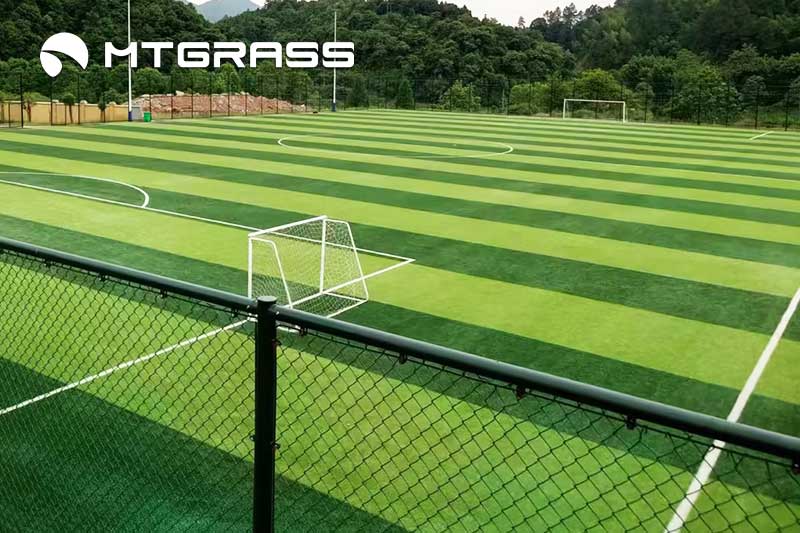
If you are buying artificial grass for the Chile market, choosing a supplier is about much more than finding a competitive price per square meter. You need a turf product that fits the application, survives Chile’s varied climate, arrives in consistent batches, and gives you enough technical documentation to support your own customers and projects.
That matters because Chile is not one uniform synthetic turf market. Landscape turf, football turf, padel court turf and other sports turf applications have different performance requirements.
For distributors, contractors and project buyers, the question is therefore not simply where can you buy artificial grass in Chile? It is which artificial grass supplier can support your business over the long term? We hope the information in this article proves helpful for your future investment decisions.
How the Artificial Grass Supply Market Works in Chile
When you search for an artificial grass supplier in Chile, you will encounter several types of businesses. Understanding the difference between them can help you compare quotations more accurately.
Local Distributors
A local distributor can be convenient when you need smaller quantities, faster domestic delivery or products already stocked in Chile.
You may also benefit from local customer service and easier coordination for smaller landscaping or installation jobs. However, a distributor is usually adding another layer between you and the original manufacturer. That can affect pricing, customization options and your ability to obtain detailed production information.
For a contractor buying a few hundred square meters for individual projects, that trade-off may make sense. For a distributor building a long-term product line, it is worth comparing the distributor’s offer with direct factory sourcing.
Local Installers and Contractors
Installation companies generally focus on the complete project rather than manufacturing the artificial grass itself. They may supply the turf together with adhesive, infill, shock pads, base preparation and installation services.
This model is particularly common in sports projects. In Chile, for example, local companies actively market complete solutions for fútbol 5, fútbol 7 and fútbol 11 projects, including synthetic grass and installation materials.
If you are an installer or sports contractor yourself, however, buying directly from a manufacturer can give you more control over the artificial turf specification and your project margin.
Chinese and Other Overseas Manufacturers
Direct factory sourcing gives you another option: buying artificial grass directly from the manufacturer rather than through a local intermediary.
This can be particularly attractive when you are purchasing container quantities, developing your own product range, supplying multiple projects or looking for OEM/private-label products.
But direct importing only works well when the manufacturer has genuine production capability. A low factory quotation is not enough. You need to understand how the artificial turf is made, how quality is controlled, what can be customized and whether the manufacturer has experience supporting Chile buyers.
Artificial Grass for Chile: Landscape or Sports Turf?
Before comparing artificial grass suppliers in Chile, define what you are actually buying. Landscape turf and sports turf may look similar in a quotation, but they are engineered for very different purposes.
For landscaping, you may prioritize appearance, softness, density, UV resistance, drainage and long-term color stability. Typical products can range from short 15–30mm decorative turf to longer 35–50 mm lawn systems, depending on the application.
For football, the specification becomes much more performance-oriented. Pile height, yarn construction, Dtex, stitch density, backing, infill and the complete base system all influence how the surface behaves.
Therefore, do not blindly select an artificial turf supplier before clarifying the specific intended use.
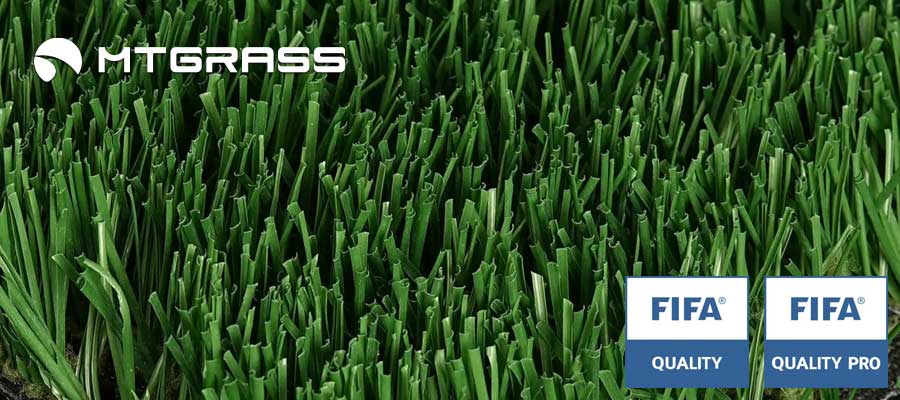
MightyGrass, for example, supplies สนามหญ้าฟุตบอลฟีฟ่า in 40 mm, 50 mm and 60 mm configurations. A 50–60 mm system is commonly used for 11-a-side football pitches where the turf works together with sand and/or rubber infill, while shorter 40mm systems can be appropriate for smaller or indoor specific-use pitches.
What Turf Specifications Matter When Importing Artificial Grass?
Chile stretches roughly 4,300 kilometers from the Atacama Desert to the Strait of Magellan, and that geography isn’t a marketing angle — it’s a set of technical constraints that should change what you order.
UV stabilization for the north. In regions like Atacama and Antofagasta, both UV intensity and daily temperature swings are extreme. Artificial turf without properly compounded UV stabilizers in the yarn — not just a surface coating — will show visible fading and yarn brittleness within two to three years in this kind of exposure.
Furthermore, for the northern region of Chile—characterized by intense sunlight and an extremely dry climate—a combination featuring a PU backing, cooling grass blades, and UV-resistant properties should be your top priority.
Drainage performance for the south. In the Lagos and Los Ríos regions, where rainfall is heavy for much of the year, an artificial turf’s permeability rate — typically measured in L/min/m² — determines whether a field or yard is usable the day after rain or turns into standing water.
If you are supplying turf for projects in regions with high rainfall, you must consider not only the permeability of the turf itself but also the crushed stone base layer and the overall drainage design.
In addition, there are specifications such as pile height, yarn material, yarn shape, Dtex, gauge, backing, and certifications, which are determined based on your specific application scenario.
For example, a MightyGrass FIFA football turf project (Football Training Base) has used a 50 mm PE monofilament turf, 5/8″ gauge, 10,000 Dtex and 10,500 stitches/m², installed with an eco-friendly infill and shock pad before passing FIFA Quality field testing. These figures are useful as reference points, but they should not be treated as universal specifications for every football field.
What Should You Look for in an Artificial Grass Supplier?
Once you know what type of turf you need, supplier verification becomes the next step. A professional artificial grass supplier should be able to answer technical and commercial questions clearly rather than simply sending you a product catalogue and a price.
Artificial Grass Supplier Evaluation Checklist
| Evaluation Area | What You Should Ask or Verify |
| Manufacturing & QC | Does the company operate its own production lines? Can it show extrusion, tufting and backing facilities? Are batch records and QC reports available? |
| Product Range & Customization | Can pile height, yarn shape, density, color and backing be customized? Can the supplier develop samples before bulk production? |
| Certifications & Testing | Can the supplier provide genuine third-party test reports? For football projects, is the product/system listed or eligible within the relevant FIFA framework? |
| MOQ & Samples | Is MOQ calculated by square meter, roll or container? Are samples available? How long does sample preparation and shipping take? |
| Export & Technical Support | Does the supplier regularly export to Latin America? Can it provide technical specifications, installation guidance and shipping documentation? |
| Supply Consistency | Can the supplier reproduce the same specification across multiple production batches? |
| Packaging & Logistics | Are roll dimensions and loading plans optimized for international sea freight? |
| การสนับสนุนหลังการขาย | Who handles technical questions when the turf reaches the installation stage? |
Who actually manufactures the artificial turf?
A trading company may have an attractive catalogue but limited control over the yarn, tufting or backing process. A vertically integrated manufacturer can control more of the product from raw material to finished roll.
MightyGrass operates in-house yarn extrusion, tufting and backing production rather than relying entirely on an external factory. covering product specifications, colors, yarn structures, backing and private-label packaging. Its manufacturing system covers the three major stages of turf production and supports factory-direct supply for distributors and contractors, and maintains consistency.
Certifications: Ask for the Actual Documentation
For football, FIFA explains that artificial football surfaces must undergo testing in the laboratory and on the final installation. The ฟีฟ่า คิวลิบ และฟีฟ่า คิวลิบ โปร marks apply to pitches that meet the relevant requirements. FIFA’s current testing framework evaluates factors including player-surface interaction, ball-surface interaction, durability, weather resistance, product composition and seam strength. Therefore, “FIFA turf” implies more than just a manufacturer claiming their product meets FIFA standards.
For that reason, your supplier should provide relevant third-party test reports and help you confirm which documents are required for your specific Chilean application, customer or tender.
MOQ and Samples
MOQ is another area where a cheap-looking quotation can become expensive. Before placing an order, clarify whether the supplier’s MOQ is based on square meters, rolls, or a full container. You should also confirm sample availability, sample charges, production lead time and freight arrangements.
For distributors, samples are not just for checking color. You can use them to compare yarn resilience, backing quality, stitch consistency and appearance against competing products before committing to a larger purchase.
MightyGrass currently lists a 1,100 m² MOQ for its factory-direct artificial turf supply and offers free sample support, while larger projects can be planned around bulk production requirements.
Should You Buy Artificial Grass Locally or Directly From a Manufacturer?
There is no single answer for every buyer. If you are a small installer who needs a few rolls immediately, a local distributor may be the most practical choice. But if you are a Chilean distributor, importer or project contractor purchasing regularly, direct sourcing can become more attractive.
| Buying From a Local Supplier | Buying Directly From a Manufacturer |
| Easier domestic delivery | ราคาจากโรงงานโดยตรง |
| Smaller quantities may be easier | Better suited to larger orders |
| Local stock may be available | More control over production |
| Easier local communication | Direct technical communication |
| Limited customization in some cases | OEM/ODM options |
| Less responsibility for importing | Buyer manages international logistics |
| Potentially higher unit cost | การควบคุมต้นทุนในระยะยาวที่ดีขึ้น |
If you buy 200 m² once, the convenience of a local supplier may outweigh the savings from direct import. If you purchase several containers a year, supply consistency, product customization and factory pricing can become much more important.
Why Work With a Chinese Artificial Grass Manufacturer for Chile?
In terms of production capacity distribution, the growth in global demand for artificial turf has driven an increase in supply from manufacturers; Chinese turf companies, possessing multiple advantages in cost, production capacity, and technology, serve as the primary global production base, accounting for over 60% of global capacity.
For Chilean distributors and contractors, the biggest risk is rarely the first order. It is what happens with the second, third, and tenth shipment. Will the product remain consistent? Can you get a clear answer when a customer raises a technical question? Can the manufacturer adapt when your market demand changes?
MightyGrass has been manufacturing artificial grass since 2003, working with distributors, contractors and project buyers across international markets. Instead of treating every order as a one-time transaction, we work with buyers who need a stable source they can build their business around.
For you as a Chilean buyer, that means you can start with samples and a specific project requirement, then gradually move toward regular supply as your market develops. You can also discuss different product categories with the MightyGrass when your business expands from landscaping into football, แพเดล or other sports applications.
In addition, MightyGrass provides direct communication with an experienced export team, including Spanish-speaking support, so you can discuss your requirements with the people responsible for the order.
ความคิดสุดท้าย
The Chilean artificial grass market gives distributors and contractors access to both local suppliers and international manufacturing partners. The right choice depends on your order volume, application, project requirements and ability to manage imports.
MightyGrass works directly with distributors, contractors and sports-project buyers that need factory-level artificial turf supply rather than a one-off product purchase. MightyGrass can help you develop artificial grass products around your actual Chilean market requirements. If you are sourcing artificial grass for Chile, please ติดต่อเรา immediately.
คำถามที่พบบ่อย
What Is the Average Price of Artificial Grass in Chile?
Artificial grass in Chile typically ranges from around CLP 2,500 to CLP 15,000+ per m², depending on pile height, yarn quality, density, backing and application. Basic residential turf is generally at the lower end, while premium landscaping and sports turf costs more. For commercial projects, importing directly from a manufacturer can offer a different cost structure because pricing depends on specifications, order volume, freight and import costs. For an accurate comparison, always compare products with similar specifications rather than price per square meter alone.
What Types of Artificial Grass Are Available in Chile?
You can find several types of artificial grass in the Chilean market, including landscape turf, football turf, padel turf and other sports surfaces. Import records also show products ranging from short-pile landscape grass to sports turf in different specifications, so your choice should be based on the intended application rather than pile height alone.
What Artificial Grass Is Best for Football Fields in Chile?
For football fields in Chile, the best artificial grass is typically a durable sports turf designed for high traffic, strong UV exposure and reliable drainage. A 50–60mm football turf with high-quality PE yarn, suitable density, stable backing and the right infill system is a practical choice for most full-size and community fields.
Your specification should also reflect the local climate and how often the field will be used. For professional or heavily used facilities, FIFA-tested or certified turf systems can provide a more reliable benchmark for performance and durability. For commercial projects, you should evaluate the complete turf system—including yarn, backing, infill, shock pad and installation—rather than choosing based on pile height alone.
Can I Import Artificial Grass Directly From China to Chile?
Yes. Chilean buyers already import artificial grass from Chinese manufacturers in commercial quantities, covering both landscape and sports applications. Shipment records show a range of Chinese artificial grass products entering Chile, including football and short-pile products. For regular distributors and contractors, direct sourcing can make sense when order volume is sufficient to justify international freight and import management.


