ไทย
ไทย  English
  العربية
  Español
  Deutsch
  Français
  Português
  Русский
  日本語
日本語  Italiano
  Nederlands
  Svenska
  Suomi
Suomi  Dansk
Dansk  Ελληνικά
  Bahasa Melayu
เกี่ยวกับผู้เขียน: This article is written from the perspective of a commercial playground construction contractor with over a decade of experience delivering turf systems for schools, municipal parks, and large-scale entertainment venues across North America. Projects referenced include ASTM F1292-compliant installations ranging from 500 m² to 12,000 m².
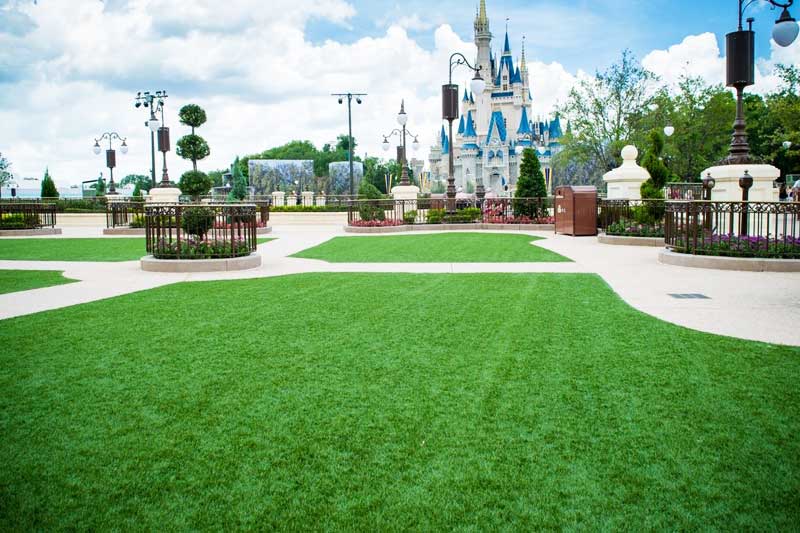
The first time I really noticed it, I was standing at the Main Entrance of Disneyland Park in Anaheim, California. A family of four had just walked past the iconic Mickey Floral display — that perfectly trimmed, lush green expanse framing the floral Mickey Mouse at the train station — and the mother reached down to touch the grass. She looked at her husband, a little puzzled. Then she looked at me. I nodded. It’s playground artificial grass.
That moment stuck with me professionally. When the world’s most visited entertainment brand — a company that employs its own team of Walt Disney Imagineering landscape architects and has earned a global reputation for obsessive detail — chooses playground artificial grass over natural turf, I pay attention. Not because Disney does everything right, but because their decisions reflect a calculus that every serious playground contractor eventually has to make: when does หญ้าเทียม stop being a compromise and start being the better specification?
This is what I’ve learned after years of building outdoor play environments, and after studying exactly what Disney has deployed, where, and why. If you’re a playground contractor, a park builder, a school district facility manager, or a procurement officer looking at a turf spec right now — read this carefully.
How Many Disney Parks Use Playground Artificial Grass?
Before we talk about playground turf decisions, it helps to understand the scale of what Disney manages. There are currently 12 Disney theme parks operating across 6 resort campuses worldwide: Walt Disney World Resort (Florida), Disneyland Resort (California), Tokyo Disney Resort (Japan), Disneyland Paris (France), Hong Kong Disneyland, and Shanghai Disney Resort. A seventh resort has been announced for Yas Island, Abu Dhabi (UAE), with an expected opening date between 2030 and 2033 — making it the first Disney destination in the Middle East.
From a contractor’s perspective, what’s relevant isn’t just how many parks exist — it’s understanding that each resort operates under different regional climate pressures, local water regulations, and maintenance cost structures. Those variables directly shape turf material decisions.
| Resort / Park | สถานที่ | Confirmed Artificial Turf Areas | Install Period |
|---|---|---|---|
| Disneyland Park | Anaheim, CA, USA | Main Entrance Mickey Floral, Haunted Mansion front lawn, Storybook Land hillside, Town Square floral beds, City Hall planters, Disneyland Hotel Adventure Tower lawn, service dog relief areas | 2012 (Cars Land launch); large-scale expansion July–Sept 2022 |
| Disney California Adventure | Anaheim, CA, USA | Cars Land (Sarge’s Surplus Hut, Flo’s V8 Cafe forecourt, Luigi’s queue line) | 2012, at park opening |
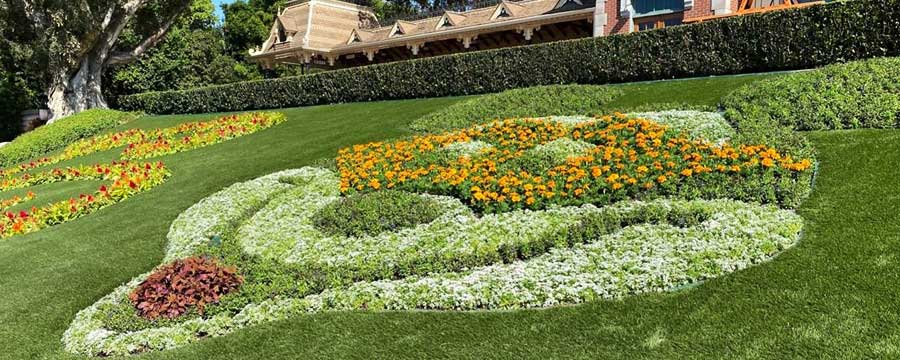
| Magic Kingdom | Orlando, FL, USA | Central Plaza (Hub) — core castle-facing lawn, approx. 13,000 sq ft + 350 faux shrubs | 2016 (Central Plaza landscape overhaul) |
| Disneyland Paris | Marne-la-Vallée, France | Select landscape zones (confirmed via third-party turf supplier references) | Ongoing |
| Disney Abu Dhabi (in construction) | Yas Island, UAE | Full-resort specification expected — extreme heat climate makes natural grass maintenance non-viable | Announced May 2025; groundbreaking 2026; opening est. 2030–2033 |
Sources: MickeyBlog (Sept 2022), Laughing Place (Sept 2022), WDW News Today (Sept 2022), AlternaScapes/EasyTurf installation records (2016), Walt Disney Company official press release (May 2025).
The product specification Disney uses — at least for the California parks — is a proprietary blend of EasyTurf artificial grass (a FieldTurf company) combining more than eight grass types with gray, brown, and off-white blade coloring to create a multi-tonal, natural appearance. Guests routinely walk past it without noticing.
As a contractor, that last sentence is the one that matters. The realism ceiling for modern playground artificial grass has shifted dramatically in the past decade — and Disney’s procurement team clearly knows it.
Does Playground Artificial Grass VS Natural Turf?
The most common objection I hear from clients who are new to commercial playground turf is: “Won’t it look fake?” It’s a reasonable question — because fifteen years ago, it often did.
The generation of synthetic grass deployed in major theme parks today is engineered on a completely different level. Disney’s specification approach answers the realism question better than any sales brochure I’ve read. They don’t use a single grass type. They blend eight or more varieties, each with slightly different pile heights, fiber textures, and color distributions. The result includes blades in natural green, straw-brown, and off-white — because real grass has all of those colors simultaneously.
What makes high-end playground artificial grass look real?
- Multi-tone fiber blending: mixing shades of green, olive, tan, and off-white to replicate natural color variation
- Thatch layer: a base layer of brown/beige fibers that mimics dead organic matter, grounding the visual realism
- Variable pile height: different blade lengths within the same product create the irregular texture of real turf
- Directional fiber lay: fibers installed against the primary viewing angle appear denser and more natural
- Correct infill depth: proper infill keeps fibers upright, preventing the flat “carpet” appearance of under-filled turf
From a specification standpoint, I always advise clients to distinguish between two product categories that sometimes get confused: landscape turf and playground turf. สนามหญ้าภูมิทัศน์ is optimized for visual appearance in low-traffic zones — it typically has longer pile heights and higher visual fidelity but doesn’t carry ASTM F1292 or IPEMA safety certification. Playground artificial grass is engineered for impact attenuation, child safety, and heavy foot-traffic recovery — and the best products today achieve both visual realism and certified safety performance simultaneously.
Disney deploys both, and they’re intentional about which goes where. Decorative grass carpeting near themed storefronts gets the landscape-grade material. The areas where children run, fall, and play get certified playground turf systems with proper shock pad specification beneath.
Contractor field noteI’ve had clients reject a turf sample in the showroom, then walk past the same product installed at a resort and assume it was natural grass. The difference is always installation quality, not product quality. Directional lay, correct infill depth, and edge finishing account for roughly 70% of the perceived realism outcome.
Why Is Playground Turf Maintenance a Deal-Breaker for Theme Park Contractors?
Let me be direct about something that doesn’t get discussed enough in turf sales conversations: natural grass maintenance in a high-traffic commercial playground is a logistical nightmare, and every experienced contractor has a war story to prove it.
Here’s the reality I’ve watched play out on projects: a municipal playground opens with beautiful natural sod. Six weeks in, the entrance apron and the corridor between equipment clusters have developed bare patches from concentrated foot traffic. The facility manager calls, asking who’s responsible. The answer is complicated, the fix is expensive, and the park may need temporary closure during re-sodding. Meanwhile, the การติดตั้งหญ้าเทียม I completed for a similar-sized school the same month looks exactly as it did on opening day.
The real cost of natural grass in commercial playground environments
The numbers tell the story clearly. A 3,000 m² (approximately 32,000 sq ft) natural grass playground area in a temperate US climate typically carries the following annual maintenance costs:
| หมวดหมู่ต้นทุน | Natural Grass (annual) | Playground Artificial Grass (annual) |
|---|---|---|
| Irrigation / water | $8,000 – $18,000 | $0 |
| Mowing & edging | $4,000 – $9,000 | $0 |
| Fertilizers & pesticides | $2,000 – $4,500 | $0 |
| Patch repair / re-sodding | $3,000 – $12,000 | $200 – $600 (brushing + infill top-up) |
| Seasonal downtime / closure | 15 – 40 days/year | 0 days |
| Estimated total annual cost | $17,000 – $43,500 | $200 – $600 |
Estimates based on industry benchmarks for commercial playground environments in the continental US. Costs vary significantly by climate zone, water pricing, and local labor rates.
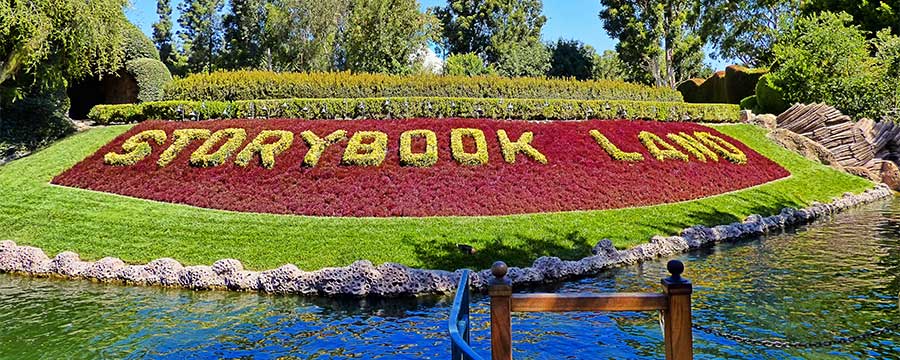
The Disney case illustrates this perfectly. When Disneyland replaced the Storybook Land Canal Boats hillside area with playground artificial grass in July 2022, the resort publicly noted it would save 81,000 gallons of water per year at that location alone — and that’s before accounting for eliminated mowing labor and fertilizer costs across a site that operates 365 days annually.
For us as contractors, the maintenance conversation matters because clients increasingly ask us to think beyond installation cost. A playground turf system that costs 40% more to install but eliminates $25,000+ in annual maintenance creates a positive ROI within 3–5 years on most commercial projects. That’s the argument that wins municipal bids and school district approvals.
Can Playground Artificial Grass Be Customized for Disney-Themed Areas and Branded Environments?
One of the most underappreciated advantages of artificial grass for playgrounds — and one that Disney has used more deliberately than any other operator I’m aware of — is the ability to customize the product to match the surrounding environment, theme, and functional brief of each zone.
When Cars Land opened at Disney California Adventure in 2012, the green carpet of artificial turf laid in front of Sarge’s Surplus Hut and around Luigi’s queue wasn’t chosen for budget reasons. It was chosen because it matched the Route 66 roadside americana aesthetic of that themed land. The color palette, the pile height, the texture — all coordinated to serve the immersive experience.
The Haunted Mansion’s artificial lawn uses a slightly darker, cooler-toned grass product that reads as overgrown and atmospheric rather than manicured. This is deliberate character design using turf as a material.
What customization options are available in commercial playground artificial grass today?
- Custom color blending: standard green, dark green, blue-green, olive, brown — or multi-tone combinations
- Inlaid pattern manufacturing: logos, navigational lines, character silhouettes, playground game markings (hopscotch, compass roses) woven directly into the fiber matrix
- Variable pile heights within a single installation: shorter pile for high-traffic activity zones, longer pile for decorative borders
- Zone-specific product selection: ASTM-certified playground turf in equipment areas, landscape-grade in passive viewing zones, non-infill systems in indoor or covered areas
- Custom backing colors and perimeter finishing to match hardscape or themed border materials
From a contractor specification standpoint, the critical point is that customization must be planned at the design stage, not as an afterthought. Inlaid patterns require digital manufacturing lead times (typically 4–8 weeks for custom orders), and zone-specific product selections need to be coordinated with shock pad specifications, drainage design, and infill types simultaneously. Theme park projects that try to add customization after the base specification is locked tend to run over schedule and over budget.
I’ve learned to ask clients one question early in every playground turf engagement: “What does this space need to feel like, not just look like?” The answer shapes the entire product selection conversation.
How Much Water Does Disney Save by Using Playground Artificial Grass — And Why Does That Matter to You?
Water conservation is the stated primary driver behind Disneyland Resort’s 2022 artificial grass expansion program — and it’s a factor that’s only growing in importance for playground construction projects worldwide.
The data from Disneyland’s program is instructive. Replacing the natural grass hillside around the Storybook Land letters alone saves 81,000 gallons of water per year. When you extend that ratio across a full playground installation of 3,000 m², the annual water saving typically falls between 500,000 and 2,000,000 gallons, depending on climate zone, irrigation system efficiency, and grass type.
Why water conservation matters to playground contractors right now
The regulatory landscape is shifting faster than many contractors anticipate. In California, where both Disneyland Resort locations operate, the state government has implemented mandatory water-use reductions for commercial properties during drought periods — including provisions that affect irrigation systems. Similar restrictions exist or are pending in: Arizona, Nevada, New Mexico (US Southwest), Western Australia, South Africa’s Cape Town region, UAE and Saudi Arabia.
For contractors bidding on municipal playground projects in these regions, the ability to specify a water-free playground turf system isn’t just an environmental talking point — it’s often a prerequisite for bid eligibility or a weighted evaluation criterion. I’ve seen playground projects in California explicitly require synthetic turf in the specification because the client’s facilities department has an internal water-use reduction mandate.
Disney’s public commitment to its water conservation program gives contractors a powerful reference point in client conversations. When a school district’s facilities director says “we’re concerned about water use,” being able to say “Disneyland uses the same category of product, and here’s what they’ve documented in water savings” is a different conversation from quoting a generic sustainability claim.
Water savings benchmark (contractor reference)Approximate annual water savings from replacing natural grass with playground artificial grass:500 m² installation: 85,000 – 170,000 gallons/year1,500 m² installation: 250,000 – 500,000 gallons/year3,000 m² installation: 500,000 – 1,000,000 gallons/yearCalculation basis: 25–30 inches average annual irrigation for cool-season grasses. Actual savings vary by climate zone and irrigation efficiency.
Is Playground Artificial Grass Actually Eco-Friendly?
This is the question that’s coming up in almost every tender response I write now, and I want to give you a complete answer — not a marketing answer, but one that will hold up under scrutiny from a sustainability officer or a green building specification reviewer.
The honest position on playground turf environmental impact is nuanced. Modern high-quality artificial grass is significantly better for the environment than a decade ago, but not without some legitimate lifecycle considerations.
The environmental case for playground artificial grass
- Water elimination: artificial grass requires zero irrigation — a major factor in drought-affected regions where natural turf requires 25–50 inches of supplemental water annually
- Chemical elimination: no fertilizers, herbicides, or pesticides enter soil, groundwater, or stormwater runoff — a significant environmental benefit in watersheds with nutrient pollution concerns
- Carbon reduction: eliminating gas-powered mowing equipment removes an estimated 0.3–0.8 metric tons of CO₂ equivalent per year per 1,000 m² of maintained turf
- Longevity: quality commercial playground turf rated for 8–15 year lifespan reduces the frequency of full-site material replacement compared to natural turf requiring re-sodding every 3–5 years under heavy use
The environmental considerations that need honest handling
- Infill materials: traditional crumb rubber infill has faced scrutiny regarding potential leaching of trace compounds. The professional specification standard now favors TPE (thermoplastic elastomer) or EPDM infill with documented REACH compliance — both are chemically stable and widely used in certified playground systems
- End-of-life: standard synthetic turf is difficult to recycle through conventional municipal streams. Premium manufacturers now offer fully recyclable product lines — MightyGrass’s ERET system uses 100% recyclable mono-material construction — which should be specified on projects with sustainability certification requirements
- Heat retention: artificial turf surfaces reach higher temperatures than natural grass in direct sun. This is a real consideration for playground design — addressed through shade structure specification, cooling fiber technology, and irrigation misters in hot climates
For contractors writing sustainability sections into bid responses, I recommend framing playground artificial grass as the better choice on water, chemicals, and lifecycle cost, while being transparent about infill selection and end-of-life options. That approach holds up better under rigorous review than an overclaim that ignores the heat or recycling questions.
What Safety Certifications Does Disney-Grade Playground Turf Need to Pass?
This is the section where I see more costly mistakes made by contractors than anywhere else in the playground turf specification process — and it’s the section where the stakes are highest, because the errors directly affect child safety and contractor liability.
The fundamental distinction every contractor must understand: product-level certification is not the same as system-level certification. A turf manufacturer’s ASTM F1292 data sheet for their grass fiber product does not tell you whether the combined system — that specific grass, with that specific infill, over that specific shock pad thickness — meets ASTM F1292 at your project’s specified Critical Fall Height.
I learned the hard way that this gap exists. I’ve watched a colleague’s municipal playground project fail its independent Gmax and HIC impact testing after installation because the turf supplier’s product certificate and the shock pad supplier’s data sheet were never combined into a system-level test. The result was 11 weeks of delays and approximately $31,000 in rework and re-inspection costs. The client’s inspector was right to require it. The supplier was wrong to imply their product certificate was sufficient.
The certification matrix for playground turf projects
| มาตรฐาน | What it governs | Required in | Contractor action required |
|---|---|---|---|
| ASTM F1292 | Impact attenuation — Critical Fall Height (CFH) for equipment fall zones | USA (mandatory for public playgrounds) | Request SYSTEM-level test report: turf + infill + shock pad combination tested together |
| ASTM F1951 | Surface accessibility — ADA wheelchair and mobility device traversal | USA (ADA compliance required) | Confirm product holds F1951 certification; document in spec submission |
| IPEMA Certification | International Playground Equipment Manufacturers Association — comprehensive playground surface safety | USA (strongly preferred; some tenders require) | Verify current IPEMA certification; request certificate with current date |
| EN 1177 | European standard for playground surfacing impact attenuation | EU, UK, Australia, Middle East | Same system-level requirement as ASTM F1292 — product cert alone is insufficient |
| REACH Compliance | Chemical safety — absence of restricted substances (heavy metals, PAHs, phthalates) | EU (mandatory); USA (best practice); Middle East (increasingly required) | Request REACH Declaration of Conformity and third-party lab test report for selected infill |
A reputable playground turf supplier operating at the level required for theme park, school, or municipal projects should be able to provide all of the above documentation as standard — not as a special request. If a supplier hesitates on system-level test reports or cannot produce a current IPEMA certificate, that is a disqualifying gap regardless of price.
What Do Theme Park Playground Contractors Actually Need from an Artificial Grass Supplier?
I want to end with the most practically useful section of this article — the one that reflects what I’ve actually needed from suppliers across commercial playground turf projects, and where suppliers have let me down or exceeded expectations.
Disney’s procurement team doesn’t just buy turf. They specify a system, validate documentation, require installation oversight, and build in quality assurance checkpoints. Most contractors don’t operate at that scale — but the underlying needs are the same. Here are the five things that determine whether a supplier relationship works for commercial playground construction.
1. Logistics and delivery reliability
Playground construction timelines are unforgiving. A school playground must be ready before the academic year. A municipal park must open for the summer season. A theme park attraction must be functional for a scheduled event. Late turf delivery does not earn sympathy — it earns penalty clauses.
The suppliers I trust are those with regional warehouse inventory and documented lead times — not aspirational lead times. For North American projects, I look for suppliers with US-based warehouse stock that can turn an order within 5–10 business days for standard specifications. MightyGrass operates a California warehouse with same-day pickup and local delivery to California, Nevada, and Arizona — that’s the kind of operational infrastructure that makes project scheduling reliable.
2. System-level documentation package
Every commercial playground project I’ve delivered in the past five years has required a documentation package at handover. The components vary by jurisdiction, but the baseline includes: ASTM/EN system-level test reports (turf + infill + shock pad), IPEMA certificate, REACH Declaration of Conformity, Technical Data Sheet, and Declaration of Performance. Some school district projects also require third-party environmental test reports for infill materials.
Suppliers who provide this as a standard package — not a per-project custom request — save contractors 2–4 weeks of administrative friction and significantly reduce the risk of a documentation gap causing project delay at final inspection.
3. Project-specific Bills of Quantities (BOQ)
No two playground projects are identical. A playground covering 800 m² with a climbing structure requiring a 2.5 m Critical Fall Height specification is a completely different material system from a 3,500 m² school field with a 1.5 m maximum fall height. I need suppliers who will work through the technical specification with me and produce a project-specific BOQ — not a generic per-square-meter price list that leaves all the system decisions to me.
The correct BOQ for a playground turf system specifies: turf product with pile height and density, infill type and quantity, shock pad specification with thickness and CFH rating, adhesive and seam tape quantities, and perimeter edging or banding. A single-line turf quote without these components is not a BOQ — it’s an incomplete specification waiting to cause problems.
4. Physical sample confirmation process
I’ve had clients sign off on a color swatch and then struggle with the installed result because the swatch didn’t accurately represent the product under natural daylight at scale. For playground artificial grass projects, I now require physical samples — cut from actual production rolls — to be reviewed by the client and approved in writing before I place an order.
Suppliers who ship samples promptly, who can provide multiple product options for comparison, and who maintain consistent color standards between sample and production run are worth a premium. Suppliers who make sample requests difficult or whose production batches diverge from approved samples create problems that arrive at exactly the worst moment — during installation week.
5. Post-installation support and warranty clarity
Commercial playground turf systems carry 8–15 year expected service lives, but that expectation is contingent on correct installation and periodic maintenance. The suppliers I return to are those who provide: an installation guide specific to their product, written guidance on infill maintenance intervals, a clear warranty that specifies what’s covered and what voids coverage, and a process for ordering replacement material from the same production batch if a zone needs repair.
The worst supplier scenario I’ve encountered in this category was a company whose warranty required the client to purchase a specific maintenance service contract — information that was buried in the warranty fine print and not disclosed during the sales process. That supplier is no longer in my approved vendor list.
Who Best Playground Artificial Grass Manufacturer in the World?
The top 3 manufacturers of artificial grass for playgrounds mainly include Mighty Grass, Foverlawn, and Tencate. It is currently the manufacturer with the most cooperation with playground contractors in the world.
When contractors ask me who to actually specify for a commercial playground turf project — not just who’s well known, but who can deliver the certification documentation, the logistics support, and the product consistency that a serious project demands — my answer always starts with the same short list.
There are dozens of manufacturers globally, but for high-specification playground environments, the field narrows quickly. Here are the three names that appear most consistently in professional specifications worldwide such as Mighty Grass ), and an honest comparison of what each brings to the table.
MightyGrass (MTGRASS) — Factory-Direct Global Supply with US Warehouse
Founded in 2003 and headquartered in China with production facilities in both China and Saudi Arabia, MightyGrass has grown into one of the fastest-expanding synthetic turf manufacturers in international markets. What distinguishes MightyGrass for contractors working on playground projects isn’t just the product range — it’s the operational infrastructure. A California warehouse enables same-day pickup and rapid delivery across North America, which is a material advantage when project timelines are tight.
For playground specifications specifically, MightyGrass supplies certified systems with ASTM F1292, IPEMA, REACH, FIFA Quality, ISO 9001, and CE documentation. The company’s ERET fully recyclable turf line is increasingly specified on projects with sustainability certification requirements. With over 20 years of manufacturing experience, 50+ patents, and confirmed supply to clients in 166+ countries, MightyGrass sits alongside the legacy European brands on international project shortlists — at a factory-direct price point that typically runs 10–40% below North American and European distributors.
ForeverLawn (Playground Grass™) — US Specialist with Proprietary Safety Innovation
ForeverLawn is a US-based manufacturer that created a dedicated playground turf sub-brand, Playground Grass™, specifically engineered for child play environments. Their product is ASTM F1292 and ASTM F1951 (ADA) certified, with a proprietary XStatic™ antistatic technology — the first patented antistatic artificial grass in the industry, important for playgrounds where children with cochlear implants or hearing aids are present.
ForeverLawn operates exclusively through a local dealer network across the US, which provides strong regional installation accountability but limits direct international availability. Their Playground Grass™ system carries a 15-year warranty and is IPEMA certified with a fall-safe rating of up to 13 feet — exceeding the 8-foot maximum required by most public playground specifications. For US-based school and municipal projects requiring a locally installed and warranted system, ForeverLawn is a credible primary or backup specification.
TenCate Grass — Global Legacy Brand with Full Value-Chain Integration
TenCate (now operating under the consolidated TenCate brand, formerly TenCate Grass) is one of the oldest and most established names in synthetic turf globally, with roots dating to 1704 in the Netherlands and active involvement in artificial turf manufacturing since the late 1960s. With nearly 5,000 employees across 14 countries and a portfolio of subsidiary companies that includes Hellas Construction, TigerTurf, Greenfields, SGW, and Geosurfaces, TenCate is the most vertically integrated manufacturer in the sector — covering R&D, fiber production, installation, and end-of-life recycling through its own network.
For playground and landscape applications, TenCate products consistently meet international certification requirements across North American, European, and Middle Eastern markets. Their scale and integration mean they are the default specification on major stadium and municipal projects in established markets. The trade-off for contractors is price: TenCate systems are positioned at the premium end of the market, with material costs reflecting their brand positioning and distribution overhead. For large government or institutional projects where specification committees require a globally recognized legacy brand, TenCate frequently appears on the approved vendor list by default.
The table below provides a structured comparison across the three dimensions that matter most to playground construction contractors: price positioning, certification coverage, and service model. These are the three questions I ask every supplier before committing to a specification.
| Comparison criteria | MightyGrass (MTGRASS) | ForeverLawn — Playground Grass™ | TenCate Grass |
|---|---|---|---|
| Headquarters & manufacturing | China (main) + Saudi Arabia; US California warehouse | USA (Dayton, OH); dealer-installed nationwide | Netherlands; production in US, EU, Middle East, Asia Pacific |
| Playground turf product line | Certified playground turf systems; landscape, sports, pet, golf ranges | Playground Grass™ (dedicated playground brand); K9Grass™, SportsGrass™ | Full synthetic turf portfolio via subsidiaries (TigerTurf, Greenfields, SGW etc.) |
| Factory-direct price (material only, approx.) | $3.50 – $8.00 / m² factory; $12 – $25 / m² full system | $15 – $28 / m² full installed system (dealer-quoted) | $18 – $35 / m² full system (market-rate; premium positioning) |
| Price positioning vs market | 10–40% below comparable EU/US brands (factory-direct advantage) | Mid-to-premium; US market focus | Premium; global institutional pricing |
| ASTM F1292 (impact attenuation) | Yes — system-level test reports provided as standard | Yes — exceeds requirements; 13 ft CFH rating | Yes — across product range |
| ASTM F1951 (ADA accessibility) | ใช่ | Yes — confirmed certification | ใช่ |
| IPEMA certification | ใช่ | Yes — IPEMA certified Playground Grass™ line | Yes — via subsidiary brands |
| EN 1177 (EU/international) | ใช่ | Not standard (US-focused brand) | Yes — core certification across EU markets |
| การรับรองคุณภาพจากฟีฟ่า | Yes (sports turf line) | No (playground/landscape focus) | Yes (via Hellas Construction, Greenfields) |
| การปฏิบัติตามข้อกำหนด REACH | Yes — standard documentation package | ASTM/IPEMA focus; REACH on request | Yes — full EU regulatory compliance |
| Recyclable turf option | Yes — ERET 100% recyclable mono-material system | Not a primary product focus | Yes — end-of-life recycling via own network |
| Custom patterns / colors | Yes — OEM/ODM customization; color and pattern design | Yes — Funserts™, Funscapes™, multi-color options | Yes — via subsidiary design teams |
| US warehouse / local inventory | Yes — California warehouse; same-day pickup; local delivery CA/NV/AZ | Dealer network nationwide (90+ dealers) | Yes — via SGW and regional subsidiaries |
| International supply capability | 166+ countries; global freight from China + Saudi Arabia | Primarily US market; limited international | 50+ countries; full international distribution |
| Documentation package (BOQ, COC, TDS) | Full system package as standard — BOQ, COC, TDS, lab reports | Standard product documentation; system reports on request | Full documentation; institutional-grade compliance packages |
| การรับประกัน | Product warranty per specification; system warranty on confirmed installation | 15-year warranty (Playground Grass™ line) | Up to 15 years (product-dependent, via subsidiaries) |
| Best suited for | International projects; cost-sensitive municipal / school bids; US projects needing fast delivery | US school & municipal playground projects requiring locally installed & warranted systems | Premium institutional, government & stadium projects; EU market specifications |
TIPS :no single manufacturer is the right answer for every project. For US school district tenders that require a locally installed and locally warranted system, ForeverLawn’s dealer network solves the accountability question in a way a direct-from-factory manufacturer cannot. For international theme park, resort, or large municipal projects where factory-direct pricing and full certification documentation are the primary drivers, Mighty Grass closes the gap with legacy European brands at a material cost advantage. For projects where the specification committee will only accept a globally recognized institutional name without discussion, TenCate ends the conversation.
The most important contractor discipline in playground artificial grass specification isn’t loyalty to a single brand — it’s knowing which supplier’s strengths map onto each project’s specific requirements. Price, certification, delivery, and post-installation support weight differently on every bid.
Why Playground Artificial Grass Is the Right Specification for Serious Projects ?
Disney didn’t switch to playground artificial grass to cut costs. They switched because the material better serves their operational requirements, their environmental commitments, and their guests’ experience expectations — simultaneously.
As a contractor, that’s the framing I bring to every serious client conversation about playground turf. This isn’t a budget solution or a shortcut. It’s a professionally specified system that outperforms natural turf on maintenance, reliability, safety documentation, and design flexibility in commercial playground environments. The world’s most demanding entertainment operator agrees.
If you’re specifying a playground turf system for a school, municipal park, resort, or private entertainment venue, the checklist is straightforward: select a product that holds current system-level ASTM F1292 and IPEMA certification, confirm your supplier can provide full documentation as standard, and work with a manufacturer who has the inventory and logistics infrastructure to support your project timeline.
MightyGrass manufactures and supplies certified playground artificial grass systems with factory-direct pricing, US warehouse inventory, and full compliance documentation. Request a project-specific BOQ or sample pack to begin your specification review.
FAQ: Disney Playground Artificial Grass
Does Disneyland actually use artificial grass?
Yes. Disneyland Resort in California has been deploying artificial grass in phases since 2012, beginning with Cars Land at Disney California Adventure. As of 2022, confirmed artificial turf installations include the Main Entrance Mickey Floral display, the Haunted Mansion front lawn, the Storybook Land Canal Boats hillside, Town Square floral beds, City Hall planters, Disneyland Hotel Adventure Tower lawn, and service dog relief areas throughout the resort. Walt Disney World’s Magic Kingdom installed approximately 13,000 square feet of artificial turf at Central Plaza in 2016.
What type of artificial grass does Disney use?
Disneyland Resort uses a proprietary blend of EasyTurf artificial grass (a FieldTurf / Tarkett company) combining more than eight different grass types. The blend incorporates blades in varying shades of green, gray, brown, and off-white to replicate the natural color variation of real turf. The high-end specification makes the product difficult to identify as artificial with a passing glance.
How much water does playground artificial grass save compared to natural turf?
Disneyland reported that replacing one hillside natural grass area with artificial turf saves 81,000 gallons of water annually. For a 3,000 m² commercial playground installation, annual water savings typically range from 500,000 to 1,000,000 gallons, depending on climate zone and local irrigation requirements. In drought-affected regions such as California, Arizona, and the UAE, water elimination is a primary specification driver.
What safety certifications does playground artificial grass require?
Commercial playground turf systems for public environments require: ASTM F1292 (impact attenuation — system-level test report, not product-level only), ASTM F1951 (ADA accessibility), IPEMA certification, and REACH compliance for all infill materials. European and Middle Eastern projects additionally require EN 1177 certification. Contractors must request system-level test reports — a product certificate alone does not confirm compliance for a specific grass-infill-shock pad combination.
Can playground artificial grass be customized with patterns or themed designs?
Yes. Modern playground artificial grass can be manufactured with inlaid patterns including logos, character outlines, game markings, and multi-color geometric designs. Color options extend beyond standard green to olive, blue-green, brown, and multi-tone blends. Theme park operators including Disney deploy zone-specific products — different grass specifications for decorative landscape areas, children’s activity zones, and high-traffic pathways — all within the same installation.
How long does commercial playground turf last in a theme park environment?
High-quality commercial playground turf systems are engineered for 8–15 year service life under heavy use conditions. Performance is maintained through periodic brushing to restore fiber orientation, infill top-up every 2–3 years, and debris removal. No mowing, watering, re-seeding, or fertilization is required. Theme parks, which operate 300–365 days per year with high foot traffic, represent some of the most demanding use cases for playground turf — and leading manufacturers design their commercial-grade products accordingly.