English
  العربية
  Español
  Deutsch
  Français
  Português
  Русский
  日本語
日本語  Italiano
  Nederlands
  Svenska
  Suomi
Suomi  ไทย
ไทย  Dansk
Dansk  Ελληνικά
  Bahasa Melayu

Over the decades, artificial turf technology has continued to advance, and 4G football pitches have emerged alongside it. Unlike previous 3G pitches that relied on sand infill, MightyGrass 4G artificial turf utilizes an advanced fiber structure and integrated cushioning technology to maintain the stability of the synthetic grass system. This eliminates the initial investment and ongoing maintenance costs associated with traditional artificial turf infill. To understand the concept of 4G football pitches, let’s briefly review the evolution of artificial turf, from the early “Astro Turf” of the 1960s to the current 4G artificial grass (Non-infill artificial grass systems).
The Evolution from 1G to 4G Sports Pitch
1G Pitch
1G turf originating in the 1960s, nylon fibers were tufted into short, dense carpets laid over hard concrete bases. These early surfaces offered speed but lacked cushioning, causing excessive ball bounce and increasing player fatigue.
2G Turf
2G artificial pitches introduced sand infill, improving ball control and surface traction. But, these surfaces were primarily used for hockey and multi-purpose sports areas rather than soccer fields, as the sand made the surface too hard for effective sliding tackles and sliding maneuvers.
3G Turf Pitches
3G football turf combines sand and rubber infill with longer monofilament polyethylene fibers to create an artificial grass system. It delivers a realistic experience for football pitches, offering a more natural feel, shock absorption, and predictable ball roll. And FIFA’s FIFA Quality and FIFA Quality Pro certifications establish specific step-by-step standards for the production and installation of 3G turf pitches. It is now widely recognized as the standard surface for club professional training and community matches.
4G Synthetic Turf
Also known as Non-infill Artificial Grass, 4G turf completely eliminates infill. Instead, it relies on high-density tufting, elastic yarn construction, and advanced backing systems to maintain stability on the playing surface. Although 4G football pitches are not yet regulated by precise data standards from FIFA, the English Football Association (FA), or World Rugby, many schools, communities, and clubs seeking low-maintenance, eco-friendly football turf surfaces are increasingly adopting this non-filled solution. The result? Cleaner, more consistent playing surfaces, reduced environmental impact, and lower maintenance costs.

Key Features of 4G Artificial Turf
Advanced Yarn and Fiber Engineering
The grass fibers used in MightyGrass 4G artificial turf feature not only higher density but also more complex shapes, S-shaped, Diamond, and V-shaped. These structures mimic the physical mechanical resilience of natural turf, helping the soccer field surface recover consistently immediately after player training sessions. We incorporate multiple functional masterbatches during production, including UV resistance and anti-static treatments. This ensures smooth ball roll and realistic visual effects even after high-intensity training and matches.
Non-infill System Design
Unlike third-generation soccer surfaces that rely on infill materials like sand layers and rubber granules, 4G synthetic turf uses no infill whatsoever. Its performance stems from ultra-dense tufting, advanced yarn geometry, and a reinforced backing that keeps each fiber upright. The no-infill design eliminates infill migration issues, reduces particle contamination, and maintains a cleaner, more consistent playing surface year-round.
Low Maintenance, High Consistency
The low maintenance requirements of 4G turf stem from the absence of infill, eliminating the need for periodic replenishment, deep cleaning, and redistribution of particles. The field maintains consistent ball roll across all areas, while surface maintenance is simplified to light brushing and occasional inspection. For clubs, schools, and community games, this translates to lower long-term costs and reduced downtime.
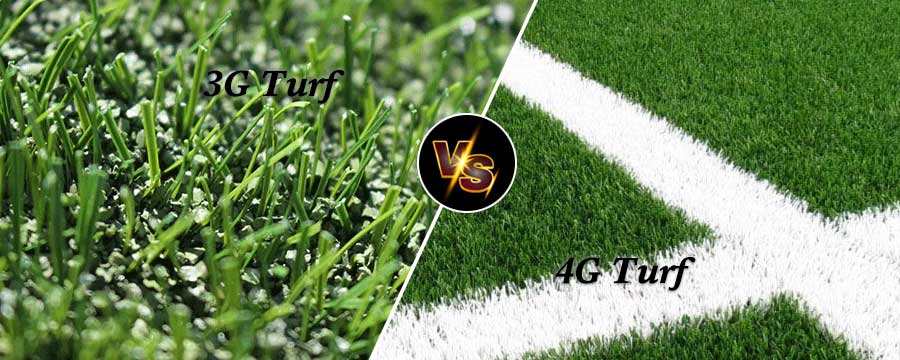
Difference Between 3G and 4G Pitch
| Dimension | 3G Football Pitch (Third Generation) | 4G Football Pitch (Fourth Generation) |
| Structure Composition | Long pile fibers (typically around 40–60 mm) + sand + rubber crumb infill + shock pad. | Long pile fibers + high-density yarn structure + (optional) shock pad/base layer. Primarily non-infill, meaning no sand or rubber granules. |
| Ball & Foot Feel | The infill provides support and cushioning, resulting in ball roll and bounce that closely mimic natural grass. | Without infill, the ball rolls more directly and the surface feels smoother. The structure also feels more like natural grass underfoot. |
| Certification Status | FIFA, the FA and World Rugby have clear data standard requirements | Although the “4G Turf” system is commercially available, it has not yet been officially tested by most regulatory agencies. |
| Maintenance | Requires periodic brushing to redistribute infill, topping up rubber granules, aligning turf fibers, and removing debris. | No infill means no need for topping up or concerns about infill migration or spillage. But, turf fiber condition and system integrity still require monitoring. |
| Lifespan & Risks | Proven through extensive use, with an average service life of 10–12 years (depending on maintenance). | Long-term data are limited, and most information comes from theoretical suggestions. |
Friendly Reminder:
If you require official competition certification, league standards, and maximum safety assurance, choose reliable FIFA-certified 3G artificial grass.
If you prioritize low infill/low maintenance/eco-friendly features, or if the surface is intended for community soccer, training fields, school grounds, or non-elite competitions, then 4G synthetic turf may be a worthwhile new option to consider.
If you decide to use a 4G football pitch, ensure the installer, sports turf quality, fiber density, sub-base structure, and drainage system meet corresponding standards, as “no infill = safe and cheap” is not necessarily true. Also clarify whether the soccer field will host competitions requiring sports governing body certification. As the industry notes: “No 4G system has yet passed FIFA or World Rugby testing standards.”
How Is a 4G Football Pitch Installed?
Below is the standard step-by-step process for installing 4G turf.
- Ground Preparation and Drainage Base: Each project begins with surveying and excavating the existing ground to establish a stable, well-drained foundation. Graded crushed stone or engineered aggregate is then laid over the ground and compacted to specific density standards.
- Shock Absorption Pad Installation: After the base layer is complete, a shock absorption pad (typically made of elastic foam or recycled rubber tiles) is laid across the entire field. Since fourth-generation artificial turf contains no infill, this pad layer is crucial for reducing impact forces and ensuring player safety.
- Laying and Joining Fourth-Generation Turf Rolls: Each roll should be aligned in the same direction to maintain consistent pile orientation and ball trajectory. Installers then precisely trim edges and join rolls using adhesive glue and seam tape.
- Line Marking and Seam Sealing: After the surface is laid, competition lines are inlaid or painted. Professional sports fields typically employ embedded white turf strips for permanent marking, offering far superior fade resistance and durability compared to paint.
- Final Inspection and Testing: Before delivery, the completed 4G field undergoes comprehensive surface performance evaluation. Specialized equipment measures parameters including ball roll, shock absorption, vertical deformation, and spin resistance.
At MightyGrass, we provide full technical guidance, from design consultation and shock-pad selection to on-site supervision and post-installation testing, helping you achieve a surface that’s durable, safe, and truly made to last.

Is 4G Turf the Future of Football Surfaces?
As environmental regulations tighten and public awareness grows, non-infill turf systems are gaining global attention. 4G artificial pitches represent the next frontier in soccer field design.
Driven by Sustainability
Sports organizations and municipal authorities worldwide face mounting pressure to reduce microplastic emissions. By eliminating rubber granule infill, 4G systems directly align with these environmental objectives, a decisive factor for future infrastructure funding and facility approvals.
Fiber Technology Innovation
Ongoing R&D in yarn structure, polymer chemistry, and shock-absorbing underlay design enables fourth-generation (4G) football pitches to match and in some cases surpass, the performance of third-generation (3G) turf. Manufacturers like MightyGrass are investing in recycled yarns and eco-friendly backing systems to achieve closed-loop turf sustainability.
Ideal for Community and School Sports
The combination of low maintenance, safety, and environmental friendliness makes fourth-generation (4G) football fields increasingly popular for campuses, training academies, and multi-sport facilities. It represents a practical and forward-thinking choice that reduces long-term maintenance costs while maintaining consistent playing quality.
Conclusion
This article provides detailed information on everything from selecting a 4G soccer field to installation procedures, aiming to assist you in making informed choices for your upcoming projects.
MightyGrass As a pioneer in artificial turf grass manufacturers, combines advanced fiber engineering, recyclable turf materials, and fully autonomous production to help you create durable, FIFA-compliant, and eco-friendly sports surfaces.
Whether you’re building a school training field or a community soccer center, your next pitch will be built to last and ready for the future.
Interested in learning more about FIFA approved artificial grass options? Contact our professional and reliable artificial turf team today.