English
  العربية
  Español
  Deutsch
  Français
  Português
  Русский
  日本語
日本語  Italiano
  Nederlands
  Svenska
  Suomi
Suomi  ไทย
ไทย  Dansk
Dansk  Ελληνικά
  Bahasa Melayu

Global industry data shows that more than 65%–70% of existing school football fields worldwide are built with 40–60mm 3G football turf systems. This is primarily because 3G systems deliver the most balanced performance across shock absorption, player safety, performance consistency, and full life-cycle cost control. When combined with a shock pad and a quartz sand + rubber infill structure, 3G football turf effectively enhances player safety and game experience, while also extending field lifespan and reducing long-term maintenance costs.
For football field contractors and builders, a school football pitch is not a short-term project, but a core physical education facility designed for 8–10 years of continuous use. When selecting a football turf system for schools, multiple factors must be considered. Safety is the top priority, followed by sports performance and budget control. In addition, usage scenarios, number of users, and weekly usage frequency all play a critical role in determining the most suitable football field turf system.
As a football turf supplier with over 20 years of experience in football turf system R&D and manufacturing, and with participation in 100+ school football pitch installations worldwide every year, Mighty Grass will systematically address the most critical questions schools face when selecting football field turf—covering six key dimensions: safety, performance, installation, cost, maintenance, and long-term operational risk.
Why 3G football is best for schools?
Approximately 80% of schools worldwide choose artificial turf as the playing surface when building or upgrading football fields.
Among them, the majority prioritize 3G football pitch systems with infill and shock-absorbing structures, as 3G football turf has proven to be the most mature and reliable solution—achieving the best balance between safety redundancy, sports performance, and long-term controllability.
Another key reason why 3G football turf has become the global mainstream standard is that it is the only football turf system officially recognized under the FIFA certification framework.
To date, more than 13,000 FIFA-certified football turf fields worldwide—including a large number of school football pitches—have been approved through FIFA’s testing and certification program.
The performance benchmarks of these certified fields provide authoritative, real-world references for educational institutions when selecting football turf systems for school use.
What is 3G football?
A 3G football pitch refers to an infill football turf system, rather than a single artificial grass product.
It is a fully engineered artificial turf system, consisting of multiple integrated components—including the turf carpet, infill materials, optional shock pad, base construction, and installation methodology—designed to work together as a complete football field solution.
What are the pros and cons of the 3G football system for schools?
As the most mature and widely adopted artificial football turf system for school football fields, 3G football turf (third-generation infill artificial turf) offers clear advantages in both performance and long-term value, while also presenting certain design and maintenance considerations that must be properly managed.
One of the core strengths of 3G football turf lies in its superior safety performance and shock absorption capability.
High-quality 3G football turf systems are constructed with quartz sand and rubber infill layers, which provide a highly controllable cushioning effect. In practical applications, these systems typically achieve shock absorption levels of around 60%, helping to significantly reduce the risk of injuries during high-intensity training, sudden stops, and jump landings.
This enhanced impact attenuation not only improves player safety, particularly for students, but also ensures stable, predictable field performance throughout the lifespan of the football pitch—making 3G systems especially suitable for school environments with frequent and long-term use.
3G Football Turf Pros & Cons Comparison Table
| Dimension | Advantages of 3G Football Turf Systems | Limitations / Considerations of 3G Football Turf Systems |
| Safety | By using a quartz sand + rubber infill system, and optionally combined with a shock pad, overall shock absorption typically reaches 55%–70%, significantly reducing the risk of injuries during jumping, sudden stops, and falls. This indicator is also one of the core testing criteria under FIFA Quality / FIFA Quality Pro certification. | If the infill layer is not properly maintained over time (e.g., compaction or infill loss), shock absorption performance may decline. A clear and scheduled maintenance plan is therefore essential. |
| Performance | Ball rebound, ball roll, and traction performance remain stable and predictable, meeting the requirements of physical education, training, and inter-school matches. The controllable performance range supports standardized sports instruction. | Performance depends on the integrity of the entire system. Low-quality materials or improper installation can directly compromise final field performance. |
| High-Frequency Use Capacity | Capable of supporting approximately 40–60+ hours of use per week, making it well suited for combined school use scenarios such as daily PE classes, after-school training, and extracurricular activities. | Under extreme or excessive usage conditions, regular maintenance is still required to slow down wear and extend service life. |
| All-Weather Adaptability | Unaffected by rain, snow, mud, or seasonal changes, allowing year-round use and significantly improving the utilization rate of school sports facilities. | In hot climates, surface temperature management should be considered (e.g., lighter yarn colors, occasional water cooling). |
| Maintenance & Operating Cost | Compared with natural grass, 3G football turf offers lower and more predictable long-term maintenance costs. Over a 10-year period, total maintenance expenses are typically only 20%–30% of those required for natural grass. | Basic maintenance equipment is required (e.g., brushing machines, infill level inspection), but these costs are manageable and controllable. |
| Standards & Certification | Fully compatible with internationally recognized certification systems such as the FIFA Quality Programme, making it easier for schools to reference unified standards during tendering, acceptance, and long-term management. | If international certification is not mandatory in a specific region, some low-spec solutions may fall short of global best practices. |
| Initial Construction Cost | — | Compared with low-end non-infill football turf systems, initial investment is higher, especially when a shock pad is included. However, this cost is typically offset over time through longer service life and lower long-term risk. |
| Environmental & Compliance Considerations | By selecting compliant rubber infill, environmentally responsible materials, and proper drainage design, most regional environmental regulations can be satisfied. | In certain countries or regions, rubber infill materials are subject to additional regulations. Compliance requirements should be confirmed during the design stage. |
Expert Insight
From a school football field development perspective, the “limitations” of 3G football turf are primarily related to the need for professional system design and standardized maintenance, rather than any inherent unsuitability for school use.
On the contrary, its strengths in safety redundancy, performance consistency, high-frequency usage capacity, and full life-cycle cost control make 3G football turf the lowest-risk, most thoroughly validated, and easiest football turf system to manage over the long term for school environments worldwide.
Recommended Football Turf System Spec for Schools
The following specifications are based on global project experience and common technical requirements under the FIFA certification.
They are designed to ensure player safety and sports performance, while also taking into account ease of maintenance and long-term durability for school use.
| Item | Recommended Specification | Description |
| Yarn Type | Sword-shaped (Monofilament) PE yarn | Enhances resilience, traction, and abrasion resistance |
| Pile Height | 50 mm | Balances player safety and realistic game performance |
| Stitch Rate | 10,500 stitches/sqm | Ensures good fiber uprightness and long-term durability |
| Dtex | 11,000–12,000 D | Provides sufficient tensile strength and wind resistance |
| Backing Structure | 3-layer backing + SBR latex coating | Strengthens yarn anchoring and base bonding |
| Color | Field Green + Light Green two-tone blend | Creates a visual appearance closer to natural grass |
Is 4G Football Turf Suitable for School Football Fields?
4G football turf (non-infill football turf) is not the preferred solution for most school football fields.
It is only suitable for a limited number of scenarios, such as low-frequency use, display-oriented fields, or schools where football is not part of daily physical education programs.
For schools whose core objectives focus on student safety, long-term high-frequency use, and overall risk control, 3G football turf remains the more reliable and globally validated option.
What Is 4G Football Turf?
4G football turf, also known as non-infill artificial turf, is a football turf system that replaces traditional infill materials with high-density yarn structures and advanced backing technology.
Unlike 3G systems, 4G football turf does not require rubber or sand infill, relying instead on fiber density and structural design to provide surface stability and performance.

What Are the Advantages and Limitations of 4G Football Turf?
Non-infill football turf, often referred to as fourth-generation football turf, has attracted attention from some schools due to its perceived advantages, such as no rubber infill, simpler installation, and easier day-to-day maintenance.
However, when evaluated against key criteria for school football fields—high-intensity sports safety, international certification standards, and long-term performance stability—the limitations of 4G football turf become evident.
As a result, it is generally not recommended as the primary football pitch solution for most schools, especially those with frequent use and structured physical education programs.
Pros & Cons Comparison Table of Non-Infill Football Turf for School Use
| Dimension | Pros | Cons / Risks |
| Installation Complexity & Initial Cost | – No need for sand or rubber infill → simplifies the installation process and reduces initial material procurement costs. – Shorter installation cycle, helping schools compress overall project timelines. | – Higher requirements for backing systems and sub-base flatness demand more precise installation, potentially increasing skilled labor costs. – In many countries or regions, the lack of unified standards may lead to stricter acceptance procedures, increasing construction management costs. |
| Long-Term Maintenance Cost (Lifecycle Cost) | – No infill replenishment required → eliminates routine sand or rubber top-up work. – Cleaner surface with no infill migration → reduced daily cleaning and housekeeping costs. | – Performance relies heavily on fiber structure; under high usage intensity or improper maintenance, fiber wear may accelerate, leading to earlier replacement or refurbishment costs—especially in high-frequency school environments. |
| Sports Safety–Related Costs | – Avoids potential chemical leaching and microplastic concerns associated with rubber infill → may reduce environmental and health mitigation costs. | – Lack of an effective impact-absorbing layer (such as infill combined with a shock pad) may increase injury risk under frequent use, potentially leading to higher liability, compensation, and medical costs. |
| Application Scenarios & Investment Value | – Suitable for low- to medium-frequency use areas, teaching demonstrations, or display-oriented zones → relatively lighter initial investment. | – Not suitable for year-round high-frequency training and matches; repeated upgrades or reinforcements on primary fields can increase overall investment burden (lower upfront cost, but potentially higher long-term expense). |
| Environmental & Policy-Related Costs | – No infill reduces particle dispersion, making compliance easier under certain environmental regulations and lowering short-term compliance costs. | – Turf fibers remain synthetic materials, with ongoing concerns around heat retention and micro-materials; some regions may introduce stricter environmental testing requirements, increasing long-term compliance and inspection costs. |
Expert Insight
From a cost perspective, the advantages of 4G football turf mainly lie in saving certain initial infill material costs and simplifying surface maintenance.
However, when considering the full life-cycle cost of school football fields, as well as sports safety responsibility and long-term operational risk, these advantages do not always translate into genuine cost savings.
By comparison, 3G football turf offers more predictable long-term maintenance, more reliable sports performance, and validation through globally recognized standards and certification systems. As a result, in most school football field applications, 3G systems continue to deliver superior overall value across all key dimensions when compared with 4G football turf.
Is 5G Football Turf Suitable for Schools?
For school football fields, the sustainability and environmentally driven design advantages of 5G football turf represent a future-oriented trend.
However, due to the lack of a fully established safety validation framework, limited long-term usage data, and insufficient international certification, 5G football turf is currently not suitable as a mainstream recommended solution. At present, 3G football turf remains the most mature and globally validated option for school use.
If a school project has clear environmental policy requirements, ESG-related tender scoring incentives, and does not prioritize high-frequency teaching or competitive play, 5G turf may be considered as a strategic supplementary solution or a “green campus demonstration field.”

What Is 5G Football Turf?
5G football turf, often referred to as sustainable football turf, is an artificial turf system in which the yarn materials, backing, and adhesive layers are manufactured using recyclable or recycled raw materials.
The entire turf system is designed to be fully recyclable at the end of its service life, enabling secondary use and material circulation.
This product category is primarily driven by Circular Economy principles and ESG (Environmental, Social, and Governance) policies, and has been introduced mainly in European public construction and school sports facility projects.
In these regions, ESG scoring systems have begun to account for approximately 10%–30% of public tender evaluation criteria.
Despite this policy-driven momentum, the actual adoption rate of 5G football turf in school environments remains extremely low worldwide.
The key advantages of 5G turf therefore lie mainly in policy alignment and environmental scoring benefits, rather than in inherent advantages in sports performance, safety, or long-term reliability.
How Does 5G Football Turf Perform for Schools?
5G football turf demonstrates potential in material innovation and environmentally responsible design.
However, at its current stage of development, its performance and safety characteristics have not yet been validated through long-term, standardized testing frameworks. As a result, when compared with mature 3G turf systems, 5G turf does not offer clear advantages in high-intensity usage scenarios or in key safety performance indicators.
If a school’s objective is year-round high-frequency physical education, skill training, and competitive matches, it is strongly recommended to prioritize systems supported by established certifications, verified safety data, and extensive global reference projects, such as 3G football turf.
Based on real-world engineering experience and project feedback from Mighty Grass, 5G turf systems also impose higher requirements on sub-base conditions, bonding technology, and base system design.
Installation processes are more complex, and due to the separable backing design commonly used in recyclable 5G systems, issues such as insufficient adhesive bonding may occur.
Under high-frequency use, this can lead to surface bubbling, turf displacement, and slipping, potentially creating serious safety risks for school users.
What Are the Differences Between 3G, 4G, and 5G Football Turf for Schools?
For schools, the core differences between 3G, 4G, and 5G football turf do not lie in the level of “technological innovation,” but rather in four critical decision factors:
- Whether safety and performance have been validated through long-term use
- Whether the system is suitable for high-frequency daily school use
- Whether costs are predictable and controllable over the full life cycle
- Whether construction and installation risks can be effectively managed
From a school-focused perspective:
- 3G football turf offers the most mature and proven safety and performance, making it well suited for high-frequency school use, with predictable costs and the lowest construction risk.
- 4G football turf features simpler surface maintenance, but provides limited safety redundancy and reduced capacity for high-intensity use, making it suitable only for specific, low- to medium-frequency scenarios.
- 5G football turf stands out for its environmental and sustainability attributes, but its higher costs, stricter construction requirements, and lack of long-term performance data mean it is better positioned as a demonstration or policy-driven project, rather than a mainstream solution for school football fields.
3G VS 4G Non-Infill Football Turf VS 5G Football Turf
| Comparison Dimension | 3G Football Turf (Infill System) | 4G Football Turf (Non-Infill) | 5G Football Turf (Recyclable System) |
| Safety & Performance Validation | ⭐⭐⭐⭐⭐ (Long-term data + established standards) | ⭐⭐⭐ (Structure-dependent) | ⭐⭐ (Limited long-term data) |
| Suitability for High-Frequency School Use | ⭐⭐⭐⭐⭐ | ⭐⭐⭐ | ⭐⭐ |
| Initial Construction Cost | Moderate, stable | Medium–high | High |
| Full Life-Cycle Cost | ⭐⭐⭐⭐⭐ (Most predictable) | ⭐⭐⭐ | ⭐⭐ |
| Construction Difficulty & Risk | Moderate, mature system | Relatively high | High |
| Authoritative Standards Support | ✔️ FIFA and related frameworks | ❌ | ❌ |
| Risk Level for School Use | Low | Medium | Relatively high |
| Recommendation Level | ✅ Strongly recommended | ⚠️ Conditional | ❌ Not recommended |
Conclusion for Schools
- 3G football turf is currently the most mature and lowest-risk option for school football fields.
4G football turf serves as a compromise solution for specific, limited-use scenarios.
5G football turf is better positioned as an environmental demonstration or policy-driven project, rather than a mainstream solution for daily teaching and training fields.
What are the installation tips for School Football Turf?
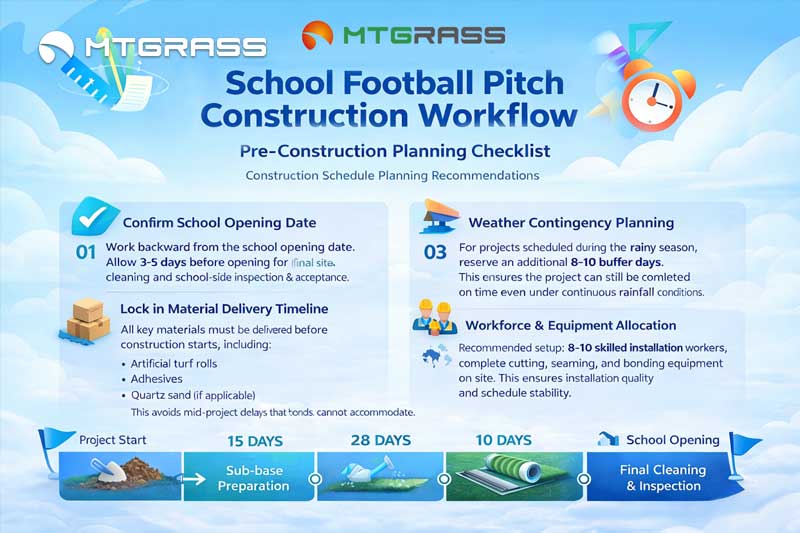
The success of a school football turf project depends 80% on early-stage planning and construction management, rather than on the turf model itself.
Only by fully accounting for school holidays, rainy seasons, and inspection milestones can a football turf system truly achieve on-time delivery, safe use, and long-term stable operation.
Due to the unique constraints of school environments—such as concentrated construction during summer and winter breaks, inspections by education authorities, examination periods, and weather-related disruptions—it is essential to integrate construction pacing, climatic factors, and acceptance timelines into a unified project plan.
This approach is critical to ensuring on-time completion, first-time acceptance approval, and long-term usability.
The following section systematically outlines the key considerations for school football turf projects across five core stages: pre-construction planning, construction process control, rainy season and holiday management, final acceptance, and post-installation maintenance.
Pre-Construction: Time Planning Is More Important Than Turf Selection
The main turf installation phase should completely avoid the academic term, with at least 10–15 days of contingency time reserved to accommodate weather disruptions or inspection adjustments.
Rainy season conditions must be incorporated into the construction schedule in advance, as in many countries and regions, school holidays often coincide with peak rainy seasons (such as summer).
During Construction: School Projects Prioritize Stability Over Speed
Regardless of whether 3G, 4G, or 5G football turf is selected, sub-base preparation is the decisive factor affecting long-term field performance.
Surface flatness, drainage design, perimeter detailing, and safety transition zones must all be carefully controlled.
Each construction step should be documented with written records and photographic evidence. This practice not only supports quality control, but also serves as a risk mitigation and accountability mechanism for school projects.
Completion and Acceptance: School Projects Must Be “Audit-Ready”
School football fields typically require:
- Internal school acceptance
- Filing or spot inspections by local education authorities or ministries of education
- Third-party testing agencies (in certain countries or international school systems)
It is recommended to prepare the following documentation in advance:
- Product technical specifications
- Installation methodology and process documentation
- Maintenance manuals
- Safety performance reports (e.g., shock absorption, structural stability)
FAQ
How much does a 3G football pitch cost per square metre for schools?
For school football fields, the typical 3G football pitch cost per square metre ranges from USD 35 to USD 60, depending on system configuration, shock pad inclusion, and local construction conditions.
Cost breakdown from a school construction perspective:
- Turf system (yarn, backing, infill): USD 18–30 / sqm
- Shock pad (recommended for schools): USD 6–12 / sqm
- Installation & infill works: USD 8–15 / sqm
- Total typical school project range: USD 35–60 / sqm
What is the average football turf cost per square meter for school projects?
Across school football projects, football turf cost per square meter typically falls between USD 30 and USD 70, depending on the turf generation and system design.
Typical cost comparison by system type:
| Turf System | Typical Cost Range (USD/sqm) | School Cost Risk |
| 3G football turf | 35–60 | Low, predictable |
| 4G football turf (non-infill) | 30–55 | Medium |
| 5G football turf (recyclable) | 55–80+ | High, uncertain |
- how much does a 4g football pitch cost ?
A 4G football pitch for schools typically costs between USD 30 and USD 55 per square metre, depending on fiber density, backing structure, and installation quality.