English
  العربية
  Español
  Deutsch
  Français
  Português
  Русский
  日本語
日本語  Italiano
  Nederlands
  Svenska
  Suomi
Suomi  ไทย
ไทย  Dansk
Dansk  Ελληνικά
  Bahasa Melayu
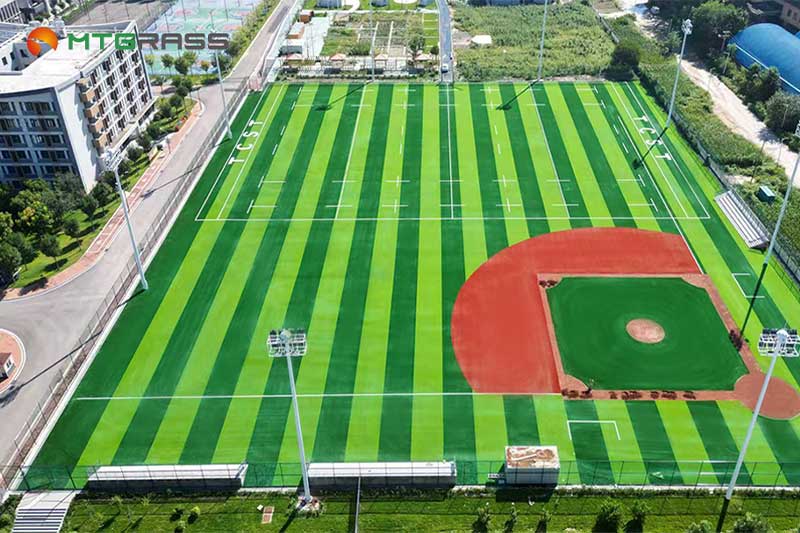
Baseball is a highly comprehensive sport that effectively develops students’ agility, coordination, and teamwork skills. As a result, it is increasingly being incorporated into core physical education programs at schools. This trend has directly accelerated the adoption of baseball turf fields across campuses—from school baseball fields and youth training centers to baseball clubs and even professional training facilities. Artificial turf baseball fields are rapidly becoming the mainstream choice.
For schools and baseball coaches, the real concern has never been whether a field “looks like a professional stadium,” but whether it can be used every day, whether it is safe, and whether students can build solid fundamentals in a stable training environment.
Compared with natural grass, baseball turf offers far greater control in teaching, training, and facility management. The surface remains consistently even, is less affected by weather, provides more predictable ball bounce and roll, reduces student injury risk, and allows training programs to proceed as planned. For school baseball programs, artificial turf for baseball delivers a more stable, safer, and more efficient teaching and training environment.
What Is a Baseball Turf Field?
A baseball turf field is not a single artificial grass product. It is a complete artificial turf baseball field system designed specifically around the technical requirements of baseball. Through the coordinated performance of different functional zones, it ensures realistic training feedback and long-term durability.
A complete artificial turf baseball field system typically includes the following key components:
Outfield Turf
Designed with running comfort and safety as the priority. Softer fibers and improved cushioning ensure that students remain stable and protected when sprinting or chasing fly balls at high speed.
Infield Turf
Through precise control of pile height, density, and fiber structure, the infield turf simulates traditional clay infield ball speed and rolling behavior, allowing students to develop correct game judgment even in an artificial environment.
Reinforced Pitcher’s Mound & Batter’s Box System
High-impact and high-wear areas are structurally reinforced to prevent surface collapse and excessive wear, ensuring long-term teaching and training intensity.
Shock Pad & Base Structure
Installed beneath the turf system to absorb impact, improve foot feel, and significantly reduce injury risks from falls and sliding.
Professional Drainage System
Ensures rapid recovery after rainfall so baseball classes and training schedules are no longer disrupted by weather conditions.
It is precisely this system-based design approach that allows baseball turf fields to maintain stable performance under the high-frequency usage typical of school environments—truly serving teaching and youth development goals, rather than merely looking like a professional baseball field.
Why Is a Baseball Turf Field Better for Schools?
Artificial turf baseball fields are characterized by high usability, enhanced safety, lower long-term operating costs, and controllable teaching quality.
Artificial turf for baseball can reduce student sports injury risk by 20%–30%, increase annual usable days to 250–300 days, and save schools 30%–50% in operating costs over a 5–10 year cycle, making it a field solution better aligned with the long-term development of school athletics.
Safer: Significantly Reducing Student Baseball Injury Risk
Through a stable surface structure and integrated cushioning system, baseball turf fields effectively reduce injury risk during base running, sliding, and sudden stops.
According to research data from the U.S. Centers for Disease Control and Prevention (CDC) and the American Academy of Pediatrics (AAP), more than 30% of school sports injuries involve the lower limbs (knees and ankles), and a significant proportion are related to unstable field conditions. In youth baseball, a flat and consistently cushioned surface is a key factor in reducing injuries caused by stopping, turning, and sliding movements.
After high-frequency use, natural grass baseball fields commonly develop:
- Local surface depressions
- Exposed hard soil
- Uneven softness after rainfall
Baseball turf fields, by contrast, provide:
- Uniform artificial turf fiber structure
- Integrated shock pad layers
- Controlled surface friction design
Field Safety Comparison
| Comparison Aspect | Natural Grass Baseball Field | Baseball Turf Field |
| Surface flatness | Easily forms depressions due to wear | Maintains long-term consistency |
| Sliding friction | Highly affected by weather | Controllable friction coefficient |
| Impact absorption | Depends on soil condition | Turf fiber + shock pad system |
| Injury risk | Medium–High | Low |
Higher Utilization: Year-Round Availability
According to campus facility management reports from the Sports Turf Managers Association (STMA), natural grass sports fields in rainy or high-use environments require 90–120 closure days per year.
Public data from multiple North American school districts shows that compared with natural grass, baseball turf fields increase effective usage time by 2–3 times, with an average annual availability of 250–300 days.
Natural grass baseball fields typically require closure under the following conditions:
- Continuous rainfall (1–3 days of downtime after rain)
- Turf maintenance and recovery periods
- Winter low temperatures or muddy seasons
Artificial turf baseball fields offer:
- Vertical + horizontal drainage structures
- Usability restored within 20–30 minutes after rainfall
- No dependence on grass growth cycles
Annual Usage Efficiency Comparison
| Item | Natural Grass Baseball Field | Artificial Turf for Baseball |
| Post-rain recovery time | 1–3 days | 20–30 minutes |
| Annual usable days | 120–160 days | 250–300 days |
| Maintenance-related closures | Yes | No |
| Suitable for high-frequency classes | No | Yes |
Lower Operating Costs
From a full lifecycle cost perspective—based on public bidding data from school sports facilities in North America and the Asia-Pacific region, as well as STMA annual maintenance reports—artificial turf baseball fields align better with long-term school budget planning.
| Cost Item | Natural Grass | Baseball Turf Field |
| Initial investment | Lower | Higher |
| Average annual maintenance | ¥60–120 /㎡ | ¥5–15 /㎡ |
| Irrigation & water costs | High | None |
| Full-time maintenance staff | Required | Not required |
| Service life | Repeated renovation needed | 8–10 years |
| Total 10-year cost | High | 30%–50% lower |
Teaching Stability
Many school baseball coaches report:
“Artificial turf makes teaching more controllable instead of constantly dealing with field conditions.”
With a baseball turf field:
- Ball speed and bounce remain consistent
- Infield roll behavior is more predictable
This helps students:
- Build correct game judgment more quickly
- Reduce technical errors caused by changing field conditions
And helps schools:
- Standardize teaching quality
- Maintain stable training schedules without disruption

How to Choose an Artificial Turf System for a School Baseball Field
A baseball turf field system is primarily composed of pile height, turf fiber type and density, shock pad, and infill. In school baseball field construction, the most appropriate choice is not about selecting the highest possible specifications.
Instead, schools should prioritize a baseball turf system that delivers high safety standards, strong maintenance tolerance, consistent training feedback, and controllable lifecycle costs—ensuring the field remains reliable, safe, and effective for teaching and daily use over the long term.
Turf Pile Height and Field Zones
Pile height determines the “movement feedback logic” of a baseball field—including running feel, ball roll and bounce speed, impact cushioning, and long-term surface stability.
In general, shorter pile height allows the ball to roll faster and more predictably, while taller pile height slows ball movement but provides better rebound control and cushioning.
For a baseball field, pile height should be zoned by function, with clear differentiation between the infield and outfield, as well as the pitcher’s mound and batter’s box areas, to ensure both proper gameplay feedback and long-term durability in high-use school environments.
Infield “Grass” Areas: The turf in the infield (the green grass portion inside the base paths) is typically shorter than a standard football field. For higher wear resistance, shorter grass is more suitable.
Outfield Grass: The longer fibers more closely resemble natural outfield grass length and provide extra cushion for athletes diving or sprinting at full speed. This helps reduce impact when outfielders lay out for a catch. It also slightly slows the ball on long hits, similar to natural grass friction. In some designs, the outfield uses the same turf as a multipurpose sports field (2″ being common for football/soccer), which can be beneficial if the outfield is shared with other sports.
Base Paths, Batter’s Box, and Mound: These high-wear, “clay” areas use very short, tight turf to emulate the firm, smooth nature of a dirt/clay surface. Manufacturers often install a special turf with a short pile (around 0.5–1 inch) and a different color (brown) for base paths, home plate circle。
| Zone | Recommended Pile Height | Reason |
| Outfield | 40–50 mm | Provides greater running comfort and better impact cushioning |
| Infield | 30–40 mm | Controls ball speed and simulates traditional infield dirt roll |
| Batter’s Box / Pitcher’s Area | 25–30 mm (reinforced zone) | High wear resistance to prevent surface compaction and collapse |
Note: If the field will host softball as well (common for schools), similar turf zone logic applies. Softball infields are smaller, but the short-pile turf in the infield and at bases will likewise improve play. Ensure the synthetic turf provider knows all sports to be played so they can adjust pile heights accordingly.
Turf Fiber Type & Density
Turf fiber type and stitch density directly determine whether students can run safely, whether the ball rolls consistently, and whether the field can withstand high-frequency use.
A properly zoned configuration is a fundamental requirement of a qualified baseball turf field.
Monofilament fibers are softer and more skin-friendly for students.
In baseball fields, the infield requires higher density to keep ball speed controllable and predictable, while the outfield does not need excessive density, prioritizing player comfort and safety.
The batter’s box and pitcher’s mound areas demand the highest fiber density due to concentrated wear and force.
Recommended Turf Fiber Type & Density by Field Zone
| Field Zone | Recommended Fiber Material | Fiber Structure | Recommended Density (stitches/㎡) | Key Problem Addressed | Why It’s Suitable for Schools |
| Outfield | PE Monofilament | C / S Shape | 10,000–12,000 | Running comfort, impact cushioning | Moderate density provides a softer feel and reduces knee and ankle impact during high-speed running |
| Infield | PE Monofilament | S / Diamond Shape | 12,000–14,000 | Ball speed control, defensive consistency | Higher density ensures predictable ground-ball roll, supporting teaching and fundamental skill development |
| Batter’s Box | High-wear PE Monofilament | Diamond / Reinforced | 14,000–16,000 | Anti-compaction, wear resistance | High density prevents surface collapse caused by repeated stance changes and pivoting |
| Pitcher’s Mound Area | High-toughness PE Monofilament | Diamond / Reinforced | 14,000–16,000 | Structural stability under concentrated force | High density extends service life where pushing-off and landing forces are highest |
| Base Paths / High-Wear Zones | PE Monofilament | S Shape | 12,000–14,000 | Wear resistance + sliding safety | Balances durability with safe sliding and consistent footing |
Key takeaway: For school baseball fields, fiber type and density should be designed by zone—not maximized everywhere. This zoned approach ensures student safety, stable ball behavior, and long-term durability under daily instructional use.
Baseball Shock Pad
The primary role of a shock pad in a school baseball field is to absorb approximately 35%–50% of impact forces, significantly reducing the risk of student injuries—without making the surface overly soft and compromising ball roll or bounce judgment. For schools, this represents the optimal balance between safety and teaching effectiveness.
For the vast majority of school baseball fields, a 10–15 mm shock pad offers the best balance of safety, cost efficiency, and performance. Selecting a shock pad that matches the school’s usage intensity is essential to ensure a baseball turf field remains safe, durable, and suitable for long-term instructional use.
Recommended Shock Pad Thickness
| Thickness | Recommendation | Application Notes |
| 8–10 mm | ✅ Optional | Elementary schools / low-intensity use |
| 10–15 mm | ✅✅ Strongly Recommended | Middle schools / high schools / youth training / high-frequency use |
| 20 mm and above | ⚠️ Use with caution | Higher cost; generally unnecessary for school environments |
Shock Pad Selection by School Scenario
| School Scenario | Recommended Thickness | Recommended Type | Selection Rationale |
| Elementary School Baseball Field | 8–10 mm | Roll-type shock pad | Safety-first approach with controlled costs |
| Middle / High School | 10–15 mm | Roll-type or modular shock pad | High usage frequency and long-term surface stability |
| Youth Training Center | 15 mm | High-resilience modular shock pad | Intensive training and higher impact loads |
| Model School / Competition-Oriented Field | 15 mm | Customized system solution | Balanced requirements for teaching and competitive play |
Key takeaway: A properly selected shock pad is not an upgrade—it is a core safety component that allows a school baseball field to perform consistently over many years while protecting student athletes.
Baseball Turf Infill
For most school baseball fields, the preferred infill solution is sand-based infill with a small percentage of elastic particles. However, it is essential that the manufacturer provides clear infill depth specifications and a defined maintenance schedule.
When selecting infill for a school baseball field, the goal is not to achieve the “softest” or “most professional-level” feel. Instead, the priority is to ensure that:
- Students can train safely every day
- The field does not harden over a 10-year service life
- The maintenance team can manage the surface easily and consistently
Infill selection should always be evaluated in relation to local climate, usage frequency, and field usage scenarios.
School-Preferred Infill Comparison
| Infill Type | Stability | Cushioning & Foot Feel | Maintenance Difficulty | Infill Migration / Cleaning | School Communication Cost | School Recommendation |
| Coated Sand / Silica Sand | High | Medium | Low–Medium | Low | Low | ⭐⭐⭐⭐⭐ |
| Sand + Small % of TPE / EPDM | High | Medium–High | Medium | Medium | Medium | ⭐⭐⭐⭐ |
| High-Percentage SBR Crumb Rubber | Medium | High | Medium–High | High | High (policy & public perception) | ⭐⭐ (use with caution) |
| Organic Infill (Coconut, Cork, etc.) | Medium | Medium | High (frequent top-up required) | Medium | Medium | ⭐⭐⭐ (depends on maintenance capacity) |
Key takeaway: For schools, the best infill solution is the one that delivers long-term safety, surface stability, and manageable maintenance—not the one that simply feels the most elastic on day one.
What should I consider when choosing artificial turf for a school baseball field?

Choosing artificial turf for a school baseball field is not about copying professional stadiums.
It is about matching turf performance to students, climate, usage intensity, teaching needs, and maintenance reality.
Only by aligning turf specifications with these realities can artificial turf truly support school baseball programs。
School population & student age Considerations
School population
The number of students directly determines how much daily stress the field will endure.
- Large student population / shared field use
- Requires higher turf density and stronger backing
- Emphasis on wear resistance and recovery performance
- Infield and base paths should be reinforced zones
- Smaller schools or limited baseball programs
- Can prioritize comfort and safety over extreme durability
- More flexibility in turf specifications and system complexity
More students = higher foot traffic = turf must be more forgiving and more durable.
Student age
Age is one of the most critical variables in turf selection.
- Elementary & middle school students
- Safety is the top priority
- Softer grass fibers, lower surface hardness
- Shock pad becomes especially important
- Moderate pile height to reduce fall impact
- High school students
- Balance safety with realistic baseball performance
- Slightly firmer response for proper ball roll and footwork training
- Higher durability in pitcher’s mound and batter’s box areas
Key tip: In all cases, ensure adequate padding and infill for softness, especially if the field will host very young kids at times. For example, an elementary school may opt for extra cushion even at the expense of some ball speed. Conversely, a high school might accept a slightly firmer surface for performance, but it must still fall within safe impact limits.
Climate
Dry & high-temperature climates
In hot and arid regions, turf must resist UV degradation and surface overheating.
- UV-stabilized PE yarns are essential
- Lighter fiber colors help reduce heat absorption
- Low-maintenance infill systems help prevent surface hardening over time
Poor UV resistance leads to brittle fibers and shortened lifespan.
Rainy & humid climates
Moist environments demand excellent drainage and moisture resistance.
- Permeable backing and fast vertical drainage
- Shock pad materials that do not retain water
- Anti-mold and anti-microbial turf treatments recommended
Drainage directly affects how often the field can actually be used.
Windy environments
Wind influences infill migration and surface cleanliness.
- Avoid loose, lightweight infill materials
- Favor low-infill or non-infill systems where possible
- Higher turf density helps stabilize fibers
Finally, always align the turf selection with local standards or regulations. Check if the state or district has any specific rules (for example, some places require certain shock attenuation standards for school fields, or have banned certain infill types). Also, using reputable standards like ASTM for testing (e.g. ASTM F355/F1936 for G-Max, ASTM drainage standards, etc.) during construction will ensure the field meets performance and safety benchmarks.
Field Usage and Multi-Purpose Use
(PE classes + team training + after-school activities)
- High stitch density turf
- Reinforced infield, base paths, batter’s box, pitcher’s mound
- Shock pad recommended to protect students and extend turf life
- Durable system design over “premium look”
High usage fields must be built for endurance, not aesthetics.
Low usage frequency
(Occasional classes or limited team use)
- Can prioritize comfort and visual appeal
- Slightly lower density acceptable
- Simplified system configuration possible
Usage Planning: Outline all intended uses early with the turf installer. If multi-sport lines are needed (soccer, lacrosse), they can be inlaid in different colors or added with paint (removable). If the baseball field outfield doubles as a soccer field, you may include soccer line tufting and ensure the centerfield area is suitably padded for football/soccer impacts (a shock pad will help). The base paths and pitcher’s mound areas for baseball can be designed to not hinder running sports – often by keeping them flat and flush with surrounding turf.
Teaching quality & training goals
A school baseball field is a classroom, not just a playing surface.
- Consistent ball roll and bounce help students develop correct fundamentals
- Stable footing supports proper running, stopping, and throwing mechanics
- Predictable surface behavior improves teaching efficiency and learning outcomes
Well-designed artificial turf ensures:
- Every class experiences the same field conditions
- Coaches spend less time adjusting drills to poor surfaces
- Students build confidence through consistent feedback
Turf consistency = better baseball education.
Maintenance budget
Artificial turf is often touted as “low maintenance” compared to natural grass – you won’t be mowing, watering daily, or spreading fertilizer/pesticides. However, “low” maintenance is not “no” maintenance. To keep the field safe and performing well, a routine maintenance plan is essential. Here’s what to consider:Maintenance capability is often underestimated—but it determines long-term success.
- Limited maintenance budget
- Favor low-maintenance or low-infill systems
- Durable fibers that resist flattening
- Shock pad helps reduce long-term surface hardening
- Moderate maintenance budget
- Periodic grooming and inspection
- Higher durability systems with longer life cycles
- Artificial turf is ideal for schools because:
- No mowing, watering, or fertilizing
- Predictable annual costs
- Fewer staff hours required compared to natural grass
The best turf is not the cheapest upfront—but the one that fits the school’s ability to maintain it.
How much does it cost to install a school baseball field?
The cost to install a turf baseball field varies widely, but generally ranges from $400,000 to $1,000,000+, depending on several factors. Here’s a more detailed breakdown:
Factors Affecting Cost:
- Field Size: Larger fields, like those used in college or professional baseball, will naturally cost more due to the increased area of turf and materials required.
- Turf Quality: Different types of artificial turf have varying price points. Higher quality turf with more realistic feel and durability will typically be more expensive.
- Infill Material: The infill material (usually sand or rubber granules) that goes between the turf blades also affects cost. Different materials offer different playing characteristics and durability.
- Design and Customization: Custom field designs, including specialized markings or logos, can add to the overall cost.
- Regional Construction Costs: Labor and material costs can vary significantly depending on your location.
- Installation Costs: This includes site preparation, excavation, drainage, and the actual turf installation.
Cost Ranges:
- Little League/Babe Ruth (9-12 year olds): $84,000 – $140,000
- High School: $220,500 – $367,500
- College/Pro: $252,000 – $420,000
Additional Considerations:
- Maintenance Costs: While upfront costs for turf fields are higher, maintenance costs are generally lower than natural grass fields.
- Lifespan: Artificial turf fields have a lifespan of around 8-10 years, after which they may need replacement.
- Additional Features: Consider the cost of fencing, dugouts, lighting, and other features that may be needed for a complete baseball field.
Typical Cost Ranges for Different Types of School Baseball Fields (Reference)
| School Type | Typical Installation Cost Range |
| Little League / Youth (Ages 9–12) | $84,000 – $140,000 |
| High School Baseball Field | $220,500 – $367,500 |
| College / Pre-Professional Training Field | $252,000 – $420,000 |
| Integrated School Artificial Turf Baseball Field (Complete System) | $400,000 – $1,000,000+ |
Note: Actual costs vary based on field size, system configuration, site conditions, and regional construction costs. These figures are provided for planning and comparison purposes only.
Conclusion:
Selecting artificial turf for a school baseball field requires balancing safety, performance, and long-term value. Unlike pro facilities, school fields must serve younger athletes and often support PE classes or community events in addition to games. The success of school baseball field construction is not about “buying the most expensive grass” but about integrating safety, teaching and long-term maintenance into a sustainable baseball turf field system.
If you are evaluating a baseball field project for a school or an education authority, we recommend first defining the student age group, usage frequency, local climate, maintenance capacity, and a 10-year budget model, and then selecting the most appropriate baseball turf field system accordingly.
MightyGrass can provide technical parameter recommendations, complete system solutions, product samples, and bid-ready technical specifications for school baseball fields—helping you move the project from simply “being built” to being built right and performing reliably for the long term.
FAQ
Q1. Why are more schools choosing a baseball turf field instead of natural grass?
For high-frequency school use, a baseball turf field delivers better year-round availability, safety consistency, and predictable long-term costs than natural grass.
Schools commonly face rainouts, uneven surfaces, turf damage from heavy use, and limited maintenance staff. A properly designed artificial turf baseball system solves these issues through engineered drainage, stable surface performance, and consistent playability.
MightyGrass provides school-specific baseball turf systems (infield/outfield zoning, reinforced high-wear areas, and drainage guidance), along with technical documentation suitable for feasibility studies and public tenders.
Q2. Which three indicators should schools prioritize when approving a baseball field project?
Schools should prioritize student safety metrics, annual usable field time, and 10-year lifecycle cost.
Initial installation cost represents only part of the investment. Inadequate shock absorption, drainage, or wear-zone design leads to surface hardening, repairs, and instructional disruption—ultimately increasing total cost.
MightyGrass Advantage: We provide 10-year lifecycle cost breakdowns (materials, installation, maintenance, replacement planning) to help schools compare bids on a consistent, transparent basis.
Q3. What are the most critical safety features for a school baseball field?
The most critical safety components are shock pad (impact layer), stable infill system, and long-term surface evenness.
Student injuries are most often linked to falls and inconsistent ground hardness. Turf fiber specifications alone cannot manage these risks without a properly designed system beneath the surface.
MightyGrass recommends 10–15 mm shock pad systems tailored to school use and supplies system-level safety data and maintenance guidelines to ensure consistent impact performance over time.
Q4. How should acceptance and inspection criteria be written into bid documents?
Acceptance criteria should clearly define base flatness, drainage performance, seam strength, infill depth, and surface hardness/impact attenuation requirements.
Many disputes arise when bids focus only on turf brand or pile height, rather than system performance. Measurable criteria reduce delivery risk and post-installation disagreements.
We can supply ready-to-use acceptance checklists and technical clauses that schools can directly include in tender documents.
Q5. What “hidden costs” should schools plan for in a baseball field project?
Budgets must include sub-base preparation, drainage, shock pad, accessories (fencing, lighting), and long-term maintenance and replacement funds.
Most cost overruns result from underestimating base construction and drainage. These elements determine durability and cannot be corrected cheaply later.
MightyGrass supports schools with bill-of-quantities (BOQ) logic to ensure early budget transparency and avoid omissions.
Q6. Why should schools specify a complete baseball turf system rather than just turf rolls?
Schools should procure a complete baseball turf system, not individual materials.
Wear patterns in baseball are highly uneven (pitcher’s mound, batter’s box, base paths). Single-product solutions fail prematurely in these zones.
We deliver integrated baseball turf system concepts, including reinforced high-wear zones, optional logo/branding integration, and system compatibility across layers.
Q7. How should pile height be specified for school baseball fields?
Pile height should be zoned by function: cushioning for outfield, control for infield, and durability for high-wear areas.
Pile height affects ball roll, bounce, athlete footing, and maintenance tolerance. Schools benefit from consistency and durability rather than professional-level extremes.
MightyGrass provides school-appropriate pile height ranges (e.g., 40–50 mm outfield, 30–40 mm infield, reinforced wear zones) with samples and spec sheets for evaluation.
Q8. How should turf fiber type and density be specified to avoid misleading “parameter stacking”?
Specifications should focus on fiber material (e.g., PE monofilament), zoned density ranges, and UV/durability requirements, not maximum numbers.
Higher density does not automatically mean better performance. Outfields need comfort and forgiveness; infields need predictable ball behavior.
MightyGrass provides zone-based density recommendations with clear explanations to support fair and informed bid evaluation.
Q9. What infill principles are most suitable for school baseball fields?
School infill systems should prioritize stability, ease of maintenance, low controversy, and student-friendly performance—typically sand-based or low-infill solutions.
Schools often lack intensive maintenance resources and are sensitive to material safety perceptions. Simpler, stable infill systems are easier to manage long term.
MightyGrass Advantage:recommends infill systems based on local climate and usage intensity, supported by maintenance frequency guidelines.
Q10. What additional requirements should be included for different climates?
Climate adaptation must be addressed at the system level: drainage for wet regions, UV resistance and heat management for hot climates, and infill stability for windy areas.
Ignoring climate factors leads to premature degradation, excessive maintenance, or safety concerns.
MightyGrass With experience across multiple regions, MightyGrass can provide climate-adapted technical specifications to reduce post-installation risk.
Q11. How can schools address concerns about long-term maintenance capacity?
Maintenance planning should be included in the bid stage through clear SOPs, annual maintenance plans, and supplier support commitments.
Artificial turf is low-maintenance, not no-maintenance. Without guidance, surface quality diverges significantly over time.
MightyGrass offers school-friendly maintenance manuals and training support for facilities teams.
Q12. How should construction schedules be planned to minimize disruption to teaching?
The optimal approach is holiday-period construction with phased milestones and inspections.
Schools must avoid class interruptions. Phased acceptance allows early correction of base or drainage issues.
MightyGrass can coordinate with contractors to provide delivery milestone checklists and material scheduling guidance.
Q13. How can schools evaluate whether a supplier has true system-delivery capability?
Evaluate school project experience, system completeness, technical documentation quality, and after-sales support. Suppliers focused only on turf rolls often lack solutions for drainage, impact absorption, wear-zone durability, and maintenance strategy.
Mighty Grass, as a baseball turf manufacturer, supports end-to-end system delivery, from specification to installation support.
Q14. What are common “low-price traps” in school baseball field bids?
The most common traps are omitting shock pads, undersized drainage bases, ignoring high-wear reinforcement, and shifting maintenance burden to schools. These shortcuts reduce upfront cost but lead to early failures, safety issues, and higher long-term expenses.
MightyGrass provides comparison checklists to help schools quickly identify incomplete or high-risk proposals.
Q15. Which two long-term costs must schools plan for from day one?
Schools must plan for annual maintenance budgets and an 8–10-year turf replacement fund. Artificial turf systems typically reach replacement age after 8–10 years. Without planning, replacement becomes a sudden financial burden. MightyGrass offers replacement cycle guidance and funding-planning recommendations aligned with school budget practices.
Q16. Which customizations add value, and which are unnecessary?
Value-adding customizations include school logos, names, primary color zoning, and regulation markings. Excessive decorative patterns are unnecessary. Thoughtful branding enhances school identity without affecting performance; over-customization increases cost and complexity.
MightyGrass support logo and color customization while maintaining performance and durability standards.