العربية
  English
  Español
  Deutsch
  Français
  Português
  Русский
  日本語
日本語  Italiano
  Nederlands
  Svenska
  Suomi
Suomi  ไทย
ไทย  Dansk
Dansk  Ελληνικά
  Bahasa Melayu

South Africa’s diverse climate means artificial grass doesn’t perform the same in every region. If you’re installing, distributing, or specifying turf, whether for residential landscapes, تجاري projects, schools, or sports fields, you must match the product to the local weather conditions. From Cape Town’s winter rain and coastal winds, to Gauteng’s high-altitude UV, to Durban’s humidity and salt-rich air, each climate zone places different stress on synthetic fibres, backing systems, drainage layers, and infill.
When you understand how heat, UV exposure, rainfall, and coastal environments affect artificial grass, you can make smarter product choices, prevent premature wear, and offer clients a longer-lasting surface. This guide helps you evaluate South Africa’s major climate zones and shows you how to choose the right turf specifications for durability, colour stability, drainage performance, and year-round reliability.
1. Strong UV Radiation Accelerates Artificial Grass Aging
South Africa experiences some of the highest UV levels in the world, especially in regions like Gauteng, Free State, and Northern Cape where altitude and latitude combine to intensify solar exposure. This high UV index has a direct and long-term impact on artificial grass performance.
Why UV Matters in South Africa Climate?
The country lies between 22–34°S, receiving stronger sunlight than Europe or North America. With long hours of direct exposure, UV radiation becomes the primary cause of artificial grass degradation.
How UV Affects Artificial Grass?
When UV protection is insufficient, you will notice:
- Colour fading due to pigment breakdown
- Accelerated aging, making fibres brittle over time
- Surface oxidation of PE/PP materials
- Possible cracking or splitting within 3–5 years
- Reduced tensile strength, especially in low-quality yarns
Cheap grass using recycled materials or thin monofilaments ages significantly faster under South Africa’s climate.
مايتي جراس Recommends Artificial Turf That Meets Your Local Standards
To protect your installation artificial grass:
- Choose turf tested for ≥ 5,000 hours UV exposure (EN / ISO / FIFA equivalent)
- Ensure the yarn contains UV masterbatch + HALS antioxidants
- Select S-shape, W-shape, or diamond-shaped UV-resistant grass fibres
- Avoid recycled or reprocessed plastics
These yarn structures reduce surface area exposure and distribute UV stress more evenly, improving lifespan.
2. High Summer Temperatures Increase Surface Heat & Fiber Softening
South African summers can be extremely hot, with real-feel ground temperatures reaching 50–60°C. These thermal conditions affect both the comfort and stability of artificial grass.
Heat Challenges in South Africa
- Ambient temperatures often hit 35–40°C
- Ground surfaces (paving, sand, shockpad) absorb heat and radiate it upward
- Prolonged UV + heat speeds up chemical aging of polymers
Heat-Related Effects on Artificial Turf
If the turf is not engineered for high-temperature environments, you may experience:
- Hotter turf surface temperatures, discomfort under foot
- Fiber softening, causing faster flattening
- Light thermal expansion which may cause slight lifting on poorly compacted bases
- Accelerated backing degradation, especially with latex adhesives
Latex backings degrade fastest in high-heat regions; PU backings remain stable and resist deformation.
Recommended Turf Specifications for Hot Regions
- You can choose MightyGrass hollow yarn artificial grass or light-colored grass fibers (such as light green) to reduce heat absorption.
- Use a PU backing, especially in inland high-temperature zones
- Ensure the sub-base is properly compacted to handle thermal expansion
- For sports fields: consider cool-infill blends, like light-colored quartz sand, TPE, or cooling infill can lower its temperature by 15–20°C.
With heat-stabilised yarns, turf maintains resilience and looks upright longer during hot seasons.

3. Low-Rainfall & Dusty Regions Increase Cleaning Requirements
Many areas in South Africa, such as Cape Town and parts of the Western Cape, face low annual rainfall, strong winds, and drought cycles. These conditions increase dust levels around homes and sports facilities.
Climate Characteristics
- Western Cape frequently experiences multi-year droughts
- Dry seasons bring heavy dust and wind
- Rainfall is insufficient to naturally “wash” the turf
- Dust and sand accumulate faster than in tropical climates
How Dust Impacts Artificial Grass
- Surface dust accumulation makes the grass look dull
- Infill displacement (SBR/EPDM) due to wind exposure
- Requires more frequent brushing or water rinsing
- Additional friction may accelerate fibre wear in high-traffic areas
MightyGrass Recommended Solutions
- For gardens and commercial landscapes: Choose عشب صناعي غير محشو to avoid wind-driven infill loss
- بالنسبة لـ كرة القدم أو الركبي fields: Apply infill 20-30 kg/m² of sand and use wind-resistant edge designs or perimeter containment
- Maintain artificial grass with periodic brushing or pressure metal mesh washing
Artificial turf engineered for dusty climates keeps its appearance longer and requires less effort to maintain.
4. Heavy Rainfall & Stormwater Demand Higher Drainage Performance
Coastal regions like Durban, KZN, and parts of the Eastern Cape experience heavy rainfall, especially during storm seasons. Intense downpours can stress artificial turf systems if drainage design is insufficient.
Climate Characteristics
- Coastal thunderstorms can drop large volumes of rain in minutes
- Humidity stays high for long periods
- Without proper drainage, water remains trapped under the system
Poorly drained sub-bases lead to excessive moisture and its effects on lawns:
- Surface water can hydrolyze the artificial turf latex backing, causing it to powder, mold, and rot.
- Over time, localized sub-base settling or uneven surfaces reduce the strength of the base layer.
Recommended Turf Design for Rainy Regions
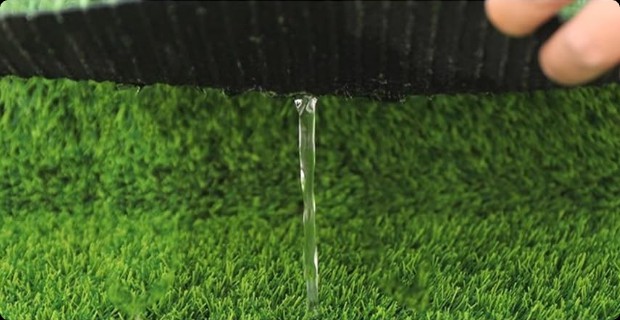
- Choose MightyGrass high permeability and drainage capacity artificial grass (As تشارمينج MT-HP الساحر).
- Use a compacted, large-particle gravel base and single-layer or dual-layer drainage base systems
- Ensure a slope of at least 0.5% and that the site artificial grass field edges and drainage ditches are designed according to specifications.
- Prefer PU backing artificial turf, which resists moisture and hydrolysis
- For sports fields, use additional FIFA shock pad drainage
Good drainage ensures the turf stays firm, safe, and usable even after heavy coastal storms.
5. Coastal Conditions — Salt, Humidity & Colour Fading
Coastal regions such as Durban, Umhlanga, Port Elizabeth, Mossel Bay, and Cape Town’s Atlantic Seaboard present a unique set of challenges for artificial grass. If your projects are located close to the ocean, you’re dealing with environmental stress factors that demand higher-grade turf specifications.
Salt Exposure
Sea mist carries salt particles that settle on the turf surface. Over time, cheap yarns with low-quality polymers may show:
- Surface roughening
- Accelerated fibre brittleness
- Loss of elasticity
MightyGrass offers you synthetic turf made with virgin polyethylene (PE) and salt-resistant stabilizers to maintain its softness and resilience.
How does high humidity affect artificial turf?
Moist, coastal air increases the risk of:
- Mildew growth on the infill
- Moisture trapped in poorly-designed backings
- Slower drainage if the base is not engineered well
That’s why you should choose turf with a perforated backing, fast-drain design, and anti-microbial additives.
Colour Fading
Constant UV + moisture + salt accelerates colour fading. MightyGrass yarns use:
- High-grade UV stabilizers
- Pigments with weather-fastness level 7–8
- Triple-extrusion yarn structures
This ensures you keep natural colour even under intense coastal exposure.
6. MightyGrass Expert Turf Solutions for South Africa’s Climate
As a turf buyer, installer, wholesaler, or contractor, you need a supplier who understands climate engineering, not just grass manufacturing. MightyGrass products are developed for multi-climate performance, making them ideal for the diverse conditions across South Africa.
High-UV Stabilized Turf (Gauteng, Free State, Northern Cape)
ستحصل على:
- UV 8+ resistance tested for high altitude
- Backing with anti-aging masterbatch coating
That reduce shine and retain yarns structure (Northern Cape, Limpopo, North West), MightyGrass offers engineered yarn options including:
- S-, U-, and Diamond-shaped abrasion-resistant grass fiber
- Hollow yarn structures that reduce heat retention
- Matte finish polymers that stay cooler under direct sun
High-Drain Turf Systems (Western Cape, KZN, Eastern Cape)
For rainy or coastal regions, you benefit from:
- Dual-layer backing with rapid drainage
- Anti-hydrolysis latex or PU backing artificial grass to resist moisture damage
- Anti-mould additives for humid conditions
Anti-Salt & Coastal-Grade Turf (Durban, Umhlanga, PE, Cape Town Coastline)
Designed for durability in salty air:
- Virgin PE yarns with salt-resistant stabilizers
Colourfast pigments for long-term shade retention - Strong PP/PU backing options to prevent delamination
MightyGrass holds multiple international certifications including FIFA Quality, FIFA Quality Pro, and SGS.
اتصل بنا الآن! You get a turf system designed for longevity, engineered by one of China’s earliest large-scale turf factories, with US warehousing and Saudi Arabia production expansion.
خاتمة
When you choose the right artificial grass system, you avoid UV fading, Fibre brittleness, Heat deformation, Drainage failures, Salt-related degradation.
With MightyGrass, you get a climate-ready solution engineered for South Africa’s toughest weather conditions. Whether you’re working on a residential yard in Cape Town, a school in Johannesburg, a resort in Durban, or a sports pitch in Kimberley, you can rely on our durability, drainage, UV stability, and coastal performance engineering.
If you want your artificial grass projects to last longer, stay vibrant, and perform better across South Africa’s climate zones, MightyGrass, as a FIFA-approved turf manufacturer, provides professional solutions to help you easily meet various challenges.
التعليمات
Does South Africa’s strong UV damage artificial grass?
Yes. South Africa has some of the highest UV levels globally, especially in Gauteng and the Northern Cape. Low-quality turf may fade or become brittle within a few years if it lacks proper UV stabilizers.
What type of artificial grass is best for hot South African climates?
In regions reaching 35–40°C, choose UV-stabilized PE monofilament fibres, hollow-cool yarns, and PU backing. These reduce heat retention and prevent early ageing.
Is artificial grass suitable for drought-prone regions in South Africa?
Absolutely. In dry areas such as the Western Cape or Northern Cape, artificial grass reduces water usage significantly. Choose non-infill or low-maintenance systems to minimize dust accumulation.
Can high altitude in Johannesburg affect artificial grass lifespan?
Yes. Johannesburg and Pretoria experience stronger UV radiation due to high altitude. Turf must pass ≥5,000h UV tests to ensure long-term performance.
Does artificial grass require different maintenance based on climate?
Yes. Dry regions need more brushing and dust removal, while coastal areas may require rinsing for salt buildup. Rainy areas need routine drainage inspection.