English
  العربية
  Español
  Deutsch
  Français
  Português
  Русский
  日本語
日本語  Italiano
  Nederlands
  Svenska
  Suomi
Suomi  ไทย
ไทย  Dansk
Dansk  Ελληνικά
  Bahasa Melayu
 When you are planning to build a football field, school playground, landscape park, or wholesale distribution project,one of the first questions you will ask is: how does Artificial Turf Cost Calculator ?the answer is not a single number.Artificial turf cost caculator depends on:Turf quality (fiber type, pile height, Dtex, density, backing、Infill system)、Project type (school, club, park, backyard, stadium)、Quantity (square meters / container load)、Installation method、Shipping terms (EXW / FOB / CIF)、Usage intensity、Procurement channel (factory-direct vs distributor) etc..
Base on industry research(Grand View Research, and FIFA Quality Programme disclosures) shows that over 65–75% of artificial turf buyers are cost-driven at the decision stage, but projects that select solely based on lowest price experience 30–40% higher long-term maintenance or replacement risk within 5–8 years.
That is why this guide is written from the perspective of the artificial turf factory purchasing team—From the perspective of purchasing directly from an artificial turf factory, how do you calculate the “artificial turf cost,” and how does each factor influence the total cost?.
This page integrates:
- Artificial Turf Cost Calculator (total cost breakdown)
- Football Field Turf Calculator(project size)
- Wholesale Turf FOB Price Calculator
- clear explanation of the key variables that impact cost — including quality, application, quantity, installation, shipping, procurement channel, and usage intensity.
- So you can estimate correctly before requesting a final quotation.
The “total cost” of artificial turf is usually composed of 5 major parts: material/system cost (turf + infill + accessories), project use case, installation & base cost, logistics & trade terms cost, and lifecycle & maintenance cost.
According to a market research report by Global Market Insights, the global synthetic turf market size is expected to exceed USD 16 billion by 2032. Among it, material and system solution costs account for more than 55%, construction costs account for about 25%, and transportation plus maintenance account for about 20%. This shows that comprehensive cost calculation is more important than single material pricing. (GMInsights, 2024 industry report)
From the factory procurement perspective, I recommend using the formula below to estimate total cost:
Total Cost = Turf System + Installation & Base + Logistics + Lifecycle
1. Turf System (turf system cost)
- Turf itself (parameters such as fiber/backing/density determine it)
- Infill system (infill: silica sand/rubber granules/organic infill, etc.)
- Accessories (seaming tape, glue, white lines, marking tape, nails/fixings, etc., depending on the project)
2. Installation & Base (installation & base cost)
- Base layer (drainage, crushed stone layer, leveling, slope, edge finishing)
- Installation (seaming, gluing, infilling, brushing, acceptance)
Many North American sports turf brands also split costs into “base preparation + materials + maintenance” in public cost analyses, and show total cost differences under different solutions.
3. Logistics & Terms (logistics & trade terms cost)
- EXW / FOB / CIF correspond to different responsibility boundaries and cost definitions
- Sea freight, port charges, customs clearance, and inland transportation (depending on destination country)
4. Risk & Lifecycle (risk & lifecycle cost)
- The higher the usage intensity, the more you need higher-spec systems, otherwise early wear will “reverse the cost”
- Maintenance frequency and correctness (brushing, refill infill, cleaning) determine the lifecycle curve
- Future replacement cost (especially for high-intensity public venues)
The cost of artificial turf is essentially determined by “system configuration parameters.” Simply put, the calculation is: Material cost per square meter + Processing cost + Structural strength + Performance requirements + System matching cost.
According to the synthetic turf market report by Grand View Research, the average market cost of high-quality single-fiber yarn is approximately 25%–65% higher than low-density, non-sports-grade yarn. Among these, UV resistance, yarn cross-section shape, Dtex specification, and yarn density are the core parameters that determine material cost. (GVR 2025 Industry Insights)
How do parameters affect the cost of an artificial turf system:
| Variable | Functional Explanation | Cost Impact Logic | Cost Trend |
| Fiber type (yarn type) | Determines wear resistance, resilience, and UV resistance | Sports-grade PE monofilament and composite yarn cost higher than PP or low-density yarn | ↑ Fiber upgrade = cost increase |
| Pile height | Determines yarn usage and cushioning space | The taller the pile, the greater the yarn consumption per square meter | ↑ Higher pile height = cost increase |
| Dtex (linear density) | Determines yarn thickness and weight | The higher the Dtex, the heavier the yarn and the greater the material usage | ↑ Higher Dtex = cost increase |
| Density | Determines stitch rate and wear lifespan | Higher density means more yarn usage and longer weaving time | ↑ Higher density = significant cost increase |
| Backing (base and coating) | Determines structural strength and dimensional stability | PU backing and double-layer structures cost higher than standard latex backing | ↑ Structural upgrade = cost increase |
| Infill system | Determines system-level performance and cushioning structure | Different infill systems may require higher pile height or higher density | ↑ System upgrade = cost increase |
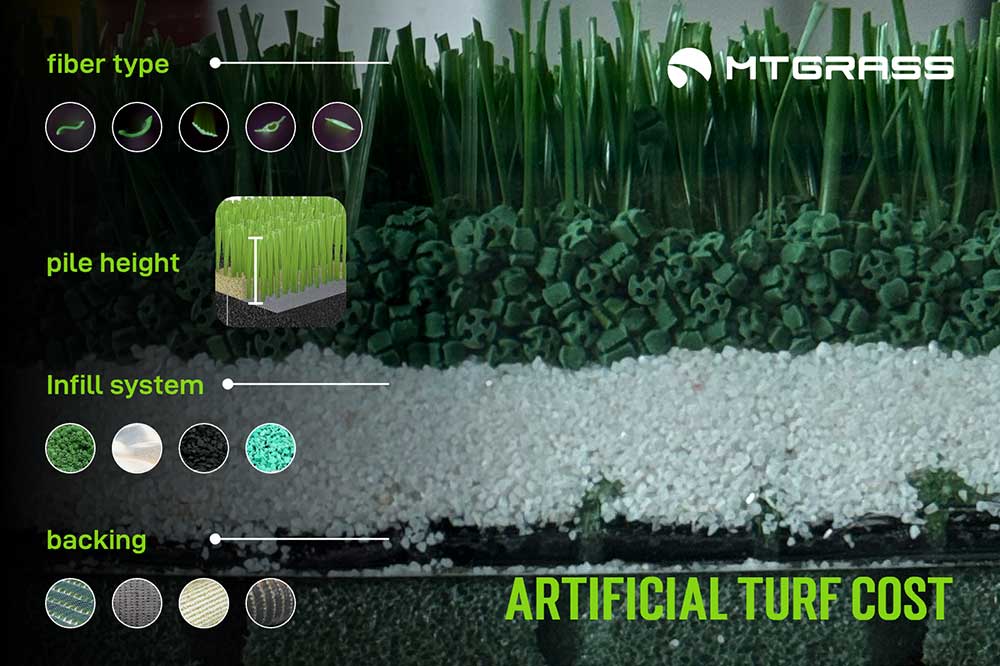
Core Logic of Cost Changes
- Increase in material usage → Cost increases
Pile height, Dtex, and density all directly increase yarn consumption. - Increase in structural strength → Cost increases
Higher-grade backing and base fabric structures mean higher production costs. - Higher performance requirements → Cost stacking
If the project requires higher usage intensity or certification standards, multiple parameters often need to be upgraded simultaneously. - System matching upgrade → Overall cost increases
The infill system, shock pad, and related components affect the total system cost, not just the turf itself.
Mighty Grass Recommended Model Selection Tips:
- Low-intensity use → Choose medium-level parameters → Cost remains controllable
- High-frequency use or high-standard projects → Upgrade multiple parameters → Cost naturally increases
- Lowering only a single parameter may shift costs to future maintenance and replacement.
| Model | Pile Height | Dtex | Gauge | Density | Backing | Application |
| MT-DIAMOND | 50 | 12,000 | 5/8 | 10,500 | 3 layers+SBR | football pitch |
| 16,000 | ||||||
| MT-UBEST 50 FIFA | 50 | 10,000 | 5/8 | 10,500 | 3 layers+SBR | football pitch |
| MT-WAVE | 30 | 12,000 | 3/8 | 18,900 | 2 layers+SBR | landscaping |
| 14,000 | ||||||
| MT-GOLF | 19 | 7,000 | 3/16 | 67,200 | 2 layers+SBR | golf |
| 12 |
Conclusion: The cost of artificial turf is not a single price, but is determined by the complete set of system parameters. The higher the specifications, the higher the cost; however, service life and stability also improve accordingly. Industry data from the international sports facility research organization Sports Turf Technology Association indicates that the material cost of high-quality football turf systems is more than 2–3 times higher than that of general landscaping turf (for example, FIFA-certified systems vs. standard entry-level models), and over the lifecycle they can significantly reduce maintenance expenses and replacement frequency.
- Project type directly determines usage intensity, target design lifespan, and performance grade, thereby determining turf specifications, infill systems, and overall system cost level.
- According to statistics from the Sports Field Management Association (SFMA), turf systems used by professional clubs and public sports facilities have an average lifespan 3–5 years longer than those used for recreational or school fields, and their corresponding annual maintenance costs are also higher. The greater the usage hours, the higher the requirements for yarn wear resistance, density, resilience recovery, and overall system stability; otherwise, the lifespan will be significantly shortened.
- Based on aggregated public data from European sports facility operation studies and the Sports Field Management Association (SFMA) in North America:
- Low-intensity recreational fields: approximately 400–800 hours/year
- School training fields: 800–1,200 hours/year
Club primary training - fields: 1,200–1,800 hours/year
- Public high-frequency open fields: 1,500–2,500 hours/year
- Professional stadiums or multi-purpose arenas: 2,000+ hours/year
Comparison Table: Impact of Different Project Types on Cost and Lifespan
| Project Type | Annual Usage Intensity (Hours) | Recommended Pile Height | Recommended Density Level | Expected Lifespan (Years) | Key Performance Focus | Cost Index (Baseline = 1) |
| Backyard (Residential) | 300–600 | 25–35 mm | Low–Medium | 6–8 | Softness, drainage | 1.0 |
| Park (Public) | 600–1,200 | 30–40 mm | Medium | 7–9 | Durability, low maintenance | 1.1–1.2 |
| School | 800–1,500 | 40–50 mm | Medium–High | 8–10 | Wear resistance, safety | 1.2–1.4 |
| Club | 1,200–2,000 | 45–55 mm | High Density | 9–12 | Consistent rebound, competitive performance | 1.4–1.6 |
| Stadium (Professional) | 2,000+ | 50–60 mm | High Density + Reinforced Backing | 10–15 | FIFA-grade performance, long-term stability | 1.8–2.2 |
Mighty Grass Expert Tips:
- For every additional 500 hours of usage per year, it is recommended to upgrade density and fiber specification by one level.
- When density and Dtex are upgraded simultaneously, material usage typically increases by 15%–35%.
- If high-intensity projects use low-spec configurations, the actual service life may be shortened by 30%–50%.
For example:
- If a school field adopts a configuration only suitable for backyard use, an 8-year design lifespan may realistically last only 4–5 years.
- If a professional training field adopts a higher-spec system, although the initial cost increases by 20%–40%, the lifecycle cost becomes more stable.
Installation method and base ground type directly determine construction difficulty, material usage, and labor cost.
Different base structures affect drainage systems, leveling requirements, fixing methods, and construction timelines, thereby creating significant price differences. For the same 7,000 m² football field, different base conditions can result in a total cost difference of 30%–60%.
According to publicly available construction market pricing data in North America and Europe, industry contractor quotation samples, and comprehensive analysis of 2023–2024 sports facility construction cost reports, actual prices may fluctuate depending on regional labor costs, project scale, and construction standards.
Installation cost (construction only) of artificial turf under different base ground conditions typically falls within the following ranges:
- Compacted Soil Base: approximately $8–$15 / m²
- Crushed Stone Base: approximately $12–$20 / m²
- Concrete Base: approximately $15–$25 / m²
- Asphalt Base: approximately $14–$23 / m²
| Ground Type | Base Work Needed | Drainage Complexity | Structural Stability | Total Cost Impact |
| Natural Soil | Minimal or thin base | Low | Low | $18–$35/m² |
| Crushed Stone | Layered compaction | High | High | $35–$60/m² |
| Concrete | Surface leveling only | Medium | Very High | $30–$55/m² |
| Asphalt | Surface prep + adhesion | Medium | High | $40–$70/m² |
Comparison Artificial Turf installation Cost
(Artificial Turf Installation System Perspective)
| Ground Type | Typical Applications | Structural Layers | Cost Characteristics | Total Installation Cost Range (Including Materials + Labor) |
| ① New Standard Crushed Stone Base | New football fields School projects Club training grounds | Compacted subgrade → Crushed stone base (150–250mm) → Leveling layer → Artificial turf → Infill system | ✔ Best drainage performance ✔ Highest structural stability ✔ Most predictable lifespan ✖ Higher initial base investment | School / Club: $35–$60 /m² High-grade facilities: $50–$80 /m² |
| ② Direct Installation on Existing Concrete | Rooftop fields Old basketball courts Indoor facilities Commercial spaces | Existing concrete slab → Surface repair & leveling → Artificial turf → (Optional) Shockpad | ✔ No need to rebuild base ✔ Faster installation ✖ Drainage must be evaluated ✖ Crack repair may increase cost | Landscape / Light use: $20–$40 /m² Sports use: $30–$55 /m² |
| ③ Natural Grass Field Conversion | Natural grass upgrade projects Park renovations | Remove existing grass → Base inspection → Partial or full reinforcement → Drainage optimization → Artificial turf system | ✔ Existing base may be partially reused ✖ Cost variability is high ✖ Drainage risks require reassessment | Partial renovation: $30–$50 /m² Full reconstruction: $40–$70 /m² |
| ④ Direct Installation on Compacted Soil | Temporary fields Low-budget projects Rural light-use areas | Compacted soil → Thin crushed stone layer → Artificial turf | ✔ Lowest initial investment ✖ Higher risk of settlement ✖ Poor drainage stability ✖ Significantly reduced lifespan | $18–$35 /m² (Low-intensity use only) |
Artificial turf procurement channels are mainly divided into five categories: Factory-Direct (Direct B2B / Factory-Direct), Local Distributor / Stocking Wholesaler, Installer / Turnkey EPC, Trader / Importer, and E-commerce / Retail. According to global artificial turf market research reports, offline channels still dominate. Some reports estimate that offline channels will account for approximately 74% of market share in 2025. The reasons include physical product accessibility, the fact that field projects often require on-site evaluation and parameter customization, as well as higher levels of professional consultation and service trust.
“Using a common 40mm football field artificial turf specification as an example, if the full-container factory-direct FOB unit price is approximately USD 4.5–6.0/m², purchasing through a local distributor may reach USD 6.5–8.5/m², while a turnkey EPC model may translate to USD 10.0–13.0/m². For the same 5,000m² field, the material cost difference alone can exceed USD 20,000.”
For many projects, separating material procurement and installation (factory-direct material purchase + local installation team) can often significantly reduce total costs. Engineering cost guides indicate that directly purchasing materials and hiring an “installation-only” contractor can reduce overall project costs by approximately 15%–25% (depending on regional labor rates and project complexity).
How Procurement Channels Impact Total Cost
| Procurement Channel | Typical Buyers / Use Scenarios | Cost Characteristics (Where the Money Goes) | Advantages (Why Buyers Choose It) | Risks / Disadvantages (Why It Can Be More Expensive or Less Stable) | When It Is Recommended |
| 1) Factory-Direct (Direct B2B) | Container-load wholesalers; school / club / municipal projects; tender projects | Usually the lowest material unit price; clearer cost structure (FOB / EXW / CIF); easier to build a “system-based quotation” | Full parameter control, batch consistency, customization capability (fiber / density / backing / infill matching); ideal for bulk, long-term cooperation, and bidding projects | Requires MOQ; buyers must provide more complete project information (area / base condition / usage intensity / delivery timeline) | Half-container or full-container orders, or any project requiring specification consistency and traceability |
| 2) Local Distributor / Stocking Wholesaler | Urgent delivery needs; small-batch replenishment; local landscaping projects | Higher unit price (includes warehousing, inventory holding, and channel service costs) | Fast delivery, flexible quantities, simplified communication; suitable for “start immediately” projects | Limited specification options; multi-batch consistency must be verified | Tight construction schedules, small quantities, or buyers without import experience |
| 3) Installer / Turnkey EPC Contractor | Property owners or schools purchasing full “turnkey solutions” | Higher apparent unit cost, but includes design, installation, warranty, and management fees | Minimal coordination required, clear responsibility boundary (materials + installation bundled); ideal for owners who prefer one contract | Lower transparency; material configuration and margin structure may not be fully visible; risk of cost control through downgraded materials | Most convenient option for owners, but specifications must be clearly written into the contract and subject to third-party inspection |
| 4) Trader / Importer | International buyers who prefer not to work directly with factories; buyers seeking integrated supply packages | Pricing between factory-direct and distributor; may bundle logistics and customs services | More localized communication; can bundle multiple materials (turf + accessories + tools) | Production transparency and batch consistency may vary; requires strict specification control | When buyers need a bundled package but still want to control key parameters |
| 5) E-commerce / Retail | Residential backyard; pet turf; small-area projects | Unit price not always lowest; convenient ordering; standardized SKUs | Quick selection, transparent pricing, suitable for standardized products | Not ideal for large-scale or sports projects: limited customization, weak technical support, unclear system responsibility | Small areas, standard products, short-term projects (not recommended for high-intensity football fields) |
Conclusion: Source artificial turf factories are better suited for customization and bulk procurement, while distributors are stronger in local logistics and spot delivery, and e-commerce platforms are more suitable for standardized orders.
- Mighty Grass Artificial Turf Factory Recommendation:
- If you pursue the lowest unit cost + specification consistency (schools / clubs / municipal projects / full-container wholesale): prioritize factory-direct procurement (clear FOB / EXW / CIF terms).
- If you pursue the fastest delivery or replenishment: local stocking distributors are more suitable.
- If you want the most worry-free solution: choose a turnkey project, but key specifications must be written into the contract and delivered according to acceptance standards.
What is artificial turf factory MOQ (Minimum Order Quantity)?
Mighty Grass standard MOQ depends on product type and customization level:
- Standard landscaping turf: 1,100 m²
- Football turf (non-FIFA model): 3000–5000 m²
- FIFA-tested models: 8000m²
- Full container orders: Recommended for best unit cost
For container loading reference:
- 20GP container: approx. 2,500–3,000 m²
- 40GP container: approx. 5,000–6,000 m²
- Each roll =4m X 25m=100m²
How does artificial grass factory provide quotations?
Many artificial grass factory typically quote under three international trade terms:
- EXW (Ex Works) – You arrange pickup from factory
- FOB (Free On Board) – We deliver to port and handle export
- CIF (Cost, Insurance & Freight) – We include sea freight to your destination port
A professional quotation usually includes:
- Turf specification (pile height, Dtex, density, backing)
- Roll size and quantity
- Infill recommendation (if applicable)
- Estimated container loading
We recommend serious buyers request FOB price + estimated sea freight for transparent cost comparison.
How much does sea freight usually cost?
Sea freight depends on:
- Destination country
- Container type (20GP / 40GP)
- Current freight market conditions
Typical global ranges:
- Asia → Africa / Middle East: USD 2000–4,000
- Asia → South America: USD 1,500–4,500
- Asia → Europe: USD 1,500–4,500
- Asia → North America: USD 1,800–2,800
Freight fluctuations can significantly impact final landed cost, so we recommend confirming shipment window before finalizing contract.
Is factory-direct purchasing artificial grass really cheaper?
Factory-direct purchasing often reduces unit cost in bulk orders because it eliminates distributor markups and allows direct system customization.In most medium-to-large projects, yes.
For example:
- A 5,000 m² football field
- Factory FOB price: USD 5.0/m²
- Local distributor price: USD 7.5–9.0/m²
Material difference alone can exceed USD 12,000–20,000.
However, factory-direct requires:
- Clear specification definition
- Proper installation team
- Basic import experience
For urgent or small projects, local distributors may be more convenient.
What will be the quantity in a 20 ft container?
For standard 4m width football or landscaping turf rolls:
20 ft container loading capacity:
- Approx. 2,500–3,000 m²
- Depends on:
- Roll length (20m or 25m)
- Pile height (higher pile = lower loading quantity)
- Backing thickness
- Packaging method (tight roll vs reinforced packaging)
Practical reference:
- 40–50mm football turf → around 2,500–2,800 m²
- 25–35mm landscaping turf → up to 3,000 m²
What will be the quantity in a 40 ft container?
40 ft container loading capacity:
- Approx. 5,000–8000 m²
- Double of 20ft, but slightly more efficient in freight cost per m².
Practical reference:
- 40–50mm football turf → around 5,000–5,500 m²
- 25–35mm landscaping turf → up to 6,000 m²