
 Dansk
Dansk  English
  العربية
  Español
  Deutsch
  Français
  Português
  Русский
  日本語
日本語  Italiano
  Nederlands
  Svenska
  Suomi
Suomi  ไทย
ไทย  Ελληνικά
  Bahasa Melayu
 Når du planlægger at bygge en fodboldbane, skolelegeplads, landskabspark eller et engrosdistributionsprojekt, er et af de første spørgsmål, du vil stille: hvordan koster kunstgræskalkulatoren? svaret er ikke et enkelt tal.Omkostningsberegneren for kunstgræs afhænger af:Græssets kvalitet (fibertype, bunkehøjde, Dtex, tæthed, underlag, udfyldningssystem), projekttype (skole, klub, park, baggård, stadion), mængde (kvadratmeter / containerlast), installationsmetode, forsendelsesbetingelser (EXW / FOB / CIF), brugsintensitet, indkøbskanal (fabriksdirekte vs. distributør) osv..
Baseret på industriforskning (Grand View Research og FIFA Quality Programme) viser, at over 65-75% af købere af kunstgræs er omkostningsdrevne i beslutningsfasen, men projekter, der udelukkende vælger baseret på laveste pris, oplever 30-40% højere langsigtet vedligeholdelses- eller udskiftningsrisiko inden for 5-8 år.
Derfor er denne guide skrevet ud fra kunstgræsfabrikkens indkøbsteams perspektiv - Hvordan beregner man "kunstgræsomkostningerne", og hvordan påvirker hver enkelt faktor de samlede omkostninger, når man køber direkte fra en kunstgræsfabrik?
Denne side er integreret:
- Omkostningsberegner til kunstgræs (samlet omkostningsfordeling)
- Fodboldbanens græsberegner(projektstørrelse)
- Beregner af FOB-pris for græs i engrosleddet
- klar forklaring af de vigtigste variabler, der påvirker omkostningerne - herunder kvalitet, anvendelse, mængde, installation, forsendelse, indkøbskanal og brugsintensitet.
- Så du kan estimere korrekt, før du beder om et endeligt tilbud.
De "samlede omkostninger" for kunstgræs består normalt af 5 hoveddele: materiale-/systemomkostninger (græs + infill + tilbehør), projektanvendelse, installations- og basisomkostninger, omkostninger til logistik og handelsbetingelser samt livscyklus- og vedligeholdelsesomkostninger.
Ifølge en markedsundersøgelsesrapport fra Global Market Insights forventes det globale marked for kunstgræs at overstige 16 milliarder USD i 2032. Heraf udgør omkostninger til materialer og systemløsninger mere end 55%, anlægsomkostninger udgør ca. 25%, og transport plus vedligeholdelse udgør ca. 20%. Dette viser, at omfattende omkostningsberegning er vigtigere end prissætning af enkeltmaterialer. (GMInsights, 2024-industrirapport)
Fra fabrikkens indkøbsperspektiv anbefaler jeg at bruge nedenstående formel til at estimere de samlede omkostninger:
Samlede omkostninger = græssystem + installation og base + logistik + livscyklus
1. Græssystem (omkostninger til græssystem)
- Selve græsset (parametre som fiber/bagside/densitet bestemmer det)
- Infill-system (infill: kvartssand/gummigranulat/organisk infill osv.)
- Tilbehør (sømbånd, lim, hvide streger, markeringstape, søm/fixeringer osv. afhængigt af projektet)
2. Installation og base (omkostninger til installation og base)
- Bærelag (dræning, knust stenlag, udjævning, hældning, kantafslutning)
- Installation (falsning, limning, udfyldning, børstning, accept)
Mange nordamerikanske sportsgræsmærker opdeler også omkostningerne i "grundforberedelse + materialer + vedligeholdelse" i offentlige omkostningsanalyser og viser forskelle i de samlede omkostninger ved forskellige løsninger.
3. Logistik og vilkår (omkostninger til logistik og handelsvilkår)
- EXW / FOB / CIF svarer til forskellige ansvarsgrænser og omkostningsdefinitioner
- Søfragt, havneafgifter, fortoldning og landtransport (afhængigt af destinationsland)
4. Risiko og livscyklus (risiko og livscyklusomkostninger)
- Jo højere brugsintensitet, jo mere har du brug for systemer med højere specifikationer, ellers vil tidlig slitage "vende omkostningerne".
- Vedligeholdelsesfrekvens og -korrekthed (børstning, genopfyldning, rengøring) bestemmer livscykluskurven
- Fremtidige udskiftningsomkostninger (især for offentlige steder med høj intensitet)
Prisen på kunstgræs bestemmes i det væsentlige af »systemkonfigurationsparametre«. Kort sagt er beregningen som følger: Materialomkostninger pr. kvadratmeter + forarbejdningsomkostninger + konstruktionsstyrke + ydeevnekrav + omkostninger til systemtilpasning.
Ifølge markedsrapporten om kunstgræs fra Grand View Research ligger den gennemsnitlige markedspris på højkvalitets enfibregarn ca. 25%–65% højere end prisen på garn med lav densitet, der ikke er beregnet til sportsbrug. Blandt disse er UV-bestandighed, garnets tværsnitsform, Dtex-specifikation og garntæthed de centrale parametre, der bestemmer materialeomkostningerne. (GVR 2025 Industry Insights)
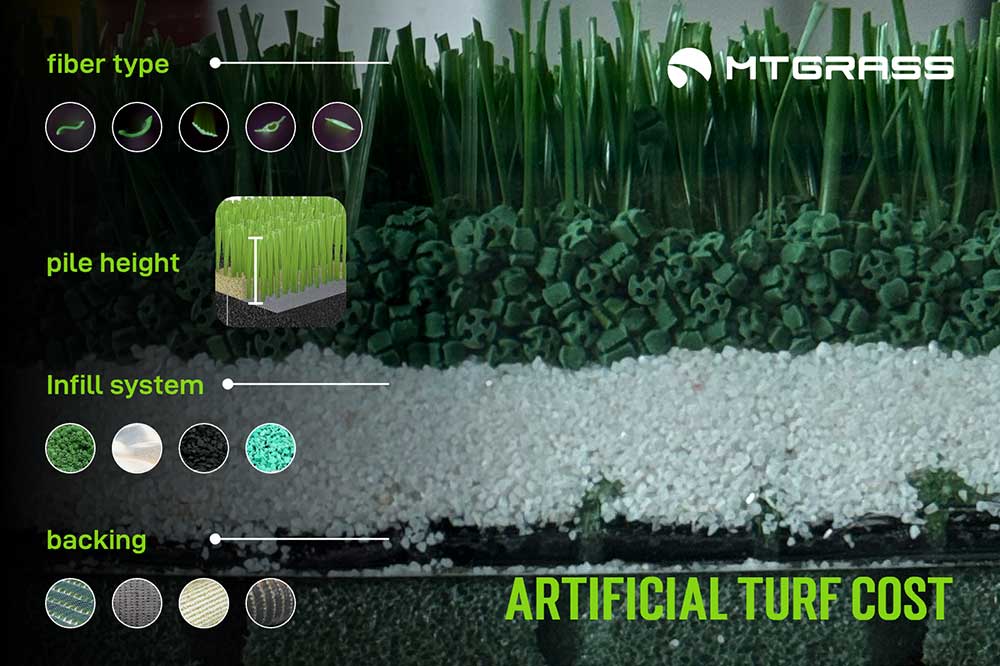
Hvordan påvirker parametrene prisen på et kunstgræsanlæg:
| Variabel | Funktionsbeskrivelse | Logik vedrørende omkostningspåvirkning | Omkostningsudvikling |
| Fibertype (garntype) | Bestemmer slidstyrke, elasticitet og UV-bestandighed | Monofilament og kompositgarn af PE i sportskvalitet koster mere end PP eller garn med lav densitet | ↑ Fiberopgradering = omkostningsstigning |
| Pilehøjde | Bestemmer garnforbruget og pladsbehovet til polstring | Jo højere bunken er, desto større er garnforbruget pr. kvadratmeter | ↑ Højere luvhøjde = højere omkostninger |
| Dtex (lineær tæthed) | Bestemmer garnets tykkelse og vægt | Jo højere Dtex-værdien er, desto tykkere er garnet, og desto større er materialforbruget | ↑ Højere Dtex = højere omkostninger |
| Tæthed | Bestemmer stinghastigheden og levetiden | En højere tæthed betyder, at der bruges mere garn, og at vævetiden bliver længere | ↑ Højere tæthed = betydelig omkostningsstigning |
| Underlag (grundlag og belægning) | Bestemmer konstruktionsstyrke og dimensionsstabilitet | PU-underlag og dobbeltlagsstrukturer er dyrere end standard latex-underlag | ↑ Strukturel opgradering = omkostningsstigning |
| Udfyldningssystem | Bestemmer ydeevnen på systemniveau og støddæmpningsstrukturen | Forskellige udfyldningssystemer kan kræve større pælehøjde eller højere tæthed | ↑ Systemopgradering = omkostningsstigning |
De grundlæggende årsager til prisændringer
- Stigning i materialeforbruget → Stigende omkostninger
Løftehøjde, Dtex og tæthed øger alle direkte garnforbruget. - Stigning i konstruktionsstyrken → Stigende omkostninger
Bagside- og grundstofstrukturer af højere kvalitet medfører højere produktionsomkostninger. - Højere ydeevnekrav → Stigende omkostninger
Hvis projektet kræver en højere anvendelsesintensitet eller strengere certificeringsstandarder, er det ofte nødvendigt at opgradere flere parametre samtidigt. - Opgradering af systemtilpasning → Samlede omkostninger stiger
Fyldsystemet, stødpuden og de tilhørende komponenter har indflydelse på de samlede systemomkostninger, ikke kun selve kunstgræsset.
Tips til valg af anbefalede modeller fra Mighty Grass:
- Lavt forbrug → Vælg parametre på mellemniveau → Omkostningerne forbliver under kontrol
- Hyppig brug eller projekter med høje krav → Opgradering af flere parametre → Omkostningerne stiger naturligvis
- Hvis man kun sænker én enkelt parameter, kan det medføre, at omkostningerne flyttes over på fremtidig vedligeholdelse og udskiftning.
| Model | Pælehøjde | Dtex | Måler | Tæthed | Opbakning | Anvendelse |
| MT-DIAMOND | 50 | 12,000 | 5/8 | 10,500 | 3 lag + SBR | fodboldbane |
| 16,000 | ||||||
| MT-UBEST 50 FIFA | 50 | 10,000 | 5/8 | 10,500 | 3 lag + SBR | fodboldbane |
| MT-WAVE | 30 | 12,000 | 3/8 | 18,900 | 2 lag + SBR | Landskabsarkitektur |
| 14,000 | ||||||
| MT-GOLF | 19 | 7,000 | 3/16 | 67,200 | 2 lag + SBR | golf |
| 12 |
Konklusion: Prisen på kunstgræs er ikke en fast pris, men afhænger af alle systemets parametre. Jo højere specifikationerne er, desto højere er prisen; til gengæld forbedres levetiden og stabiliteten også tilsvarende. Branchedata fra den internationale forskningsorganisation for sportsanlæg, Sports Turf Technology Association, viser, at materialeomkostningerne til fodboldgræssystemer af høj kvalitet er mere end 2–3 gange højere end for almindeligt anlægsgræs (f.eks. FIFA-certificerede systemer sammenlignet med standardmodeller i den laveste prisklasse), og over hele levetiden kan de reducere vedligeholdelsesudgifterne og udskiftningshyppigheden betydeligt.
- Projekttypen har direkte indflydelse på brugsintensiteten, den forventede levetid og ydeevnen, hvilket dermed bestemmer græstæppets specifikationer, fyldmaterialesystemerne og det samlede omkostningsniveau for systemet.
- Ifølge statistikker fra Sports Field Management Association (SFMA) har kunstgræssystemer, der anvendes af professionelle klubber og offentlige idrætsanlæg, en gennemsnitlig levetid, der er 3–5 år længere end dem, der anvendes til fritids- eller skolebaner, og de tilhørende årlige vedligeholdelsesomkostninger er også højere. Jo flere driftstimer, desto højere er kravene til garnets slidstyrke, tæthed, elasticitet og systemets samlede stabilitet; ellers vil levetiden blive væsentligt forkortet.
- Baseret på sammenstillede offentlige data fra undersøgelser af driften af europæiske idrætsanlæg og Sports Field Management Association (SFMA) i Nordamerika:
- Fritidsbaner til lavintensiv brug: ca. 400–800 timer/år
- Skolens praktikområder: 800–1.200 timer/år
Klubbens grundlæggende træning - arbejdstid: 1.200–1.800 timer/år
- Offentlige områder med højfrekvent stråling: 1.500–2.500 timer/år
- Professionelle stadioner eller multifunktionsarenaer: over 2.000 timer/år
Sammenligningstabel: Forskellige projekttyper indvirkning på omkostninger og levetid
| Projekttype | Årlig brugsintensitet (timer) | Anbefalet bunkehøjde | Anbefalet tæthedsniveau | Forventet levetid (år) | Vigtigste præstationsmål | Omkostningsindeks (basis = 1) |
| Baghave (boligområde) | 300–600 | 25-35 mm | Lav-medium | 6–8 | Blødhed, dræning | 1.0 |
| Park (offentlig) | 600–1.200 | 30-40 mm | Medium | 7–9 | Holdbarhed, lav vedligeholdelse | 1,1–1,2 |
| Skole | 800–1.500 | 40-50 mm | Mellemhøj | 8–10 | Slidstyrke, sikkerhed | 1,2–1,4 |
| Klub | 1.200–2.000 | 45–55 mm | Høj tæthed | 9–12 | Stabil fremgang, konkurrencedygtige resultater | 1,4–1,6 |
| Stadion (Professionel) | 2,000+ | 50-60 mm | Høj tæthed + forstærket bagside | 10–15 | Ydeevne i FIFA-klasse, langvarig stabilitet | 1,8–2,2 |
Mighty Grass – eksperttips:
- For hver yderligere 500 driftstimer om året anbefales det at opgradere tætheden og fiberspecifikationen med ét niveau.
- Når tætheden og Dtex øges samtidigt, stiger materialeforbruget typisk med 15%–35%.
- Hvis der anvendes konfigurationer med lave specifikationer til projekter med høj belastning, kan den faktiske levetid blive forkortet med 30%–50%.
For eksempel:
- Hvis en skolebane anlægges på en måde, der kun egner sig til brug i baghaven, vil en forventet levetid på 8 år i praksis måske kun vare 4–5 år.
- Hvis et erhvervsuddannelsescenter indfører et system med højere specifikationer, stiger de indledende omkostninger ganske vist med 20%–40%, men livscyklusomkostningerne bliver mere stabile.
Monteringsmetoden og undergrundstypen har direkte indflydelse på byggeriets sværhedsgrad, materialforbruget og arbejdsomkostningerne.
Forskellige undergrundsforhold har indflydelse på dræningssystemer, krav til udjævning, fastgørelsesmetoder og byggetidsplaner, hvilket medfører betydelige prisforskelle. For en fodboldbane på 7.000 m² kan forskellige undergrundsforhold resultere i en samlet prisforskel på 30%–60%.
Ifølge offentligt tilgængelige prisdata for byggemarkedet i Nordamerika og Europa, eksempler på tilbud fra entreprenører i branchen samt en omfattende analyse af rapporter om byggeomkostninger til sportsanlæg for perioden 2023–2024 kan de faktiske priser variere afhængigt af regionale lønomkostninger, projektets omfang og byggestandarder.
Installationsomkostningerne (kun anlægsarbejdet) for kunstgræs under forskellige underlagsforhold ligger typisk inden for følgende intervaller:
- Komprimeret jordunderlag: ca. $8–$15 / m²
- Underlag af knust sten: ca. $12–$20 / m²
- Betonfundament: ca. $15–$25 / m²
- Asfaltunderlag: ca. $14–$23 / m²
| Underlagstype | Der skal udføres grundarbejde | Kompleksitet i dræning | Konstruktionsstabilitet | Samlet omkostningseffekt |
| Naturlig jord | Minimal eller tynd bund | Lav | Lav | $18–$35/m² |
| Knust sten | Lagvis komprimering | Høj | Høj | $35–$60/m² |
| Beton | Kun udjævning af overfladen | Medium | Meget høj | $30–$55/m² |
| Asfalt | Overfladebehandling + vedhæftning | Medium | Høj | $40–$70/m² |
Sammenligning af omkostninger ved installation af kunstgræs
(Set fra perspektivet af et installationssystem til kunstgræs)
| Underlagstype | Typiske anvendelser | Strukturelle lag | Omkostningskarakteristika | Samlet prisinterval for installation (inkl. materialer og arbejdsløn) |
| ① Ny standard for underlag af knust sten | Nye fodboldbaner Skoleprojekter Klubbens træningsanlæg | Komprimeret undergrund → Underlag af knust sten (150–250 mm) → Udjævningslag → Kunstgræs → Udfyldningssystem | ✔ Bedste dræningsevne ✔ Højeste konstruktionsstabilitet ✔ Den mest forudsigelige levetid ✖ Højere indledende basisinvestering | Skole / Klub: $35–$60 /m² Førsteklasses faciliteter: $50–$80 /m² |
| ② Direkte montering på eksisterende beton | Marker på tagene Gamle basketballbaner Indendørs faciliteter Erhvervslokaler | Eksisterende betonplade → Reparation og udjævning af overflader → Kunstgræs → (Valgfrit) Stødpude | ✔ Det er ikke nødvendigt at genopbygge basen ✔ Hurtigere installation ✖ Dræningsforholdene skal vurderes ✖ Reparation af revner kan medføre højere omkostninger | Landskab / Lysforbrug: $20–$40 /m² Anvendelse til sportsformål: $30–$55 /m² |
| ③ Omlægning til naturgræsbane | Projekter til opgradering af naturgræsbaner Renovering af parker | Fjern det eksisterende græs → Inspektion af fundamentet → Delvis eller fuldstændig forstærkning → Optimering af dræning → Kunstgræssystem | ✔ Den eksisterende base kan delvist genbruges ✖ Omkostningsvariabiliteten er stor ✖ Der er behov for en ny vurdering af dræningsrisiciene | Delvis renovering: $30–$50 /m² Fuldstændig genopbygning: $40–$70 /m² |
| ④ Direkte anlæg på komprimeret jord | Midlertidige felter Lavbudgetprojekter Områder i landdistrikterne med lavt forbrug | Komprimeret jord → Tyndt lag af knust sten → Kunstgræs | ✔ Laveste startinvestering ✖ Større risiko for forlig ✖ Dårlig dræningsstabilitet ✖ Betydeligt kortere levetid | $18–$35 /m² (kun til brug med lav intensitet) |
Indkøbskanalerne for kunstgræs kan hovedsageligt inddeles i fem kategorier: Direkte fra fabrikken (direkte B2B / direkte fra fabrikken), lokal distributør / grossist med lager, installatør / nøglefærdig EPC, forhandler / importør samt e-handel / detailhandel. Ifølge globale markedsundersøgelser om kunstgræs dominerer de fysiske kanaler stadig. Nogle rapporter anslår, at offline-kanaler vil udgøre ca. 74% af markedsandelen i 2025. Årsagerne hertil omfatter fysisk tilgængelighed af produkterne, det faktum, at anlægsprojekter ofte kræver vurdering på stedet og tilpasning af parametre, samt et højere niveau af professionel rådgivning og tillid til servicen.
»Hvis vi tager en almindelig specifikation for kunstgræs til en 40 mm fodboldbane som eksempel, hvis enhedsprisen FOB direkte fra fabrikken for en fuld container ligger på ca. 4,5–6,0 USD/m², kan prisen ved køb gennem en lokal forhandler nå op på 6,5–8,5 USD/m², mens en nøglefærdig EPC-model kan koste 10,0–13,0 USD/m². For den samme bane på 5.000 m² kan forskellen i materialomkostninger alene overstige 20.000 USD.”
I mange projekter kan en adskillelse af materialekøb og installation (direkte køb af materialer fra fabrikken + lokalt installationsteam) ofte medføre en betydelig reduktion af de samlede omkostninger. Ifølge vejledninger om ingeniøromkostninger kan direkte indkøb af materialer og ansættelse af en entreprenør, der udelukkende varetager installationen, reducere de samlede projektomkostninger med ca. 15%–25% (afhængigt af regionale lønninger og projektets kompleksitet).
Hvordan indkøbskanaler påvirker de samlede omkostninger
| Indkøbskanal | Typiske købere / anvendelsesscenarier | Omkostningsforhold (hvor pengene går hen) | Fordele (hvorfor køberne vælger det) | Risici / Ulemper (Hvorfor det kan være dyrere eller mindre stabilt) | Hvornår anbefales det? |
| 1) Direkte fra fabrikken (direkte B2B) | Engroshandlere med containerlast; skole-, forenings- og kommunale projekter; udbudsprojekter | Som regel den laveste enhedspris på materialer; en mere overskuelig omkostningsstruktur (FOB / EXW / CIF); lettere at udarbejde et »systembaseret tilbud« | Fuld kontrol over parametrene, ensartethed i hver batch, mulighed for tilpasning (tilpasning af fiber, tæthed, bagside og fyldmateriale); ideel til store mængder, langsigtet samarbejde og udbudsprojekter | Der kræves et minimumsordremængde; købere skal fremlægge mere udførlige projektoplysninger (areal / grundforhold / brugsintensitet / leveringstidsplan) | Bestillinger på halve eller hele containere eller ethvert projekt, der kræver ensartethed i specifikationerne og sporbarhed |
| 2) Lokal forhandler / grossist med lager | Behov for hurtig levering; genopfyldning af små partier; lokale anlægsarbejder | Højere enhedspris (inklusive omkostninger til oplagring, lagerbeholdning og distribution) | Hurtig levering, fleksible mængder, enkel kommunikation; velegnet til projekter, der skal »gå i gang med det samme« | Begrænsede specifikationsmuligheder; konsistensen på tværs af flere batcher skal kontrolleres | Stramme byggetidsplaner, små mængder eller købere uden erfaring med import |
| 3) Installatør / Nøglefærdig EPC-entreprenør | Ejendomsejere eller skoler, der køber komplette »nøglefærdige løsninger« | Højere tilsyneladende enhedsomkostninger, men inkluderer udgifter til projektering, installation, garanti og administration | Kræver minimal koordinering, klare ansvarsgrænser (materialer og montering i én pakke); ideelt for ejere, der foretrækker én kontrakt | Mindre gennemsigtighed; materialesammensætning og margenstruktur er muligvis ikke fuldt synlige; risiko for omkostningsstyring gennem brug af materialer af lavere kvalitet | Den mest praktiske løsning for ejerne, men specifikationerne skal være tydeligt angivet i kontrakten og underkastes en uafhængig inspektion |
| 4) Forhandler / Importør | Internationale indkøbere, der foretrækker ikke at samarbejde direkte med fabrikker; indkøbere, der søger integrerede leveringsløsninger | Prisforskel mellem salg direkte fra fabrikken og via distributøren; kan omfatte logistik- og toldtjenester | Mere lokaliseret kommunikation; mulighed for at samle flere varer i ét tilbud (kunstgræs + tilbehør + værktøj) | Gennemsigtigheden i produktionen og ensartetheden mellem partier kan variere; kræver streng kontrol af specifikationerne | Når købere har brug for en samlet pakke, men stadig ønsker at have kontrol over de vigtigste parametre |
| 5) E-handel / Detailhandel | Baghaven i et boligområde; kunstgræs til kæledyr; projekter på små arealer | Enhedsprisen er ikke altid den laveste; nem bestilling; standardiserede varenumre | Hurtigt valg, gennemsigtige priser, velegnet til standardiserede produkter | Ikke ideelt til store projekter eller sportsprojekter: begrænsede tilpasningsmuligheder, mangelfuld teknisk support, uklar ansvarsfordeling i systemet | Små arealer, standardprodukter, kortvarige projekter (anbefales ikke til fodboldbaner med høj belastning) |
Konklusion: Fabrikker, der producerer kunstgræs, er bedre egnet til tilpasning efter kundens behov og indkøb i store mængder, mens distributører er stærkere inden for lokal logistik og levering med kort varsel, og e-handelsplatforme er mere velegnede til standardiserede ordrer.
- Anbefaling fra Mighty Grass-fabrikken for kunstgræs:
- Hvis du går efter de laveste enhedsomkostninger og ensartede specifikationer (skoler / klubber / kommunale projekter / engroshandel med hele containere), bør du prioritere indkøb direkte fra fabrikken (klare FOB-, EXW- og CIF-betingelser).
- Hvis du går efter den hurtigste levering eller genopfyldning, er distributører med lokale lagre det bedste valg.
- Hvis du ønsker den mest bekymringsfri løsning, skal du vælge et nøglefærdigt projekt, men de vigtigste specifikationer skal være fastlagt i kontrakten og leveres i overensstemmelse med godkendelseskriterierne.
Hvad er MOQ (minimumsordremængde) for en kunstgræsfabrik?
Mighty Grass’ standard-minimumsordremængde afhænger af produkttype og graden af tilpasning:
- Standard græstørv til landskabsanlæg: 1.100 m²
- Fodboldbane (ikke-FIFA-model): 3000–5000 m²
- FIFA-testede modeller: 8000 m²
- Bestillinger af fulde containere: Anbefales for at opnå den bedste enhedspris
Som vejledning ved lastning af containere:
- 20GP-container: ca. 2.500–3.000 m²
- 40GP-container: ca. 5.000–6.000 m²
- Hver rulle = 4 m × 25 m = 100 m²
Hvordan udarbejder en kunstgræsfabrik tilbud?
Mange kunstgræsfabrikker afgiver typisk tilbud i henhold til tre internationale handelsbetingelser:
- EXW (Ex Works) – Du sørger for afhentning fra fabrikken
- FOB (Free On Board) – Vi leverer til havnen og står for eksporten
- CIF (Cost, Insurance & Freight) – Vi inkluderer søfragt til din bestemmelseshavn
Et professionelt tilbud indeholder normalt:
- Specifikationer for kunstgræs (fibrehøjde, Dtex, tæthed, bagside)
- Rullestørrelse og antal
- Anbefaling vedrørende udfyldning (hvis relevant)
- Anslået containerlastning
Vi anbefaler, at seriøse købere anmoder om en FOB-pris + et skøn over søfragtomkostningerne for at kunne foretage en gennemsigtig sammenligning af omkostningerne.
Hvor meget koster søfragt normalt?
Søfragt afhænger af:
- Modtagerland
- Containertype (20GP / 40GP)
- De nuværende forhold på fragtmarkedet
Typiske globale udbredelsesområder:
- Asien → Afrika / Mellemøsten: 2.000–4.000 USD
- Asien → Sydamerika: 1.500–4.500 USD
- Asien → Europa: 1.500–4.500 USD
- Asien → Nordamerika: 1.800–2.800 USD
Udsving i fragtomkostningerne kan have en betydelig indflydelse på de endelige omkostninger ved levering, så vi anbefaler, at man bekræfter leveringsvinduet, inden kontrakten indgås.
Er det virkelig billigere at købe kunstgræs direkte fra fabrikken?
Direkte køb fra fabrikken sænker ofte enhedsomkostningerne ved storkøb, da det eliminerer forhandlerens fortjeneste og giver mulighed for direkte tilpasning af systemet. I de fleste mellemstore til store projekter er det tilfældet.
For eksempel:
- En fodboldbane på 5.000 m²
- FOB-pris fra fabrik: 5,0 USD/m²
- Pris hos lokal forhandler: 7,5–9,0 USD/m²
Alene prisforskellen kan udgøre mere end 12.000–20.000 USD.
Direkte salg fra fabrikken kræver dog:
- Tydelig definition af specifikationer
- Et kompetent installationsteam
- Grundlæggende erfaring med import
Ved hastesager eller mindre projekter kan det være mere praktisk at benytte lokale forhandlere.
Hvor stor vil mængden være i en 20-fods-container?
For standardruller med en bredde på 4 m til fodbold eller haveanlæg:
Lastekapacitet for en 20 ft container:
- Ca. 2.500–3.000 m²
- Afhænger af:
- Rullelængde (20 m eller 25 m)
- Stabelhøjde (jo højere stabel, desto mindre mængde)
- Tykkelse på bagside
- Emballeringsmetode (tæt rulle kontra forstærket emballage)
Praktisk oversigt:
- 40–50 mm fodboldgræs → ca. 2.500–2.800 m²
- 25–35 mm græstørv til landskabsanlæg → op til 3.000 m²
Hvor meget vil der være i en 40-fods-container?
Lastekapacitet for en 40 ft container:
- Ca. 5.000–8.000 m²
- Det svarer til to 20-fods-containere, men er lidt mere effektivt med hensyn til fragtomkostninger pr. m².
Praktisk oversigt:
- 40–50 mm fodboldgræs → ca. 5.000–5.500 m²
- 25–35 mm græstørv til landskabsanlæg → op til 6.000 m²
