
 English
 العربية
 Español
 Deutsch
 Français
 Português
 Русский
 日本語
 Italiano
 Nederlands
 Svenska
 Suomi
 ไทย
 Dansk
 Ελληνικά
 Bahasa Melayu


For schools, universities, sports facility owners, and field contractors, building a new baseball field or upgrading an existing one is a major investment. You need a playing surface that can withstand intensive use, deliver consistent playing conditions, and keep long-term maintenance requirements manageable. Artificial turf is an increasingly attractive option for meeting these demands. A key question that naturally arises is: How much does it cost to artificial turf a baseball field?
Having a clear understanding of the potential costs is essential for setting a realistic budget and making informed project decisions. In this guide, we’ll break down the typical costs of a turf baseball field, explain the major factors that affect your overall budget, and show you how to estimate the amount of artificial turf material your project requires. As an experienced artificial turf manufacturer, we are here to provide you with reliable artificial turf solutions.
How Much Does a Turf Baseball Field Cost?
The cost of an artificial turf baseball field varies considerably depending on how much of the field is covered and what construction work is included. For an initial budget, the following figures provide useful U.S. market reference points.
| Project Scope | Estimated Cost | Pricing Basis |
| Infield-only conversion | 80,000–180,000 | Installed infield system, including basic site work, base and turf; complex work may cost more |
| Full-field turf installation | 650,000–740,000 | Example of a roughly 75,000 sq ft project including base, shock pad, turf, infill and drainage options |
| New full-field construction | 900,000–1.5 million+ | Broader project budget including turf installation and additional site and facility work |
| Existing turf replacement | 140,000–870,000 | Broad project estimate; depends on removal, replacement scope and infrastructure upgrades |
These are planning estimates, not guaranteed contractor prices. A recent North Texas proposal for a 74,960 sq ft baseball field priced the base, shock pad, turf, and installation at $648,550, increasing to $737,259 with drainage options. The proposal excluded items such as fencing, dugouts, lighting, and some earthwork.
For surface installation, a useful preliminary benchmark is approximately 8–15 per square foot, depending on the system and site requirements. This is not the same as the price of artificial turf rolls alone. A material quotation covers the turf products specified by the supplier, whereas an installed price may include the base, drainage, infill, labor, and other construction work.
What Goes Into the Cost of a Turf Baseball Field?
An artificial turf baseball field is a layered system, and each layer has its own cost, budget includes more than the artificial grass itself. The following components determine how much the project will cost.
| Cost Component | What It Covers |
| Site preparation | Excavation, grading, soil stabilization |
| Base construction | Aggregate, geotextile, compaction |
| Drainage | Pipes, channels, outlets |
| Turf system | Fibers, backing, face weight |
| Infill and shock pad | Infill materials and cushioning |
| Installation | Labor, seaming, grooming |
| Additional costs | Design, shipping, permits, customization |
Site Preparation and Base Construction
The base is often where budgets change most. Crews excavate and grade the site, stabilize weak soil, install a geotextile layer, build up compacted aggregate or asphalt/concrete base layer, and finish with a precisely graded surface. A poor base leads to settlement, ponding, and uneven ball play, so this is not a place to economize. Poor soil, a sloped site, or the need to import material can raise this line substantially.
Drainage System
Baseball fields need to drain quickly, especially around the infield. Systems include subsurface drains, collector pipes and channels, perimeter drainage, and water outlets. For new construction, drainage is a major budget line, the underlying drainage layer cost around 4–5 per square foot. For conversions, the question is whether existing drainage performs well enough to keep or needs to be rebuilt.

Artificial Turf Types and Specifications
Two turf rolls can look identical on a sample board and still behave very differently on a baseball field. Fiber type, density, backing, and construction determine how the surface plays, how long it lasts, how well it absorbs impact, and what you pay per square foot. This is the part of the budget you can control most directly.
When you compare specifications, a few terms matter most:
- Face weight is the amount of fiber per square yard, usually measured in ounces.
- Pile height is the length of the fiber, and infield turf often uses a shorter pile than outfield turf.
- Fiber shape: MightyGrass PE monofilament yarns are individually extruded and tend to stand up well and flexibility.
- Backing type affects tuft bind, dimensional stability, and drainage.
| Turf Tier | Relative Material Cost | Typical Characteristics |
| Entry-level | Lowest | Shorter pile, lighter face weight, simpler backing. Shorter expected service life. Suited to low-traffic or practice areas. |
| Mid-range sports turf | Moderate | Balanced density and durability. Commonly specified for school and community baseball fields. |
| Premium performance turf | Highest | Dense fiber, engineered pile height, reinforced backing. Often paired with specialized infill or shock pad for higher use and higher performance standards. |
The right tier depends on your budget, how heavily the field will be used (practice, league play, tournaments), and the performance you require. Sharing your field drawings and use requirements with the turf manufacturer as early as possible, so that we can recommend the most suitable artificial grass specifications for you.
Infill and Shock Pad System
Infill options include silica sand, crumb rubber, TPE, EPDM, and organic infill. Each has different cost, performance, temperature behavior, and regulatory acceptance. Shock pads add cushioning and reduce impact forces, but they add material and installation cost.
Not every baseball field uses the same system. Some are sand-only, some use a shock pad with minimal infill, and some use multi-layer infill. The right choice depends on the level of play, local regulation, climate, and budget. Ask for impact-absorption test data (such as Gmax) when comparing systems.
Installation Labor and Additional Project Costs
Once the base and materials are ready, contractors must complete turf installation and finishing work.
Typical installation tasks include:
- Positioning and joining turf rolls
- Seaming and securing field edges
- Cutting and installing custom markings
- Applying and distributing infill
- Power brushing and surface grooming
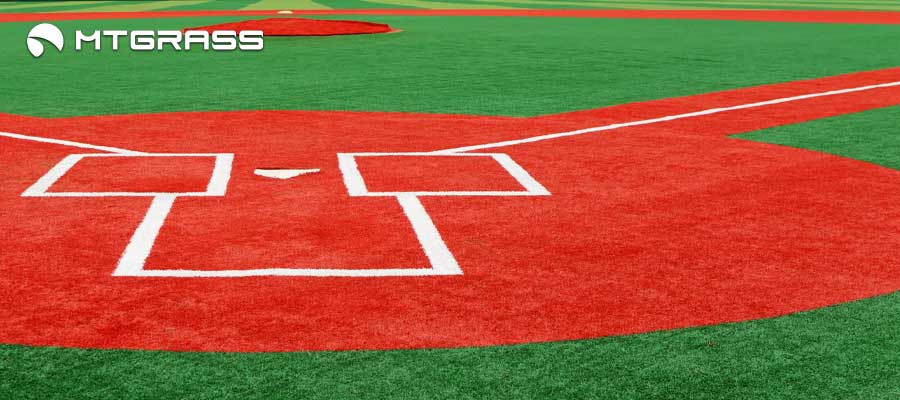
Baseball fields may also require custom base paths, batter’s boxes, logos, and different turf colors.
Other expenses can include transportation, equipment rental, engineering, permits, testing, and project management.
These items should be listed separately in a quotation. Turf installation labor is not the same as the cost of all additional construction and facility work.

How Does the Project Scope Affect Baseball Field Turf Costs?
Two baseball fields with similar dimensions can have very different budgets because the areas being converted and the existing site conditions may not be the same.
Infield-Only vs. Full-Field Turf Installation
An infield-only project covers a fraction of the total area, so turf quantity and cost are much lower. A full-field project covers the infield and outfield, which multiplies area and drives the largest cost gap. A hybrid approach, with synthetic infield and natural outfield, is also common. It reduces upfront cost while removing the highest-wear, highest-maintenance area from natural turf.
Design also differs by zone. Infields need a durable, high-traffic surface with careful detailing around bases, mound, and home plate. Outfields can use a different construction with an emphasis on consistent ball roll and appearance.
New Construction vs. Existing Field Conversion
New construction requires a full base and drainage build, so the scope is largest. Converting a natural grass field requires an assessment of existing soil, grade, and drainage before deciding what can stay.
Replacing an old turf field requires removing the old system and checking whether the base is still sound and reusable. Reusing a good base can reduce the scope considerably, while a failed base can bring the project close to new-construction cost.
How to Estimate the Artificial Turf Material Cost for a Baseball Field
For contractors, distributors, and project buyers purchasing directly from an artificial turf manufacturer, material budgeting should begin with the actual turf coverage area.
Calculate the Required Turf Quantity
Start with the approved field layout and identify every area that requires artificial turf. Separate the infield, outfield, and any additional turf zones. Exclude areas that will use natural grass, clay, concrete, or other materials.
Once the installation area has been determined, a certain margin should be added when calculating the amount of artificial turf required, in order to account for material loss during cutting, seaming, and the overall installation process. A basic calculation is:
Required Turf Quantity = Coverage Area x (1 + Waste Rate);
For example, if a project requires 100,000 sq ft of turf and uses an assumed 5% waste allowance: 100,000 x 1.05=105,000sqft.
The actual waste rate depends on the field layout, roll width, roll length, seam positioning, and cutting plan. Irregular boundaries and multiple turf colors may increase material requirements. The material cost can then be estimated using:
Turf Material Cost = Required Turf Quantity x Unit Price;
For example, at an illustrative supplier price of $3 per sq ft, 105,000 sq ft would represent $315,000 in turf material costs. This is a calculation example, not a market quotation.
Understand What Is Included in a Turf Supplier’s Quote
When comparing quotes from artificial grass suppliers, you also need to verify exactly what is included in each quote.
| Quotation Item | What to Confirm |
| Artificial turf rolls | Product model, pile height, face weight, roll dimensions |
| Backing and yarn | Construction, material, and technical specifications |
| Customization | Colors, field markings, and logos |
| Packaging | Roll protection and packaging requirements |
| Transportation | Shipping terms, freight, and delivery destination |
| Technical support | Samples, test reports, and product documentation |
Generally speaking, a manufacturer turf quotation is not a complete baseball field construction quotation. It generally covers the specified turf products and agreed supply services, not excavation, aggregate base construction, drainage, or local installation labor.
What Are the Long-Term Costs of an Artificial Turf Baseball Field?
Although artificial turf reduces the need for mowing, irrigation, and natural grass recovery, it still requires regular maintenance and occasional repairs.
Typical ongoing expenses include:
- Routine cleaning and grooming: Removing debris, brushing fibers, and maintaining an even playing surface.
- Infill replenishment: Adding infill where material has shifted or been displaced through use.
- Seam and localized repairs: Repairing damaged seams, loose edges, or worn areas.
- Performance inspections: Checking surface hardness, drainage, infill distribution, and overall playing conditions.
- Eventual turf replacement: Replacing the carpet when its fibers, backing, or playing performance deteriorate beyond acceptable limits.
The actual maintenance budget depends on playing frequency, climate, maintenance practices, and the quality of the original turf system. For example, Cornell’s sports field guidance highlights regular grooming, infill redistribution, and periodic hardness testing as important synthetic turf maintenance practices.
How to Get an Accurate Baseball Field Turf Quotation?
Getting an accurate turf quotation starts with providing the manufacturer with sufficient project information. Before requesting a price, prepare the following details:
- Calculate the lawn installation area based on baseball site layout and dimensions to determine the required quantity of baseball turf materials.
- Define infill requirements and system compatibility.
- Calculate transportation costs.
For sports field contractors, distributors, and facility buyers, working directly with an artificial turf manufacturer can also help clarify product specifications, customization options, and supply arrangements.
MightyGrass is your trusted artificial turf manufacturer for sports applications. We offer customized sports turf solutions tailored to the specific requirements of your project or market, including options for fiber structure, pile height, backing, color, and other technical specifications.
With over 20 years of experience in manufacturing and exporting, MightyGrass provides complimentary product samples, technical documentation, quality control, and comprehensive international supply support.
If you are planning a baseball field project, submit your field layout, required turf coverage, and product specifications to the MightyGrass team. We can help assess the material requirements and prepare a customized artificial turf quotation for your project.
FAQ
How much does it cost to turf a baseball field per square foot?
A preliminary budget for an installed artificial turf baseball field surface is approximately 8–15 per sq ft, depending on the turf system, base construction, drainage, and installation scope. Turf material alone costs less and should be quoted separately.
How much does it cost to turf a baseball infield?
An infield-only artificial turf conversion may cost approximately 80,000–180,000, depending on the infield dimensions, base condition, turf specifications, and installation requirements. Larger or more complex projects may exceed this range.
What is the biggest expense when installing a turf baseball field?
The artificial turf system and base construction are generally among the largest expenses. In one published 74,960 sq ft baseball field proposal, the padded turf system accounted for approximately 71% of the base bid, while the compacted base and geotextile accounted for about 27%. The proportions vary by project.
How much does it cost to replace artificial turf on a baseball field?
Replacing an existing artificial turf baseball field can cost approximately 140,000–870,000 as a broad U.S. project estimate. The price depends on the field size, old turf removal, replacement materials, and whether the existing base and drainage can be reused.
How long does artificial turf last on a baseball field?
Artificial turf commonly has an expected service life of approximately 8–15 years, although actual lifespan varies with product quality, playing intensity, climate, maintenance, and installation conditions. High-use fields may require replacement sooner, while well-maintained systems may last longer.
Does an artificial turf baseball field require regular maintenance?
Yes. Artificial turf baseball fields require regular debris removal, brushing, infill redistribution, seam inspections, and periodic performance checks. Maintenance frequency depends on field usage and the type of turf system installed.


