English
  العربية
  Español
  Deutsch
  Français
  Português
  Русский
  日本語
日本語  Italiano
  Nederlands
  Svenska
  Suomi
Suomi  ไทย
ไทย  Dansk
Dansk  Ελληνικά
  Bahasa Melayu
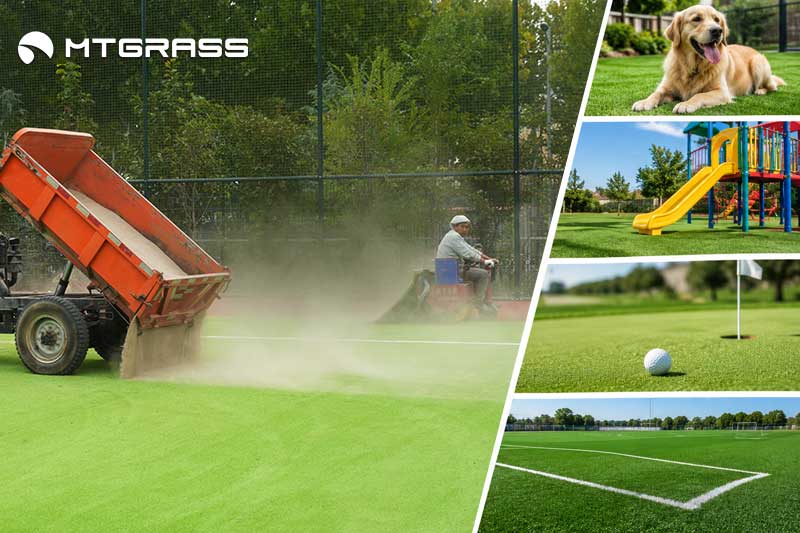
Most artificial turf infill calculations start with one question: how many pounds or kilograms do you need per square foot or square metre?
In practice, a 30mm residential lawn, a pet area, and a 50mm football field do not use infill in the same way. The artificial turf application, pile height, traffic, infill material, and performance requirements all change the calculation.
In this guide, we will explore how to calculate the amount of infill needed and understand the factors that affect the required quantity, helping you avoid purchasing or installing more infill than your synthetic turf system actually requires.
Quick answer: Residential artificial grass may commonly require around 1–4.5 lbs of infill per sq ft, depending on the turf system and installation requirements. Sports fields should instead be calculated from the manufacturer’s specified kg/m² rate, taking the turf, infill, shock pad, and required performance into account.
What Is Artificial Turf Infill and Why Does It Matter?
What is Turf Infill?
Artificial turf infill refers to the granular material placed between the turf fibers.It serves not only to support the turf blades but also to improve comfort, safety, and appearance, while influencing the surface’s performance during use. As a result, the same turf product can perform differently when the infill quantity or material changes.
The infill is applied after the turf has been laid, typically using a drop spreader and a power broom to ensure even distribution and complete the installation of the artificial turf system.
Why Do You Need Turf Infill?
You can think of infill as a functional layer within the turf system. Its main jobs are to:
- Hold the turf blades upright and support their recovery after use.
- Add cushioning and impact absorption where the turf system is designed for it.
- Add ballast to help keep the turf stable and reduce shifting or wrinkling.
- Support surface drainage when the infill is matched with a properly designed turf backing and base.
- Reduce excessive yarn and surface wear, helping the turf system maintain its performance over time.
Can Artificial Grass Be Installed Without Infill?
If you are installing an artificial turf product specifically designed to be “non-infill,” then omitting loose infill is a reasonable approach. However, the situation differs for standard landscape and sports turf. Manufacturers design the turf blades and backing based on specific infill levels; omitting the infill may prevent the product from achieving its intended stability and service life.
In addition, MightyGrass offers both traditional infill and non-infill turf products, ensuring that the installation method aligns with the product design.
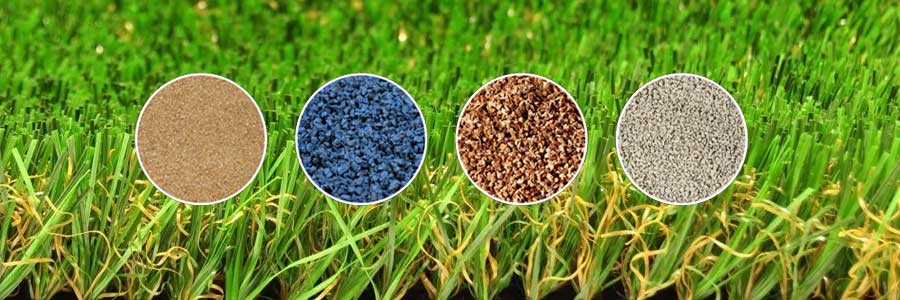
Types of Artificial Turf Infill: Sand, Zeolite, TPE, EPDM, and More
You do not have to choose infill independently of the turf. In practice, your application usually narrows the options quite quickly.
| Infill Type | Where You May Use It | What It Brings to the System |
| Silica sand | Residential landscape | Ballast and fiber support |
| Coated sand | Premium landscape and pet areas | Lower dust and improved particle performance |
| Zeolite | Pet turf | Odor-management properties |
| TPE | Sports and athletic turf | Elasticity and resilience |
| EPDM | Sports fields | Durable elastic performance |
| Organic infill | Eco-focused applications | Natural-material alternative |
For a backyard lawn, silica sand may be all you need. If you are building a dog area, odor control can become more important than simply adding weight. For football and other sports surfaces, you may need a combination of ballast sand and elastic infill.
There is also a practical reason you should not convert every system into a single pounds-per-square-foot number: different infills have different bulk densities. The same depth of sand, rubber, and TPE will not necessarily produce the same weight. MightyGrass details the properties and applications of these materials in its guide, “Types of Infill for Artificial Grass.”
How Much Infill Per Square Foot Does a Residential Lawn Need?
For residential landscape turf, roughly 1–4.5 lbs/sq ft is a reasonable broad planning range. Shorter, lightly used turf tends toward the lower end, while taller turf designed for regular foot traffic may require more. You should not, however, choose the rate simply because it falls inside that range.
Imagine two lawns, both measuring 1,000 sq ft. One uses a landscape turf beside a pool. The other uses a taller landscape turf where sports fields or pets play every day. Their infill requirements may be different even though the areas are identical.
So, what factors influence the amount of infill for the turf? Pile height, stitch density, yarn design, and the space available between fibers all influence how much infill the system is designed to hold.
That is why the manufacturer’s technical specification should be your final reference.
How to Calculate the Exact Amount of Infill You Need? Once you have the recommended application rate, the calculation is straightforward:
Total Infill Weight = Area × Infill Rate Coefficient
Assuming your project area is 1,000 square feet, the specified fill rate is 2.5 pounds per square foot, and the fill material comes in 50-pound bags:
1,000 × 2.5 ÷ 50 = 50 bags
For large-scale projects or sports field projects, a target infill depth—rather than a weight-based ratio—may sometimes be specified to meet surface performance requirements. You can then use:
Required Weight = Area × Infill Depth × Bulk Density
How Much Infill Do Pet Turf and Playground Turf Need?
As a general planning range, about 2–4 lbs of infill per square foot can be a useful starting point, but the actual rate depends on the turf pile height, backing, infill material, and how the area will be used.
- Pet turf usually needs more attention than a standard landscape lawn because the surface has to handle repeated traffic, cleaning, and drainage. If odor management is a priority, you may also consider zeolite or a specialty antibacterial odor-control infill rather than simply increasing the amount of standard sand. The material you choose can matter as much as the quantity.
- For playground turf, you need to separate two things that are sometimes confused: infill and impact protection. Infill helps stabilize the turf and contributes to the surface characteristics, but it is not a substitute for a properly designed shock pad. The required infill quantity therefore depends on the complete playground system. If impact attenuation is required, you should evaluate the turf, infill, shock pad, and base together rather than applying a standard landscape rate.
- Golf putting greens feature short-pile surfaces, whereas sand-filled systems with longer piles utilize a completely different infill strategy. Your target ball roll, pile height, turf construction, and manufacturer specification should determine the final rate rather than a generic landscape figure.

How Much Infill Do Sports Fields and Athletic Turf Need?
Sports field infill follows an entirely different logic than residential turf. The infill amount isn’t chosen independently. It’s engineered together with the shockpad underneath and the turf’s stitch construction to hit a specific performance target. Third, certified fields — built to standards like FIFA or World Rugby turf accreditation — are tested for shock absorption (often through G-Max ratings) and ball roll, with infill quantity as one of the calibrated variables in that testing process.
Take MightyGrass FIFA-certified football turf system projects as an example:
| System | Pile Height | Silica Sand | Rubber Infill |
| MT-Ubest | 40 mm | 20 kg/m² | 6 kg/m² |
| MT-Ubest | 50 mm | 26 kg/m² | 6 kg/m² |
| MT-Diamond | 60 mm | 10 kg/m² | 15 kg/m² |
The infill quantities provided above are for reference only. Actual requirements may vary from project to project depending on factors such as the required safety performance, grass pile height and density, shock absorption requirements, and the type and construction of the base system. If you’re speccing turf for a certified sports field, follow the system manufacturer’s engineered infill rate — sand, TPE and EPDM quantities are calculated per system, not estimated with a residential formula.
How Often Should You Top Off Artificial Turf Infill?
Infill can move or gradually leave the surface through traffic, brushing, weather, and maintenance. A residential lawn should be checked at least once a year, while busy commercial and sports areas deserve more frequent inspection.
You do not need sophisticated equipment to identify obvious problems. Walk across the turf and look for areas where the blades are becoming noticeably flatter, where the surface feels different, or where the infill appears thinner than elsewhere.
If you need to replenish it, spread small amounts evenly and brush them into the fibers. A power brush can make this easier on larger installations.
The goal of regularly replenishing artificial grass infill granules is to restore the infill height to design specifications and help extend the service life of the synthetic grass surface.
Choosing the Right Synthetic Turf System Makes Infill Planning Easier
If you are still trying to calculate infill before choosing the turf, you may be approaching the project in the wrong order.
The easier approach is to start with the application. Decide how the surface will be used, select a turf designed for that purpose, and then confirm the compatible infill material and installation rate.
That approach is particularly important when you are buying for a commercial landscape or sports project. A quotation should tell you more than the turf price. You should know the pile height, yarn construction, backing, recommended infill material, application rate, and—where applicable—the complete sports system specification.
At MightyGrass, you can source landscape and sports artificial turf together with different infill solutions for residential, pet, playground, football, and other applications. For project-based requirements, you can also confirm the appropriate turf and infill parameters with us before ordering.
Do you already have a project plan? Share your required installation area and intended application with the MightyGrass team. Based on your project requirements, we can recommend suitable artificial grass system specifications and infill requirements to help you achieve the right performance without unnecessary material costs.
FAQ
What’s the best infill for a dog run?
You should consider odor management, drainage, cleaning, and fiber support. Zeolite is commonly used in areas requiring high standards of odor control, while antimicrobial-coated sand helps inhibit bacterial growth, making your pet lawn system more comfortable and safe.
Do I need infill for a small artificial grass?
Not necessarily. If you choose a turf specifically engineered for non-infill installation, loose infill may not be required. Conventional infill turf should be installed according to its specification.
What infill is used on football fields — TPE or EPDM?
Both are used in sports applications. TPE provides elastic performance and can be supplied in different formulations, while EPDM is widely used for durable outdoor sports surfaces. Your system specification should determine the material and quantity.
How do I know if my turf needs more infill?
Look for flattened or matted fibers, areas where the turf appears less dense, exposed backing, or changes in surface stability. Pay particular attention to high-traffic areas and zones where players frequently stop, turn, or change direction, as these areas may require more frequent infill maintenance.