
 English
 العربية
 Español
 Deutsch
 Français
 Português
 Русский
 日本語
 Italiano
 Nederlands
 Svenska
 Suomi
 ไทย
 Dansk
 Ελληνικά
 Bahasa Melayu


Artificial grass gives dogs a comfortable space to play and relax, but lingering urine odor can make it difficult to enjoy. Even with regular rinsing, the smell may return, especially in areas where dogs urinate frequently or where drainage is poor.
So, how to remove urine smell from artificial grass and keep it from coming back? This guide walks you through why the smell happens, how to work out where it is coming from, and what to do at each level of severity. It also covers what to do when cleaning is no longer enough.
Why Artificial Grass Smells Like Urine
Pet urine contains water, urea, uric acid and other waste compounds. On natural lawns, soil microbes help break these down. Artificial grass has no soil biology on the surface, so what happens to the urine depends on how well it drains and what it lands on.
Two things cause most of the smell:
- Urea breaks down into ammonia: Bacteria convert urea into ammonia, which is the sharp, “cat box” smell most people notice first.
- Uric acid crystals don’t dissolve easily in water: When urine dries, uric acid can be left behind on fibers, infill, backing or base layer beneath under the turf. A quick rinse moves the liquid but may not remove these crystals. When the turf gets warm or damp, they can release odor again.
That is why a yard can smell fine in the morning and strong in the afternoon sun, or seem clean until it rains. The smell is not in your imagination, and it is not always a sign that your dog is the problem. It is usually a sign that urine is being held somewhere in the turf system.

Find Where the Smell Is Coming From
Before you pick a cleaning method, spend a few minutes working out what kind of smell problem you have. This saves time and stops you from repeating a treatment that can’t work.
| What you notice | Likely cause | Where to go next |
| A few specific spots smell, the rest is fine | Your dog’s regular bathroom spots are collecting urine | Refer to the Level 1 or 2 below, focused on those spots |
| The smell is strongest in the afternoon or on hot days | Dried urine residue releasing odor as the turf heats up | Refer to the Level 2 below |
| The smell gets worse after rain or watering | Urine is held in the infill or base and is being re-wetted, or water is not draining well | Refer to the Level 2 or 3, then check drainage |
| The smell comes back within days of cleaning | Infill or lower layers are saturated | Refer to the Level 3 and the section on fixing the system |
| The smell is strong even in cool weather and the turf feels damp | Poor drainage or trapped moisture under the turf | Test drainage, then see the system section |
| Smell is mostly at the edges or seams | Liquid is running to the edges and collecting there | Treat edges specifically and check the base along them |
A simple drainage check: Pour a bucket of water onto a clean patch of turf and watch what happens. If the water disappears quickly through the turf, drainage at that spot is probably fine. Conversely, if it pools, spreads sideways or takes a long time to drain, the problem may be in the backing, infill or base. Treating the surface alone is unlikely to solve a smell that comes from below. This is a rough test, not a diagnosis. But you can use this assessment to determine the extent of the remedial measures to take.
How to Remove Urine Smell: Choose Your Level
Level 1: Fresh Urine or a Mild Smell
Use this when the smell is new, limited to a few spots, or only noticeable up close.
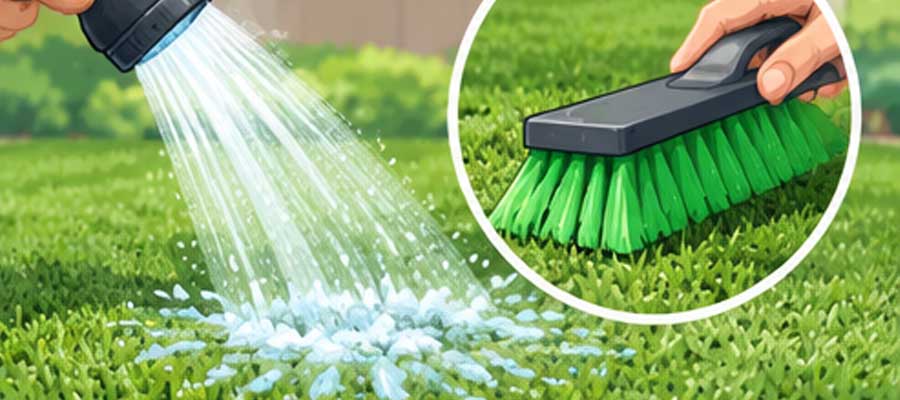
What you need: a garden hose, a pet-safe enzymatic or odor-neutralizing turf cleaner, a spray bottle or hose-end sprayer, and a stiff nylon brush or turf rake.
- Remove solid waste first: Pick up any solids so they don’t get spread around when you rinse.
- Flush with water: Rinse the area with a steady flow for at least 30 to 60 seconds. The goal is to dilute and push urine down through the turf, not to blast it sideways.
- Brush the fibers upright: Use a nylon brush or turf rake to lift the blades and help the area dry.
Level 2: A Smell That Keeps Coming Back
Use this when the smell returns after rinsing, gets stronger in heat or after rain, or you have more than one dog.
- Clear and pre-rinse the whole area: Remove debris and pet hair with a leaf blower or rake, then rinse the full zone, not just the visible spots. Urine travels, and smells often come from places you can’t see.
- Saturate with a cleaner: Apply the cleaner generously so it soaks through the fibers, infill and into the backing. For heavily used spots, do two passes, letting the first sink in before applying the second.
- Give it the full contact time: Longer contact is often what separates a treatment that works from one that doesn’t. Follow the manufacturer’s directions for time and temperature. Many products work best when applied in the cooler part of the day.
- Rinse if directed, then dry thoroughly: Leave the turf to dry fully before letting pets back on it. Moisture that stays trapped helps odor-causing bacteria.
- Groom the infill: Brush the area so the infill is even and not compacted. Matted infill drains poorly and holds smells.
Level 3: Strong or Long-Standing Smell
Use this when the turf has smelled for months, you have several dogs using a small area, or Level 2 didn’t hold.
At this stage, urine is likely stored in the infill and layers below. Cleaning the blades won’t reach it.
- Check the infill: If your turf uses infill and it is dirty, clumped or smells strongly when you scoop some out, it may be holding a lot of urine residue. In the worst-smelling zones, remove the contaminated infill with a turf vacuum or by careful scooping before you treat the area. Alternatively, you can use Zeolite Turf Infill, since zeolite can absorb ammonia.
- Deep-saturate the turf and the layers below: Apply a cleaner suited to pet urine heavily enough that it reaches the backing and the base, not just the surface. Repeat as the label allows. A heavy treatment on a stubborn area may need more than one round.
- Allow time and repeat if needed: Old smells can take more than one treatment. Let the area dry fully between rounds.
- Replace or top up infill in treated areas once the turf is completely dry, using an infill suited to pet areas.

Adjust According to Your Situation
| Situation | What’s different | How to adjust |
| Balcony, rooftop or indoor turf | No soil or gravel base, so urine has nowhere to go except into the turf and onto the surface below | Clean the surface under the turf periodically, since the smell often lives there. Rinse more often with enough water to carry urine to the drain. Choose a high-permeability pet turf so liquid doesn’t sit on the backing. |
| Several dogs or large dogs | High urine volume and frequency, usually concentrated in a few spots | Treat favorite spots on a schedule, not only after you smell something. Set up a designated potty zone on pet-suitable turf so the heaviest load is in one place. Expect to repeat deep treatments (Level 2 or 3) more often. |
When Cleaning Isn’t Enough: Fix the System
If you have worked through Levels 1 to 3 and the smell returns, the cause is usually built into the turf system. Three things matter most.
1. Backing and drainage
Turf with limited drainage can hold urine on top of the base. The more quickly urine passes through the turf, the less time it has to sit and break down into ammonia.
MightyGrass high-permeability artificial grass — a pet-friendly turf system engineered for rapid liquid drainage, which helps reduce the chance of urine pooling or lingering. It is a good fit for pet areas, balconies and any place where drainage is a concern.
2. Antimicrobial and bacteria-resistant fibers
Turf made to resist bacterial growth can help slow that process, which means less odor between cleanings.
MightyGrass antimicrobial (antibacterial) artificial grass is made with antibacterial protection to help keep bacteria from building up on the turf. It does not replace cleaning, but it can make routine care easier and help reduce odor in pet areas.
3. The base and what’s under the turf
- Use a free-draining base. Compacted or clay-heavy base material can hold liquid.
- Avoid non-permeable layers directly under the turf. A solid barrier can trap urine where you can’t clean it.
- Check the slope. Turf should drain away from the house, and low spots will collect liquid.
- Replace infill that can’t be cleaned. If the infill is badly contaminated, replacing it with a pet-suitable option (e.g., Zeolite Turf Infill) is usually more effective than repeated surface treatments.
Which Cleaner Works? Enzyme vs. Microbial vs. Home Remedies
Not sure which product to use? Take a look at the cleaner comparison below.
| Option | What it does | Good for | Watch out for |
| Water flushing | Dilutes and moves fresh urine through the turf | First response, every time | Doesn’t remove dried residue by itself |
| Enzymatic or bio-based pet cleaners | Designed to break down organic compounds in urine | Most pet-urine smells on turf | Results vary by product. Needs contact time and moisture. Follow the label, and choose one that says it is suitable for artificial turf |
| Microbial (bacteria-based) cleaners | Use live bacteria to break down urine compounds | Ongoing maintenance and repeat problem spots | Often work best when applied in cooler hours and kept damp. Many products blend enzymes and bacteria, so the label matters more than the category name |
| Vinegar and water | A mild deodorizer | Light surface smells | Doesn’t fix deeper residue. Not a replacement for a proper cleaner |
| Baking soda | Absorbs some surface odor | Dry, light odors | Can leave residue if not removed. Doesn’t solve smell coming from below the surface |
| Bleach and harsh chemicals | Strong disinfectants | Not recommended | Can damage fibers and backing and may affect your warranty |
| Scented sprays and deodorizers | Mask the smell | Nothing long-term | The smell returns and may build up underneath |
A few practical notes:
- Always use a product that says it is safe for pets and for artificial turf. Check your turf’s care guidelines or warranty first.
- Do not mix cleaning products. Combining cleaners can create irritating or hazardous fumes.
- Follow the label on dilution and contact time. More product is not always better, and too little contact time is one of the most common reasons treatments fail.
- Let the turf dry before pets return, especially after any cleaner or disinfectant.

How Often to Clean Fake Grass From Dog Urine?
A simple routine does more than occasional heavy cleaning. You can refer to the table below and make adjustments based on the actual conditions of your own yard and your personal sense of smell.
| Task | Light use (one small dog, cooler climate) | Heavy use (multiple or large dogs, hot climate) |
| Pick up solids | Daily | Daily |
| Rinse bathroom spots | A few times a week | Daily |
| Treat with pet-safe cleaner | Every few weeks, or monthly | Weekly on hotspots, whole area as needed |
| Brush and groom the turf and infill | Monthly | Every couple of weeks |
| Deep treatment of the whole area | Seasonally | Every month or two, or at the first return of odor |
A few habits make the biggest difference:
- Rinse soon after your dog goes, so urine doesn’t dry and leave residue.
- Give your dog a designated spot. Concentrating the load makes treatment easier.
- Fix drainage problems early. Standing water is the main reason smells come back.
- Don’t wait until you smell it. By then, urine residue has usually built up.
Final Thoughts
Urine smell almost always comes from urine held somewhere in the turf, not from the blades you can see. Find where it is being held, treat it at the right level, and the smell is manageable.
If you’re choosing turf for a pet area or replacing turf that never stopped smelling, explore MightyGrass antimicrobial and high-permeability artificial grass, or get in touch to find the right option for your yard.
For more on keeping turf clean and pet-friendly, see How to Clean Artificial Grass With Dogs, What to Put Under Artificial Grass for Dogs and Pet Safe Artificial Grass: FAQs and Things to Consider.
FAQ
Is the turf safe for my dog after I clean it?
Only use products labeled safe for pets, follow the label, and let the turf dry before your dog goes back on it. If you have any concerns about a specific product, check with the manufacturer or your vet.
Will antimicrobial or high-permeability turf stop the smell completely?
No turf can promise that. Antimicrobial fibers and fast drainage help reduce how much odor builds up, and make routine cleaning more effective. You still need to pick up waste, rinse and maintain the area.
When should I replace the turf or infill instead of cleaning?
If you have done a deep treatment and the smell returns within a couple of weeks, if water pools on the surface, or if the infill is heavily contaminated, fixing the base, replacing infill or switching to a pet-focused turf will likely save time and money.


