Dansk
Dansk  English
  العربية
  Español
  Deutsch
  Français
  Português
  Русский
  日本語
日本語  Italiano
  Nederlands
  Svenska
  Suomi
Suomi  ไทย
ไทย  Ελληνικά
  Bahasa Melayu
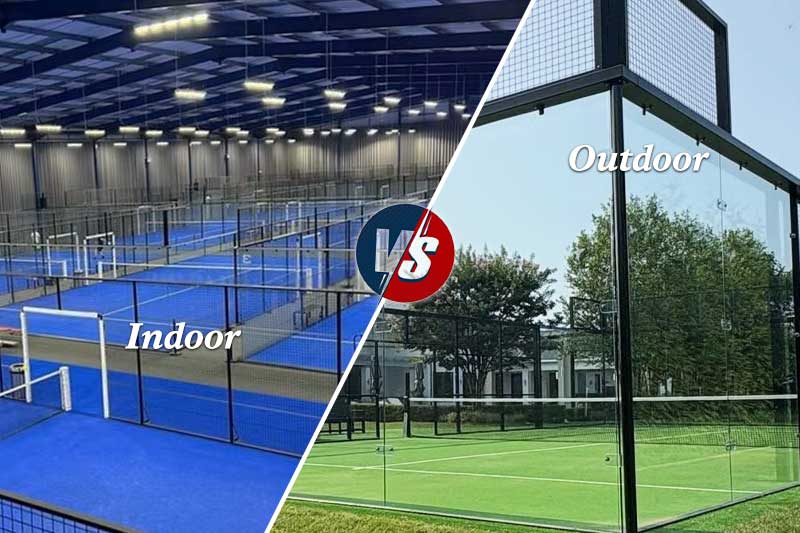
At first glance, the indoor padel court and outdoor padel court look almost identical. The court dimensions are the same, the glass walls are still in play, and artificial turf remains a common surface choice.
However, considering the climate and environment: wind changes the flight of a lob. Temperature influences how the ball feels off the racket and how the surface responds underfoot. Rain introduces moisture into the turf and infill system. Direct sunlight changes both visibility and surface temperature. Inside a controlled building, many of these variables disappear.
The court environment doesn’t just change the atmosphere of a match; it changes the physics of the ball, the pace of rallies, and the strategy players need to succeed. Understanding these differences can help players adapt their game and help club owners make smarter investment decisions.
Indoor vs. Outdoor Padel Courts: What Are the Differences?
Key Characteristics of Indoor Padel Courts
Indoor padel courts offer something outdoor courts simply cannot: consistency. Because temperature, humidity, and airflow are generally more controlled, indoor courts provide more consistent playing conditions.
- No wind interference — Lobs, smashes, and bandeja shots travel in predictable arcs, rewarding precision and technical skill.
- Stable temperature and humidity — The ball’s bounce stays consistent throughout a match, and even across different times of day or year.
- Artificial lighting — While this removes glare from direct sunlight, it can introduce its own challenges, such as shadows from structural beams or reflections off glass walls.
- Uniform flooring and surface wear — Without direct UV exposure and rainfall, indoor turf is generally less exposed to weather-related degradation. High-quality, purpose-built turf systems are engineered specifically for consistent ball response and reduced wear in these controlled environments.
- Acoustics — Enclosed spaces amplify sound, which can affect communication between doubles partners and overall focus.
Indoor courts tend to favor fast-paced, technical play, since players can trust that the ball’s trajectory won’t be disrupted by external forces.
Key Characteristics of Outdoor Padel Courts
Outdoor courts introduce a dynamic, ever-changing set of variables that players must read and adapt to in real time.
- Wind — Even light wind can dramatically alter the path of a lob or smash, forcing players to adjust timing and shot selection mid-match.
- Sun position and glare — Serving or hitting overhead shots against direct sunlight is a common challenge, especially during certain times of a sunny day.
- Temperature swings — Morning, midday, and evening play can feel like entirely different sports due to changing air and surface temperature.
- Humidity and precipitation — Moisture affects grip, ball weight, and surface traction; rain can suspend play entirely.
- UV exposure — UV exposure can gradually degrade turf fibers and weather-sensitive components of the court system. This is why choosing a UV-stabilized turf system, such as MightyGrass padel turf range, makes a measurable difference in court longevity and consistent ball bounce over years of sun exposure.
Outdoor play generally demands greater adaptability, situational awareness, and physical endurance, since players are competing against the court and the elements simultaneously.
| Faktor | Indoor | Udendørs |
| Turf specification priority | Playing consistency | Playing performance + climate resistance |
| Key turf considerations | Consistent ball response, wear resistance | UV resistance, drainage, moisture management, dimensional stability |
Indoor and outdoor padel can use the same fundamental type of playing surface, but the environmental demands placed on that surface are very different. This is why an outdoor padel court should not simply be treated as an indoor court without a roof.
How Climate Actually Affects the Ball
A padel ball’s performance is highly sensitive to environmental conditions, primarily because it’s a pressurized rubber sphere.
Temperature and Bounce
Warm conditions: Heat increases the internal pressure of the ball, making it more elastic and lively. Balls bounce higher and faster, which can speed up rallies and make defensive play more difficult.
Cold conditions: Lower temperatures cause the internal gas to contract, making the ball harder and less responsive. Bounces are lower and shots tend to lose pace, which can favor more controlled, patient play styles.
This is why many players notice their game “feels different” between a summer afternoon and a winter evening — the ball itself is behaving differently, not just the conditions around them.
Humidity and Surface Grip
Humid air causes the ball’s felt covering to absorb moisture, making it heavier and reducing bounce responsiveness. High humidity also affects the court surface, sometimes making it slicker and increasing the risk of slipping, particularly on kunstgræs.
Altitude
At higher altitudes, lower atmospheric pressure causes balls to travel faster and bounce higher, similar to the well-documented effect in tennis. Some manufacturers produce specific ball types (often labeled by pressure or altitude rating) to compensate for this — a detail worth considering for clubs located in mountainous regions.
Strategic and Technical Implications
The environmental differences between indoor and outdoor courts translate directly into different playing strategies:
| Faktor | Indoor Play | Outdoor Play |
| Shot predictability | Konsekvent | Variabel |
| Preferred style | Fast, technical, aggressive | Adaptive, patient, defensively aware |
| Physical demand | Consistent pace | Variable, often higher due to heat/wind |
| Equipment considerations | Konsekvent | More affected by heat and wind |
Players who train exclusively indoors often need an adjustment period before competing outdoors, and vice versa. Many competitive players intentionally practice in both environments to build versatility.

Considerations for Club Owners and Court Builders
For those investing in padel infrastructure, the indoor vs. outdoor decision carries real financial and operational weight.
- Construction costs: Indoor courts require a structural enclosure (roofing, climate control, lighting systems), significantly raising upfront investment compared to outdoor installations.
- Material durability: Outdoor courts need UV-resistant turf and tempered glass or acrylic panels rated for weather exposure, while indoor materials can prioritize acoustics and consistency over weather resistance. Choosing the right turf specification upfront — see MightyGrass padel court turf solutions — can significantly reduce long-term replacement costs.
- Climate suitability: In regions with extreme heat, heavy rainfall, or strong seasonal winds, indoor courts allow year-round bookings and more predictable revenue. In milder climates, outdoor courts offer lower build and maintenance costs.
- Maintenance: Outdoor courts require more frequent turf replacement, drainage upkeep, and glass cleaning due to weather exposure; indoor courts have lower material turnover but higher energy costs (climate control, lighting).
Indoor Padel vs. Outdoor Padel: Does the Turf Need to Be Different?
Not necessarily. There is no universal rule stating that every indoor padel court must use one turf specification while every outdoor court requires another.
A better approach is to start with the playing requirements and then adapt the turf system to the conditions of the site. Two courts may use the same basic yarn construction, for example, while the outdoor court may require higher UV resistance, more robust backing, or better drainage because it is exposed to sunlight and rainfall.
For example, a court in Lima, with its relatively dry coastal conditions, has different priorities from a court in a region with heavier rainfall. Likewise, courts at higher altitudes may face different playing conditions from those near sea level.
In other words, the right turf specification depends not simply on whether the court is indoors or outdoors, but on how and where the court will be used. Consider the following project conditions before selecting your turf:
| Project Condition | What to Pay Attention To |
| Hot and sunny climate | UV resistance, heat exposure, fiber durability |
| Heavy rainfall | Drainage, backing, sub-base and site drainage |
| Coastal environment | Moisture, corrosion around the court structure and turf maintenance |
| Cold climate | Temperature fluctuations, drainage and seasonal use |
| High-humidity climate | Moisture management and ventilation |
| Indoor climate-controlled facility | Consistent playing performance and wear resistance |
| Open-air commercial club | UV, rain, wind, infill stability and maintenance |
How MightyGrass Approaches Padel Turf
MightyGrass works with padel court builders, contractors, distributors and project buyers that need artificial turf for different playing environments.
MightyGrass as a leading Kinesisk producent af kunstgræs, we can work with you on more than pile appearance. Yarn construction, Dtex, gauge, backing, color, UV resistance and drainage performance can be considered according to the intended application.
If you are comparing padel turf suppliers, You can kontakt os now to request samples and a quote.
Final Takeaway
Indoor vs outdoor padel is ultimately a conversation about climate and consistency. The court dimensions do not suddenly change when you move outside. The FIP rules still define the requirements for the playing environment, and artificial grass remains one of the permitted court surfaces when it provides the required ball response.
Inside, the environment is more controlled. Outside, wind, sunlight, temperature and rain become part of the playing experience and part of the maintenance equation.
That is why outdoor padel turf needs more than good-looking fibers. It needs the right combination of playing performance, UV resistance, drainage, backing stability and durability for the climate where the court will operate.
Planning to build or upgrade a padel court? MightyGrass designs turf systems engineered specifically for indoor and outdoor padel — from UV-stabilized outdoor fibers to acoustically optimized indoor surfaces. Get a free consultation to find the right solution for your climate and court type.
FAQ
Does temperature really change how a padel ball bounces?
Yes. Heat increases the internal air pressure of the ball, making it bounce higher and travel faster. Cold air has the opposite effect, causing the ball to bounce lower and feel heavier off the racquet.
Is it harder to play padel outdoors than indoors?
Not necessarily harder, but outdoor padel requires more adaptability. Players must read wind, sunlight, and temperature changes in real time, while indoor conditions stay consistent throughout a match.
What type of turf is best for outdoor padel courts?
Outdoor courts need UV-stabilized, weather-resistant turf that won’t degrade quickly under sun and rain exposure. Indoor courts can use turf optimized more for consistent ball response and acoustics, since UV resistance is less critical.
Do professional padel players train differently indoors vs. outdoors?
Many competitive players intentionally practice in both environments. Indoor sessions help sharpen precision and technique, while outdoor sessions build the adaptability needed to handle climate change like the wind, glare, and temperature shifts in real match conditions.