Dansk
Dansk  English
  العربية
  Español
  Deutsch
  Français
  Português
  Русский
  日本語
日本語  Italiano
  Nederlands
  Svenska
  Suomi
Suomi  ไทย
ไทย  Ελληνικά
  Bahasa Melayu
When you start sourcing artificial grass, one of the first decisions you’ll face is:
Should you choose infill artificial grass, or go with artificial turf without infill?
At first glance, the difference may seem minor. In reality, it affects almost every part of your project—from installation and cost to maintenance and long-term performance.
You may have already come across questions like:
- What is infill artificial grass?
- Do you really need infill?
- Is no infill artificial grass a better option?
The answer depends on how and where you plan to use the turf.
For example, sports fields almost always rely on infill systems, while many modern landscaping projects are shifting toward non infill artificial grass for simplicity and cleaner results.
In this guide, you’ll get a clear breakdown of how each system works—and how to choose the right one for your project.
What Is Infill Artificial Grass?
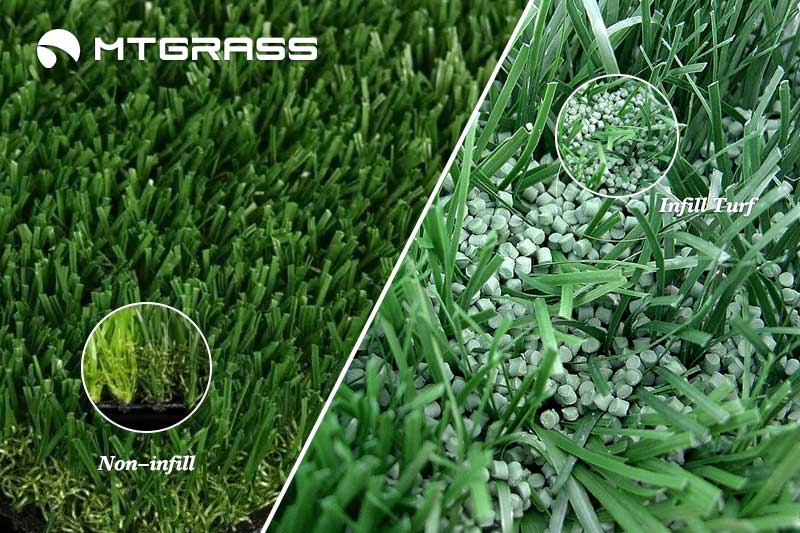
Infilled artificial turf, also known as 3G kunstgræs, is a traditional turf system that requires granular material to be filled between the synthetic grass fibers after the turf installation is complete. These materials, referred to as “artificial turf infill,” commonly include quartz sand, rubber granules, and organic granules.
The synthetic turf within this artificial grass system does not function in isolation; rather, it works in synergy with the infill material to collectively form a complete system.
If your supplier suggests something along the lines of, “requires 6–26 kg/m² of sand infill,” then what you are looking at is an infill-type artificial turf.
What Does Infill Do in Artificial Turf?
- Supports the grass fibers: Infill helps the fibers stay upright, which keeps the turf looking fuller and more natural over time. Without it, the surface may flatten faster, especially in frequently used areas.
- Adds weight and stability: Infill acts as a ballast layer, helping the turf stay in place. Particularly in large-scale outdoor paving projects, or in areas susceptible to strong winds or heavy foot traffic (high pedestrian load).
- Improves durability in high-use areas: Infill reduces friction at the base of the fibers, which can help extend the lifespan of the turf under heavy use.
- Provides cushioning for sports applications: For sports fields, infill is essential. It helps absorb impact and improves player comfort and safety.
What Is Non Infill Artificial Grass?
Non infill artificial turf known as “artificial turf without infill,” “no-infill artificial grass,” “non-infill synthetic turf” or “4G Turf”. It is designed to deliver exceptional performance without the addition of any sand or artificial turf infill materials.
This type of turf does not rely on infill materials; instead, it integrates structural characteristics directly into the turf—through methods such as higher fiber density, curled fibers or simulated thatch layers, modified fiber structures, and reinforced backing systems—to maintain the stable performance of the artificial turf system.
Why is this type of turf becoming more popular?
For many projects, especially landscaping, buyers are choosing no infill artificial grass for practical reasons.
- Simpler installation: no need to spread or brush infill materials
- Lower maintenance: no refilling or leveling over time
- Cleaner surface: no loose sand or particles
- The Ideal Choice for Multiple Settings: Residential Lawns, Rooftops and Balconies, Pet Areas, and Commercial Decorative Spaces.
If you prioritize aesthetic appeal and ease of maintenance, infill-free artificial turf often proves to be the more convenient solution.
Non Infill vs Infill Artificial Grass: Key Differences
When comparing infill artificial grass and non infill artificial grass, the main differences come down to how the system is built and how it performs over time.
- Installation
- Infill artificial grass: Requires additional steps to spread and brush sand or rubber
- Non infill artificial grass: Installed directly without extra materials, making the process faster
- Opretholdelse
- Infill systems: May require periodic refilling and surface leveling
- No infill artificial turf: Generally easier to maintain with no material loss
- Præstation
- Infill artificial grass: Better suited for high-traffic or sports applications
- Non infill synthetic turf: Ideal for landscaping and light to medium use
- Renlighed
- Sand infill systems: Loose particles can sometimes spread outside the installation area
- Artificial turf without infill: Provides a cleaner surface, especially for residential use
- Cost Consideration
- Infill turf: Lower initial artificial turf cost, but additional material and labor required
- Non infill turf: Higher artificial turf costs, but simpler installation and fewer extras
Simple way to decide: Choose infill artificial grass if your project or market requires durability and performance (especially for sports). Choose non infill artificial grass if you want a cleaner, low-maintenance solution for landscaping
Pros and Cons of Infill Artificial Grass
If you are considering infill artificial grass, it’s important to look beyond the surface and understand how it performs over time.
- Fordele
- Better performance in high-traffic areas: Infill systems are designed to handle frequent use. If your project involves sports or heavy foot traffic, this added support makes a noticeable difference.
- Improved stability: The added weight from sand infill helps keep the turf in place, especially in large outdoor installations.
- Longer lifespan under heavy use: Because infill reduces stress on the fibers, the turf tends to perform more consistently over time in demanding environments.
- Essential for sports applications: For football fields, training grounds, or multi-sport areas, it’s part of the system.
- Ulemper
- More complex installation: You’ll need additional steps such as spreading and brushing infill, which increases labor and time.
- Ongoing maintenance: Over time, infill can shift or settle, meaning you may need to refill or level the surface.
- Less clean surface: Loose particles (especially sand) can sometimes move outside the turf area, which may not be ideal for residential use.
In short: Infill artificial grass is built for performance and durability, but it comes with more operational effort.
Pros and Cons of Non Infill Artificial Grass
Non infill artificial grass offers a different approach, simplifying the system while focusing on convenience and appearance.
- Fordele
- Easier and faster installation: Without the need for sand or rubber, installation becomes more straightforward and efficient.
- Low maintenance: There’s no infill to refill, redistribute, or manage over time.
- Cleaner user experience: You don’t have to worry about sand being tracked into indoor spaces or surrounding areas.
- Ideal for residential and decorative use: For landscaping projects, non infill turf often provides a more practical solution.
- Ulemper
- Less suitable for heavy use: Without infill support, the turf may not perform as well in high-traffic or high-impact environments.
- Limited cushioning: For sports or activities that require shock absorption, non infill systems may not provide enough support.
Which One Should You Choose? (By Application)
Landscaping / Bolig
If your project primarily involves settings such as home gardens, villas, residential lawns, rooftops, balconies, or pet activity areas, non-infill artificial turf is typically the superior choice. This is due to its distinct advantages, including easier installation, a cleaner surface appearance, and minimal maintenance requirements following installation. Consequently, many modern landscaping projects are increasingly shifting toward the use of non-infill artificial grass.
Sports Fields
Applications for sports venues require excellent shock absorption, a stable surface structure, and consistent athletic performance; therefore, infill artificial turf serves as the standard solution.
Indoor Artificial Grass Field
If your project involves indoor sports facilities—such as five-a-side soccer fields, training centers, or school gymnasiums—traditional or older venues typically still require the use of infill-based systems. However, based on research and performance data from MightyGrass indoor sports fields, opting for non infill artificial turf presents an alternative cost-effective solution, particularly for venues characterized by controlled usage and moderate foot traffic. MightyGrass indoor artificial turf can help you reduce maintenance costs while simultaneously maintaining professional-grade performance.
Outdoor Artificial Grass Field
If your project involves the design of outdoor soccer fields, rugby pitches, or multi-purpose sports grounds, infill artificial turf is the preferred professional solution. Furthermore, FIFA has established clear specifications for “3G turf”—covering every detail of both the artificial grass and the infill material—to ensure that critical performance metrics (such as shock absorption, ball roll characteristics, and surface stability) meet the required standards, thereby delivering a playing experience comparable to that of natural grass.
Kommerciel & Public Areas
For commercial projects—such as shopping malls, public landscaped areas, office buildings, and exhibition spaces—your specific choice of artificial turf should be determined by the volume of foot traffic in the area.
If your primary consideration is visual aesthetics, the foot traffic is light to moderate, and you require minimal maintenance, please select non-infill artificial turf. Conversely, you may opt for infill or low-infill artificial turf.
Summary: Landscaping or decorative use → non infill artificial grass; Sports or high-impact use → infill artificial grass; Mixed-use commercial areas → choose based on traffic intensity.
Why More Buyers Are Choosing Non Infill Turf Today
The growing demand for non infill artificial grass is not a coincidence—it reflects a shift in buyer priorities across the landscaping market. If your target market focuses on landscaping, residential, or retail channels, non infill artificial grass can significantly improve your product competitiveness.
| Key Driver | Forklaring | Hvad det betyder for købere |
| Rising Labor Costs | Infill artificial grass requires additional steps like material handling, spreading, and brushing, which increases installation time and labor intensity. | Lower installation complexity helps you save time and reduce labor costs. |
| Changing Maintenance Expectations | End users prefer solutions that are easy to maintain, clean, and consistent over time. Non infill turf avoids issues like infill displacement and uneven surfaces. | You can offer a product that delivers low maintenance and long-term consistency. |
| Cleaner & User-Friendly Surface | In applications such as residential lawns, pet areas, schools, and playgrounds, cleanliness is a key concern. Non infill turf eliminates loose particles. | Provides a cleaner, safer, and more user-friendly experience for end users. |
| Growth of DIY & Retail Markets | The rise of DIY installations, e-commerce, and small contractors favors products that are easy to transport and install. | Non infill systems are easier to sell, ship, and install, making them ideal for scalable markets. |
How to Choose a Reliable Artificial Turf Supplier?
No matter which system you choose—infill or non infill—the supplier you work with will directly impact your results. Here’s how you can evaluate a supplier more effectively.
- Check if they are a real manufacturer
- Look at production capabilities
- Verify certifications
- Evaluate customization support
- Check export experience
A reliable artificial turf supplier is not just a seller—but a long-term partner who can deliver certified quality, consistent performance, and dependable service.
Why Choose MightyGrass for Infill and Non Infill Artificial Turf?
If you are looking for a supplier that can support both infill artificial grass systems and non infill artificial grass solutions, working with an experienced manufacturer makes a clear difference.
Factory experience since 2003
With over 20 years of manufacturing experience, you get consistent product quality and a deep understanding of different project requirements.
Fully integrated production system
From yarn extrusion to tufting and backing, everything is produced in-house. This allows you to maintain stable quality, shorten lead times, customize products more efficiently
Solutions for both infill and non infill systems
Whether your project requires silica sand or rubber infill systems (for sports), or non infill artificial grass (for landscaping and commercial use) you can get tailored solutions based on your application.
Holds Authoritative Certification
MightyGrass products meet international standards, including FIFA-certified turf systems, SGS, ISO, and CE certifications. This ensures compliance across different markets.
Global supply capability
With export experience across 166 countries and regions, and a California warehouse, you can benefit from more flexible logistics and faster delivery options.
You’re not just buying artificial grass—you’re working with a partner who understands how to support your business, from product selection to final delivery. Contact our professional team today to customize a synthetic turf system tailored to your market, along with factory-direct pricing.
Konklusion
Choosing between infill artificial grass and non infill artificial grass is not about which one is better—it’s about which one fits your project.
If your priority is performance, durability, and sports use, infill systems remain the standard solution.
If your focus is low maintenance, clean appearance, and easier installation, non infill artificial grass is often the better choice.
If you are planning to source artificial grass and are not sure which system fits your project, you can contact MightyGrass for tailored recommendations based on your specific requirements.
FAQ
How Much Infill for Artificial Grass?
The answer depends on your turf specifications and application, but there are general guidelines you can use. We provide the following references based on MightyGrass’s actual FIFA turf project case studies.
| Vare | MT-Ubest (40 mm) | MT-Ubest (50 mm) | MT-Diamond (60 mm) |
| Pælehøjde | 40 mm | 50 mm | 60 mm |
| Tæthed | 12,600 stitches/m² | 10,500 stitches/m² | 12,600 stitches/m² |
| DTEX | 10,000 / 4F | 10,000 / 4F | 10,000 / 6F |
| Fyld med kiselsand | 20 kg/m² | 26 kg/m² | 10 kg/m² |
| Rubber Infill Quantity | 6 kg/m² | 6 kg/m² | 15 kg/m² |
What are the different types of infill for artificial turf?
Many options exist for artificial grass infill. Each one has its own unique qualities, pros, and cons. While choosing, bear in mind what your purpose is, your needs, and the qualities you’ll need from your turf.
| Artificial Grass Infill Types | Beskrivelse | Known For |
| Coated Sand | Made from a mix of natural and synthetic materials, usually polymer-coated sand. | Durable, consistent performance, reusable, antimicrobial, non-toxic, environmentally friendly. |
| Organic | Made from natural materials like walnut shells, cork, and coconut blends. For example, Safeshell. | All-natural, free of chemicals, compostable, low maintenance, reduces surface temperature. |
| Crumb Rubber | Made from ground-up car and truck tires combined with raw silica sand. | Inexpensive and readily available. But abrasive, heat-retaining and potentially toxic. |
| Raw Silica Sand | Finely ground quartz, traditional infill material. | Cost-effective, widely available. However, dusty, prone to compaction, and notorious for hardening over time. |
| Virgin Polymer (EPDM & TPE) | Made from selected components, specifically for athletic surfaces. | Resilient, consistent, and can be modified for enhanced performance. However, it’s more expensive and rife with quality-control issues. |