
 Français
  English
  العربية
  Español
  Deutsch
  Português
  Русский
  日本語
日本語  Italiano
  Nederlands
  Svenska
  Suomi
Suomi  ไทย
ไทย  Dansk
Dansk  Ελληνικά
  Bahasa Melayu

Si vous avez déjà réservé une partie de « football à 5 » pour vous retrouver sur un terrain dur équipé de panneaux de rebond fixés aux murs et avec un ballon qui rebondit à peine, vous avez déjà été confronté à la confusion que cet article va dissiper. On entend souvent ces deux termes utilisés de manière interchangeable dans le langage courant, mais le football à 5 et le futsal sont régis par des règlements différents, se jouent sur des surfaces différentes et — si vous êtes chargé de définir les spécifications ou de construire l’installation — nécessitent deux systèmes de gazon synthétique véritablement distincts.
Que vous soyez un promoteur immobilier chargé de définir les grandes lignes d’une nouvelle salle omnisports, un entrepreneur chargé d’établir un devis pour la rénovation des installations sportives d’une école, ou encore le propriétaire d’un club cherchant à déterminer quel type de terrain s’adaptera le mieux à l’espace dont vous disposez, ce guide vous explique en détail ce qui distingue ces deux disciplines et ce que cela implique pour la surface sur laquelle évoluent vos joueurs.
Qu'est-ce que le football à 5 ?
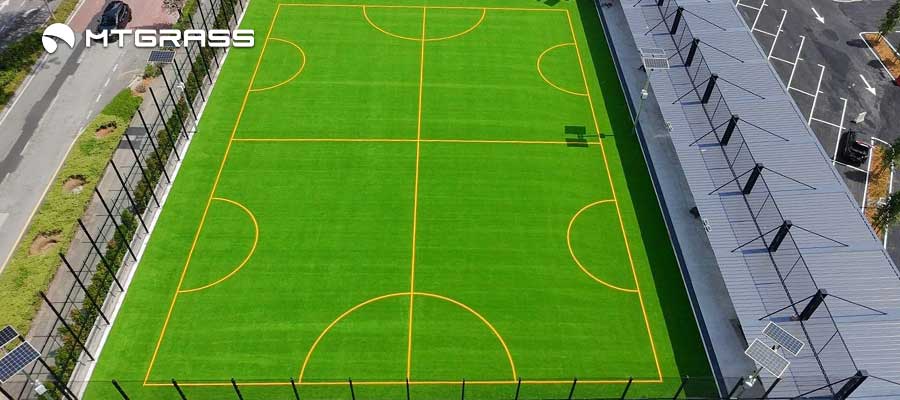
Le football à 5 est une variante du football à effectif réduit : il s'agit du même sport que celui que vous regardez le samedi après-midi, mais en version réduite à cinq joueurs par équipe (gardien compris) et disputé sur un terrain plus petit. Les dimensions recommandées par la FA pour un terrain de football à 5 sont de 40 x 30 yards (36,5 m x 27,5 m), avec des buts mesurant 3,66 m de large sur 1,22 m de haut. On utilise généralement le même ballon de taille 5 que pour le football à 11, des surfaces de réparation courbes au lieu d’une surface rectangulaire et, selon la ligue, une ligne médiane et un cercle central facultatifs.
Le football à 5 se joue presque toujours sur gazon synthétique, et non sur un terrain en dur. On le retrouve sur les terrains synthétiques 3G/4G en plein air, dans les salles de football couvertes et sur les surfaces en gazon synthétique des centres de loisirs. La surface se comporte comme une version réduite d'un véritable terrain de football : le ballon roule, rebondit et adhère comme il le ferait sur un terrain de football à 11, mais dans un espace plus restreint.
Qu'est-ce que le futsal ?
Le futsal (de l'espagnol « fútbol sala ») est la variante à effectifs réduits officiellement reconnue par la FIFA ; il repose sur un ensemble de règles totalement différent. Il oppose également cinq joueurs par équipe sur le terrain, mais celui-ci est plus petit et plus dur : la norme de la FIFA est de 40 m x 20 m, avec une fourchette internationale acceptée d’environ 38 à 42 m de long sur 20 à 25 m de large. Les buts mesurent 3 m de large sur 2 m de haut, ce qui les rend nettement plus hauts et plus étroits que ceux du football à 5.
C'est au niveau du ballon que le futsal se distingue véritablement. Au lieu d'un ballon de football standard de taille 5, le futsal utilise un ballon de taille 4 pesant entre 400 et 440 g, dont le rebond est considérablement réduit — spécialement conçu pour rester au ras du sol et favoriser le contrôle précis du ballon sur une surface dure et plane. Cette surface est traditionnellement constituée de parquet à ressorts ou d’un revêtement sportif en polyuréthane, bien qu’un nombre croissant d’installations utilisent désormais un revêtement à poils courts, gazon artificiel sans remplissage pour obtenir un roulement de balle bas et rapide, à la manière du futsal, tout en conservant le faible coût et la facilité d'entretien d'un revêtement synthétique.
Que vous développiez un complexe sportif communal, un terrain d'entraînement scolaire ou un stade de football professionnel, le choix du gazon adapté ne représente qu'une partie du projet. Les dimensions du terrain, la construction de la couche de fondation, le drainage, les méthodes de pose et la planification budgétaire jouent tous un rôle important. Pour en savoir plus, consultez notre guide complet Guide sur les mini-terrains de football : conception, coût et installation.
Les principales différences entre le football à 5 et le futsal
Environnement de jeu
Le football à 5 offre une grande flexibilité quant au lieu où il est pratiqué : terrains extérieurs de type 3G/4G, salles couvertes, gymnases réaménagés, etc. Le futsal, en revanche, a été conçu dès le départ pour être pratiqué en salle et se joue presque toujours sur un terrain fixe et clos, avec une hauteur sous plafond minimale d’environ 4 mètres selon les règles de la FIFA. Si vous développez un complexe polyvalent en salle, cette distinction est importante pour déterminer la hauteur d’éclairage, planifier le système de chauffage, de ventilation et de climatisation, et calculer la hauteur sous plafond, avant même d’aborder la question du revêtement de sol.
Disposition des emplacements
| Football à 5 | Futsal | |
| Longueur x Largeur | 36,5 m x 27,5 m (40 x 30 yards) | 40 m x 20 m (normes de la FIFA) |
| Rapport longueur/largeur | Environ 4:3 | Environ 2 pour 1 |
| Forme de la surface de réparation | Courbe (rayon de 6 m à partir du centre du but) | Deux quarts de cercle de 6 m reliés par une ligne de 3,16 m |
| Rayon du cercle central | 3 m (souvent en option) | 3 m (obligatoire) |
Le terrain de futsal est proportionnellement plus étroit et plus long qu'un terrain de football à 5, ce qui explique en partie pourquoi les deux ne sont pas interchangeables, même si leur superficie semble similaire sur le papier : un terrain construit selon les proportions du futsal paraîtra exigu à des joueurs de football à 5 habitués à un terrain plus large, et inversement.
Choix du gazon et du revêtement
C'est là que les deux formats divergent véritablement d'un point de vue structurel.
Les terrains de football à 5 sont aménagés avec du gazon synthétique à poils longs, généralement compris entre 40 mm et 60 mm, rempli de sable de silice et de granulés de caoutchouc (SBR, TPE ou EPDM) afin de maintenir les fibres à la verticale, de contrôler le roulement du ballon et d’assurer l’absorption des chocs. Ce gazon est conçu pour reproduire les caractéristiques de déplacement du ballon sur une surface en gazon naturel, mais sur une surface plus petite—Gazon synthétique MightyGrass certifié par la FIFA La gamme, qui comprend notamment le système 50 mm, 5/8″, composé d’un fil monofilament de 10 000 Dtex et offrant une densité de 10 500 points par mètre carré, est l’un des produits les plus souvent choisis par les entrepreneurs professionnels pour la réalisation de terrains de sport hautement performants.
Le futsal pose un autre type de défi technique. Ce sport nécessitant une surface dure, plane et à faible rebond, les terrains de futsal sont généralement recouverts de parquet à ressorts ou d’un revêtement sportif en PU. Lorsqu’une solution en gazon synthétique est privilégiée — pour des raisons de coût, de rapidité d’installation ou de polyvalence multisports —, un système de gazon synthétique à poils courts (environ 20 mm à 35 mm), dense et sans remplissage constitue la solution la plus adaptée, car elle évite le remplissage en vrac qui ralentirait trop le ballon et gênerait le jeu de passes rapide et ras du sol caractéristique du futsal. La gamme de gazon de football sans remplissage de MightyGrass a été développée précisément pour ce type de terrain compact, nécessitant peu d’entretien et polyvalent.
Différences au niveau des installations et des équipements
La taille des buts est l'indice le plus évident dès lors que l'on sait ce qu'il faut rechercher. Un but de futsal mesure 3,66 m de large et seulement 1,22 m de haut : bas et large, il est conçu en fonction du comportement du ballon dans le football à 11. Un but de futsal mesure 3 m de large et 2 m de haut : plus étroit mais nettement plus haut, ce qui modifie considérablement les angles de tir et le positionnement du gardien. Le choix du ballon suit la même logique : le football à 5 utilise un ballon de taille 5 standard, tandis que le futsal utilise un ballon de taille 4, plus petit, plus lourd et à rebond réduit, conçu pour les parquets durs.
Règles et durée des matchs
Les championnats de football à 5 se déroulent généralement selon un format informel à chronomètre continu, souvent en deux mi-temps de 20 minutes (40 minutes au total), le chronomètre ne s'arrêtant jamais, quelles que soient les interruptions — un format plus proche, dans l'esprit, du chronométrage du football classique, mais condensé. Le futsal, en revanche, se joue en deux mi-temps de 20 minutes avec un chronomètre arrêté, conformément aux règles officielles de la FIFA : le chronomètre s’arrête chaque fois que le ballon sort du terrain ou que l’arbitre interrompt le jeu, et chaque équipe dispose d’un temps mort d’une minute par mi-temps. Dans la pratique, un match de futsal de « 40 minutes » dure souvent près d’une heure en temps réel une fois pris en compte tous les arrêts de jeu — un détail qu’il est bon de connaître si vous programmez des réservations consécutives sur un terrain commercial.
Le futsal ne connaît pas non plus la règle du hors-jeu, utilise des remises en jeu au lieu des remises en touche, impose aux gardiens de but une limite stricte de quatre secondes pour la possession du ballon et applique une règle de fautes cumulées dès que cinq fautes d'équipe ont été commises au cours d'une mi-temps. Les règles du football à 5 varient davantage selon les ligues, mais restent généralement plus proches des conventions du football classique.
Considérations relatives à la construction
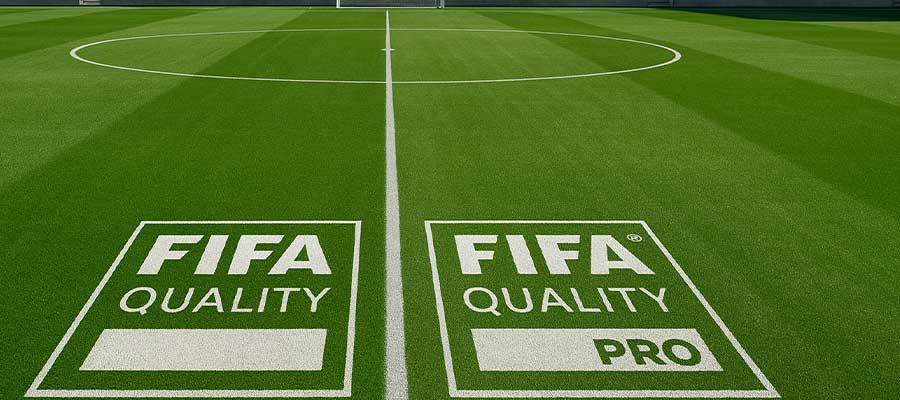
Pour un terrain de football à 5, vous devez mettre en place un système complet de gazon synthétique : une couche de fondation compactée (150 mm à 200 mm de gravier, d’asphalte ou de béton), une membrane géotextile perméable, une couche amortissante facultative pour la sécurité des joueurs et la conformité aux normes de qualité de la FIFA, ainsi qu’une couche de sable de stabilisation nivelée au laser avant la pose du gazon proprement dite. Le drainage est ici essentiel : la sous-couche du gazon de football MightyGrass est conçue pour offrir une perméabilité élevée, dépassant largement le seuil minimal de drainage exigé par la FIFA, condition incontournable pour toute installation en extérieur.
La construction d’un terrain de futsal est un tout autre défi. En effet, bien que le terrain soit clos et généralement situé en intérieur, les tolérances de planéité du sous-plancher sont bien plus strictes : la vitesse et le roulement bas du ballon en futsal mettront en évidence même les plus petites irrégularités de surface qui passeraient inaperçues sur un terrain de football à 5 à poils longs. Si vous optez pour un revêtement synthétique plutôt que pour un parquet à ressorts, vous devrez choisir un système plus fin, plus dense et sans remplissage, collé sur un support stable et parfaitement plat, ainsi qu'un rembourrage mural renforcé et des panneaux de rebond tout autour du terrain.
Exigences en matière d'entretien
Si vous optez pour du gazon synthétique pour ces deux types de terrains, les coûts d’entretien sont inférieurs à ceux du gazon naturel, mais les méthodes d’entretien diffèrent. Le gazon synthétique avec remplissage pour le 5-à-5 nécessite un brossage mécanique régulier afin de maintenir les fibres dressées et de redistribuer le remplissage, ainsi qu’un appoint annuel de remplissage et un nettoyage en profondeur pour préserver les performances de drainage. Le gazon de type futsal sans remplissage évite totalement l’entretien lié au remplissage — il n’y a ni sable ni caoutchouc à rajouter — mais comme l’aplatissement des fibres de gazon peut devenir visible pendant le match, il est nécessaire de brosser régulièrement la surface et d’éliminer les débris afin de maintenir la régularité du roulement du ballon.
Comment choisir la solution de gazon synthétique la mieux adaptée ?
Lorsqu’on compare le football à 5 contre 5 et le futsal, la principale différence réside dans la conception générale du site où se déroule la compétition. Le choix du format de jeu a une incidence sur :
- Dimensions du terrain
- Exigences en matière de construction
- Choix du matériel
- Planification de la maintenance
- Caractéristiques techniques du gazon synthétique
Que vous construisiez un centre de football commercial, un complexe sportif communautaire ou un centre d'entraînement professionnel, le choix du bon fabricant de gazon synthétique peut faire toute la différence pour la réussite à long terme de votre projet.
MightyGrass propose des solutions sur mesure de gazon synthétique pour les installations de football du monde entier, notamment du gazon de qualité FIFA, des terrains de loisirs et des systèmes spécialisés de gazon synthétique.
Fort de son expérience dans la fabrication de gazons synthétiques pour le sport, le développement de produits et l'accompagnement de projets à l'échelle mondiale, MightyGrass collabore avec des distributeurs, des entrepreneurs et des propriétaires d'installations afin de créer des surfaces de football durables, conçues pour offrir des performances optimales en conditions réelles.
Si vous envisagez d'aménager un terrain de football à 5 ou une installation de futsal, contactez MightyGrass pour discuter de la solution de gazon synthétique la mieux adaptée à votre projet. Demandez un devis gratuit ou consultez notre Gazon de football gamme de produits pour trouver une fiche technique adaptée à votre argumentaire.
FAQ
Peut-on jouer au futsal sur du gazon artificiel ?
Le futsal est conçu pour être pratiqué sur une surface dure et plane — traditionnellement un parquet à ressorts ou un revêtement sportif en PU — car le ballon à faible rebond et le jeu de passes rapides s’appuient sur cette réactivité de la surface. Les instances dirigeantes, notamment la FA, soulignent que le gazon naturel ou le gazon synthétique standard ralentissent sensiblement le jeu, et ne les recommandent que lorsqu’il n’existe pas d’installation couverte dotée d’un sol dur. C'est le cas, par exemple, des terrains scolaires polyvalents, des installations communautaires ou des ligues de loisirs : un gazon de football à poils courts et sans remplissage se rapproche davantage du roulement rapide et bas du ballon propre au futsal qu'un gazon sportif standard avec remplissage, tout en restant plus facile à installer et à entretenir qu'un revêtement à suspension. La gamme de gazon de football sans remplissage de MightyGrass a été développée précisément pour ce type de terrain compact et multisports.
Qu'est-ce qui est le plus difficile : le futsal ou le football à 5 ?
Il n’y a pas de réponse universelle : ces deux formats exigent tout simplement des compétences différentes. Le terrain plus étroit et le ballon à rebond réduit du futsal privilégient le contrôle précis du ballon, les passes rapides en une touche et une grande maîtrise technique dans un espace restreint. Le terrain plus large et le ballon de football standard du 5-à-5 rapprochent davantage ce sport du football traditionnel, favorisant la vitesse, des lignes de passe plus larges et des schémas tactiques plus familiers.
Faut-il des chaussures différentes pour le football à 5 et le futsal ?
Pour le futsal, qui se pratique généralement sur un terrain intérieur dur et plat, les chaussures de salle à semelle plate dotées d’une semelle extérieure en caoutchouc non marquante constituent le meilleur choix. Elles offrent l’adhérence nécessaire aux mouvements rapides tout en évitant une traction excessive qui pourrait augmenter le risque de blessure.
Pour le football à 5 pratiqué sur gazon artificiel, il est recommandé de porter des chaussures de gazon artificiel ou des crampons AG (Artificial Ground). Leurs crampons courts et densément répartis sont spécialement conçus pour offrir une adhérence équilibrée sur le gazon synthétique tout en limitant l'usure excessive de la surface. Les chaussures de football traditionnelles et les chaussures de futsal ne sont pas adaptées, car elles risquent de ne pas offrir le niveau adéquat d'adhérence ou de stabilité.
En fin de compte, c'est la surface de jeu qui détermine le type de chaussures dont vous avez besoin — et choisir les bonnes chaussures permet d'améliorer vos performances tout en préservant la qualité et la durée de vie de la surface sportive.


