Français
  English
  العربية
  Español
  Deutsch
  Português
  Русский
  日本語
日本語  Italiano
  Nederlands
  Svenska
  Suomi
Suomi  ไทย
ไทย  Dansk
Dansk  Ελληνικά
  Bahasa Melayu
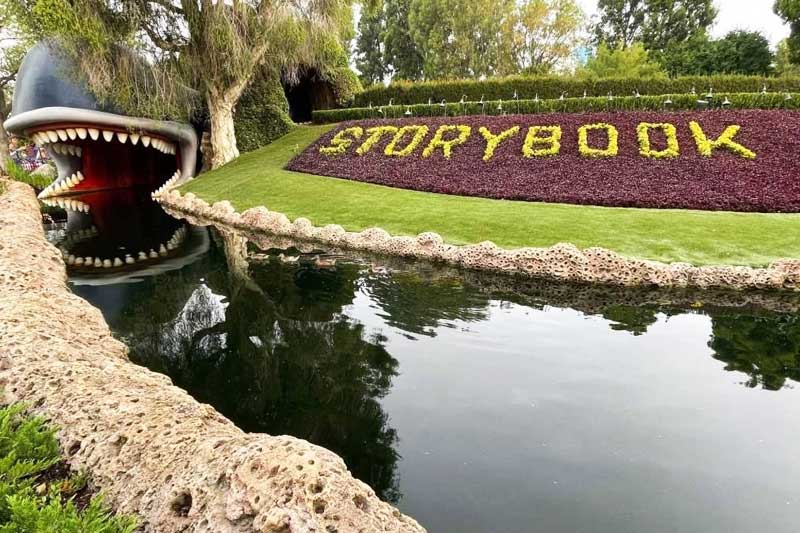
Most people think Disneyland relies on natural grass, but in reality, many high-traffic areas across Disneyland Resort and Walt Disney World already use synthetic turf.
Why?
Because natural lawns fail under real-world conditions:
- Heavy foot traffic quickly damages grass
- Irrigation and maintenance costs keep rising
- Seasonal changes affect visual consistency
For theme parks and commercial landscapes, these issues directly impact operational costs and visitor experience.
That’s why more developers are turning to synthetic grass for theme parks—to achieve durability, water savings, and year-round aesthetics.
In this guide, you’ll learn how Disneyland applies gazon artificiel, and hope to assist you in applying the successful principles of Disney theme parks to your own projects.
Disney’s Global Theme Park Network and Landscape Standards
When you evaluate artificial grass for a commercial project, few benchmarks are more convincing than Disney.
Across the globe, Disney operates one of the most complex and high-standard theme park systems in the world—spanning the United States, Europe, and Asia. From Walt Disney World to Disneyland Resort, and from Tokyo Disney Resort to Shanghai Disney Resort, every park is designed to deliver a flawless, immersive guest experience—365 days a year.
Behind this consistency is one critical organization: Walt Disney Imagineering.
This team is responsible for everything from storytelling and architecture to landscape material selection. And for them, “grass” is not just decoration—it’s part of the experience design.
That means every landscape surface must meet three non-negotiable standards:
- Visual perfection — lawns must look “camera-ready” every single day
- Durability under pressure — millions of annual visitors, constant foot traffic
- Operational efficiency — minimal maintenance disruptions in high-revenue areas
This is exactly why traditional natural grass often falls short.
In high-traffic, high-visibility zones, even the best-maintained natural turf cannot consistently meet these requirements. Seasonal browning, mud patches, irrigation downtime, and repair closures all conflict with Disney’s operational model.
And this is where artificial turf starts to become not just an option, but a strategic choice.
Disney Theme Park Operating Structure
Disney currently operates resort complexes in six regions worldwide: Disneyland Resort in California (USA), Walt Disney World Resort in Florida (USA), Disneyland Paris (France), Tokyo Disney Resort (Japan), Hong Kong Disneyland, and Shanghai Disney Resort—totaling 12 theme parks.
The 7th Resort is Currently Under Construction: In May 2025, The Walt Disney Company signed an agreement with Abu Dhabi’s Miral Group to construct Disney’s seventh resort complex on Yas Island in Abu Dhabi, UAE. This project marks Disney’s first theme park in the Middle East, with its opening currently projected to take place between 2030 and 2033.
| Resort | Location | Number of Theme Parks | Operating Entity |
| Walt Disney World | Orlando, Florida, USA | 4 (Magic Kingdom, EPCOT, Animal Kingdom, Hollywood Studios) | Operated directly by Disney |
| Disneyland Resort | Anaheim, California, USA | 2 (Disneyland, California Adventure) | Operated directly by Disney |
| Tokyo Disney Resort | Chiba, Japan | 2 (Tokyo Disneyland, Tokyo DisneySea) | Operated under license by Oriental Land Company |
| Disneyland Paris | Paris, France | 2 (Disneyland Park, Walt Disney Studios Park) | Operated directly by Disney |
| Hong Kong Disneyland | Hong Kong, China | 1 | Joint venture: Disney (48%) + Hong Kong Government (52%) |
| Shanghai Disney Resort | Shanghai, China | 1 | Joint venture: Disney (43%) + Shanghai Shendi Group (57%) |
| Abu Dhabi Disney (under development) | Yas Island, UAE | Planned | Operated under license by Miral Group |
Core Design and Construction Entity: Walt Disney Imagineering is the research and development division of Disney responsible for the creative design and construction of the company’s theme parks worldwide. Headquartered in Glendale, California, it is comprised of a team of professionals including architects, engineers, lighting designers, and creative writers.
Where Disneyland Uses Artificial Turf?
Disney’s adoption of artificial turf is not theoretical—it’s already implemented in some of the most demanding areas inside its parks.
Case 1: Disneyland California — Largest Scale, Continuous Expansion (2012–Present)
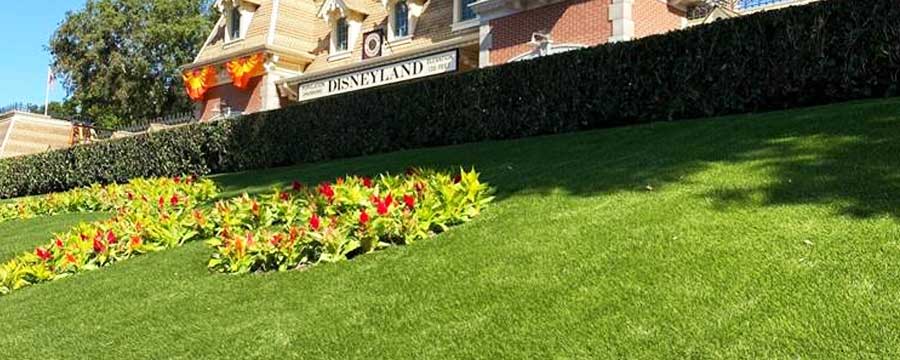
At Disneyland Resort, artificial turf has been gradually introduced and expanded since 2012—starting with one of the busiest themed areas in the park: Cars Land.
Key application areas include:
- Queue zones (e.g., Luigi’s Rollickin’ Roadsters) where constant foot traffic destroys natural grass
- Retail and dining fronts such as Sarge’s Surplus Hut and Flo’s V8 Cafe
- Iconic visual landmarks, including the Mickey floral display at the park entrance
- The Haunted Mansion front lawn, a highly photographed guest area
One of the most notable upgrades took place in 2022, when Disney—as part of a water-conservation initiative—replaced natural turf with artificial turf in several prominent areas.
A standout example is the Storybook Land Canal area:
- Turf replacement completed in just 3 days
- Estimated 81,000 gallons of water saved annually
Even more important than speed or sustainability is the design detail:
Disney didn’t use a single “green” turf.
Instead, they applied custom-blended artificial grass, mixing:
- Green fibers
- Brown tones
- Beige and gray shades
The result: a more natural, slightly “imperfect” look that matches real-world landscapes—while maintaining full performance.
Case 2: Walt Disney World, Florida — Magic Kingdom: Central Plaza
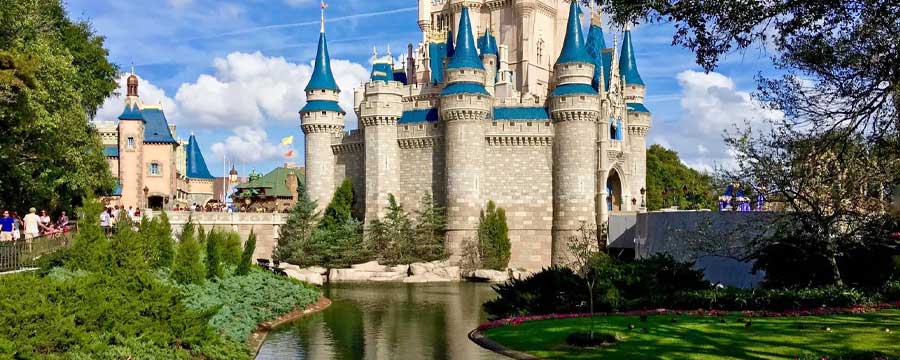
At Magic Kingdom, artificial turf was installed in one of the most critical locations in the entire Disney ecosystem: the Central Plaza (the main hub in front of Cinderella Castle).
This is not just a landscape area—it is:
- The first impression zone for visitors
- A primary photo location
- One of the highest foot-traffic areas in any theme park worldwide
The installation included:
- Approximately 13,000 square feet of artificial turf
- Integration with 350 artificial shrubs and 55 artificial trees
This decision sends a strong signal to commercial buyers: If artificial turf can perform in the most visible, most demanding, and most photographed area of Disney—
it is more than capable of handling any commercial landscape project.
Artificial turf is used not in secondary areas, but in mission-critical zones. It is chosen not for cost savings alone, but for performance, consistency, and control. “For your specific project, have you selected the most appropriate and suitable type of artificial turf?” However MightyGrass premium artificial turf is not an off-the-shelf, generic product, but rather an engineered solution custom-tailored for your theme park or landscaping project.
Why Did Disney Replace Natural Grass with Artificial Turf?
If you look beyond the surface, Disney’s decision isn’t about aesthetics—it’s about solving operational challenges that natural grass simply cannot handle at scale.
1. Water Conservation in Drought Regions
In places like California, water is not just a resource—it’s a regulated cost.
By replacing natural grass with artificial turf in key areas, Disney significantly reduced irrigation needs.
One small area alone (Storybook Land) saves over 81,000 gallons of water per year.
For commercial projects, this translates directly into:
- Lower utility costs
- Reduced dependency on irrigation systems
- Compliance with local water restrictions
If your project is located in a region prone to drought—or where water usage is strictly regulated by policy—artificial turf has evolved from an “optional choice” into an “essential standard.”
2. Extreme Foot Traffic Durability
Theme parks represent one of the harshest environments for any landscape surface:
- Constant foot traffic
- Queue congestion
- Seasonal peak surges
Natural grass cannot recover fast enough under this pressure.
The result?
Balding patches and bare spots on the lawn, muddy ground conditions, and potential safety hazards—artificial turf puts a definitive end to this vicious cycle.
3. 365-Day Perfect Appearance
Disney doesn’t operate on “good enough.”
Every lawn, every corner, every visual element must support a fully immersive experience—every day of the year.
Natural grass introduces variability:
- Seasonal color changes
- Weather damage
- Uneven growth
Artificial turf delivers:
- Consistent color
- Uniform texture
- Zero seasonal downtime
For the commercial environments of high-end theme parks or resorts, “consistency” is not an optional extra—it is, in itself, an integral part of the “product” you deliver.
What Kind of Artificial Turf Meets Theme Park Standards?
Not all artificial grass is suitable for theme parks.
Disney-level applications require engineering-grade gazon pour terrains de jeux solutions. Should possess:
- Premium raw materials → Brand-new materials, ensure long-lasting performance and fiber integrity
- Multi-color blended yarns → Natural look (green + brown + beige tones etc.)
- High density & stitch rate → Better durability in high-traffic areas
- UV-resistant materials → Prevent fading in strong sunlight
- Advanced drainage systems → Avoid water accumulation in heavy-use zones
- Environmental & safety compliance → Non-toxic, safe for public interaction
Why Choose MightyGrass for Theme Park Turf Projects
If you’re planning a theme park, resort, or large commercial landscape project, your requirements go far beyond standard turf.
You need a solution that performs under pressure—and scales globally.
This is where MightyGrass playground turf fits in. As a leading artificial grass manufacturer China, MightyGrass can provide the following for your commercial landscaping projects:
- High-end custom turf solutions → Multi-tone, highly realistic landscape systems
- Proven durability for heavy traffic → Engineered for commercial and public environments
- Global supply capability → Including Entrepôt américain for faster delivery
- Extreme climate adaptability → Ideal for CA, Middle East, Southeast Asia, and high-UV regions
- OEM & project customization → Tailored specs, packaging, and branding
Choose MightyGrass and make every project—from design to realization—completely worry-free. We provide architects with comprehensive design support, ensure reliable supply for contractors, and craft durable, safe, and low-maintenance long-term solutions for facility managers. Let your green space visions truly come to life—act now to embark on an experience of excellence!
Conclusion
When the world’s most experience-driven theme parks choose synthetic grass for their most critical, high-traffic areas, the reason isn’t convenience—it’s performance, consistency, and long-term control.
The real difference isn’t whether you use artificial turf—
it’s whether you choose a system that’s built for commercial-grade demands.
Ready to Upgrade Your Landscape Performance? Explore MightyGrass commercial playground turf solutions, deliver durability, efficiency, and year-round visual impact—just like the world’s leading theme parks.
FAQ
Is artificial turf better for theme parks?
Yes, in most cases. Artificial turf performs better than natural grass in theme parks due to its durability, low maintenance requirements, and ability to maintain a uniform look under heavy use. It is especially suitable for entrances, queue areas, and central plazas.
What type of artificial grass is used in Disney parks?
Disney parks use custom-engineered artificial turf systems, typically featuring multi-color blended fibers, high density, and strong UV resistance. These are designed to replicate natural grass while delivering superior durability and performance.
How long does artificial turf last in high-traffic commercial areas?
High-quality commercial artificial turf usually lasts 8 to 10+ years, depending on foot traffic intensity, installation quality, and maintenance practices. In theme parks, premium-grade turf is specifically selected to maximize lifespan under extreme usage.
Does artificial turf get too hot in sunny climates?
Artificial turf can become warmer than natural grass under direct sunlight. However, MightyGrass solutions use heat-resistant yarns, cooling infill, or specialized fiber structures to significantly reduce surface temperature—making them suitable even for hot regions like the Middle East.
Can artificial turf help reduce water usage?
Yes. One of the biggest advantages of artificial turf is eliminating the need for irrigation. This can lead to significant water savings, especially in drought-prone regions or areas with strict water regulations.
Is artificial grass safe for public spaces like theme parks?
Yes, MightyGrass high-quality artificial turf is designed to meet strict safety and environmental standards. It is non-toxic, lead-free, and safe for children, pets, and public interaction when sourced from certified manufacturers.
Where is artificial turf most commonly used in theme parks?
Artificial turf is typically used in:
- High-traffic walkways and queue areas
- Entrance landscapes and iconic photo zones
- Commercial and dining areas
- Pet relief zones and functional spaces
These are areas where durability and appearance are critical.
What should buyers look for when choosing artificial turf for a theme park project?
Buyers should focus on:
- Durability and wear resistance
- Stabilité aux UV et rétention de la couleur
- Realistic appearance (multi-tone fibers)
- Performance en matière de drainage
- Supplier reliability and customization capability
Is artificial turf suitable for extreme climates like deserts?
Yes. MightyGrass Specialized artificial turf products are engineered for extreme heat, strong UV exposure, and dry conditions, making them ideal for projects in regions like the Middle East.
How do I choose a reliable artificial turf supplier for large projects?
Look for suppliers with:
- Proven large-scale project experience
- In-house manufacturing capabilities
- Options de personnalisation
- International certifications
- Stable global supply and logistics support