Bahasa Melayu
  English
  العربية
  Español
  Deutsch
  Français
  Português
  Русский
  日本語
日本語  Italiano
  Nederlands
  Svenska
  Suomi
Suomi  ไทย
ไทย  Dansk
Dansk  Ελληνικά
Choosing the right artificial turf for your football field isn’t as simple as picking a patch of grass that looks lush and green. Different materials, pile heights, fiber structures, and infill systems all influence how the turf performs during a game. Are you build a professional stadium, a school pitch, a mini soccer field, or a turf pitch for a club? We’ve summarized the relevant information about different types of artificial turf for football fields. We hope to help you choose an artificial grass for football ground that is durable, provides stable ball rolling, and ensures player safety.
Benefits of Artificial Turf for Soccer Fields
The benefits of artificial grass on soccer fields we’ve described are based entirely on comparisons with natural grass. Here’s a brief explanation:
Wear-Resistant: It withstands frequent matches and training, maintaining a vibrant green all year round.
Game-Ready Performance: Meeting over eight key FIFA standards (ball roll, shock absorption, vertical deflection, etc.), MightyGrass delivers professional-level play quality.
All-Weather Performance: 100% playable in rain, heat, or snow. No mud, no downtime, no field closures.
Consistent Surface: Artificial turf offers a more uniform and softer surface, reducing the risk of injury.
Cost-Effective: Compared to natural grass, it requires less maintenance, requiring no watering, mowing, or overseeding.
By Artificial Turf Material
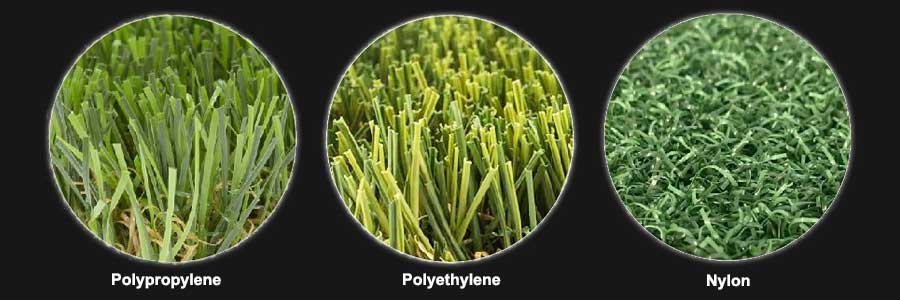
Nylon Artificial Grass
Kelebihan: Extremely durable, highly elastic fiber with quick recovery after compression, suitable for high-friction training football pitches.
Cons: Harder feel underfoot, more expensive, and not as soft as PE during tackles.
Best Uses: Indoor futsal fields or multi-purpose sports fields where durability is more important than softness.
Polypropylene (PP) Turf
Kelebihan: Affordable, lightweight, moisture-resistant, and easy to install.
Cons: Less durable and less elastic, and can flatten more quickly with frequent use.
Best Uses: Temporary or low-budget pitches, practice fields, or low-intensity mini-soccer fields.
Polyethylene (PE) Artificial Turf
Kelebihan: Realistic appearance, soft, player-friendly surface, good balance of durability and comfort, and a realistic feel of the ball rolling.
Cons: Slightly less abrasion-resistant than nylon, but more comfortable.
Best Uses: Outdoor 7-a-side and 11-a-side courts where player safety, comfort, and performance are prioritized.
Hybrid Fiber Artificial Turf (Nylon + PE or PP):
Kelebihan: This blend offers the durability of nylon, the cost-effectiveness of PP, or the softness of PE, achieving a balance between wear resistance and comfort.
Cons: Compared to single-material artificial turf, it is more expensive and more complex to maintain.
Best Use: Multi-purpose community sports fields requiring a balance between performance and performance.
Types of Artificial Turf for Soccer

Monofilament Turf
Monofilament fibers are single, smooth blades that closely resemble natural grass in both appearance and performance. They provide excellent ball roll and consistent play, making them popular for professional stadiums and high-level training grounds. While they cost more than basic fiber types, their durability and player comfort justify the investment for competitive environments where performance standards are strict.
Fibrillated Turf
Fiberized turf consists of fine, flat fibers that are split or abraded to create a soft, natural-looking surface. It has the advantage of being very durable, and great at holding infill material in place, but not as good at staying upright. They offer good surface coverage at a relatively low cost, making them suitable for community pitches and schools. Over time, heavy use can cause the fibers to flatten, slightly affecting ball speed.
Texturized Turf
Texturized fibers are short and curly, designed primarily to stabilize infill and improve surface grip. They are often used as a secondary layer in combination with longer upright fibers, but can also be used in smaller, low-impact pitches such as futsal courts. Their main strength lies in helping maintain surface consistency, although they are not intended to replicate the look of natural grass on their own.
Straight & Curly Combined Turf
Hybrid turf combines straight monofilament fibers with curly texturized fibers in a single surface. The upright blades support realistic ball movement, while the curled fibers provide cushioning and hold infill in place. This combination results in balanced playability, enhanced comfort, and reduced maintenance needs, making it a versatile choice for fields that see heavy year-round use.
Slit-Film Fiber Turf
Slit-film fibers are wide synthetic blades slit into many thin strips to improve durability and resist wear. They are particularly suitable for high-traffic areas such as school fields, municipal pitches, and community sports complexes. While they may not offer the most natural ball roll compared to monofilament fibers, their long lifespan and resilience make them a cost-effective solution for busy facilities.
| Jenis Turf | Fiber Structure | Terbaik Untuk | Key Advantages |
| Monofilamen | Single, smooth, upright blade | Professional stadiums, high-level training | Natural look, excellent ball roll, durable, consistent play experience |
| Fibrillated | Flat strips slit into thin strands | Community pitches, schools | Affordable, dense coverage, decent durability for medium-intensity use |
| Texturized | Short, curly fibers | Small-sided pitches, futsal courts | Stabilizes infill, improves surface grip, maintains surface consistency |
| Straight & Curly Hybrid | Combination of upright monofilament & curly fibers | Heavy-use fields, multi-purpose pitches | Balanced playability, good cushioning, holds infill well, reduces maintenance |
| Slit-Film Fiber | Wide blades slit into multiple thin strips | High-traffic community and school fields | Very durable, resists wear, long lifespan, cost-effective for busy venues |
5-a-Side, 7-a-Side, and 11-a-Side Soccer – Different Turf Type & Pile Height

Choosing the right turf setup for your pitch size ensures the best playing experience and safety for players. Each format has its own demands in terms of ball speed, player movement, and cushioning.
| Turf Feature | 5-a-Side | 7-a-Side | 11-a-Side |
| Ketinggian Longgokan | 40–50mm | 50–55mm | 55–60mm |
| Game Speed | Very fast | Fast but balanced | Natural game pace |
| Pad hentakan | Essential | Disyorkan | Optional / Pro use |
| Durability Need | Very high | tinggi | Very high |
| Jenis gentian | Monofilament / Fibrillated | Monofilament PE / Mixed | Monofilament Premium |
| Pengeisian | Non-infilled or Light Infill | Sand + Rubber | Sand + rubber (deeper) |
| Why It Works | Shorter pile height keeps ball speed fast and stable for quick passes and agile play. | Balanced height offers comfort underfoot while keeping ball control predictable. Good for both recreational and competitive games. | FIFA-certified, taller pile height with cushioning improves player safety during longer matches and supports realistic ball bounce/roll. |
Quick Tips:
- Shorter pile height = faster gameplay (ideal for smaller pitches).
- Taller pile height = better shock absorption (essential for full-size pitches).
- Always match the turf system to the player intensity dan competition level.
Infilled vs. Non-Infilled Turf
Infill Artificial Turf: Uses sand and rubber granules for stability, cushioning, and performance.
Non-infill Artificial Turf: No loose materials; easier to maintain but less cushioned, typically used in indoor or low-impact fields.
PS: Are You Choosing the Right Artificial Turf for Soccer Field? Beyond the aforementioned football turf types, consider factors such as ball speed, bounce and traction, foot traffic, and cost. As a professional FIFA-approved turf manufacturer and wholesaler, MightyGrass can provide you with high-quality artificial turf while reducing your artificial turf soccer field costs. Hubungi kami now to get factory prices on artificial grass.
MightyGrass FIFA Football Turf
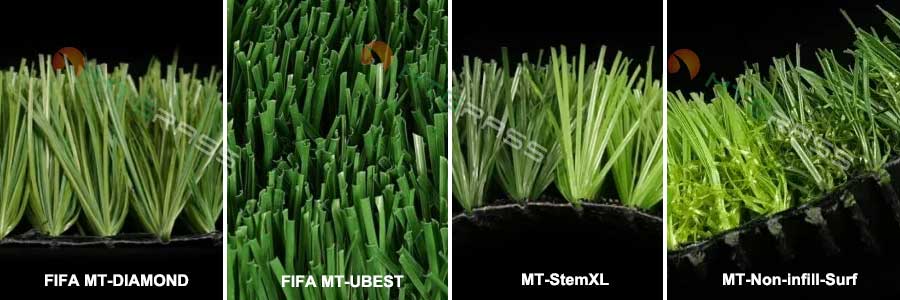
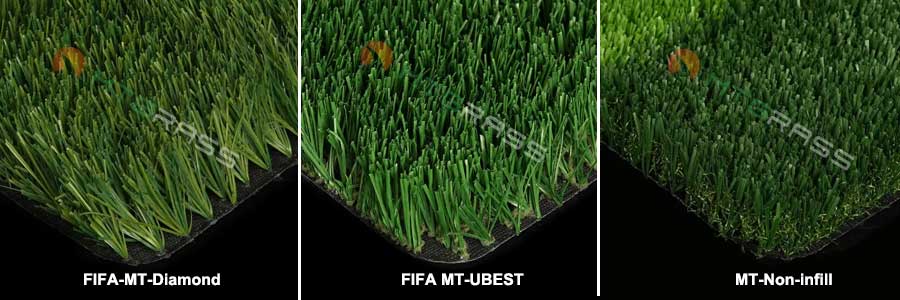
FIFA-MT-Diamond: Reka bentuk gentian rumput FIFA-Diamond menawarkan keanjalan yang luar biasa, dengan ketumpatan gentian rumput sederhana, sesuai untuk acara lalu lintas tinggi. Ia boleh menahan hentaman yang kerap tanpa ubah bentuk.
FIFA MT-UBEST 50: The FIFA MT-Ubest grass fiber enhances the turf’s compressive strength and stability through its reinforced ribbed structure, ensuring the field remains in excellent condition even after intense matches.
MT-StemXL: The MT-StemXL fibers are focused on providing support and rebound performance, offering players a more comfortable and smooth movement on the field. Whether for local events or international tournaments, these turfs provide athletes with an ideal competitive experience, improving the quality of the game.
MT-Bukan-Isi-Surf: Rumput MT-Non-Infill-Surf, yang menggunakan reka bentuk bukan isian, mempunyai ketinggian rumput yang sederhana dan menyediakan kawalan kelajuan bola yang ideal dan pengalaman bermain yang selesa sambil mengurangkan kos penyelenggaraan dengan berkesan.
Kesimpulan
Selecting the right artificial grass for a football field comes down to matching the material, pile height, and fiber type with the level of play and maintenance budget. Understanding the differences between each option ensures you get a field that’s safe, durable, and enjoyable for players year-round.
Soalan Lazim
What does FIFA certification mean for artificial turf?
FIFA certification ensures the turf meets international standards for durability, safety, ball behavior, and performance, making it suitable for professional matches and high-level competition.
MightyGrass is FIFA Quality or FIFA Quality Pro certified. This ensures the synthetic turf meets the following stringent performance standards:
- Penyerapan kejutan
- Ball bounce and roll
- Surface evenness
- Durability under heavy use
What types of artificial grass are best for football fields?
The best types depend on usage and budget, but monofilament polyethylene fibers with a pile height of 50–60mm and infill are commonly preferred for durability and playability. For smaller pitches, shorter pile heights and denser fibers may be better.
How do I choose the right pile height for my football pitch?
Pile height affects ball control and cushioning. Shorter piles (around 40mm) are suited for mini soccer pitches or 5-a-side pitches, while full-size 11-a-side fields benefit from taller piles (50–60mm) that offer better shock absorption and player comfort.
Is infill necessary for football artificial turf?
Yes, infill materials like sand and rubber provide cushioning, stability, and impact absorption, which help player safety and extend turf lifespan, especially on full-sized outdoor pitches.
Can artificial turf be used in all weather conditions?
Yes, artificial turf is designed to perform consistently in rain, sun, and snow without becoming muddy or uneven, making it ideal for year-round play.
Maintenance and Lifespan
- Even with minimal upkeep, artificial turf requires:
- Regular brushing to keep fibers upright
- Removing debris to prevent infill displacement
- Periodic infill top-ups
With proper care, a quality football turf can last 8–10 years, depending on usage intensity.