Nederlands
  English
  العربية
  Español
  Deutsch
  Français
  Português
  Русский
  日本語
日本語  Italiano
  Svenska
  Suomi
Suomi  ไทย
ไทย  Dansk
Dansk  Ελληνικά
  Bahasa Melayu

Pickleball, a sport combining elements of tennis, badminton, and table tennis, has rapidly gained popularity worldwide. The International Pickleball Federation (IFP) reports that by 2023, over 70 countries had officially adopted pickleball, and the Sports and Fitness Industry Association (SFIA) reports that by 2025, pickleball participation had reached 24.3 million. As a result, pickleball is no longer a niche sport in retirement communities; the demand for professional courts in schools, parks, residential communities, and commercial facilities is exploding.
Whether you’re planning to build a pickleball court in your backyard or construct a multi-court recreation center, ensuring accurate pickleball court dimensions from the outset will provide your athletes with the necessary experience while saving you unnecessary additional expenses.
Today, we’ll provide a comprehensive analysis of pickleball court specifications, layout, and construction requirements, hoping to assist you in developing your pickleball court.
What Are the Official Pickleball Court Dimensions?
One unique characteristic of pickleball is that singles and doubles use exactly the same court size. Unlike tennis, there are no separate singles sidelines, making court construction simpler and reducing installation costs.
Although the playing area measures 20 × 44 feet, experienced court designers rarely recommend constructing only this minimum rectangle. Players require additional space to move safely beyond the baselines and sidelines during rallies. These additional safety zones improve movement, reduce collision risks, and create a better playing experience.
- For recreational facilities, a recommended overall area is approximately: 30 ft × 60 ft (9.14 m × 18.29 m)
- For USAPA tournaments or competitive environments, prefer: 34 ft × 64 ft (10.36 m × 19.51 m)
Official Pickleball Court Size:
| Item | Afmeting |
| Playing Area | 20′ × 44′ (6.1m × 13.41m) |
| Total Area (Minimum) | 30′ × 60′ (9.1m × 18.3m) |
| Total Area (Standard) | 34′ × 64′ (10.4m × 19.5m) |
| Non-Volley Zone(Kitchen/NVZ) | 7 feet (2.13m) on each side |
| Service Courts | 10′ × 15′ × 2 (3.05 m × 4.57 m x 2) |
| Court Line Width | 2” (5cm) |
Pickleball singles/doubles uses the same court size.
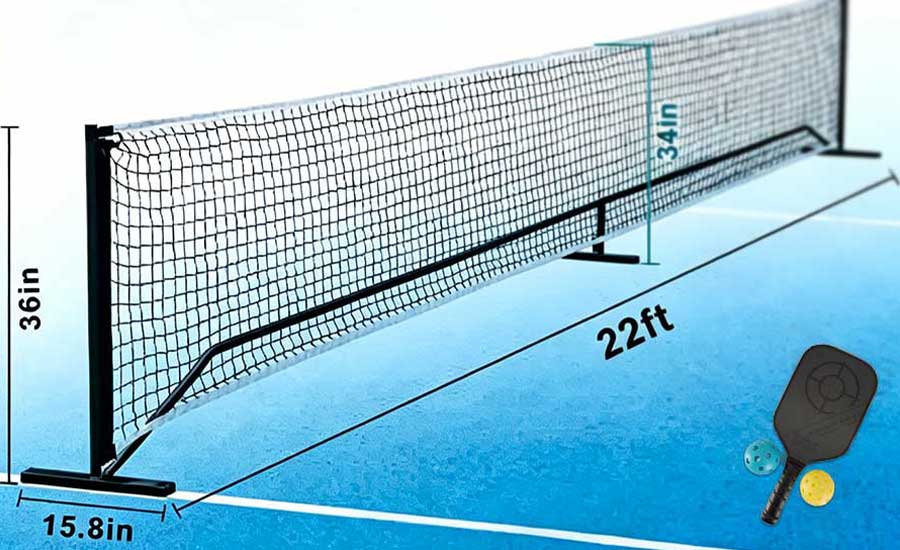
Pickleball Net Dimensions
Unlike many other racket sports, the pickleball net is intentionally lower in the center than at the posts. This subtle difference influences ball trajectory and contributes to the sport’s distinctive style of play.
Pickleball Net Height
| Position | Height |
| At sidelines | 36 in (91.4 cm) |
| In het midden | 34 in (86.4 cm) |
Pickleball Net Length
The net should span the full court width and extend beyond each sideline. The additional length ensures secure attachment to the posts while maintaining proper tension.
| Specificatie | Measurement |
| Minimum net length | 22 ft (6.7 m) |
| Court width | 20 ft (6.10 m) |
Pickleball Court Layout: What You Need to Know
Although the pickleball court may seem simple, it actually has several key areas, each with clear rules and functions. The pickleball court is divided across its width at the midpoint, creating two 20 × 22 ft halves. Each half of the court is further divided into several functional areas:
Non-Volley Zone (Kitchen)
The non-volley zone (commonly known as the “kitchen”) is the area extending 2.13 meters (7 feet) from either side of the net. Players cannot directly intercept balls in the air within this area.
Rule Explanation:
- After entering the non-volley zone, you must wait for the ball to bounce before hitting it.
- If you hit a volley and your body or equipment (such as racket, hat, or clothing) is carried into the non-volley zone or onto the line due to the momentum of the swing, it is also considered a foul.
- The non-volley zone exists to prevent players from standing at the net and “sweeping” the ball, ensuring a more strategic game.
Service Area
The service area are the areas behind the net on either side where the ball lands. Each half of the court is divided into two service courts by the center line, and each service court is 10 ft wide × 15 ft long (~ 3.05 m × 4.57 m) in standard dimensions.
Serving Rules:
- The server must stand behind the baseline and serve the ball diagonally.
- For odd-numbered scores, the server serves from the left side; for even-numbered scores, the server serves from the right side.
- The serve must land within the diagonal service area; otherwise, it is considered a fault.
Centerline
The centerline connects the non-volley zone to the baseline, dividing the service area into left and right sections. The server must stand in the correct service area according to the score to serve.
Baselines and Sideline
The baseline is located at the outermost edge of the court, defining the area where the ball is out of bounds. When serving, a player must not step on or cross the baseline; otherwise, it is considered a service fault.
Court Line Width
According to international standards, all lines on a pickleball court must meet the following requirements:
- Standard line width: 5 cm (2 inches)
- All boundary lines must be clearly visible, and the color must contrast sharply with the ground.
- All lines are within the court’s boundaries (i.e., the ball landing on a line is still valid).
How Many Pickleball Courts Fit on a Tennis Court?
Existing tennis courts can often be converted into pickleball courts without the need to build new sports centers. So how can we make reasonable use of space by converting a tennis court into several pickleball courts?
A standard tennis court measures 78 ft long × 36 ft wide (doubles) or 27 ft wide (singles), with a total recommended space of 120 × 60 ft including run-off zones. Given a pickleball court’s 30 × 60 ft recommended footprint, you can fit four pickleball courts side by side within the footprint of a single tennis court.
For sports clubs, municipalities, and schools, the increased court capacity and the renovation of underutilized tennis facilities are undoubtedly very attractive. However, four courts crammed into one tennis court leaves almost no buffer space between courts — meaning wayward balls and colliding players become real concerns. In practice, most conversion projects comfortably fit two to three pickleball courts on a tennis court while maintaining safe buffers.

Pickleball Court Vs Tennis Court Comparison Table
The difference in tennis and pickleball court specifications.
| Item | Pickleball Court | Tennisbaan |
| Lengte rechtbank | 44 ft (13.41 m) | 78 ft (23.77 m) |
| Court Width (Singles) | 20 ft (6.1 m) | 27 ft (8.23 m) |
| Court Width (Doubles) | 36 ft (10.97 m) | |
| Net Height (Centre) | 34 inches (86.4 cm) | 36 inches (91.4 cm) |
| Net Height (Sideline) | 36 inches (91.4 cm) | 42 inches (1.07 m) |
| No Volley Zone | 7 ft from the net | Geen |
| Service Area Width | 10 ft (3.05 m) | 13.5 ft (4.11 m) |
| Service Area Length | 15 ft (4.57 m) from the baseline | 21 ft (6.40 m) from the net |
| Total Surface Area (Singles) | 880 sq ft | 2.106 m² |
| Total Surface Area (Doubles) | 2.808 m² | |
| Courts per Tennis Footprint | 2–4 | 1 |
One critical note if you’re doing a tennis-to-pickleball conversion: the tennis net sits 2 inches higher at center and 6 inches higher at the posts. You cannot simply repurpose an existing tennis net for pickleball without adjustment. Dedicated pickleball net systems are widely available and run between $200 and $600 for portable models, or $800–$2,000+ for permanent post-and-net installations. Furthermore, pickleball courts are the same size for singles and doubles games, tennis courts are wider for doubles matches compared to singles.
Indoor vs. Outdoor Pickleball Courts
The official pickleball court dimensions in feet are identical whether you’re playing indoors or outdoors 30 ft × 60 ft, but the pickleball court specifications of the surface materials and surrounding facilities may vary, and these differences can significantly affect construction costs and material selection.
| Functie | Indoor Pickleball Court | Outdoor Pickleball Court |
| Oppervlak | Hardwood floors, premium sports tiles, or synthetic turf | Acrylic-coated asphalt, post-tensioned concrete, or artificial turf |
| Verlichting | Even illumination of 30–50 foot-candles with minimal shadows and glare | Full-cutoff LED sports lighting to improve nighttime visibility and reduce light spill |
| Type bal | Lighter balls with larger holes for smoother indoor flight | Slightly heavier balls with smaller holes for better wind resistance |
| Facility Requirements | USAPA recommends a minimum ceiling height of 20 ft (6 m), with 25 ft (7.6 m)+ preferred for competitive play | Courts should be designed to handle wind, drainage, UV exposure, and temperature fluctuations |
While indoor courts benefit from a controlled environment, outdoor courts require more durable materials and effective drainage systems to ensure long-term performance.
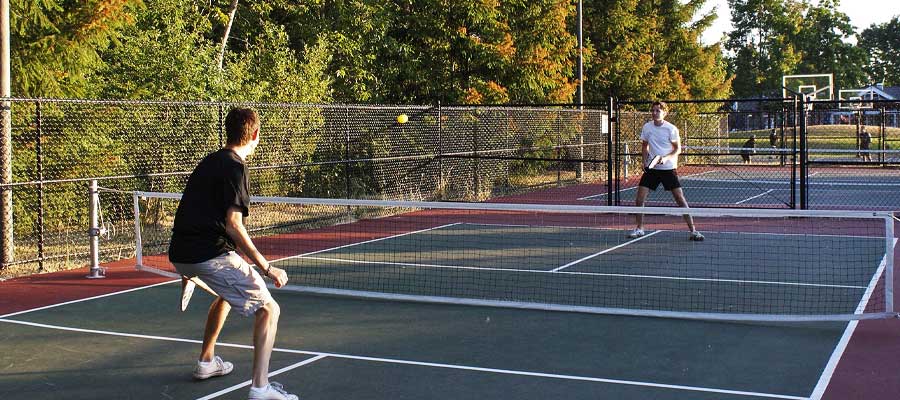
Pickleball Court Surface Options: Which Is Best?
A high-quality pickleball court not only needs to have standard dimensions, but also must have a suitable surface material. The playing surface directly affects ball response, player comfort, maintenance requirements, and lifetime operating costs.
Acrylic hard surface: The most common choice for professional tournaments and public courts, offering advantages such as stable ball bounce, high durability, and low maintenance costs.
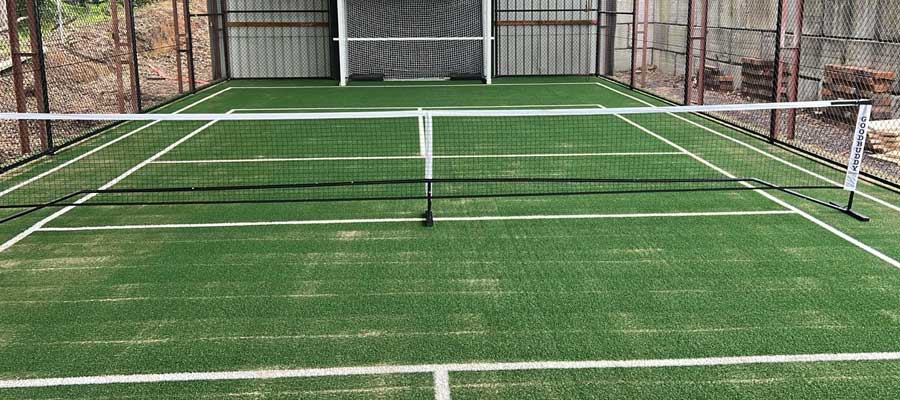
Artificial turf surface: High-quality pickleball turf provides a more comfortable feel and cushioning, while also offering good drainage and aesthetic appeal, suitable for backyard and recreational courts.
Hardwood flooring surface: Quick to install and with good shock absorption, popular in indoor venues and residences.
Concrete or asphalt base: The foundation structure of most pickleball courts, providing stable load-bearing capacity, but usually requires a professional sports surface such as acrylic or artificial turf.
If you prioritize tournament-level performance, choose acrylic hard surfaces; if you value comfort, aesthetics, and versatility, choose a high-quality artificial turf system.
Why Are More Facilities Choosing Artificial Turf for Pickleball?
Initially, playing pickleball was considered a retirement recreational sport, not a professional competition. And for decades, outdoor pickleball courts were primarily built on asphalt or concrete with an acrylic coating. However, as pickleball has grown in parks, schools, resorts, residential communities, and integrated recreational sports facilities, project owners are evaluating court surfaces from a broader perspective. They are discovering high-quality artificial turf systems designed specifically for the sport, offering stable ball trajectory feedback, excellent drainage, and significantly less impact on knees, hips, and ankles compared to concrete or asphalt, making them safer and less prone to injury.
What makes a well-engineered synthetic turf system work for pickleball is the infill and pile construction. A turf designed for pickleball needs a short pile height (typically 10–20mm), a firm, dense infill system, and a backing that resists the lateral movement forces generated by pickleball quick-stop-and-lunge movement patterns. However, there is a fundamental difference between a pickleball turf and a football field turf or a landscape turf. You can check out more information about MightyGrass pickleball turf.
Upgrade Your Pickleball Court with MightyGrass Synthetic Turf
When choosing a pickleball turf, it is essential to ensure that its surface can withstand continuous, high-intensity foot traffic without tearing or abrasion. Furthermore, consider that UV-resistant materials not only prevent fading caused by prolonged sun exposure but also play a crucial role in extending the turf’s lifespan.
MachtigGras kunstgras systems are engineered for exactly this kind of application. Where generic turf products compromise on firmness or pile density, MightyGrass products are designed to deliver a consistent, predictable ball bounce across the full court surface — including near the kitchen line, where millimeters of inconsistency can change a competitive point.
- Drainage Performance: MightyGrass backing system is meticulously designed for rapid drainage—crucial for outdoor courts that need to be quickly restored to usability after rain.
- UV Stability: MightyGrass fibers are UV-stabilized to prevent fading and fiber degradation, ensuring a product lifespan 10+ years under normal outdoor conditions.
- Lateral Load Durability: MightyGrass’s tuft density and backing structure are designed to withstand the loads of “kitchen dance,” split-step, and scrambling without pile collapse or seam separation.
- Customizable Options: MightyGrass offers customization options for grass height, fiber type, color, density, backing system, roll size, and branding—helping you create a more competitive artificial turf solution tailored to your project needs, budget, and market positioning.
- Year-Round Applicability: Unlike painted concrete, which becomes extremely slippery when wet or frozen, pickleball courts turf maintain excellent grip in a wider range of weather conditions, extending the court’s usability season.
Pickleball Court Construction Checklist
Building a successful pickleball court begins long before the first line is painted. Proper planning reduces construction errors, extends surface life, and improves player satisfaction. You can refer to the following list for a useful roadmap for new projects:
- Site Survey and Planning: Includes pickleball court size measurement, drainage planning, and functional positioning.
- Base Construction and Leveling: Uses concrete or asphalt base layers, ensuring a proper slope to prevent water accumulation.
- Surface Type Selection: Choose a suitable surface based on your budget, local climate, and usage. Artificial turf courts are generally more advantageous than asphalt courts in areas with high rainfall or significant temperature variations.
- Surface Installation and Line Marking: Install a durable playing surface and accurately mark the court layout according to official pickleball court measurements, including the service areas and non-volley zones.
- Installation of Accessories: Includes nets, boundary fencing, lighting fixtures, player seating, trash cans, and other user-friendly amenities.
How to Build a Home Pickleball Court?
If you plan to build your own pickleball court in your backyard, it is recommended to reserve at least 30 × 60 feet (approximately 9.14 × 18.29 meters) of space and prioritize a stable hard base or a professional sportgras system. Once you have your net, measuring tools, and line marking equipment ready, you can set up the net, baselines, sidelines, kitchen area, and service area according to standard pickleball court dimensions. Through proper court planning and professional selection of court materials, you’ll not only achieve more consistent ball performance and a better gaming experience, but also create a year-round pickleball court suitable for family and friends to enjoy together.
Synthetic turf has become particularly popular for backyard pickleball courts because it serves double duty: the same surface that functions as a pickleball court on weekends can look like an attractive lawn space the rest of the time. MightyGrass products are particularly well-suited to this kind of residential dual-use application, where aesthetics matter as much as performance.
Pickleball Court Application Scenarios and Trends
- School and University Sports Facilities: Pickleball is suitable for mixed-gender instruction, with a moderate physical workload, making it easy to promote.
- Community Fitness Facilities: Pickleball is a sport suitable for all ages and is ideal for residents’ daily exercise.
- Commercial Fitness Clubs: Pickleball has become a new highlight, effectively increasing member loyalty and user activity.
- Government Public Fitness Projects (Municipal Parks): Many places have listed pickleball courts as a key construction target for new public fitness projects.
- Multi-functional Recreation Centers: In 2021, the city of Naples, Florida, transformed its entire tennis center into a complex with 60 pickleball courts.
- Hotels and Resorts: Hospitality operators are constantly seeking recreational activities that appeal to a broad range of guests. An attractive synthetic turf court can also enhance the visual appeal of outdoor recreational spaces while integrating with landscape design.
Conclusion: Artificial Turf Fields Enhance the Pickleball Experience
From the dimensions and net height of the pickle court to the playing surface and markings, you now have all the information you need to create and equip a pickle court. In addition, you’ll need indoor and outdoor pickles, rackets, and various pickle training equipment that meet USAPA standards, such as bouncers and speed bumps. Following standard specifications will make the sport more structured and enjoyable.
If you’d like to try this sport, why not set up a small pickle court according to standard dimensions and enjoy this simple yet challenging activity with family and friends? Whether you’re planning a single backyard court or a multi-court complex, the MightyGrass team can help you evaluate surface material choices, plan your court layout, and select the right products based on your climate and usage. Neem contact met ons op Today.
Veelgestelde vragen
Can you play pickleball on a tennis court?
Yes, and this is one of the most practical court modification options available.
The main thing that needs adjustment is the net. The center height of a tennis net is 36 inches, and the posts are 42 inches—both higher than the standard pickleball height. You have two options: install a dedicated pickleball net system (recommended for everyday use), or use center tape to lower the center height of your existing net to 34 inches, accepting that the posts will still be slightly higher. Many recreational players use the second method in informal matches, but this approach is not suitable for competitive matches or leagues.
Court lines are another factor to consider. Pickleball lines can be temporarily drawn on the tennis court using removable tape. Dedicated court marking tape costs approximately $15 to $30 per roll and will not damage the court surface when removed.
Can you fit a pickleball court on a tennis court?
Yes, depending on how much buffer space you’re willing to sacrifice, a tennis court can accommodate two to four pickleball courts. A pickleball court requires a minimum footprint of 30 x 60 feet, while the recommended total area for a standard tennis court is 120 x 60 feet. While the space could theoretically accommodate four pickleball courts, it is recommended to allow for adequate safety buffers around each court. In practice, planning for two to three courts will provide a safer and more comfortable playing environment.
Can pickleball be played on artificial turf?
Of course, it’s not without reason that more and more venues and owners are choosing artificial turf as their primary playing surface. The key is choosing the right turf specification—not all artificial turf products offer the same feel or consistent ball feedback.
Artificial turf suitable for pickleball requires shorter fiber height (10-20 mm), a dense and solid infill system, and a backing capable of withstanding the lateral forces generated by the sport. Long-fiber landscaping turf or thick soccer turf can result in inconsistent ball bounce and hinder the quick stops required in pickleball.
Choosing the right artificial turf can provide better joint protection than concrete or asphalt, rapid drainage after rain, clear line markings, and prevent surface cracking like older hard surfaces. MachtigGras artificial turf, designed specifically for sports fields, is built to meet these needs—stable ball rebound, rapid drainage, and performance that remains like new even after 10 years of use.
How much space is needed around a pickleball court?
The playing court itself is 20 × 44 ft, but that’s only the in-bounds area. USAPA recommends a minimum 5-foot buffer on each sideline and a 7-foot buffer behind each baseline, bringing the recommended total footprint to 30 × 60 ft per court. For competitive and tournament play, the preferred envelope is 34 × 64 ft.
Is a pickleball court the same size as a badminton court?
The dimensions are very close, which is one reason temporary pickleball setups are sometimes installed on existing badminton courts. A standard doubles badminton court measures 20 feet wide × 44 feet long — identical to a pickleball court. Singles badminton is played on a narrower 17 × 44 ft court, which doesn’t match pickleball dimensions.
The similarity in footprint is useful for facilities trying to maximize the utility of existing marked surfaces. However, the net heights are different: a badminton net is 5 feet 1 inch at the center (significantly taller than pickleball’s 34 inches), so the net height would need to be swapped or adjusted.