Português
  English
  العربية
  Español
  Deutsch
  Français
  Русский
  日本語
日本語  Italiano
  Nederlands
  Svenska
  Suomi
Suomi  ไทย
ไทย  Dansk
Dansk  Ελληνικά
  Bahasa Melayu
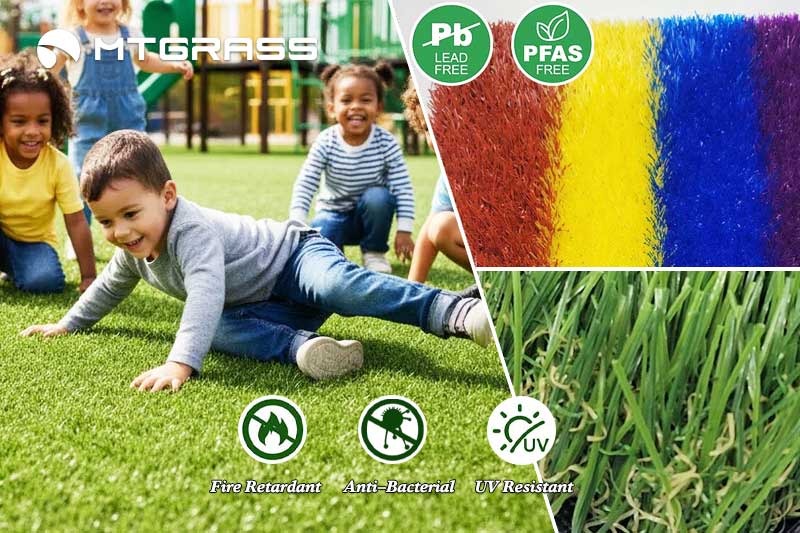
If you’re specifying artificial grass for playground, safety isn’t a feature—it’s the foundation of your entire project.
Parents don’t see shock pads, fall heights, or impact attenuation curves. But inspectors do. And more importantly, injury statistics do.
According to the U.S. Consumer Product Safety Commission, over 200,000 children are treated annually for playground-related injuries in the United States, with falls to the surface being the leading cause. That single data point explains why playground turf is no longer just about aesthetics or durability—it’s about compliance.
In today’s market, buyers like you are expected to understand and meet multiple safety standards, including ASTM F1292, EN1177, and ADA accessibility requirements. The challenge is not just knowing these standards—but knowing how they actually impact your turf system design, cost, and long-term performance.
This guide provides a detailed analysis of the aforementioned topics, aiming to assist you in making confident and cost-effective decisions regarding the selection of safe playground turf for your upcoming project.
Why Playground Turf Safety Standards Matter More Than You Think
Most turf buyers initially focus on pile height, yarn type, or price per square meter. But for playgrounds, those factors are secondary.
According to statistics, more than 50% of playground injuries come from falls, making surface impact performance the #1 safety factor.
What truly determines whether your project passes final acceptance is the artificial turf itself, along with the entire underlying ground system.
When a child falls from a height of 1.5 to 3 meters (5–10 feet), the surface must absorb impact energy effectively. Otherwise, the risk of head injury (HIC – Head Injury Criterion) increases dramatically. Both ASTM and EN standards are built around this exact principle.
The following points require your attention, and we strongly advise you not to overlook them.
- A “soft” turf product alone does not meet safety standards
- Shock absorption comes from the system combination: synthetic turf + enchimento de relva artificial + shock pad + base
- Poor installation can invalidate even certified materials
In real projects, we’ve seen contractors pass lab tests but fail on-site compliance due to improper sub-base compaction or incorrect shock pad thickness.
For example, to meet a critical fall height of 2.5 meters (~8.2 ft), most systems require:
- Shock pad thickness: 25–50 mm
- HIC value: ≤ 1000
- G-max value: ≤ 200
These are not optional benchmarks—they are the difference between a compliant playground and a liability.
If you are responsible for procurement for school, municipal park, or commercial playground projects, we recommend shifting your focus from simply “buying artificial grass” to building a comprehensively certified surfacing system solution.
What is ASTM F1292 for Playground Surfacing?
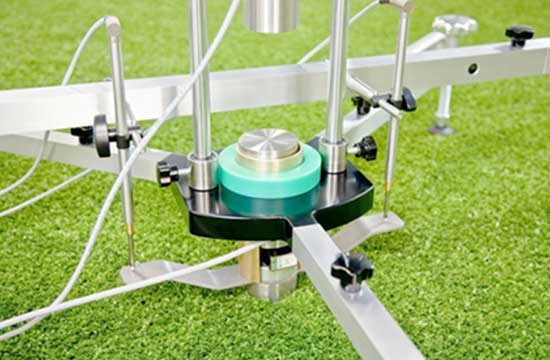
ASTM F1292 is the primary U.S. standard used to evaluate the impact attenuation of playground surfaces.
It is developed by ASTM International and focuses on how well a surface can reduce the severity of a head impact during a fall.
Instead of judging materials by appearance or thickness, ASTM F1292 measures performance using two key metrics:
- HIC (Head Injury Criterion): ≤ 1000
- G-max: ≤ 200
What matters for you is this: ASTM F1292 does not certify a turf product alone—it certifies the entire installed system.
This system consists of an artificial turf layer, infill (if required), a shock-absorbing pad, and a sub-turf base structure.
At MightyGrass, you’re not just buying turf—you’re getting engineered system matching. Based on your target fall height and project type, we help you configure:
- The correct almofada de choque density and thickness
- Turf structure that works with (not against) impact absorption
- Infill options that maintain long-term performance
Because passing ASTM F1292 once in a lab is easy. Passing it after 3–5 years of use is what really matters.
What Is EN1177 for Playground Surfacing?
EN1177 is the European standard for playground surfacing, developed under the framework of the European Committee for Standardization.
While similar in purpose to ASTM F1292, EN1177 uses a slightly different approach.
Instead of focusing primarily on HIC and G-max thresholds, EN1177 introduces the concept of: Critical Fall Height (CFH) — the maximum height from which a child can fall without sustaining a life-threatening head injury.
In practical terms:
- A surface rated for CFH 2.0 m is tested to safely absorb impacts from that height
- The higher the CFH, the safer the system
This makes EN1177 more intuitive for many international buyers, especially when designing playgrounds with specific equipment heights.
However, just like ASTM:
- EN1177 applies to the complete surface system
- Performance depends heavily on installation quality
- Long-term wear (compaction, infill loss) can reduce CFH over time
If you are constructing an artificial turf playground for schools in Europe, the Middle East, or international schools, compliance with the EN1177 standard is often a mandatory and non-negotiable requirement.

ASTM F1292 vs EN1177: Key Differences You Need Know
At first glance, ASTM F1292 and EN1177 seem interchangeable. In reality, they reflect different regulatory philosophies.
ASTM is more data-driven and threshold-based, while EN1177 is more application-oriented.
| Aspect | ASTM F1292 (USA) | EN1177 (Europe) |
| Core Focus | Impact force measurement | Critical fall height |
| Key Metrics | G-max & HIC | CFH (Critical Fall Height) |
| Pass Criteria | ≤200 G-max, ≤1000 HIC | Must meet safe fall height threshold |
| Aplicativo | U.S. playgrounds | EU playgrounds |
| Testing Style | Force-based | Outcome-based |
| Turf Design Impact | Focus on shock absorption values | Focus on system thickness vs height |
When you purchase from us, you are acquiring more than just artificial turf—you are investing in a safe, certifiable playground system. How does MightyGrass fit into your compliance strategy? Leveraging our in-house turf production capabilities and over two decades of manufacturing expertise, we can precisely configure the optimal combination of turf and shock-absorption pads to meet the specific critical fall height requirements of your site. Furthermore, to address the diverse needs of your target markets, we offer OEM customization services as well as eco-friendly, recyclable turf options.
What is ADA Compliant Playground Turf Surfacing?
When you design a playground in the U.S., safety alone is not enough. Accessibility is equally critical—and that’s where ADA compliance comes in.
O Americans with Disabilities Act (ADA) requires playgrounds to be accessible to children of all abilities. For surfacing, this means your artificial turf system must allow wheelchairs, walkers, and mobility devices to move freely and safely across the play area.
In practical terms, ADA-compliant turf surfacing must meet guidelines defined by the U.S. Access Board, including:
- Firmness and stability: The surface should not deform excessively under load
- Slip resistance: Safe for both dry and wet conditions
- Smooth transitions: No abrupt level changes that block mobility devices
Unlike loose-fill materials (like wood chips or sand), artificial turf systems are widely preferred because they create a continuous, even surface.
It is worth noting that a poorly installed artificial turf sub-base can lead to uneven settling, making the surface non-compliant—even if the turf itself is high quality.
At MightyGrass, ADA compliance is approached as part of a long-term usability system, not a checkbox. Because accessibility failures don’t just affect inspections—they directly impact how children experience the space.
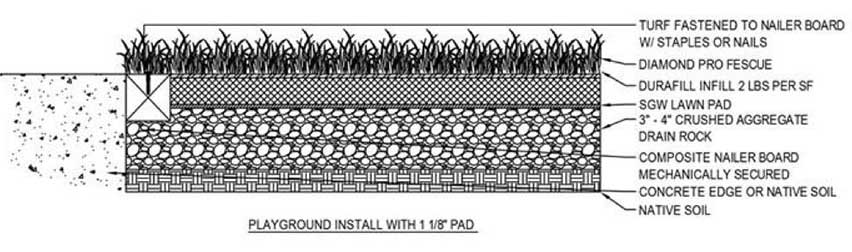
How to Build a Safe Artificial Grass Playground for You?
Building a safe playground is not about choosing the “softest” turf. It’s about engineering a surface that performs consistently over time.
If you’re planning a project, here’s how you should think about it:
Start from the fall height, not the grass.
Every piece of playground equipment has a defined fall height. Your surfacing system must be designed to meet or exceed that number—whether you’re targeting ASTM F1292, EN1177, or both.
Then, build your system in layers:
- A base layer of concrete, asphalt, or properly compacted aggregate ensures the structural stability of the entire system
- A shock pad (typically 25–50 mm) provides impact attenuation
- Turf and infill work together to protect the shock pad and maintain performance
- Drainage is another factor you cannot ignore. A well-designed artificial turf system can achieve drainage rates of 500–1,000 mm/hour, preventing water accumulation and reducing slip risks.
By choosing Poderosa grama, you gain access to comprehensive support and service spanning the entire process—from initial design to final product delivery. We will custom-tailor a flooring system solution specifically for you, based on your project’s unique requirements regarding critical fall height, usage frequency, and local climatic conditions. This ensures that your playground not only fully complies with safety standards from day one but also stands the test of time, retaining its original safety performance for years to come.
Why More Schools and Parks Are Switching to Artificial Turf Systems
Across the U.S. and globally, schools and municipalities are moving away from natural grass and loose-fill materials—and the shift is accelerating.
The reason is simple: predictability and safety.
Natural grass may look appealing, but it quickly becomes:
- Uneven under heavy use
- Muddy and slippery after rain
- Expensive to maintain year-round
Loose-fill materials like wood chips or sand come with their own issues:
- Displacement over time (leading to inconsistent fall protection)
- High maintenance requirements
- Poor accessibility for wheelchairs
Artificial turf systems solve these problems by offering a controlled, engineered surface.
From a cost perspective, while initial installation may be higher, lifecycle savings are significant:
- Maintenance costs reduced by up to 60–70% compared to natural grass
- No irrigation or mowing required
- Longer service life (typically 8–12+ years for playground applications)
More importantly, turf systems provide consistent safety performance, which is critical for schools managing liability.
This is why you’re seeing artificial turf widely adopted in:
- Public parks and municipal playgrounds
- School campuses (K-12 and universities)
- Commercial play areas and resorts
The shift is not about trends—it’s about risk reduction and operational efficiency.
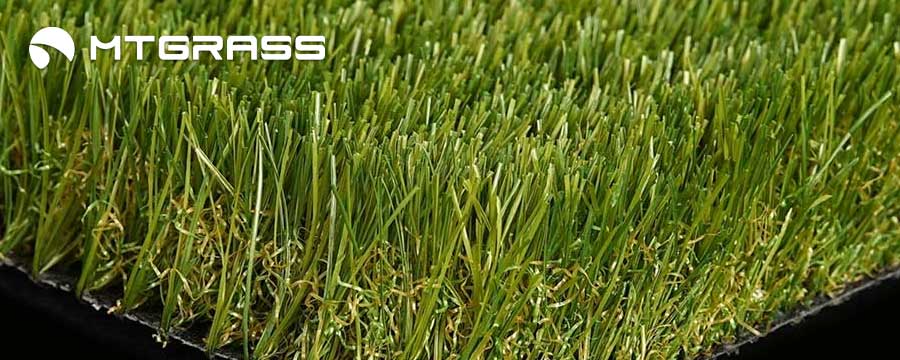
Why Choose MightyGrass Artificial Turf for Playground Safety Surfacing
If you’re sourcing playground turf, you’re not just comparing products—you’re choosing a partner who directly impacts your project’s success.
MightyGrass is built around that responsibility.
With over 20 years of manufacturing experience and full in-house production—from yarn extrusion to backing—you gain control where it matters most: quality consistency. With a Armazém na Califórnia, MightyGrass can better support U.S.-based projects with reduced lead times.
But what makes the difference for your project is not just production—it’s how we support your compliance and performance goals:
You get turf systems engineered to meet ASTM F1292 and EN1177 requirements, not generic products with generic test reports.
Beneficia de:
- Customized shock pad + synthetic turf system matching
- Support for ADA-compliant surface configurations
- Durable yarn structures designed for high-traffic playgrounds
- Optional recyclable turf solutions for future-proof projects
Our experience across global markets—from North America to the Middle East—means you’re not experimenting. You’re working with solutions already tested in real environments.
Because in playground projects, failure is not measured in returns or complaints—it’s measured in safety risks.
At MightyGrass, you get more than materials. You get a compliance-ready solution designed around your project’s specific requirements. Whether you’re a contractor, distributor, or project owner, we help you reduce risk, pass inspections, and deliver long-term performance. Talk to our team today and get a tailored playground turf system that meets both safety standards and real-world demands.
Conclusão
Playground safety is no longer a simple specification—it’s a system-level responsibility.
Standards like ASTM F1292, EN1177, and ADA compliance are not just technical requirements. They define how safe, accessible, and reliable your playground will be over time.
For you as a buyer, the key takeaway is clear:
You’re not buying artificial grass.
You’re building a certified safety surface system.
And the difference between a project that passes—and one that fails—comes down to how well that system is designed, installed, and supported.
With MightyGrass, you’re choosing a partner who understands that difference—and helps you get it right from the start.
Perguntas frequentes
What is the safest surface for a playground?
The safest playground surface is one that meets certified impact attenuation standards such as ASTM F1292 or EN1177. Artificial turf systems with shock pads are widely considered one of the safest options because they provide consistent fall protection, stable footing, and long-term performance compared to loose-fill materials like wood chips or sand.
Does artificial grass meet playground safety standards?
Yes—but only when it is installed as a complete system.
Artificial grass alone does not meet safety standards. To comply with ASTM F1292 or EN1177, the system must include a properly designed shock pad, stable base, and (if required) infill. The full system is what gets tested and certified, not just the turf product.
How thick should playground turf and shock pad be?
The thickness depends on the required fall height.
For most playground applications:
- Shock pad thickness: typically 25–50 mm (1–2 inches)
- Turf pile height: usually 20–40 mm
Higher fall heights require thicker shock pads to meet ASTM or EN safety standards. System design should always be based on equipment height, not just product preference.
How long does playground artificial turf last?
High-quality playground turf systems typically last 8–12+ years, depending on usage and maintenance.
Factors that affect lifespan include:
- Intensidade do tráfego de pedestres
- UV exposure
- Infill maintenance (if applicable)
- Quality of yarn and backing
MightyGrass UV-resistant turf system helps maintain both performance and safety over time.
Is artificial turf better than wood chips for playgrounds?
In many cases, yes.
Artificial turf offers:
- Consistent impact protection (does not shift like loose-fill)
- Lower maintenance over time
- Better accessibility (ADA compliance)
- Cleaner and more visually appealing surfaces
Wood chips may have lower upfront cost but require frequent replenishment and can become uneven, reducing safety performance.
How do I choose the right playground turf system?
Start with your project requirements—not the product.
You should define:
- Required fall height
- Applicable standards (ASTM, EN, ADA)
- Usage level (school, park, commercial)
- Condições climatéricas
From there, select a complete turf system (turf + shock pad + base) that meets those requirements. Working with an experienced manufacturer like MightyGrass helps ensure proper system matching and compliance.
Can playground turf maintain safety performance over time?
Yes, but only if the system is properly designed and maintained.
Over time, factors like infill loss, compaction, and wear can reduce impact absorption. That’s why MightyGrass high-quality playground turf systems are designed to maintain performance after aging tests and real-world use.
Regular inspection and light maintenance help ensure long-term compliance and safety.