
 Français
  English
  العربية
  Español
  Deutsch
  Português
  Русский
  日本語
日本語  Italiano
  Nederlands
  Svenska
  Suomi
Suomi  ไทย
ไทย  Dansk
Dansk  Ελληνικά
  Bahasa Melayu
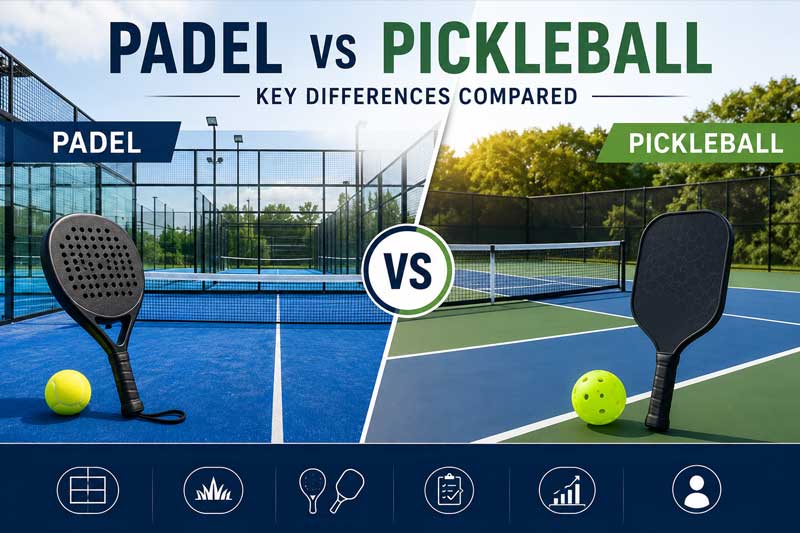
Deux sports. Deux terrains totalement différents. Une question que tout le monde dans le monde des sports de raquette ne cesse de se poser : padel ou pickleball ?
Si vous avez suivi l'actualité sportive ces dernières années, vous avez pu constater que ces deux sports sont passés du statut de loisirs de niche à celui de véritables phénomènes mondiaux. Les responsables de clubs, les gestionnaires d'installations et les joueurs amateurs évaluent tous leurs options — et les enjeux sont bien réels.
Ce guide vous explique tout en détail : les courts, les revêtements, les règles, les chiffres relatifs à la croissance du sport et, si vous envisagez de construire un court, les caractéristiques techniques des revêtements qui comptent le plus.
Quelle est la différence entre le padel et le pickleball ?
Padel contre pickleball : origines historiques
En bref : le padel est souvent décrit comme un mélange de tennis et de squash ; pratiqué sur un terrain clos aux parois vitrées, il offre des rebonds spectaculaires et de longs échanges. Le pickleball, quant à lui, combine des éléments du tennis, du badminton et du tennis de table, et se joue sur un terrain plus petit avec une balle en plastique perforée. Ces deux sports conviennent parfaitement aux joueurs de tous âges et de tous niveaux.
Le padel a vu le jour au Mexique en 1969, inventé par Enrique Corcuera, et s'est d'abord développé en Espagne et en Amérique latine avant de se répandre dans le monde entier. Il se joue sur un terrain fermé, entouré de parois en verre et en filet — et ces parois font partie intégrante du jeu. Les joueurs renvoient régulièrement les balles contre les parois arrière et latérales, ce qui donne lieu aux longs échanges caractéristiques de ce sport et lui confère toute sa richesse tactique.
Le pickleball, quant à lui, a été inventé en 1965 dans l'État de Washington comme jeu de jardin destiné aux familles. Il se joue sur un terrain ouvert, avec une balle en plastique perforée (semblable à une balle de wiffle), et suit un système de pointage et de jeu au filet qui s'inspire largement du badminton et du ping-pong. Le jeu est plus rapide, se déroule plus près du sol et est nettement plus accessible aux débutants.
Padel vs Pickleball : une comparaison rapide des principales différences
| Fonctionnalité | Padel | Pickleball |
| Origine | Mexique (1969) | États-Unis (1965) |
| Dimensions du terrain | 20 m × 10 m (clôturé par des parois en verre ou en treillis) | 13,4 m × 6,1 m (cour ouverte, plus petite) |
| Format de jeu | En général, en double | Simple ou double |
| Surface du court | Gazon artificiel ou surface synthétique | Surface en acrylique, en béton ou synthétique |
| Raquette/Pagaie | Raquette pleine avec des trous, sans cordage | Pagaie plate en bois ou en matériaux composites |
| Type de balle | Balle de tennis à basse pression | Balle légère en plastique perforé |
| Murs | Verre trempé + cloisons en treillis métallique | Pas de murs |
| Mode de service | Par en dessous, sous la taille | Service par en dessous, en diagonale vers le camp adverse |
| Système de notation | Comme au tennis (15, 30, 40, jeu) | Seuls les points marqués par l'équipe au service comptent ; la première équipe à atteindre 11 ou 15 points remporte le set. |
| Vitesse et style | Un jeu rapide, marqué par des rebonds sur les murs et un excellent travail d'équipe | Stratégique, avec des échanges plus lents et des placements précis |
| Régions les plus populaires | Europe, Moyen-Orient, Amérique latine | États-Unis, Canada, Australie, Inde, Japon (marché émergent) |
P.S. : Le padel, c'est avant tout les murs, les échanges et la stratégie sur un terrain clos. Le pickleball, c'est plutôt la rapidité des mains, le jeu près de la ligne de fond et les réflexes vifs.
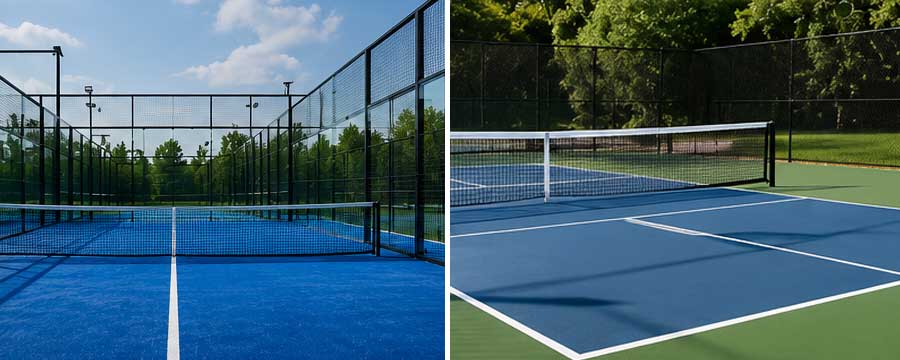
Dimensions et conception des terrains de padel et de pickleball
La différence physique entre ces deux terrains est si flagrante qu'il n'y a aucune ambiguïté dès lors qu'on les a vus tous les deux de ses propres yeux.
Un terrain de padel standard mesure 20 mètres de long × 10 mètres de large (environ 66 ft × 33 ft), soit une surface de jeu totale de 200 mètres carrés. Il est entouré de tous côtés par une combinaison de panneaux de verre trempé et de treillis métallique, avec des parois mesurant généralement entre 3 et 4 mètres de haut sur les côtés et 4 mètres à l'arrière. Le filet mesure 88 cm au centre et 92 cm au niveau des poteaux. Ce terrain clos structure d'un terrain de padel est au cœur même de la pratique de ce sport, car toutes les tactiques et stratégies du padel s'articulent autour des murs qui l'entourent.
Un terrain de pickleball est nettement plus petit : 13,4 mètres de long × 6,1 mètres de large (44 pieds × 20 pieds), sans aucun mur. Le filet est placé à 91,4 cm (36 pouces) au niveau des lignes latérales et à 86,4 cm (34 pouces) au centre. L'une des caractéristiques distinctives de ce sport est la « cuisine » — une zone de non-volée de 2,13 mètres de chaque côté du filet, dans laquelle les joueurs ne peuvent pas effectuer de volée.
Principales différences : Les terrains de padel mettent l'accent sur les coups joués en rebondissant sur les murs et sur l'amortissement, privilégiant ainsi le contrôle et la puissance. Les terrains de pickleball privilégient quant à eux la vitesse, la précision et la simplicité, avec des limites ouvertes et une surface de jeu plane et dure.
| Padel | Pickleball | |
| Longueur de la Cour | 20 m (66 ft) | 13,4 m (44 pieds) |
| Largeur de la cour | 10 m (33 ft) | 6,1 m (20 pieds) |
| Surface totale | 200 m² | 81,7 m² |
| Annexe | Verre trempé + cloisons en treillis métallique | Pas de murs |
| Hauteur nette (au centre) | 88 cm | 86,4 cm |
| Format type | En général, en double | Simple et double |
Si vous êtes responsable de la planification des installations d’un site, cette différence de taille a des implications concrètes. Un terrain de padel nécessite environ 2,5 fois la surface au sol d’un terrain de pickleball, sans compter les exigences structurelles et techniques liées à la verrière. Les terrains de pickleball, en revanche, peuvent être installés de manière plus dense — un court de tennis standard peut être transformé en quatre terrains de pickleball —, ce qui les rend particulièrement intéressants pour les salles de sport et les centres communautaires disposant d’une surface au sol limitée.
Consulter le guide des dimensions des terrains de padel
Consulter le guide des dimensions des terrains de pickleball
Surface des terrains de padel et de pickleball
C'est là que ces deux sports divergent le plus nettement d'un point de vue technique — et c'est là que le choix d'un revêtement adapté a l'impact le plus important sur la sécurité des joueurs, leurs performances et les coûts d'entretien à long terme.
Les terrains de padel sont construits sur du gazon synthétique. Il ne s’agit pas simplement d’une convention : c’est une exigence imposée par la Fédération internationale de padel (FIP) et la Fédération espagnole de padel (FEP) pour tout terrain souhaitant obtenir une certification. Le gazon naturel ne peut tout simplement pas offrir le rebond régulier de la balle, l’adhérence ou la durabilité qu’exige ce sport. Le gazon synthétique présente généralement une hauteur de poils de 10 à 15 mm ; il est composé de fibres de polyéthylène monofilament fibrillées ou bouclées, et stabilisé par un remplissage de sable de silice.
Les trois principaux types de revêtement utilisés sur les terrains de padel présentent chacun des caractéristiques techniques différentes :
- Gazon à fibres fendues offrant un toucher naturel, une durabilité exceptionnelle et un rebond de balle prévisible et régulier. Nécessite environ 17 à 18 kg/m² de sable de remplissage et est généralement plus abordable — un choix judicieux pour les terrains d'entraînement ou de loisirs.
- Le gazon texturé (ondulé) est le choix privilégié pour les terrains à forte fréquentation dans le secteur commercial, notamment pour les terrains de niveau professionnel et ceux du World Padel Tour. La structure ondulée de ses fibres retient exceptionnellement bien le sable de remplissage, ne nécessite que 7 à 8 kg/m² de sable, offre une excellente résistance au glissement et nécessite moins d'entretien tout au long de sa durée de vie.
La granulométrie du sable de remplissage a également son importance : les spécifications prévoient généralement une granulométrie comprise entre 0,2 et 0,5 mm pour garantir des caractéristiques de jeu et des performances de drainage optimales.
En revanche, les terrains de pickleball sont dotés de surfaces dures : bien que l'on utilise parfois du gazon synthétique, la pratique la plus courante consiste à appliquer un revêtement sportif acrylique sur une base en asphalte ou en béton. La couche acrylique apporte de la couleur, de la texture et un certain amorti, mais la surface sous-jacente reste rigide. En salle, le pickleball se joue souvent sur du parquet, des dalles de terrain de sport ou du vinyle amortissant.
Le gazon synthétique destiné au padel offre une absorption naturelle des chocs qui réduit la sollicitation des articulations lors des mouvements latéraux explosifs et des changements de direction brusques caractéristiques de ce sport. Les terrains de pickleball à surface dure sont plus rapides à installer et moins coûteux à l’achat, mais peuvent contribuer à la fatigue des genoux et des chevilles lors de longues séances de jeu. Alors que la population des joueurs de pickleball aux États-Unis vieillit de plus en plus, certains propriétaires et entrepreneurs testent la possibilité de jouer sur terrain de pickleball en gazon synthétique tribunaux.
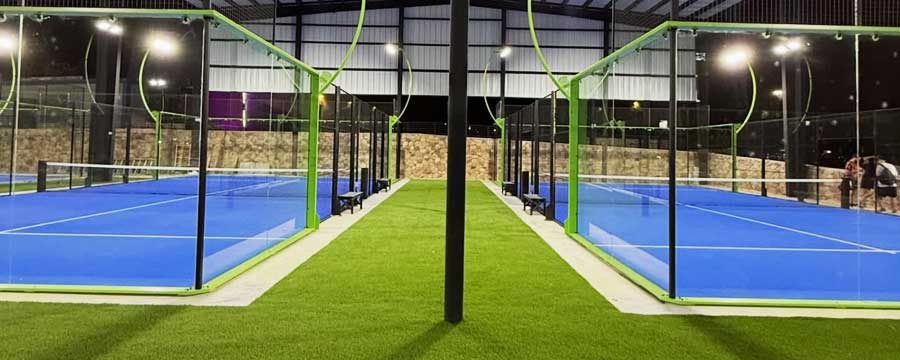
Pourquoi le choix de la surface est-il plus important qu'on ne le pense ?
Pour les exploitants de clubs, la surface de padel constitue en substance le fondement même de l’expérience globale du joueur. Si vous vous trompez — hauteur de poils inadaptée, densité de remplissage incorrecte, drainage défaillant —, vous constaterez un rebond irrégulier de la balle, des glissades des joueurs et une usure prématurée des fibres. En revanche, si tout est bien fait, une surface de padel de qualité peut offrir entre 8 et 12 ans, voire plus, de performances constantes, à condition d’être correctement entretenue.
À Herbe puissante, notre gamme de revêtements pour padel est spécialement conçue pour offrir des performances de niveau FEP. Nos options de monofilaments bouclés et de fils fibrillés sont fabriquées à partir de polyéthylène de pointe résistant aux UV, conçues pour conserver des couleurs vives et leur intégrité structurelle même après des années d’exposition au soleil en extérieur. La mémoire élastique élevée des fibres leur permet de reprendre immédiatement leur position verticale après compression, garantissant ainsi un rebond constant de la balle, échange après échange.
Notre padel turf Cette gamme offre non seulement des performances exceptionnelles certifiées FEP, mais se distingue également par une esthétique saisissante — disponible dans une large palette de couleurs telles que le bleu, le rouge, le vert, le noir, la terre cuite, le bleu arc et le violet diamant — qui est très photogénique et contribue efficacement à rehausser l'image de votre marque.
Équipement de padel et de pickleball
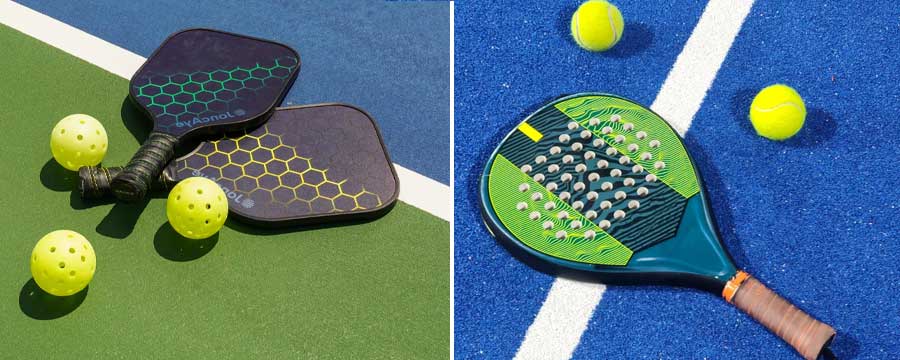
Au padel, les joueurs utilisent une raquette composite solide sans cordage, généralement fabriquée en fibre de carbone, en fibre de verre ou avec un noyau en mousse, et mesurant environ 45 à 47 cm de long. La face est perforée de trous afin de réduire la résistance à l’air. La balle est une balle en feutre dépressurisée similaire à une balle de tennis, mais dont la pression interne est légèrement inférieure (généralement entre 4,6 et 5,2 psi contre 12 à 13 psi pour le tennis), ce qui produit un rebond caractéristique, plus bas et mieux contrôlé, adapté au court fermé. Les raquettes de padel coûtent généralement entre $80 et $300 selon le niveau, les modèles professionnels en fibre de carbone étant plus onéreux.
Au pickleball, les joueurs utilisent une raquette rigide fabriquée à partir de matériaux composites, de graphite ou de polymères, mesurant environ 40 à 43 cm de long. La balle est une balle en plastique perforée et légère (semblable à une balle de wiffle) qui ne pèse que 22 à 26 grammes. Le prix des raquettes de pickleball varie de moins de $30 pour les modèles d'entrée de gamme à $150–$250 pour les modèles haut de gamme en graphite ou en fibre de carbone.
Aucun de ces deux sports ne nécessite la gestion complexe de la tension des cordes propre au tennis, ce qui contribue à rendre ces deux disciplines si accessibles aux débutants. Il suffit de prendre la raquette et de jouer.
Règles et système de score du padel et du pickleball
Comprendre le système de notation et les règles permet de mieux saisir pourquoi chaque sport procure des sensations différentes lorsqu'on le pratique.
Le système de pointage du padel est presque identique à celui du tennis : les points se comptent de 15 à 30, puis 40, et le jeu est remporté ; les jeux s'enchaînent pour former des sets, et les matchs se jouent généralement au meilleur des trois sets. Le service est effectué par en dessous, au-dessous de la taille, et la balle doit rebondir dans le carré de service. L’une des règles les plus caractéristiques : un joueur peut quitter le court par les portes latérales ouvertes pendant le jeu pour récupérer une balle qui est sortie du terrain — et tout de même remporter le point en la renvoyant dans le court.
Le système de comptage des points au pickleball est assez différent. Seule l’équipe au service peut marquer des points, et les manches se jouent généralement jusqu’à 11 points (avec deux points d’écart), bien que certains formats de tournoi prévoient parfois 15 ou 21 points. La règle du double rebond impose aux deux équipes de laisser la balle rebondir une fois avant de la renvoyer après le service. La zone de non-volée (la « cuisine ») interdit toute volée à l’intérieur de ses limites, ce qui impose un type spécifique de jeu allant de la ligne de fond à la « cuisine » et qui définit les tactiques du pickleball.
Les différences entre les règles donnent lieu à des expériences de jeu très différentes. Le padel se caractérise par des matchs plus longs et plus physiques, avec un jeu tactique contre le mur et des échanges prolongés. Les matchs de pickleball peuvent être plus rapides et plus frénétiques, la « kitchen » donnant lieu à une lutte pour la position au filet qui s'apparente à une partie d'échecs.
Points communs entre le padel et le pickleball
À la base, le padel et le pickleball sont deux sports distincts qui ont toutefois un ancêtre commun : le tennis. Les terrains de ces deux sports sont séparés par un filet bas, et tous deux sont réputés pour leurs échanges spectaculaires, intenses et prolongés.
Ces deux sports se pratiquent principalement en double, ce qui les rend intrinsèquement conviviaux. Il faut un partenaire, on rencontre souvent des inconnus au club, et ce format favorise naturellement la création d’une communauté. Ces deux sports sont nettement plus accessibles que le tennis pour les débutants : le terrain à couvrir est plus petit, la vitesse de la balle est moins élevée au début et la courbe d’apprentissage pour atteindre un niveau compétitif est plus courte. Ils suscitent tous deux un vif intérêt chez les anciens joueurs de tennis à la recherche d’une alternative sociale et moins intense physiquement.
Ces deux sports se prêtent également très bien à des matchs regroupant des joueurs d'âges et de niveaux variés, ce qui permet aux clubs d'être occupés tout au long de la semaine, et non plus uniquement aux heures de pointe.
Popularité du padel et du pickleball à travers le monde
Le padel et le pickleball ont tous deux connu une croissance rapide à l'échelle mondiale, mais leur popularité se concentre dans des régions différentes.
- Le pickleball reste le sport de raquette le plus populaire en Amérique du Nord — notamment aux États-Unis et au Canada — où le nombre de pratiquants a explosé au cours des cinq dernières années ; on estime que ce sport compte plus de 24 millions de pratiquants rien qu'aux États-Unis.
- Le padel bénéficie d'une présence internationale plus étendue, puisqu'il a acquis une grande popularité en Europe et en Amérique latine, notamment en Espagne, en Italie, en Suède et en Argentine. Aujourd'hui, ce sport s'est développé dans plus de 130 pays à travers le monde et compte plus de 30 millions de pratiquants.
Les joueurs accordant de plus en plus d'importance à l'accessibilité, à l'engagement social et à la flexibilité des activités de loisirs, de nombreux promoteurs et clubs sportifs construisent des installations polyvalentes combinant des terrains de padel et de pickleball. Ce modèle permet à votre complexe sportif de séduire un public plus large tout en optimisant l'utilisation des installations.
Conclusion
Le padel et le pickleball sont tous deux des sports à part entière, en pleine expansion, qui comptent des communautés de pratiquants passionnés. Ils ne se disputent pas les mêmes terrains, mais les mêmes moments de loisirs, et tous deux en sortent gagnants.
MightyGrass s'engage à fournir des systèmes de gazon synthétique de haute qualité destinés aux clubs sportifs, aux terrains multisports scolaires et aux installations professionnelles de padel et de pickleball à travers le monde. Nous sommes pleinement conscients que les surfaces de jeu doivent résister aux rigueurs d'une utilisation intensive, année après année, tout en offrant en permanence des performances exceptionnelles.
Si vous construisez un terrain de padel ou de pickleball, ou si vous souhaitez discuter des différentes options de revêtement, contactez l'équipe MightyGrass. Nous vous proposerons le gazon synthétique le mieux adapté à votre climat, à votre fréquence d'utilisation et à votre budget — et ferons en sorte que votre terrain soit prêt à l'emploi dès le premier jour.
FAQ
Padel ou pickleball : lequel choisir ?
En fin de compte, le choix entre le padel et le pickleball dépend de vos préférences personnelles, de votre niveau, de la disponibilité des terrains et de vos objectifs sportifs. Ces deux sports sont faciles à pratiquer, très conviviaux et permettent de faire de l'exercice de manière agréable, mais le choix qui vous conviendra le mieux dépendra du type d'expérience sportive que vous recherchez.
Pensez au padel si :
- Vous appréciez les matchs stratégiques au rythme effréné qui font appel aux rebonds sur les murs.
- Vous aimez le tennis, mais vous recherchez une alternative plus conviviale et plus accessible.
- Vous souhaitez développer votre puissance, vos effets et vos réflexes.
Pensez au pickleball si :
- Vous préférez un jeu au rythme plus lent, qui met l'accent sur la tactique et la précision des tirs.
- Vous recherchez un sport à faible impact adapté à tous les âges.
- Vous aimez les jeux qui se pratiquent sur des terrains plus petits et qui sont faciles à apprendre.
Quels sont les coups les plus courants au padel et au pickleball ?
Ces deux sports font appel au service, à la volée, au lob et au smash, mais leurs styles de jeu diffèrent considérablement. Les joueurs de padel s'appuient souvent sur les rebonds contre le mur, les « bandejas » et les « viboras » pour prolonger les échanges et créer des occasions d'attaque. Les joueurs de pickleball utilisent généralement des « dinks », des « third-shot drops » et des volées contrôlées pour se positionner au filet. Par conséquent, le padel se caractérise généralement par des échanges plus rapides et un jeu contre le mur, tandis que le pickleball met l'accent sur la précision, la stratégie et le toucher.
En quoi le padel diffère-t-il du paddle-tennis ?
On confond souvent ces deux sports en raison de la similitude de leurs noms, mais ils sont en réalité très différents. Le padel se joue sur un terrain clos dont les parois en verre font partie intégrante du jeu, permettant à la balle de rebondir et de prolonger l'échange. Le paddle-tennis se joue généralement sur un terrain ouvert, sans parois, et obéit à des règles différentes. Les raquettes, la configuration du terrain et le style de jeu en général sont également différents.
Qu'est-ce qui est le plus facile, le padel ou le pickleball ?
Si vous n'avez jamais pratiqué de sport de raquette auparavant, sachez que la plupart des gens trouvent le pickleball plus facile à prendre en main. Le terrain est plus petit, la balle roule un peu moins vite, et les débutants peuvent très rapidement prendre plaisir à enchaîner les échanges. Le padel présente une courbe d'apprentissage légèrement plus raide, car les joueurs doivent comprendre comment utiliser les murs, mais de nombreux joueurs de tennis s'y adaptent presque immédiatement. Au final, ces deux sports sont conçus pour être ludiques et accessibles à tous les âges.
Quelle est la principale différence entre une raquette de padel et une raquette de pickleball ?
La principale différence réside dans la conception. Une raquette de padel est plus épaisse, présente des trous percés sur la face et est conçue pour frapper une balle sous pression. Une raquette de pickleball, quant à elle, possède une surface plane et pleine et s'utilise avec une balle légère en plastique percée de trous. L'équipement étant spécialement conçu pour chaque sport, l'un ne peut pas remplacer efficacement l'autre.
Est-ce que je peux jouer au pickleball sur un court de tennis ?
Oui, et de nombreux clubs le font déjà. Comme un court de tennis est bien plus grand qu’un terrain de pickleball, il est possible de le transformer en y ajoutant les lignes de pickleball et en utilisant un filet portable ou fixe. En effet, il est courant d’aménager plusieurs (2 à 4) terrains de pickleball sur la surface d’un seul terrain de tennis, ce qui en fait une option très prisée pour les installations collectives.
Est-ce que je peux jouer au padel sur un court en gazon synthétique ?
Tout à fait. Le gazon synthétique est en effet le revêtement standard utilisé pour la plupart des terrains de padel professionnels et amateurs à travers le monde. Associé à un remplissage de sable de silice, il offre une adhérence fiable, un rebond régulier de la balle et un excellent drainage, ce qui permet au terrain de rester performant quelles que soient les conditions météorologiques.
Est-ce que je peux jouer au pickleball sur un terrain en gazon synthétique ?
C'est possible, mais ce n'est généralement pas le meilleur choix. Le pickleball est conçu pour être pratiqué sur des surfaces dures et lisses, telles que le béton recouvert d'acrylique ou l'asphalte, où la balle rebondit de manière régulière. Sur le gazon artificiel, le rebond a tendance à être plus faible et moins prévisible ; bien que cette surface convienne à une pratique occasionnelle, elle n'offre pas l'expérience de jeu attendue pour les matchs officiels.


