
 Nederlands
  English
  العربية
  Español
  Deutsch
  Français
  Português
  Русский
  日本語
日本語  Italiano
  Svenska
  Suomi
Suomi  ไทย
ไทย  Dansk
Dansk  Ελληνικά
  Bahasa Melayu
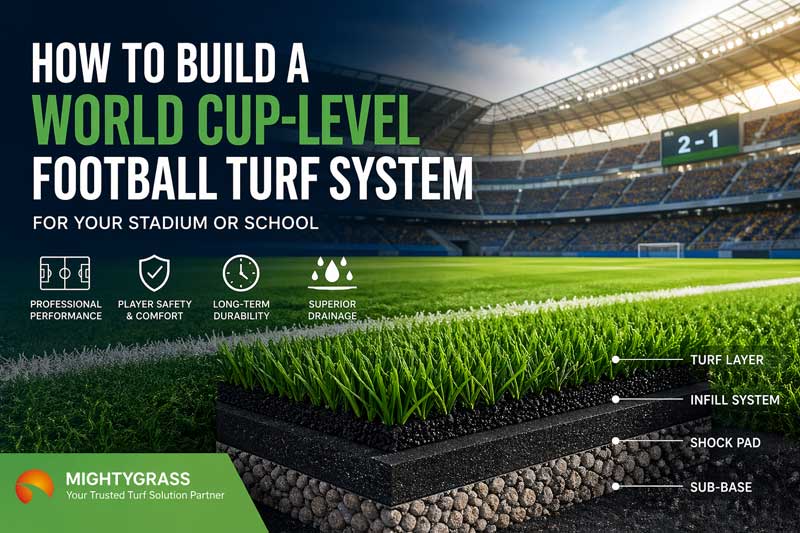
Wanneer je begint met het ontwerpen van een voetbalveld, is het verleidelijk om je te richten op wat mensen zien: verlichting, tribunes, huisstijl of zelfs de kleur van het kunstgras. Maar in het professionele voetbal wordt de werkelijke kwaliteit van een veld bepaald door iets dat veel minder zichtbaar is: het systeem eronder.
Een voetbalveld van WK-niveau ontstaat niet alleen door de keuze voor een hoogwaardig kunstgrasproduct. Een veld van WK-niveau wordt aangelegd als een gelaagd systeem met gecontroleerde prestatiekenmerken – van de rol van de bal tot de schokdemping. En hoewel deze velden worden aangelegd voor toernooien op topniveau, zijn de onderliggende technische principes absoluut toepasbaar op stadions, scholen en trainingsfaciliteiten.
In deze handleiding leer je hoe je op professionele wijze voetbalgrassystemen zijn opgezet – en hoe u dat kwaliteitsniveau kunt evenaren voor uw eigen stadion, school of trainingscentrum.
Wat kenmerkt een voetbalgrasmat van WK-niveau?
In het profvoetbal wordt de kwaliteit van het speelveld niet beoordeeld op basis van het uiterlijk, maar gemeten aan de hand van de prestaties.
Sportvelden van topklasse zijn zo ontworpen dat ze voldoen aan specifieke technische normen, zoals:
| Belangrijke prestatiefactor | FIFA-referentiebereik | Waarom dit voor u van belang is |
| Kogelrol | 4-8 m | Zorgt voor een realistische spelsnelheid en een consistente balcontrole |
| Schokabsorptie | 55%–70% | Vermindert het risico op blessures bij sporten met veel impact |
| Energieteruggave | 30%–50% | Verbetert de wendbaarheid en reactievermogen van de speler |
| Verticale vervorming | 4-10 mm | Zorgt voor de juiste balans tussen comfort en stabiliteit in het veld |
Deze waarden zijn niet willekeurig. Ze hebben een directe invloed op de manier waarop het spel wordt gespeeld.
- Als de bal te snel rolt, verlies je de controle.
- Als de schokdemping te laag is, neemt het risico op blessures toe.
- Als de energieteruggave niet constant is, raakt de speler sneller vermoeid.
Wat een voetbalgrasmat van WK-niveau onderscheidt van een standaardveld, is het vermogen om deze prestatieniveaus consistent te handhaven – over elke vierkante meter en gedurende jarenlang gebruik.
Een dergelijke consistentie kan alleen worden bereikt door middel van een goed ontworpen systeem, en niet door afzonderlijke materialen op zichzelf te kiezen.
Een structuur op WK-niveau achter de kunstgrasvelden in het profvoetbal
Van een afstand gezien lijken alle kunstgrasvelden op elkaar. Vanuit technisch oogpunt is het verschil tussen een doorsnee installatie en een systeem van professionele kwaliteit echter aanzienlijk.
Een hoogwaardig voetbalgrasveld bestaat uit vier functionele lagen, die elk verantwoordelijk zijn voor een specifiek onderdeel van de algehele prestaties.
Aanleg van kunstgras voor voetbal
De kunstgraslaag is het punt waar de interactie met de spelers begint, maar de rol ervan reikt veel verder dan alleen het esthetische aspect.
Belangrijke structurele parameters bepalen hoe het veld presteert:
- Paalhoogte, doorgaans tussen 40 en 60 mm voor voetbal
- Steekdichtheid, die van invloed is op de duurzaamheid en de balreactie
- Vezelstructuur, die van invloed is op veerkracht, warmtebehoud en herstel
Moderne stadionsystemen maken steeds vaker gebruik van geavanceerde vezelontwerpen, zoals versterkt monofilament of S-vormige garens, die de elasticiteit verbeteren en ervoor zorgen dat de matten bij intensief gebruik op de lange termijn minder snel plat worden.
In warme klimaten of omgevingen waar intensief gebruik plaatsvindt, wordt warmtebeheer een andere cruciale factor. Technologieën zoals holle vezelstructuren helpen de opbouw van oppervlaktetemperatuur te verminderen en het comfort van de speler tijdens langdurig spel te verbeteren.
Ook hier speelt productiecapaciteit een belangrijke rol. Leveranciers die zelf garen extruderen en producten ontwikkelen, zoals MachtigGras—kunnen de sterkte, vorm en prestaties van de vezels nauwkeurig afstemmen op de projectvereisten, in plaats van terug te vallen op gestandaardiseerde, kant-en-klare materialen.
Invulsysteem
Terwijl de graslaag het oppervlak bepaalt, bepaalt het vulmateriaalsysteem hoe het zich tijdens het spel gedraagt.
Een typisch kunstgrasveld voor voetbal bestaat uit een combinatie van silicazand voor de structurele ondersteuning en rubber of organische materialen voor demping en veerkracht. De totale vuldiepte ligt doorgaans tussen de 20 en 30 mm, afhankelijk van het beoogde ontwerp.
Invulling is echter niet zomaar een vulmiddel — het is een onderdeel dat cruciaal is voor de prestaties.
Het bepaalt hoe diep de voet van een speler in contact komt met het oppervlak, hoe stabiel de voetstand aanvoelt bij snelle bewegingen en hoe de bal reageert na de balcontact.
Een systeem waarin te weinig vloeistof zit, voelt vaak onstabiel aan en slijt snel.
Een te vol systeem kan het spel vertragen en de reactiesnelheid verminderen.
Professionele systemen worden zorgvuldig gekalibreerd om deze variabelen in evenwicht te brengen, zodat het veld onder alle omstandigheden een natuurlijke, voorspelbare speelervaring biedt.
Schokdemper
Onder het gras en de opvulmaterialen bevindt zich een van de belangrijkste onderdelen van een professioneel voetbalgrasveld: de schokdempende laag.
De belangrijkste functie ervan is het opvangen van schokken en het verdelen van de kracht, wat in belangrijke mate bijdraagt aan de algehele schokdempende prestaties van het systeem.
In veel veeleisende toepassingen is het schokdempingskussen verantwoordelijk voor het behalen van het beoogde stootdempingsbereik van 55%–70%. Zonder dit kussen is het systeem sterk afhankelijk van de vulling alleen, wat leidt tot een snellere prestatievermindering en verminderde veiligheid op de lange termijn.
Wat nog belangrijker is: een goed ontworpen schokdemper zorgt voor consistentie.
Het zorgt ervoor dat de prestaties over het hele veld gelijk blijven, zelfs na jarenlang intensief gebruik.
Voor toepassingen met een hoge gebruiksfrequentie, zoals schoolvelden, trainingsfaciliteiten of multifunctionele stadions, is de schokdempende onderlaag geen extraatje, maar een vereiste.
Onderlaag
Zelfs het meest geavanceerde grasmatten-systeem kan niet naar behoren functioneren als de ondergrond eronder onvoldoende is.
De onderlaag speelt een cruciale rol bij de afwatering, stabiliteit en duurzaamheid op lange termijn. Bij de meeste professionele aanlegwerkzaamheden wordt gebruikgemaakt van een verdichte onderlaag van steenslag of een asfaltlaag, in combinatie met een gecontroleerde hellingshoek (doorgaans tussen 0,5% en 1%) om een efficiënte waterafvoer te garanderen.
Een slechte fundering is een van de meest voorkomende oorzaken van defecten in het veld.
Problemen zoals waterophoping, onregelmatige balbewegingen en voortijdige slijtage van het systeem zijn vaak het gevolg van een onjuiste voorbereiding van de ondergrond en niet zozeer van de kwaliteit van het kunstgras.
Daarom doen ervaren systeemleveranciers meer dan alleen materialen leveren.
Ze bieden aanbevelingen voor geïntegreerde systemen, waaronder richtlijnen voor het ontwerp van funderingen die zijn afgestemd op de lokale klimaatomstandigheden, bodemkenmerken en gebruiksfrequentie.
Belangrijkste ontwerpparameters van MightyGrass voor echte FIFA-velden
Zodra je de structuur van het systeem begrijpt, is de volgende stap ervoor te zorgen dat de prestatieparameters daadwerkelijk zijn gedefinieerd – en niet alleen worden verondersteld.
Dit is waar veel projecten uit de koers raken. De systeemlagen mogen dan wel ‘compleet’ zijn, maar het veld presteert nog steeds niet zoals verwacht, simpelweg omdat niemand de streefwaarden van tevoren vast heeft gelegd. Vanuit een praktisch, operationeel perspectief bieden wij u de parameters voor FIFA-gecertificeerde kunstgrasvelden, afkomstig uit daadwerkelijke installatieprojecten van MightyGrass:
| Item | MT-Ubest (40 mm) | MT-Ubest (50 mm) | MT-Diamant (60 mm) |
| Poolhoogte | 40 mm | 50 mm | 60 mm |
| Dikte | 12.600 steken/m² | 10.500 steken/m² | 12.600 steken/m² |
| DTEX | 10.000 / 4e verdieping | 10.000 / 4e verdieping | 10.000 / 6F |
| Kiezelzand opvulling | 20 kg/m² | 26 kg/m² | 10 kg/m² |
| Hoeveelheid rubbervulling | 6 kg/m² | 6 kg/m² | 15 kg/m² |
Maar de cijfers alleen zijn niet de oplossing.
Het gaat erom hoe deze parameters in het hele systeem op elkaar zijn afgestemd.
Als je bijvoorbeeld de hoogte van de pinnen verhoogt zonder de vuldiepte aan te passen, wordt het speelveld te zacht. Het verbeteren van de schokdemping zonder rekening te houden met de energieteruggave kan het spel vertragen.
Daarom is het juist het afstemmen op systeemniveau – en niet zozeer de keuze van afzonderlijke componenten – wat een professionele installatie kenmerkt.
Hoe je een systeem op WK-niveau aanpast aan je eigen project
Niet elk veld hoeft te voldoen aan de eisen van een toernooistadion, maar elk veld heeft er baat bij om volgens dezelfde systeemlogica te worden ontworpen.
Het komt erop aan die logica aan te passen aan je concrete gebruikssituatie, in plaats van specificaties klakkeloos over te nemen.
| Type project | Systeemfocus | Veelvoorkomende aanpassingen | Wat dit voor u betekent |
| Stadionprojecten | Consistente prestaties en professioneel spel | Hogere grasdichtheid, nauwkeurig afgestelde vulverhouding, volledige integratie van schokdempende matten | Je bouwt met het oog op wedstrijdomstandigheden, dus het systeem moet op de lange termijn stabiel blijven – het mag er niet alleen op de openingsdag goed uitzien |
| Scholen en gemeenschapsvelden | Duurzaamheid en weinig onderhoud | Veerkrachtigere vezelstructuren, evenwichtige vulling, versterkte schokdemper | Het veld zal dagelijks intensief worden gebruikt, dus betrouwbaarheid op lange termijn is belangrijker dan topprestaties |
| Opleiding en sectoren met een hoge werkdruk | Herstelsnelheid en plaatselijke slijtvastheid | Versterkte zones met intensief gebruik, geoptimaliseerde verdeling van de vulling, grasvezels die snel herstellen | Het oppervlak moet na herhaalde oefeningen snel weer in vorm komen, en niet alleen tijdens wedstrijden goed presteren |
| Multifunctionele velden | Evenwicht tussen veelzijdigheid en veiligheid | Matige tufhoogte, flexibel opvulsysteem, verbeterde schokdemping | Je ontwerpt voor gemengde activiteiten, dus het systeem moet verschillende gebruikspatronen aankunnen zonder dat dit ten koste gaat van de kwaliteit |
Hoe MightyGrass de aanleg van grasvelden van wereldklasse ondersteunt
Bij de aanleg van een professioneel voetbalveld gaat het niet om het inkopen van onderdelen, maar om ervoor te zorgen dat alle lagen onder reële omstandigheden en op de lange termijn als één systeem samenwerken.
Op dit punt pakt MightyGrass het anders aan.
In plaats van ons uitsluitend te richten op de levering van graszodenrollen, ligt onze prioriteit bij het helpen realiseren van een ondergrond die vanaf de eerste dag tot en met langdurig gebruik voorspelbare prestaties levert.
- Systeemgebaseerde ontwerpondersteuning: afstemming van de configuraties van kunstgras, vulmateriaal en schokdempende onderlagen op basis van uw projecttype, gebruiksfrequentie en prestatiedoelstellingen — zodat u de onderdelen niet op goed geluk in elkaar zet
- Interne productiecontrole: van garenextrusie tot de productie van de drager – elke belangrijke stap vindt plaats binnen één enkel productiesysteem, wat een strengere kwaliteitscontrole en consistentere prestaties mogelijk maakt
- Door de FIFA goedgekeurde fabrikanten van kunstgras: De geselecteerde kunstgrassystemen zijn getest en gecertificeerd volgens de FIFA Quality- en FIFA Quality Pro-normen, waardoor wordt gewaarborgd dat prestatie-indicatoren zoals balrolgedrag, schokdemping en duurzaamheid voldoen aan de eisen op professioneel niveau
- Flexibiliteit op het gebied van OEM en maatwerk: het aanpassen van vezelstructuren, dichtheden, verpakkingen en systeemaanbevelingen aan lokale klimaatomstandigheden, projectbudgetten en toepassingsscenario’s
- Wereldwijde projectervaring met lokale ondersteuning: ondersteuning bij installaties in stadions, scholen en trainingsvelden in verschillende markten, met een magazijn in de VS om doorlooptijden te verkorten en de logistiek te vereenvoudigen
Wat dit uiteindelijk voor uw project betekent, is niet alleen toegang tot gecertificeerde producten, maar ook toegang tot een systeem dat is ontworpen, getest en aangepast voor gebruik in de praktijk.
Als je het budget voor je project aan het opstellen bent, kun je het volgende controleren onze gedetailleerde gids met een kostenoverzicht.
Conclusie
Een voetbalgrasmat op WK-niveau: je hoeft de specificaties van een stadion niet exact na te bootsen, maar je moet wel de systeemlogica erachter nabootsen.
Zodra je de overstap maakt van productgericht denken naar systeemgericht ontwerpen, wordt het aanleggen van een voetbalveld van professionele kwaliteit een gestructureerd en voorspelbaar proces – of het nu gaat om een stadion, een school of een trainingscomplex.
In de praktijk is dat precies wat het verschil maakt tussen een standaardinstallatie en een echt professioneel speelveld.
Laat een op maat gemaakt kunstgrasveld voor voetbal ontwerpen, speciaal voor uw project. Of je nu een stadion plant, een schoolveld wilt opknappen of een intensief gebruikt trainingsveld wilt aanleggen: je kunt werken met een systeem dat op maat is gemaakt – en niet geïmproviseerd.
Veelgestelde vragen
Waarom is een schokdempende onderlaag belangrijk bij kunstgrasvelden voor voetbal?
Een schokdempende onderlaag zorgt voor een betere schokabsorptie, vermindert het risico op blessures en draagt bij aan het behoud van constante prestaties op de lange termijn. Dit is met name belangrijk voor velden die intensief worden gebruikt, zoals op scholen en in trainingscentra.
Hoe lang gaat een professioneel voetbalgrasveld mee?
Bij een correcte aanleg en goed onderhoud gaat een hoogwaardig kunstgrasveld voor voetbal doorgaans 8 tot 12 jaar mee. Het ontwerp van het systeem, de gebruiksintensiteit en de klimatologische omstandigheden zijn allemaal van invloed op de levensduur.
Wat is het verschil tussen kunstgrasinstallaties voor stadions en scholen?
Stadionsystemen zijn gericht op consistente prestaties en wedstrijdomstandigheden, terwijl schoolsystemen de nadruk leggen op duurzaamheid, minder onderhoud en veiligheid bij intensief gebruik.


