
 Français
  English
  العربية
  Español
  Deutsch
  Português
  Русский
  日本語
日本語  Italiano
  Nederlands
  Svenska
  Suomi
Suomi  ไทย
ไทย  Dansk
Dansk  Ελληνικά
  Bahasa Melayu
Lorsqu'on commence à planifier un terrain de football, il est tentant de se concentrer sur ce que les gens voient - l'éclairage, les sièges, la marque ou même la couleur du gazon. Mais dans le football professionnel, la véritable qualité d'un terrain est définie par quelque chose de beaucoup moins visible : le système qui se trouve en dessous.
Un terrain de football de niveau Coupe du monde ne se crée pas en sélectionnant uniquement un produit de gazon synthétique de qualité supérieure. Un terrain de niveau Coupe du Monde est construit comme un système en couches avec des performances contrôlées - du roulement de la balle à l'absorption des chocs. Et bien que ces terrains soient construits pour des tournois d'élite, les principes d'ingénierie sous-jacents sont absolument transférables aux stades, aux écoles et aux installations d'entraînement.
Dans ce guide, vous apprendrez comment les professionnels systèmes de pelouse pour le football et comment vous pouvez reproduire ce niveau de qualité dans votre propre stade, école ou centre d'entraînement.
Qu'est-ce qui définit un système de pelouse de football de niveau Coupe du monde ?
Dans le football professionnel, la qualité de la surface n'est pas jugée sur l'apparence, mais sur la performance.
Les terrains des stades de haut niveau sont conçus pour répondre à des critères techniques spécifiques, tels que
| Facteur clé de performance | Gamme de référence de la FIFA | Pourquoi c'est important pour vous |
| Rouleau de billes | 4-8 m | Assure une vitesse de jeu réaliste et un contrôle constant du ballon |
| Absorption des chocs | 55%-70% | Réduit le risque de blessure lors des jeux à fort impact |
| Restitution de l'énergie | 30%-50% | Améliore l'agilité et la réactivité des joueurs |
| Déformation verticale | 4-10 mm | Offre un bon équilibre entre le confort et la stabilité sur le terrain |
Ces valeurs ne sont pas arbitraires. Elles influencent directement le déroulement du jeu.
- Si le roulement de la balle est trop rapide, le contrôle est perdu.
- Si l'absorption des chocs est trop faible, le risque de blessure augmente.
- Si le retour d'énergie est irrégulier, la fatigue du joueur s'accélère.
Ce qui distingue un système de gazon de football de niveau Coupe du monde d'un terrain standard, c'est la capacité à maintenir ces performances de manière constante, sur chaque mètre carré et au fil des années d'utilisation.
Ce niveau de cohérence ne peut être atteint que par le biais d'un système correctement conçu, et non par la sélection de matériaux individuels isolés.
Structure de niveau Coupe du monde derrière les systèmes de pelouse pour le football professionnel
De loin, tous les terrains de football artificiels se ressemblent. Cependant, d'un point de vue technique, la différence entre une installation moyenne et un système de qualité professionnelle est significative.
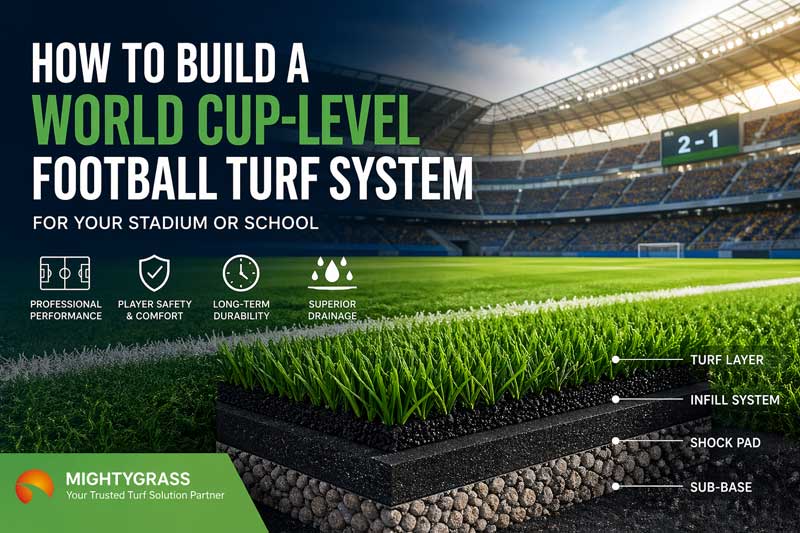
Un système de pelouse de football de haute performance est construit en quatre couches fonctionnelles, chacune responsable d'une partie spécifique de la performance globale.
Football Turf Laye
La couche de gazon synthétique est le point de départ de l'interaction avec le joueur, mais son rôle va bien au-delà de l'esthétique.
Les paramètres structurels clés déterminent les performances du champ :
- Hauteur des pieux, généralement entre 40 et 60 mm pour le football
- Densité des points, affectant la durabilité et la réponse de la balle
- La structure des fibres, qui influe sur la résilience, la rétention de la chaleur et la récupération.
Les systèmes de stades modernes reposent de plus en plus sur des fibres de conception avancée, telles que des monofilaments renforcés ou des fils en forme de S, qui améliorent l'élasticité et réduisent l'aplatissement à long terme en cas d'utilisation intensive.
Dans les climats chauds ou les environnements à forte utilisation, la gestion de la chaleur devient un autre facteur critique. Des technologies telles que les structures en fibres creuses permettent de réduire l'accumulation de la température de surface et d'améliorer le confort des joueurs pendant les périodes de jeu prolongées.
C'est également à ce niveau que la capacité de production est importante. Les fournisseurs disposant d'un service interne d'extrusion de fil et de développement de produits, comme les Herbe puissante-sont capables d'affiner la résistance, la forme et les performances des fibres en fonction des exigences du projet, plutôt que de s'appuyer sur des matériaux standardisés et disponibles dans le commerce.
Système de remplissage
Alors que la couche de gazon définit la surface, le système de remplissage définit la façon dont elle se comporte sous le jeu.
Un système de gazon de football typique utilise une combinaison de sable siliceux pour le soutien structurel et de caoutchouc ou de matériaux organiques pour l'amortissement et la réactivité. La profondeur totale du remplissage se situe généralement entre 20 et 30 mm, en fonction de l'objectif de conception.
Cependant, le remplissage n'est pas un simple élément de remplissage, c'est un élément essentiel à la performance.
Il contrôle la profondeur de l'interaction entre le pied du joueur et la surface, la stabilité du pied lors des mouvements rapides et la réaction du ballon après l'impact.
Un système insuffisamment rempli est souvent instable et s'use rapidement.
Un système trop rempli peut ralentir le jeu et réduire la réactivité.
Les systèmes professionnels sont soigneusement calibrés pour équilibrer ces variables, garantissant ainsi que le terrain offre une expérience de jeu naturelle et prévisible dans toutes les conditions.
Amortisseur
Sous le gazon et le remplissage se trouve l'un des composants les plus importants d'un système de gazon de football professionnel : l'amortisseur.
Sa fonction première est d'absorber les chocs et de répartir les forces, contribuant ainsi de manière significative à la performance globale du système en matière d'absorption des chocs.
Dans de nombreux domaines à haute performance, le tampon antichoc est responsable de l'obtention de la plage d'atténuation d'impact cible 55%-70%. Sans lui, le système dépend fortement du remplissage seul, ce qui entraîne une dégradation plus rapide des performances et une réduction de la sécurité à long terme.
Plus important encore, un amortisseur bien conçu garantit la cohérence.
Il permet de maintenir une performance uniforme sur l'ensemble du champ, même après des années d'utilisation intensive.
Pour les applications à haute fréquence telles que les terrains d'école, les installations d'entraînement ou les stades à usage multiple, l'amortisseur n'est pas une amélioration, c'est une exigence.
Sous-base
Même le système de gazon le plus avancé ne peut pas fonctionner correctement si les fondations sont inadéquates.
La couche de fondation joue un rôle essentiel dans le drainage, la stabilité et la durabilité à long terme. La plupart des installations professionnelles utilisent une base en pierre concassée compactée ou une couche d'asphalte, combinée à une pente contrôlée (généralement entre 0,5% et 1%) pour assurer un écoulement efficace de l'eau.
Une mauvaise construction de la base est l'une des causes les plus courantes de défaillance du champ.
Les problèmes tels que l'accumulation d'eau, le mouvement irrégulier de la balle et la dégradation prématurée du système proviennent souvent d'une mauvaise préparation de la base plutôt que de la qualité du gazon.
C'est pourquoi les fournisseurs de systèmes expérimentés ne se contentent pas de fournir des matériaux.
Ils proposent des recommandations de systèmes intégrés, y compris des conseils de conception de base adaptés aux conditions climatiques locales, aux caractéristiques du sol et à la fréquence d'utilisation.
Paramètres de conception clés de MightyGrass pour les terrains de la FIFA
Une fois que vous avez compris la structure du système, l'étape suivante consiste à s'assurer que les paramètres de performance sont réellement définis, et non supposés.
C'est là que de nombreux projets dérivent. Les couches du système sont peut-être "terminées", mais le terrain ne fonctionne toujours pas comme prévu, simplement parce que personne n'a fixé les valeurs cibles à l'avance. D'un point de vue opérationnel pratique, nous vous fournissons les paramètres de terrains de football certifiés par la FIFA, tirés de projets d'installation réels de MightyGrass :
| Objet | MT-Ubest (40 mm) | MT-Ubest (50 mm) | MT-Diamant (60 mm) |
| Hauteur des poils | 40 mm | 50 mm | 60 mm |
| Densité | 12 600 points/m² | 10 500 points/m² | 12 600 points/m² |
| DTEX | 10,000 / 4F | 10,000 / 4F | 10,000 / 6F |
| Remplissage en sable de silice | 20 kg/m² | 26 kg/m² | 10 kg/m² |
| Remplissage en caoutchouc Quantité | 6 kg/m² | 6 kg/m² | 15 kg/m² |
Mais les chiffres seuls ne sont pas la solution.
Ce qui importe, c'est la manière dont ces paramètres sont adaptés à l'ensemble du système.
Par exemple, l'augmentation de la hauteur des pieux sans ajustement de la profondeur du remblai adoucira trop le terrain. Améliorer l'absorption des chocs sans tenir compte du retour d'énergie peut ralentir le jeu.
C'est pourquoi la mise au point du système - plutôt que la sélection des composants - est ce qui définit une installation professionnelle.

Comment adapter un système de niveau Coupe du monde à votre projet actuel ?
Tous les terrains n'ont pas besoin de correspondre à un stade de tournoi, mais tous les terrains ont intérêt à être conçus selon la même logique.
L'essentiel est d'adapter cette logique à votre scénario d'utilisation réel, plutôt que de copier aveuglément les spécifications.
| Type de projet | L'accent sur le système | Ajustements typiques | Ce que cela signifie pour vous |
| Projets de stades | Cohérence des performances et jeu professionnel | Densité de gazon plus élevée, ratio de remplissage calibré, intégration complète des amortisseurs. | Vous construisez pour des conditions de match, le système doit donc rester stable dans le temps et ne pas se contenter d'être beau le jour de l'ouverture. |
| Écoles et terrains communautaires | Durabilité et faible entretien | Structures de fibres plus résistantes, remplissage équilibré, amortisseur de chocs renforcé | Le terrain sera soumis à un usage quotidien intensif, de sorte que la fiabilité à long terme est plus importante que les performances maximales. |
| Formation et domaines à forte utilisation | Vitesse de récupération et résistance à l'usure localisée | Zones de passage renforcées, répartition optimisée du remplissage, fibres de gazon à récupération rapide | La surface doit rebondir rapidement après des exercices répétés et ne pas se contenter d'être performante pendant les matches. |
| Champs à usages multiples | Équilibre entre polyvalence et sécurité | Hauteur modérée des poils, système de remplissage adaptable, meilleure absorption des chocs | Vous concevez pour des activités mixtes, le système doit donc gérer différents modèles d'utilisation sans compromis. |
Comment MightyGrass soutient les constructions de systèmes de gazon de classe mondiale
Construire un terrain de football professionnel ne consiste pas à s'approvisionner en composants, mais à s'assurer que chaque couche fonctionne comme un système, dans des conditions réelles, au fil du temps.
C'est là que MightyGrass aborde les choses différemment.
Plutôt que de se concentrer uniquement sur la livraison de rouleaux de gazon, la priorité est de vous aider à construire une surface dont les performances sont prévisibles du premier jour à l'utilisation à long terme.
- Une aide à la conception basée sur le système : Adaptation des configurations de gazon, de remplissage et d'amortisseurs en fonction du type de projet, de la fréquence d'utilisation et des objectifs de performance, afin de ne pas assembler les composants à l'aveuglette.
- Contrôle de la fabrication en interne : De l'extrusion du fil à la production du support, chaque étape clé est gérée au sein d'un système de production unique, ce qui permet un contrôle de qualité plus strict et des performances plus constantes.
- Fabricants de gazon artificiel approuvés par la FIFA: Les systèmes de pelouse sélectionnés sont testés et certifiés pour répondre aux normes FIFA Quality et FIFA Quality Pro, ce qui garantit que les critères de performance tels que le roulement du ballon, l'absorption des chocs et la durabilité sont alignés sur les exigences du niveau professionnel.
- Flexibilité des OEM et de la personnalisation : Ajustement des structures de fibres, des densités, de l'emballage et des recommandations du système en fonction des conditions climatiques locales, des budgets du projet et des scénarios d'application.
- Une expérience de projet mondiale avec une assistance locale : Prise en charge des installations dans les stades, les écoles et les terrains d'entraînement sur différents marchés, avec un entreposage aux États-Unis pour réduire les délais et simplifier la logistique.
En fin de compte, cela signifie pour votre projet non seulement l'accès à des produits certifiés, mais aussi l'accès à un système qui a été conçu, testé et adapté à des applications réelles.
Si vous planifiez le budget de votre projet, vous pouvez vérifier notre guide détaillé de ventilation des coûts.
Conclusion
Pour un système de pelouse de football de niveau Coupe du monde, il n'est pas nécessaire de reproduire exactement les spécifications d'un stade, mais il faut reproduire la logique du système qui le sous-tend.
Une fois que l'on passe d'une conception basée sur le produit à une conception basée sur le système, la construction d'un terrain de football de qualité professionnelle devient un processus structuré et prévisible, qu'il s'agisse d'un stade, d'une école ou d'un centre d'entraînement.
Dans la pratique, c'est ce qui différencie une installation standard d'une surface de jeu véritablement professionnelle.
Obtenez un système de gazon de football personnalisé conçu pour votre projet. Qu'il s'agisse de planifier un stade, de moderniser un terrain d'école ou de construire un terrain d'entraînement à usage intensif, vous pouvez travailler avec un système sur mesure - et non improvisé.
FAQ
Pourquoi un amortisseur est-il important dans les pelouses de football ?
Un amortisseur de chocs améliore l'absorption des impacts, réduit les risques de blessures et aide à maintenir des performances constantes au fil du temps. Il est particulièrement important pour les terrains à usage intensif tels que les écoles et les centres d'entraînement.
Quelle est la durée de vie d'une pelouse de football professionnelle ?
Avec une installation et un entretien corrects, un système de gazon de football de haute qualité dure généralement de 8 à 12 ans. La conception du système, l'intensité de l'utilisation et les conditions climatiques influent sur la durée de vie.
Quelle est la différence entre les pelouses de stade et les pelouses scolaires ?
Les systèmes pour stades se concentrent sur la constance des performances et les conditions de match, tandis que les systèmes pour écoles donnent la priorité à la durabilité, à la réduction de l'entretien et à la sécurité en cas d'utilisation fréquente.


